
Guide to Georgian Legal Research
By Irma Aladashvili
Irma Aladashvili works for the State Fund for Protection and Assistance of (Statutory) Victims of Human Trafficking in Tbilisi, Georgia. She had been working for more than a decade for the Georgian Young Lawyers’ Association from Tbilisi, Georgia, where she is the Coordinator of the Law Library and Information Centre. She holds a B.S. in Law from the Tbilisi State University, and she graduated from the International Relations and Translation program (1998 – 2000) at Tbilisi Law Institute. She attended the Summer School of Human Rights: Role of Lawyers in Promoting Human Rights and Public Interest law in Budapest, Hungary, from June 7-18, 1997; in 1999, she attended a Human Rights training program in Montreal, Canada; in 2001, a training in Florence, Italy on Electronic Publishing. And in October 2002, in Budapest, Hungary, she attended the Training for Law Librarians organized by the International Legal Institute and the Open Society Institute. She speaks Georgian, English, and Russian.
Published February 2005
Table of Contents
- 1. Introduction
- 2. The Regional Structure of Georgia
- 3. The Historical Experience
- 4. Beginning of a New Life
- 4.1. Lead-up to Elections
- 4.2. Scandals
- 4.3. Elections (November 2, 2003)
- 4.4. Revolution of Roses
- 4.5. Constitutional Changes
- 5. The President of Georgia
- 6. The Parliament of Georgia
- 7. The Relationship of the President with Parliament
- 8. The Executive Power of Georgia (Government)
- 9. The Relationship of the Government with the President
- 10. The Relationship of the Government with the Parliament
- 11. New Challenges of the Georgian Judiciary
- 12. The Judiciary
- 12.1. The Constitutional Court
- 12.2. The Supreme Court
- 12.3. Common Court
- 13. Regionalism and Local Self-Government in Georgia
- 14. The Electoral Process in Georgia
- 15. Hierarchy of Legal Norms of Georgia
- 16. The Official Gazette, Legal Journals, and Main Newspapers
- 17. Web Resources
1. Introduction
Georgia is located in the wrinkled Alpine zone, in subtropical zones of northern periphery between the 41° 07 and 43° 35 latitudes and West 40° 05 and 46° 44 longitudes. The border length is 1970 km, 315 km of which (16%) is coastline. The country is bounded by the Russian Federation to the north, by Azerbaijan to the east, by Armenia and Turkey from the south, and by the Black Sea to the west.
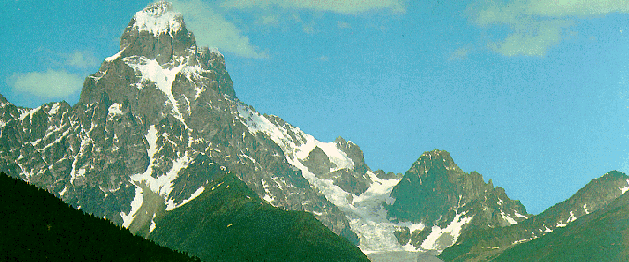
The geological constitution is characterized by the formations from the Mesozoic and Cenozoic eras. According to the wrinkles, it’s divided by several geotectonic units: from north to south by Caucasian main ring’s Antiklinorium, Georgian Belt, Achara-Trialeti system, Artvin-Bolnisi Belt and Loc-Karabag’s wrinkled zone.
Georgia is rich in mineral resources: oil, coal, peat, iron, magnum, copper, projectile-zinc, arsenic, mercury, andezit, barite, talc, serpentit, agate, quartz, basalt, granite, diorite, marble, etc.
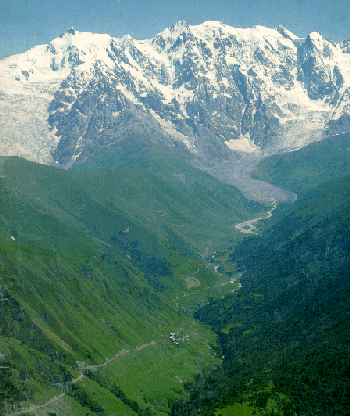
Different areas of Georgia are characterized by the contrast relief. The country is made up of high, middle and low mountain highland plane unity. The Caucasus reflects sharply from the inter-mountain lowlands.
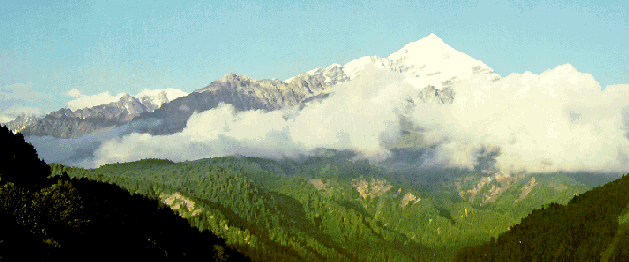
The territory of Georgia features a highly contrasting topography.
Georgia is rich in underground waters, and there are mineral and thermal waters (Borjomi, Utsera, Dzau, Nabeglavi, Sairme, Zvare, Nunisi etc.).
| Population and Area | |
| Area | 69,500 |
| Census results of 1989 | 5,400,800 |
| Official data of 1997 | 5,423,000 |
| Population Density (per sq.km) | 78 |
2. The Regional Structure of Georgia
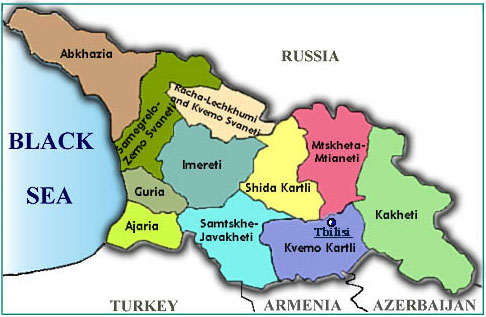
Apart from the two breakaway regions of Abkhazia and South Ossetia, Georgia today is made up of the following geographical areas: Ajara, Samegrelo-Zemo Svaneti, Guria, Samtskhe-Javakheti, Racha-Lechkhumi-Kvemo Svaneti, Kakheti, Kvemo Kartli, Shida Kartli, Mtskheta-Mtianeti and Imereti. This arrangement by-and-large coincides with the medieval traditional division of Georgia and the structure of public administration today. The overall regional arrangement of Georgia is not yet determined by the constitution.
 |
 |
3. The Historical Experience
Georgia, known to Greeks and Romans as Kolkheti (western part of the country) and Iberia (eastern part), adopted Christianity in the 4th century under the influence of Byzantium. The country managed to unite during the 10th-13th centuries, despite numerous invasions by Arabians, Mongolians, Turks and Persians. This period in Georgian history is called the “Golden Era”; King David Agmashenebeli (1089-1125) and his granddaughter the King-woman Tamar (1184-1213) made great contributions during this period. Recollections of this period helped to preserve a national self-awareness in the following centuries, when Georgia was conquered by foreigners. Russia, which started annexation of the region in 1801 and finished it in 1917, was the last among such conquerors. Georgia became part of the Soviet Union in 1921 and became an independent Republic of the Soviet Union in 1936.


The well-known Soviet dictator Joseph Stalin and the “Head” of his political police, Lavrenti Beria, both Georgians by origin, destroyed the hope of Georgians to win national independence. The repressions went on after Stalin’s death: in 1956 his successor, Nikita Khrushchev, severely suppressed a revolutionary attempt by means of Soviet tanks, leading to the deaths of hundreds of people. During Brezhnev’s governance, Georgian Authorities gained a little success – the Georgian language was declared the state language.
In modern Georgian history, the year 1989 was a crucial moment. In April 1989, the Soviet Army broke up a peaceful demonstration, resulting in the murder of 20 people. Georgian society now strongly supported the policy of complete independence and separation from the Soviet Union.
On May 26, 1991, Georgia elected the Chairman of the Supreme Council Zviad Gamsakhurdia as President of the country.
Tension between the ruling and opposition parties gradually intensified, and in 1991-92 developed into an armed conflict. President Gamsakhurdia left the country, the Supreme Soviet ceased to function, and power was taken over by the Military Council, which was reconstituted into a State Council. The State Council restored Georgia’s Constitution of 1921.
In 1992, Eduard Shevardnadze (ex-Minister of Foreign Affairs of the Soviet Union) returned to Georgia, assuming chairmanship of the Military Council; the news was announced August 4, 1992, the day of Parliamentary elections.
On July 31, 1992, Georgia became the 179th member of the UN. Presently Georgia is also a member of various other international and regional organizations.
In February and March of 1993, the Parliament of Georgia formed the State Constitutional Commission, presided over by Eduard Shevardnadze, and commissioned it with preparation of a new edition of the 1921 Constitution of Georgia. All the representatives of the Parliamentary factions (more than half of the entire composition), a large group of lawyers, policy experts and economists, and famous people of the Republic formed the Commission.
On August 24, 1995 the newly elected Parliament of Georgia adopted a new Constitution. The majority expressed their wish and ability to solve the fundamental problems of government authority and individuals not by violence but only based on the Constitutional Justice.
4. Beginning of a New Life
On November 2, 2003, the Georgian people passed a crucial test in democratization. It was in principle a success. On that day, parliamentary elections were held, which gave a boost to the processes leading eventually to the change of power. The “Rose Revolution” of November 23 was not a coup d’etat; it was more like a transfer of power behind which the Georgian population stood.
Several days after the Rose Revolution, the same rank-and-file citizens who spent day and night in the pelting rain before the parliamentary building said: “We were not the blind weapon in the political struggle for power. Rather, we were defending ourselves in those days.”
4.1 Lead-up to Elections
The lead-up to the pre-election period gave a good indication of the fierceness of the struggle for mandates. Though parliamentary elections officially involved 23 parties and party blocks, the essential fight for mandates was held only among several parties, among them: President Shevardnadze’s party bloc “For New Georgia,” “Renaissance Union” “National Movement,” “Burdjanadze-Democrats Bloc,” “Labor party,” and the “New Rightists.” Some experts named the “Industry Will Save Georgia” Party also on the list of favorites. However, many doubted its ability to pass the seven-percent barrier.
Given the style and characteristics of the President’s rule, all concerns appeared to be well founded. It may be that Eduard Shevardnadze was not a dictator, but he stood behind the old regime, which bore signs far more dangerous than the dictatorship itself. It was a system full of corruption, whose bonds flourished beyond the limits of the imagination. As early as 1998, World Bank experts put out the catastrophic results of their survey: all branches of government, including parliament, appeared to be corruption-riddled.
This system put a drain on the state coffers, not to mention on the economic development of the country. The shadow economy reached enormous scales, while most of the population continued to live below the poverty line. In parallel, the word was spreading widely in the press of millions of dollars missing and placing blame on public officials. However, none of them appealed in any sign of protest, instead just calling these charges a “dirty battle” against them.
4.2. Scandals
From autumn that year on, the number of visits by representatives of international organizations increased considerably. The members of the OSCE Observers Mission held meetings with the leaders of the Georgian political parties. “The country’s stay within the Council of Europe depends on the conduction of elections” – Western diplomats repeated often. What they required of the Georgian authorities was a particular attention to elector lists, as well as the political independence of election commissions.
In the same period, opposition parties began to speak out loudly on the clampdown measures employed by the government. “The executive authorities do not allow opposition parties to meet those employees of budgetary organizations, who declare their support for them,” party representatives are quoted as saying.
The Central Election Committee adopted a resolution to instruct the ministers of Justice and Internal Affairs, as well as the local and self-governing bodies, to redress all errors before October 18. The basis for this resolution was provided by the New Rightist Party, who submitted evidence revealing the growth of the number of electors in one of the precincts by 650,000. Unofficial indications are that there are over 3 million electors in Georgia. The lists did not include living electors. Rather, they were filled with the names of their deceased relatives.
From then on, a joke gained currency in Georgia: “After the elections, Shevardnadze appeals to his people: ‘Thank you very much for your support. You have dutifully served your civil debt. Peace be with you. May the earth-clods be like a feather upon you.’”
4.3. Elections (November 2, 2003)
The day of the elections there was complete chaos in the elector’s lists, incompetence and total ignorance of election commission members, permanent breaches of provisions of the electoral code, unprecedented and unlawful decisions adopted by CEC, contradictory statements on previous polls by political parties and an absence of official information from the CEC.
4.4. Revolution of Roses
How events were unfolding in those days is difficult to describe without emotion. The country was confronted squarely with the prospect of an armed conflict. In those decisive hours, the President’s entourage promoted the illusion of civil clash, bringing in scores of policemen in civilian clothes from Adjara.
November 23, 5.00 pm: Deputies assemble in parliament, but no quorum is made. In several minutes, they are joined by the New Rightist Party enabling the President to declare the sitting as open. After just seven minutes, opposition leaders intrude into the sitting hall. The President is forced to flee. On the following day, he declares his resignation. The favorite of the presidential elections and the leader of the revolution, Mikheil Saakashvili, sweeps to power with 96 percent of the vote.
4.5. Constitutional Changes
On February 6, 2004, the Georgian Parliament amended the Constitution. The purpose of the amendment was to provide an effective settlement of existing problems in the country by changing the organization of power. This needed to happen sooner or later, although it could have been implemented more simply and smoothly. Although the constitutional amendment was easier than it had been in the past, we have got the changes of a revolutionary nature; similar changes are expected in the legislation to bring it in compliance with the Constitution itself.
5. The President of Georgia
The President, who was both the Head of State and had executive power, is now solely the Head of State. The President, as Head of State, ensures the proper governing of the country and leads domestic and foreign policy. He ensures the unity and integrity of the country and the coordination of state bodies. In this, he has the role of arbitrator in their activities. The President is the supreme representative of the country within and outside the country – in foreign relations, in the conclusion of constitutional agreements (on the bases of the changes on March 30, 2001), international agreements and treaties, and negotiations with foreign states; he receives and accredits ambassadors and other diplomatic representatives of foreign states and international organizations, and awards highest diplomatic ranks.
The President is also authorized to conclude constitutional agreements with the apostle autocephalous Orthodox Church of Georgia on behalf of the state. The President takes decisions on granting citizenship, honorary, citizenship and dual citizenship to a person who has a special merit before Georgia or due state interests. He can give shelter to foreign citizens and stateless people, and pardon convicts.
The President has extensive powers in the field of state security and defense. In particular, he established the national Security Council, which he heads. Its purpose is military institutional building and the organization of state defense. The members of the Council are appointed by the President.
The President is the supreme Commander-in-Chief of the armed forces. He appoints and dismisses the Head of the General Staff of the Armed Forces and other commanders. The President approves the structure of the armed forces.
The President participates in the organization of the judiciary power; in particular, he is the chairman of the Supreme Council of Justice. He appoints four members to the Supreme Council of Justice (under the role defined by law) and three members to the Constitutional Court.
The President appoints the President of the National Bank. The President may call for a referendum, sign and promulgate laws, issue decrees and ordinances, and award state honors, highest military ranks or special and honorary titles. The President also establishes the presidential administration and appoints its chief.
We would like to address separately the President’s other authorities in terms of their relationship with the Parliament or Government as far as their execution is directly linked to them.
6. The Parliament of Georgia
According to the Constitution of Georgia, the Parliament is the supreme legislative power of country. It is made up of 235 members, 150 of whom are elected based on a proportional representation (PR) system, and 85 of whom are elected from single-mandate districts in accordance with the majoritarian system (electoral systems that do not result in proportional representation are known as majoritarian systems). The Parliament is elected for a four-year term based on free, universal, equal and direct suffrage by secret ballot. It is unicameral, although when Georgia regains its territorial integrity, it is intended to be transformed into a bicameral body.
Parliament exercises legislative power, determines the principal directions of domestic and foreign policy, and controls the activity of the Government. Parliament has extensive power in any democratic country, and the development and progress of a country largely depends on it. The Parliament has a legitimate opportunity to make decisions of political and state-importance and establish the legal base for the progressive development of the country.
Legislative activity (i.e. law making) is the exclusive right of the Parliament. Although the President has the right not to sign a law and to veto it, he does not have an absolute right to stop a law, as Parliament may negate the veto. The Speaker of Parliament is authorized to sign and promulgate a law if the President refuses to sign it a second time.
Parliament is also charged with the revocation of a member of the Parliament, as needed; election of the Speaker and Vice-Speakers of Parliament; the establishment of the internal entities; ratification, denunciation and cancellation of international agreements and treaties, and the adoption of decisions.
Parliament elects three members of the Constitutional Court, four members of the Supreme Court of Justice and the Chairman of the Chamber of Control. Parliament determines the type and composition of the armed forces and approves the number of the armed forces upon a submission from the National Security Council. The detention, imprisonment, search of apartment, car, workplace or person, and criminal proceedings of a delegate or member of the Supreme Court are inadmissible without the consent of Parliament.
It is the exclusive right of Parliament to call for the impeachment, under the rule establishment in the Constitution, of persons in question. Parliament shall be notified about international agreements and treaties that do not require ratification. We shall review other authorities of the Parliament in relation with the President and Government.
7. The Relationship of the President with Parliament
The President schedules the date of parliamentary elections (no later than 60 days beforehand), as well as extraordinary elections. He schedules the day of the first sitting of the Parliament within 20 days after the elections.
Parliament defines the major tendencies of the development of the country’s internal and foreign policies, while the President leads and implements them. The President has the right to convene a special (extraordinary) session or sitting. However, if such an initiative comes from Parliament and the President fails to issue the act of convocation, the Parliament is obliged to start its work within 48 hours.
A state of emergency or martial law is also declared by the President. However, he submits the decision (ordinance) to Parliament for approval within 48 hours. If parliament will not approve it, the state of emergency or martial law is considered annulled.
The Constitution foresees the issuance of decrees by the President having the force of law only in the case of state emergency or martial law. The decrees issued during martial law, or a state of emergency, shall be submitted to Parliament within 48 hours of approval.
The President cannot use armed forces during the state of emergency or for the execution of international liabilities without the consent of the Parliament. In special cases, and as foreseen under the law, the President makes the decision on bringing other armed forces into the country, including their use and allocation for the purposes of the self-defense of the country. However, the decision is first submitted to Parliament for their approval.
Parliament elects the Chairman of the Supreme Court and members of the National Bank Council upon the nomination of the President. The President nominates a Prosecutor general before Parliament for appointment.
The special authority – assigned to the President against the Parliament within the framework of the Constitutional changes – is the right of its pre-term dissolution. This was one of the critical issues that were quite topical during the adoption of the changes, with the idea of having its supporters and opponents. The supporters believed that if Parliament had the right to declare no-confidence in the Government, then the principle also requires entitling the President to dissolve Parliament. Those in opposition believed that the dissolution of the Parliament would cause a crisis in the legislative power, as Georgia has a one-chamber Parliament.
There are countries where the dissolution of a one-chamber parliament is constitutionally possible, such as Portugal and Bulgaria. However, these countries, unlike Georgia, have quite a complicated procedure for this. In Georgia it is executed upon the simple decision of the President.
The existence of such practice in foreign countries does not mean that it is acceptable. The right to dissolve the Parliament is unanimously assessed negatively in legal and political literature. It is underlined that in this case, legislative power falls under the influence of the President and practically becomes the unconditional executor of his policies. This is against the principle of supremacy of the Parliament. Affected by such threat, the Parliament can never be courageous in its decisions. Consequently, the following question arises – do people need such an obedient representative body that fails to act as an effective and actual counterbalance of the President, and is not able to declare no-confidence in an irresponsible Government, especially if the Government is the team of the president (except the unconditional no-confidence)? In this case the boldness of Parliament – to sacrifice their seats and numerous social and legal privileges for the interests of the country and nation – remains the only chance. Such a step requires a choice that is up to Parliament and depends on the willingness of Parliamentarians to prioritize between themselves and the good of the country.
Parliamentary crises do not take place in countries with a bicameral (two chamber) system because, as a rule, if the lower chamber is dissolved, parliamentary functions are still executed by the upper house. A crisis is inevitable in the case of dissolution of a one-chamber parliament, until new parliamentary elections can take place. According to the constitutional changes, extraordinary elections are held not earlier than 45 days and not later than 60 days before the enforcement of an order on the dissolution of the Parliament i.e. that the country might stay without Parliament for two months and all the activities carried out by the legislative body shall be terminated for two months.
The President is not authorized to dissolve Parliament unconditionally upon his/her initiative. This can be done only in cases foreseen under the constitution. In particular:
a) In case the Government and its program submitted by the President does not gain the confidence of the Parliament three times, the President can dissolve the Parliament and schedule extraordinary elections, forming the Government himself. He appoints the Prime Minister and the latter appoints ministers upon the consent of the President. This is quite a complex situation, when the dissolution of Parliament is almost justified. If no-confidence shall be declared in the Government three times, in turn, the President should have the opportunity to avoid a government crisis by applying the mentioned measure;
b) In case Parliament declares no-confidence in the Government and the President does not agree with this decision, Parliament is entitled to declare no-confidence in the Government again not earlier than 90 days and not later than 100 days. In these circumstances, the President might dissolve the Parliament. If the Government fails to execute its functions and program relevantly and Parliament declares no-confidence twice, the President in both cases may conclude that the issue is more likely to be resolved if the Government is appointed by him, whereas the Parliament is the opposition;
c) Parliament may be dissolved when the Prime Minister puts the question of the confidence of the Government on the State Budget, Tax Code and Procedure of the Structure, Authority and Activity of the Government. If Parliament does not declare confidence in the Government, the President gains the authorization to dissolve parliament again.
These are the three cases which are foreseen under the constitutional changes; however, none of the conditions can serve as a basis for the dissolution of Parliament if:
- 6 months have not passed after the Parliamentary elections;
- there are 6 month left before the termination of the term of office of the President;
- There is a state of emergency or martial law in the country;
- the Parliament has begun an impeachment procedure.
In cases when the impeachment procedure is carried out, the President in not entitled to dissolve Parliament. Impeachment may be initiated in case of violation of the Constitution, commission of high treason and other criminal offences. Parliament initiates the procedure of impeachment regardless of whether there is the actual threat of its dissolution or not. The fact that Parliament may do so for the reason to blackmail the President or to avoid its own dissolution is baseless, since the principles of impeachment are defined in the constitution and its initiation without the motivation is inadmissible in any case. Moreover, during the procedures of the confidence or no-confidence in the Government, it is impermissible to put the issue of the dismissal of the President in accordance with the impeachment procedure.
The dissolved Parliament assembles in the case of a declaration of a state of emergency or martial law by the President, to decide on the issues of prolongation or approval of the state of emergency or martial law.
If Parliament fails to meet within five days or does not approve (prolong) the order of the President on the declaration (prolongation) of a state of emergency, the announced state of emergency is cancelled. If Parliament does not approve the order of the President on the declaration (prolongation) of a state of martial law within 48 hours, the state of martial law shall be cancelled. The President submits the decision on reconciliation to the Parliament for approval within 48 hours.
The President needs the consent of Parliament to suspend the activity of self-government or other representative bodies of territorial units or dismiss them in cases foreseen under the constitution. The President, upon the consent of Parliament, appoints and dismisses ambassadors of Georgia and other diplomatic representatives.
Under the new constitutional changes, the President gained a new important right to issue decrees on tax and budgetary issues during the period from the dissolution of Parliament to the first convocation of the new Parliament. However, the decree shall be invalid if it is not approved by the newly elected Parliament within a month of its first convocation. This decree shall be effective for four months, which is not considered to be that short of a time in the tax and budgetary field.
If the President exercised the right of legislative initiative without any restriction before the constitutional changes, he now enjoys this right only in “exclusive cases.” Upon the President’s request, Parliament considers the draft law submitted by him out of turn.
The President submits a report to Parliament on important state issues once a year.
If the President is unable to execute his/her authority, or in case of pre-term termination of his/her office, the Speaker of Parliament exercises the responsibilities of the President. A person acting as the President acts within the framework defined under the Constitution. Parliament provides for the conduct of pre-term elections.
These issues are considered as the most important in terms of the relation between the President and Parliament. They execute mutual control and keep balance for the purpose of avoiding the imbalance of the power and development of negative tendencies.
8. The Executive Power of Georgia (Government)
The Government is now based upon a collective government model. The Government did not exist as a state body before. It was the President’s deliberative advisory body; the members answered to the President. The ineffective activity of the executive body was commonly explained by the lack of unity and collegiality of the Government. The way out of this situation was the imposition of joint liability and joint support, and the promotion of the government program.
The competence of the Government, its relations with the President and Parliament, and the rule of its establishment and procedure seem to be characteristic of a semi-presidential or so-called mixed system. However, the issue of whether Georgia can be considered a semi- presidential republic is considered here.
According to the constitutional changes, the Government exercises executive power as well as “the internal and foreign police of the country,” although this function is also included in the President’s competence. Subsequently, to avoid duplication, it was necessary to make a distinction and note that the Government “ensures the exercise of the internal and foreign policy within the frame of its competencies.”
The Head of the Government – the Prime Minister – convokes and chairs Government sessions and signs decisions, statements and orders taken in cabinet.
The Government is responsible to the President and Parliament. This is important from the legal- political view. It refers to elements from the republican model of government.
Due to the Government’s joint responsibility, the resignation of the Prime Minister or the termination of his/her authority results in the termination of the authority of the Government.
9. The Relationship of the Government with the President
The President is not the head of the executive, and the Government is not his advisory body. However, this does not mean that their interrelation is insignificant. On the country, as we will see, the Government for the most part depends on the President. They are so closely interrelated that it leaves the impression that the President has such an influence on the Government that the latter may turn out to be inactive and powerless without the President.
After the President takes the oath of inauguration, the previous Government resigns. The President is entitled to oblige the old Government with the exercise of the duties before the appointment of the new Government.
The President submits the new composition of the Government to Parliament for approval. In a case of not receiving confidence in the new government, the President is entitled to submit the same composition three times, and in case of still not gaining the confidence the President is entitled to appoint the Prime Minister. The Prime Minister then appoints the Ministers upon the consent of the President i.e. the composition of the Government can be carried out ignoring Parliament and without its participation. This is an example of when the President is expected to be an individual decision-maker in the formation of the Government. It should be mentioned that the President then submits the new Government to the Parliament once again. However, the Constitution is silent about receiving a confidence vote from Parliament this time around.
The President is authorized to convene and preside over government sessions regarding issues of exclusive state importance. The decision adopted at the session is formed by act of the President. Issues of exclusive state importance cannot be a matter of subject appraisal. The Prime Minister should not be ignored by the President.
The President is authorized to suspend and annul the acts of the Government and executive bodies if they are in contradiction with the Constitution. This norm seems unconstitutional, as the decision on this matter has to be taken by the Constitutional Court, since it is the body of constitutional control. The entitlement to the President of these rights is nothing else but intervention in the functions of the Constitutional Court. The President may suspend or annul the acts of the Government in terms of their legality or reasonability. This also can serve as a subject of another discussion as far as this being one more instrument for the execution of significant restrictions of state authority.
Apart from cases foreseen under the Constitution, the President is authorized to dissolve the Government upon his/her own initiative. Apparently, facing the following threat – when the President is entitled to dissolve the Government without any motivation and upon his/her own opinion – the latter will do their best not “to upset” the President and not to cause any confrontation. For the purpose of releasing the government from constant fear, it would be better to dissolve the Government only in the cases foreseen under the Constitution, and not at any time the President wishes. Relevantly, the Government, from its part, would try by its activity not to allow the precedent, which provides for the application of such measure by the President.
The President appoints the Prime Minister and gives the Prime Minister consent to appoint ministers. The President may dismiss the Prime Minister. He solely dismisses the Ministers of Internal Affairs, Defense and State Security. They report to the President together with the Prime Minister.
The Prime Minister introduces and annuls the position of the State Minister (minister without portfolio working on specific, ad hoc issues), and dismisses him/her by the consent of the President.
The Minister hands his/her resignation to the President, who makes the relevant decision. It would be more reasonable if the minister addresses the Prime Minister on the issue of his/her resignation because it is the latter who appoints him/her to the post, even though it is with the consent of the President. However, it would be better if the Minister, as a member of the Government, could address the Head of the Government regarding these issues.
The fact that the Prime Minister is not entitled to appoint or dismiss even deputy ministers confirms that the position has rather limited power. Such a limitation of the Prime Minister is unreasonable.
The Government and the members of the Government give their resignations to the President. The structure, authority and rule of procedure of the Government is determined by the Constitution and law, the draft of which is submitted to Parliament by the Government, but only upon the consent of the President. The President gives consent to the Government on the submission of the draft of the state budget to Parliament.
The case when the Prime Minister may exercise the responsibilities of the President is very significant in terms of the relationship of the President with Government. This takes place when the performance of the duties mentioned by the Speaker of Parliament is not possible.
10. The Relationship of the Government with the Parliament
According to the procedure typical for mixed form governing, the Parliament participates in the formation of the Government together with the President. At the same time, the Government is accountable to both. The level of this accountability as well as the form of influence of the President and Government over the Parliament varies from country to. In Georgia, the President enjoys this advantage; however, the influence of Parliament within the framework is determined by the Constitution. First, this control becomes evident by the fact an MP is authorized to question a member of the Government.
Parliament is entitled to submit the question of official liability of a particular Member of the Government to the Prime Minister, and in case the Prime Minister does not dismiss the member of the Government, he/she is obliged to submit the motivated decision on the issues to the Parliament.
The member of the Government is entitled, and in case of request, obliged, to attend the sittings of Parliament, its committee or Commission, to answer questions raised at the sitting and submit an account on the alleged activity. This measure is considered a form of individual control over the Government by Parliament. Parliament is entitled to begin an impeachment procedure against a member of the Government who violates the Constitution, commits high treason, or other criminal offences.
Upon the request, the Prime Minister submits to the Parliament the progress report of the governmental program. This is the control executed over the activity of the Government, being the collegial (collective) body.
As already mentioned, the President submits the composition of the Government to Parliament for a vote of confidence. Parliament votes on the composition of the Government and the government program. Parliament is entitled to declare no-confidence in the composition of the Government and raise the question of challenge of a particular member of the Government.
The President is entitled to dissolve Parliament. The principle of the power separation requires Parliament to raise the issue of the dismissal of the Government. Parliament is authorized to declare no-confidence in the Government based on reasonable grounds. However, the President may not share this opinion, and in the case the Parliament declares no-confidence to the Government again, it may be dissolved by the President.
The President may declare no-confidence in the Government unconditionally. In case the Parliament takes such a decision by a majority of three-fifths of the members of Parliament, the President dismisses the Government.
The Government enjoys the right of legislative initiative. The Parliament, upon request, has to review out of turn the draft law submitted by the Government. In case the Government in its turn does not submit remarks on the draft law to be reviewed in Parliament, within a fixed term, the draft law is deemed approved by the Government.
There is no doubt that the Constitution should be applicable for an indefinite period of time. As such further work on the improvement and completion of the Constitution should continue.
11. New Challenges of the Georgian Judiciary
Over the last decade a new legal system, mainly meeting European standards, has been created in Georgia. Soviet era laws were replaced with new laws, drafted with the help of ongoing consultations with the active cooperation of European experts. As a result of this collaboration, Georgia adopted new Civil, Administrative, Company, Criminal laws. In 1999 the new legislation governing the judiciary came into force. The implementation of these new laws raised the question of the need for institutional reform, an integral part of which was considered to be judicial reform. As a result of these reforms, the judiciary was freed from control, dependence and subordination to the executive branch of government. This promoted and strengthened the independence of the judiciary.
A new court instance – appellate courts – was created. The competences between courts of deferent instances were clearly defined and separated. The rules for the competences and jurisdiction of the courts are now prescribed by law and are no longer dependent on the will and decisions of the chairmen of the courts.
The Supreme Court was transformed into the court of cassation, which reviews only the legal aspects of appeal decisions and does not discuss the cases on merit.
As a result of the reform, the peculiarities of the Soviet court system that still exist in most post-Soviet countries and challenge the independence of their judicial system were abolished. For example:
- The practice of prosecutorial oversight of the courts was eliminated;
- The supervisory review procedure, which gave the Chairman of the Supreme Court and his deputies the right to quash final and binding court decisions, regardless of the data of their entry into force, has been abolished. This radically condensed the time limits for deciding cases and ended the so-called “never finished” disputed, sometimes being discussed at courts for years. Accordingly, a fundamental principle of the rule of law, the principle of legal certainty, is now being observed;
- For the first time in the country’s history, an administrative law chamber was established. This gives every citizen the right to appeal the actions of state organs which the citizen believes have infringed upon his or her rights;
- The Supreme Court has been deprived of the right to issue resolutions of a normative character that are binding on courts of lower instances. This practice of issuing plenum resolutions still exists in other post-Soviet countries;
- Transparency of the court process has become a characteristic of the Georgian judiciary. All decisions of the Supreme Court are published and accessible for all interested individuals. An organization called the “Media Group” at the Supreme Court is staffed with representatives of mass media and civil society. These representatives, together with judges discuss issues that face the judiciary. Representatives of the mass media are always provided with information concerning cases prior to the proceedings. They thus have the opportunity to select and attend the proceeding that they want to hear.
The rule of law should not only be a goal, but it should also be a lifestyle. Establishing a new lifestyle requires changes in mentality. This can only happen through educational reforms.
12. The Judiciary
The structure of Judicial Power in Georgia is defined and outlined in the Constitution adopted by Parliament in 1995.
Chapter Five of the Georgian Constitution deals specifically and solely with Judicial Power. It identifies all the judicial bodies that implement justice in the country (the Constitutional Court, courts of general jurisdiction and military courts within the system of the courts of general justice in time of war).
To guarantee human rights and uphold the rule of law, the Constitution prohibits the establishment ad hoc of courts. It also lays down some general principles:
- The independence and inviolability of Judicial Power
- The independence, immunity and security of judges
- transparency of court proceedings
- the authority and competence of the Constitutional Court and the rules governing its establishment
- The authority and competence of the Supreme Court and the rules governing its establishment
12.1 The Constitutional Court
The legal body for Constitutional supervision is the Constitutional Court of Georgia.
The Constitutional Court protects the constitutional rights of individuals (by revoking normative bills that conflict with the provisions of the constitution) and to consider or settle constitutional disputes between public institutions. In specific cases, the Constitutional Court may arbitrate on election issues. The court also participates in the procedure for the impeachment of high-ranking government officials in cases stipulated by the constitution.
By the article 89 of the Constitution:
- “The Constitutional Court of Georgia, upon the Complaints or Submission of the President, of not less than one fifth of the Members of Parliament, of the courts, of supreme representative bodies of Abkhazia and Adjaria, of the public defenders or of a citizen and under the rules established by organic law:
- decides the Constitutionality of the law, the President’s normative acts and the normative acts of the supreme bodies of authority of Abkhazia and Adjaria;
- considers disputes on the competence between state bodies;
- considers questions of the constitutionality of the creation and activity of political parties;
- considers disputes connected with the question of the Constitutionality of referenda and elections;
- considers disputes connected with questions of the constitutionality of treaties and international agreements;
- on the basis of complaints of citizens, considers questions of the Constitutionality of normative acts on the issues envisaged by the second chapter of this Constitution;
- exercises other authorities determined by the Constitution and organic law of Georgia.
- The decision of the Constitutional Court is final. Normative acts or their parts recognized as unconstitutional have no legal power from the moment the appropriate decision of the Constitutional Court is published.”
The Constitution determines the composition of the Constitutional Court: nine judges, each with a 10-year term of office. Three are appointed by the President of Georgia, three are elected by Parliament and three are appointed by the Supreme Court of Georgia.
The Constitution Court considers a case if an application has been filed by any citizen, Legal entities of Georgia, the President, and no less than one fifth of MPs, any court, representative bodies of Abkhazia or Adjara, or the Public Defender. A decision by the Constitutional Court is final, and the normative act or a part of it which is considered unconstitutional loses its legal force once the decision has been made public.
The Organic Law on the Constitutional Court provides for its authority the rules of its creation and activities.
12.2. The Supreme Court
The Supreme Court of Georgia is the highest judicial body in Georgia. By Article 90 of the Constitution:
“The Supreme Court of Georgia, in accordance with existing legal procedure supervises the enforcement of justice of every court of Georgia, and reconsiders cases determined by law in the court of first instance.”
Judges of the Supreme Court are also nominated by the President and elected by Parliament for 10-year terms. There are thirty judges in the Supreme Court at present.
There are three Chambers of Cassation and Collegium of Criminal Law in the Supreme Court.
The Chambers are:
- The Chamber of Civil, Entrepreneurship and Bankruptcy Cases
- The Chamber of Criminal Cases
- The Chamber Administrative and Other Categories of Cases
The chairmen of the Chambers and the Collegium are also deputies of the Chairman of the Supreme Court.
Chambers of the Supreme Court, composed of three members, consider complaints relating to decisions of the Courts of Appeal and those of the High Courts of the Autonomous Republics.
The Collegium of Criminal Cases, within the Supreme Court, considers in the first instance only grave criminal cases such as terrorism, assassination of a senior official, etc.
Since 2001, a Grand Chamber has been operating within the Supreme Court. It consists of the Chairman of the Supreme Court, the Chairman of the Collegium and at least twelve other judges from the chambers elected by the Plenum.
Cases are heard by nine judges and include those who sat on the original decision.
The Plenum works within the Supreme Court. It consists of the Chairman of the Supreme Court, his/her deputies, the chairman of the high Courts of Abkhazia and Adjara, all the judges of the Supreme Court and Chairman of Tbilisi and Kutaisi District Courts.
Similar to the Constitutional Court, there is a separate Organic Law “On the Supreme Court of Georgia,” which provides for its authority, rules of creation and activities. The Supreme Court has selected decisions in English.
12.3. Common Court
Regional (City) Courts are the lowest level of general courts. Cases are considered by one judge.
The District Court, like the Regional one, is a court of the first instance, where cases are considered by three judges.
Within the District Courts there is:
- A Collegium of Criminal Cases
- A Collegium of Civil and Bankruptcy Cases
- A Collegium of Administrative Justice and Taxation
Special Chambers of Appeal have been created within the District Courts. These chambers are II Instance Courts. They consider appeals from the Regional (City) Courts. There are three chambers for criminal cases, civil and bankruptcy cases, and administrative law and taxation cases.
By the article 91 of the Constitution:
“The procurator’s office of Georgia is the institution of the judiciary which performs capital prosecution, supervises investigation, enforces sentences handed down by the courts and prosecutes state indictments.
The procurator’s office of Georgia is one, centralized system. The Procurator General is appointed for a period of five years by Parliament upon the President’s nomination, by the majority of the total number of deputies. Subordinate procurators are appointed by the Procurator General.
The authority, organization and procedure of the procurator’s office are determined by organic law.”
13. Regionalism and Local Self-Government in Georgia
The organic Law on Local Government and Self-Government (adopted in 1997), and amendments to it introduced in 2001, provide for two levels of local government (and Self-Government).
The first (and lower) is the municipal level – that of village, community, settlement or small town, which are governed by elected local councils, except for larger towns where the chairman of the council also acts as gamgebeli (head of the administration). The heads of the executive branch are elected. Municipal elections have been held twice, in 1998 and 2002.
The second level is that of the districts (rayony) and ‘cities of republican subordination’ (cities which come directly under the republic). District councils consist of representatives from different municipalities of the district; city councils are elected by the population in a majoritarian system. The gamgebelis (chief executives) of districts are appointed by the President from among the members of council. The district authorities, according to the legislation, act as the local government as well as territorial branches of central government.
The self-government and local government practice that guides the capital, Tbilisi, is regulated by separate legislation. The governing body of Tbilisi is a city council elected by proportional representation.
The legislation also gives some additional authority to local governments in the mountain regions of Georgia.
The mayors of the two most economically important cities (Tbilisi and Poti, Port City) are appointed by the President, and the populace basically has no control over the executives here.
14. The Electoral Process in Georgia
Since 1990, Georgia has held five parliamentary elections (in 1990, 1992, 1995 and 1999), five Presidential elections (in 1991, 1992, 1995, 2000, 2003), and three local elections (in 1991, 1998 and 2002). The government bodies formed because of the 1990 and 1991 elections were violently overthrown in the 1991-1992 coup against President Zviad Gamsakhurdia, but since the new constitution was adopted in 1995, all presidential and parliamentary elections have been held in full accordance with the constitution and conducted in an orderly manner.
In August 2001, Parliament enacted a new, comprehensive Electoral Code.
In general, Georgia’s Election legislation includes all the standard democratic provisions. There are no restrictions on the rights to run for office or to vote, save for certain restrictions for internally displaced persons and a ban on the registration of regional parties.
15. Hierarchy of Legal Norms of Georgia
Article 2 I of the Civil Code of Georgia states that “the Civil Code, other acts of private law and their interpretation, shall conform to the Constitution of Georgia.” This provision underlines the circumstance that the Constitution as the state’s basic law is at the top in the hierarchy of legal documents and legal rules. According to Article 6 I, “the Constitution is the supreme law of the state” and “all other legal acts shall be in compliance with the Constitution.
In Georgia, in the hierarchy of norms, an international treaty takes the next highest rank after the Constitution, as per Article 6 II. It enters into force in compliance with Article 65 of the Constitution (in some cases after being ratified by Parliament). Thus, it is not necessary to adopt a special normative act on the enactment of its provisions.
After the Constitution and international treaties come laws. There is a difference between “ordinary” and organic laws. Article 66 of the Constitution states that the consent of the majority of Members of Parliament is needed for the adoption of an organic law. Organic laws are of a higher rank than ordinary laws and are adopted for the implementation of a particular requirement of the Constitution.
Sub-legislative normative acts are of a general character and thus tend to be applicable to an indefinite amount of social relations and indefinite group of persons. Consequently, pursuant to Article 2 III of the Civil Code of Georgia, sub-legislative normative acts adopted for the regulation of private law relations is admissible only if they complement the norms of law. If it contravenes the law, the sub-legislative normative act shall not be applied.
Georgian law, like Romano-Germanic law, is divided into public (jus publicum) and private (jus privatum or jus civile) law-order. Public law comprises constitutional, administrative and criminal laws as well as customs, taxation and procedure legislation. Traditionally civil and company law fell within the scope of private law. Today such a division has retained its practical importance for the classification of legal acts and the identification of the course of justice.
Private law disputes are adjudicated under civil proceedings on an adversarial basis. Public law disputes are adjudicated under administrative proceedings, and with inquisitional elements.
An administrative body has a special authority precisely prescribed by the law, whereas natural persons and legal persons of private law are entitled to carry out any action not forbidden by the law. An administrative body is bound by the principle of observing legitimacy and state interests; the principle of autonomy of will be provided for by private law does not apply to it. Due to this fundamental distinction, legal persons of public law cannot be treated like private persons under a common civil law regime. Thus, it becomes necessary to introduce a special regime for the activity of legal persons of public law.
Administrative law is the common law of public governance.
Article 1 of the Civil Code of Georgia defines the scope of application of civil law – it “regulates property, family and personal relations of a private nature, based on the equality of persons.” Pursuant to Article 8 I of the Civil Code, “any natural or legal person may be a subject of private law relations. This rule applies to both entrepreneurial and non-entrepreneurial persons of Georgia or of other countries.”
“Private law relations between state bodies and legal persons of public law, on the one hand, and other persons on the other hand, shall likewise be regulated by civil laws unless these relations, in the interests of the state or the public, are to be regulated by public law” (Article 8 II of the Civil Code).
Pursuant to Article 7 of the Civil Code “an object of private legal relations may be a material or non-material good of property or non-property value, which has not been excluded from (commercial) circulation by law.” According to Article 10I “the exercise of civil rights shall not depend upon political rights regulated by the Constitution or by other laws of public law.”
“Participants in a civil relation may exercise any action not prohibited by law, including any action not directly foreseen by law” (Article 10 II of the Civil Code).
As for the scope of application of the administrative law, pursuant to Article 2 I of the Administrative Procedures Code, a common court shall hear disputes arising from legal relations that are regulated by administrative legislation.
Pursuant to Article 2 II of the Administrative Procedure Code of Georgia the subject of an administrative dispute may be in conformity of an administrative act with Georgian legislation; conclusion or performance of an administrative transaction; and the obligation of administrative body relating to compensation of damage, issuance of administrative act, or taking any other action.
16. The Official Gazette, Legal Journals, and Main Newspapers
The Official Gazette, where all laws are published, is called “Sakanonmdeblo matsne.“
The main law journals of Georgia are: “Samartali” (LAW), “Adamiani da Konstitutsia” (Human and Constitution), “Saertashoriso Samartali” (International Law), “Almanakhi,” “Tavisufleba” (Liberty), “Martlmsadjulebis matsne,” “Advokati meokhi,” etc.
Mains newspapers:
- “Rezonansi”
- “24 Hours“
- “Mtavari gazeti ,” “Kviris palitra”
- “Alia”
- “Saqartvelos respublika”
- “Tbilisi”
- “Akhali versia“
- “Akhali Taoba“
- “Georgia Today“
- “Tbilisi Today”
- “The Georgian Times” (Media Holding Georgian Times)
- “Akhali 7 dge“
- “Akhali Epoqa“
- “The Messenger“
- “Dilis gazeti“
17. Web Resources
- Parliament of Georgia
- The Executive Power of Georgia
- Ministry of state security of Georgia
- Armed Forces & Security
- Supreme Court of Georgia
- Human Rights Protection in Georgia
- Public Defender of Georgia
- Ministry of Foreign Affairs
- Ministry for Special affairs
- Ministry of Internal Affairs
- Central Electoral Commission of Georgia /CEC/
- Council of Justice of Georgia
- Ministry of Finance of Georgia
- Georgian search engine
- Georgian search engine
- Online magazine of United Nations Association of Georgia
- Constitutional Court of Georgia
- General Courts of Georgia