
Researching Japanese Law
By Keiko Okuhara[1]
Keiko Okuhara is a librarian at the University of Hawaii at Manoa William S. Richardson School of Law Library.
Published January/February 2026
(Previously updated by Makoto Ibusuki & Takako Okada in February 2009; and by Keiko Okuhara in May/June 2014, March 2015, July/August 2019, and in November/December 2020)
Table of Contents
- 1. Background
- 2. Three Principles in the 1947 Japanese Constitution
- 3. Legal System
- 4. Court System
- 5. Resources
- 5.10. Archives
- 5.11. Legal Research Guides
- 6. Japanese Law by Topics
- 6.1. Civil Law
- 6.2. Criminal Law
- 6.3. Product Liability and Consumer Protection
- 6.3.1. Consumer Protection Law
- 6.3.2. Consumer Policy
- 6.4. Labor Law
- 6.5. Alternative Dispute Resolution (ADR)
- 6.6. Disability Law
- 6.7. Article 9 of the Constitution of Japan
- 6.7.1. Introduction
- 6.7.2. Article 9 and Public Understanding in Japan
- 6.7.3. Overview of Article 9 of the Constitution of Japan
- 6.7.3.1. Summary of the Complex and Ongoing Debates on Article 9
- 6.7.3.2. Consideration of Five Aspects for Article 9 Amendment
- 6.7.3.2.1. Clarification of the Definition of Renunciation of War
- 6.7.3.2.2. Clarification of the Right of Belligerency
- 6.7.3.2.3. Self-Defense Forces
- 6.7.3.2.4. Ashida Amendment
- 6.7.3.2.5. Civilian Control
- 6.7.4. Abolishment of Article 9 ~ Constitutionalism and Constitution~
- 6.7.5. Further Consideration on the Japanese Constitution’s Article 9 Amendment
- 6.7.6. Reading for Western Researchers
- 6.7.7. Exhibits
1. Background
A written history of Japan appears in the Chinese Book of Han (Kansho, 漢書). A Chinese historical text, the Record of the Three Kingdoms (Sangokushi, 三国志), states that the most powerful kingdom during the 3rd century was called Yama-taikoku. Although a unified regime was gradually established and Japan evolved into a cohesive society by the 8th century, the law was not codified. Japan adopted the Chinese legal codes called Ritsuryō in the 7th century, marking the first reception of foreign law. The second transplant of foreign law was in the 19th century during the Meiji Restoration. As imperial rule was restored after the feudal regime, the Meiji Government enacted various codes based on Prussian and French models, and the Constitution of Imperial Japan was enacted in 1889. The third transplant was after World War II. The U.S. Allied Occupation implemented democratization in Japan, and the new Japanese Constitution was enacted in 1946. For a more thorough historical background, refer to
the history section of the AsianLII Japan.
2. Three Principles in the 1947 Japanese Constitution
The 1947 constitution consists of thirty-one articles, and the three principles of the 1947 constitution are 1) the sovereignty vested in the Japanese people (Article 1), 2) fundamental human rights (Article 11), and 3) Pacifism (Article 9). The 1947 Japanese Constitution also provides legal anchoring for women’s rights in Article 14, which establishes legal equality of opportunity for men and women in relations between citizens and the State. “All of the people are equal under the law, and there shall be no discrimination in political, economic, or social relations because of race, creed, sex, social status, or family origin.” Also, the 1947 Constitution establishes the separation of powers in the government: Legislative (Diet), Executive (Cabinet), and Judicial (Courts).
3. Legal System
The Japanese legal system is based on the civil law system, following the model of European legal systems, especially those of Germany and France. Japan established its legal system when imperial rule in Japan was restored in 1868—the Meiji Restoration. The Meiji Constitution was the organic law of the Japanese Empire in effect from 1890 to 1945. After Japan’s defeat in World War II, there was a major legal reform, and the constitution was drawn up under the Allied Occupation, with U.S. influence. The current Japanese legal system is a hybrid of continental and American law.
4. Court System
Judicial power is vested in the Supreme Court and the lower courts (High Courts, District Courts, Family Courts, and Summary Courts). Japan’s court system is divided into four tiers. The first tier of courts is the 438 summary courts, which handle minor criminal and civil cases with claims worth less than 1,400,000 yen. The second is the district courts, the principal courts of first instance, which deal with most civil, criminal, and administrative law cases. Since 2009, all district courts and some of their branches have held criminal proceedings with lay assessors (saiban-in) for the most serious criminal offenses involving possible sentences of death or life imprisonment. There are fifty district and family courts with an additional 203 branches. In addition to adjudicating cases, district, family, and summary courts also offer mediation services. There are eight High Courts. There also exists the Intellectual Property High Court. There is one Supreme Court with rule-making power.
The Constitution guarantees the independence of the judiciary. Most judges are virtually lifetime employees of a national governmental bureaucracy. The judgments of the Supreme Court are considered to be binding on lower courts. The decisions of the high courts are very influential in the lower courts. Important judicial decisions are compiled and codified. Judiciary statistics can be found on the Courts in Japan website.
5. Resources
5.1. Legislation—Bills, House, and Committee Minutes
Legislative power resides in the National Diet, which is the only law-making body in Japan. There are two chambers of parliament: the House of Councilors (Upper Diet, Sangi-In) and the House of Representatives (Lower Diet, Shūgi-In). Japanese politics encompasses the multi-party system. Many bills are drafted by government agencies, submitted to the Cabinet, and posted on their websites. Also, Diet members can draft and submit a bill if a certain number of co-sponsors are present. The bills since the 142nd Diet Session (1998) can be found on the House of Representatives website. The bills from the ministries and other agencies can be found on the website of the prime minister and his cabinet, Kankōchō linku shū.
Statutes are promulgated after Congress passes them. The emperor promulgates them, and new legislation is published in Kanpō (Gazettes). They are available open access in PDF format on the National Printing Bureau’s website. The last five days of Kanpō are available to the public. Kanpō is updated weekly on the Prime Minister’s Office website after the legislation has been enacted in the Diet. On the website of the House of Representatives, Seitei Hōritsu, laws passed by the Congress since 1947 are available except for the most recent ones. The minutes of each House and committee are searchable on the website supported by the National Diet Library
5.2. Governmental Information
Since the Freedom of Information Act was passed in May 1999, numerous resources for government information have become available online. Before the legislation was enacted, many government sites began providing information online. On the web, there are numerous resources for government information, including current laws, cabinet orders, ministry ordinances, white papers, and statistical data. Also, there is an index, Nihon Hōrei Sakuin, of current and abolished laws, treaties, regulations, and bills. E-Gov is a portal website of government information administered by the Ministry of Internal Affairs and Communications and managed by the Digital Agency. Also, current laws can be found through a commercial database, Shin Nihon Hōki Web Saito. Accumulated government documents can be searched on the site of the Government Printing Office.
5.3. Statutory Research
The Roppō is a collection of Japanese laws, and the most important legal material for Japanese legislation and regulations. “Roppō” comes from the enactment of six fundamental codes: the Constitution (Kenpō), the Civil Code (Minpō), the Code of Civil Procedure (Minji Soshōhō), the Commercial Code (Shōhō), the Criminal Code (Keihō), and the Code of Criminal Procedure (Keiji Soshōhō). Roppō is an unofficial legal material, and various types of Roppō are published by different publishers with various formats such as DVD-ROM, CD-ROM, and web products. The Roppō Zensho, 六法全書, published annually by Yūhikaku, is widely used in Japan. Also, there are open access websites for each code published in the CD-ROM format. Hōrei Zensho, published by Kokuritsu Insatsukyoku, covers laws since 1867 and has a subject and word index. As a long-standing series of English translations of Japanese laws, the EHS Law Bulletin Series has been published by the Eibun Hōreisha since 1946. As one objective of the Justice System Reform in Japan, English translations of Japanese laws have become more widely available since 2004. However, the definitive version of Japanese law is in Japanese, and there are no official English translations.
5.4. Case Law Research
5.4.1. Official Case Reports on the Web
Except for Supreme Court cases, judgments are reported at a small percentage, and an unreported judgment can be obtained by requesting a copy in person at the record office of each court. Lower court decisions of intellectual property cases and labor law cases have been available since July 1999. The naming method for cases is different in Japan. There is no actual case name system. The name of the court and date of the judgment are generally used to search for a case. Parties’ names are not used if individuals are parties. Therefore, parties’ names are not queried in searching cases. Names of corporations may be used for the title of the case name.
Official case reports in Japanese, published since 1947, are available on the Saibanrei Jōhō website, and the case reports, including administrative and labor law-related cases, are searchable by keywords. Official case reports in Japanese from the Supreme Court and other lower courts over the last three months, as well as some English case reports from the Intellectual Property High Court, are also available at the IP Judgments Database. English translations of some Supreme Court judgments can be found on the Supreme Court Website.
5.4.2. Unofficial Case Reports in Print and Electronic Format
Several court report journals are published. Each issue has case interpretations and analyses, the essential elements of the court decisions, and comments. Hanrei Jihō, published by Hanrei Jihōsha, includes important cases and gives key points of judgments. Juristuto (Jurist), published by Yūhikaku, is equivalent to the Harvard Law Review. It features main topics, with several articles and reports on new legislation and notable cases, along with interpretation and analysis. Jurisprudence books, including treatises, dictionaries, and journals, are produced by numerous publishers, mainly in Japan, and the three major legal publishers are Yūhikaku, Dai-Ichi Hōki, and Gyōsei.
The commercial databases have played a vital role in Japanese case law research because cases are not fully published. In addition to Westlaw Japan and LexisNexisJP, there are three other full-text databases with different functionalities. The text in these databases is in Japanese. LEX/DB Internet, produced by TKC, also offers a legal database called “Law Library,” customized for a law school curriculum. Dai-Ichi Hōki has a full-text database called D1-Law.com.
5.5. Citation Form/Romanization/Japanese Era Names
There is an English version of the citation form published by the University of Washington in 1967 entitled “Form of Citation of Japanese Legal Materials.” Also, in 2014, the Hōritsu Bunken tō no Shutten no Hyōji hōhō was published. The University of Washington Manual of International Legal Citation is also a useful tool. Another important resource is the romanization scheme. The Library of Congress has a list of romanizations. Also, the Japanese era names and the conversion website will be useful tools. See Dan Fenno Henderson, “Form of Citation of Japanese Legal Materials” (1967) 42 Wash. L. Rev. 589.
5.6. Law Journals/ Law Reviews
Jurisuto, Hōgaku Kyōshitsu, Hōritsu Jihō, and Hōgaku Seminā are all widely read legal magazines. Hōgaku Kyōshitsu is for law school students and is a companion to the Juristuto, with comments on cases by scholars. Hōritsu Jihō, published by Nihon Hyōronsha, has a list of comments on recent cases. Hōgaku Seminā, published by Nihon Hyōronsha, gives descriptions and commentary on cases. Minshōhō Zasshi, published by Yūhikaku, is a leading journal on private law and cases related to civil and commercial codes. NBL (New Business Law), published by Shōji Hōmu, focuses on the fields of business, property, and credit. Gendai Keijihō, published by Gendai Hōritsu Shuppan, covers criminal cases. Legal journals on Japanese law in English include the Asian-Pacific Law and Policy Journal (APLPJ), Asia-Pacific Journal: Japan Focus, the Hitotsubashi Journal of Law & Politics, published by Hitotsubashi Daigaku, and the Journal of Japanese Law, published by the Deutsch-Japanische Juristenvereinigung (Doku-Nichi Hōritsuka Kyōkai). The Ōhara Institute at Hōsei University provides a database of articles on social security and labor law.
Because of scholarly electronic publishing initiatives in Japan, many universities make their law reviews accessible through their academic institutional repository programs. Institutional repositories such as JAIRO are reaping both short-term and ongoing benefits for universities and legal scholars worldwide. Articles in law reviews digitized in their institutional repositories on the web are searchable via Google Scholar, and each article includes a link to the CiNii Articles website. CiNii Articles, produced by the National Institute of Informatics, provides links to an online catalog of over 1,200 academic institutions in Japan, access to over 12 million books and journal titles, and a gateway to academic articles in the National Diet Library’s Japanese Periodicals Index Database.
5.7. Newspapers
For news, Asahi Shinbun, Mainichi News, Yomiuri News, and Nihon Keizai Shinbun distribute their stories via the web. Asahi Shinbun has also had a full-text commercial database for its news since 1986. For English readers, The Japan Times, Nikkei Net, and Mainichi Daily News distribute legal news in English.
5.8. Legal Blogs
The legal blogosphere in the United States has been active for quite some time; however, law-related blogs are a relatively new medium for reporting Japanese legal news. Japanese Law Blog garners current news and information about Japanese law. Japanese Law and the Asia-Pacific focuses on Japanese law in an Asia-Pacific socioeconomic context. The Australian Network for Japanese Law (ANJeL) also promotes communications on Japanese law in Australia. “Attorney Ochiai’s Page” provides daily law-related news. The number of lawyers’ and law professors’ blogs is currently small. The Law Library of Congress’s Blogs have become an increasingly popular and powerful resource for finding Japanese law-related information, including the Global Legal Monitor – Guide to Law Online: Japan page.
5.9. Legal Publishers
Numerous publishers in Japan produce law books, including treatises, dictionaries, and journals. Some legal publishers have begun providing their book catalogs online. Examples include Nihon Hyōronsha, Yūhikaku, Dai-Ichi Hōki, Hanrei Timuzusha, and Shin-Nihon Hōki. Shin Nihon Hōki Shuppan and Yūhikaku offer legal e-books.
Yūhikaku is a well-known legal publisher in Japan and publishes a compiled version of laws and cases, such as the Roppo: the Compendium of Laws, a collection of codes, important laws, and ordinances often used by legal practitioners. Some publishers in Japan distribute CDs containing cases that have been published in print case reports, and they also support online databases similar to Westlaw and LexisNexis.
5.10. Archives
- National Archives of Japan Digital Archives, Cross-institutional search Kokuritsu Kōbunnkan
- National Archives of Japan Digital Archives Kokuritsu Kōbunnkan
- Guide to Study Japanese Classical Literature and Classical Japanese Language: Websites and Apps for Studying Kuzushiji & Hentaigana
- Historical Institute of the University of Tokyo:
- Kyoto Prefectural Library and Archives (Kyoto Prefectural University) Historical Materials Archive (Public)
- Classical books or Classic texts Database
- Database of Classical Japanese Books Kokusho Dētēbēsu
- Tōkyō University
- How to Read Old Documents and Historical Records
5.11. Legal Research Guides
Legal Research Guides Outside of Japan:
- Japanese Legal Research: University of Washington
- Legal Research Guide: Japan: Library of Congress
- AsianLII: Asian Legal Information Institute
- World LII: World Legal Information Institution
- Japanese Law Research Guide: UC Law SF Library
Legal Research Guides in Japan:
- Keio University Library
- Kobe University Library
- Japan Legal Information Institute— Nagoya University
- Kyoto Sangyō University
- Risāchi Nabi National Diet Library
- University of Osaka Libraries
- Waseda University Library
Legal Research Guide in Print:
- Mariko Ishikawa, Noriko Murai, Yasuko Fujii, 2016. Rīgaru Risāchi = Legal Research. Tōkyō: Nihon Hyōronsha.
Legal Research Study in Japan:
- Jōhō Kanri Web
- Rīgaru Risāchi Nyūmon Legal Research for the Practical Tips 55 Jōhō Kanri 511 (2012)
6. Japanese Law by Topics
6.1. Civil Law
The body of private law, the Civil Code (Law No. 89 of 1896), was promulgated in 1896 and went into effect in 1898. The French and German Civil Codes heavily influenced the code. After the American occupation in 1945, the Code remained unchanged except for the fifth (family law) and sixth (inheritance law) sections, which had followed Japanese feudal traditions. The first Code of Civil Procedure (Minji Soshōhō) (CCP) was enacted in 1891, modeled on the 1877 German CCP, and subsequent revisions were made in 1927, modeled after the Austrian CCP. Although the postwar modifications revised the CCP in an Anglo-American style to introduce the adversary principle at the oral argument stage and to confirm the rule of law and constitutional safeguards for fundamental human rights, the basic structure remained in effect until 1996. More recent amendments to the CCP (Act No. 109 of 2006) were added in 2003 to place greater emphasis on expediting proceedings, as stressed in the 2001 recommendations of the Judicial Reform Council.
References
- Mark Levin, “Civil Justice and the Constitution: Limits on Instrumental Judicial Administration in Japan” (2010) 20 Pacific Rim Law & Policy Journal 265.
- Yasuhei Taniguchi, “How Much Does Japanese Civil Procedure Belong to Civil Law and to Common Law?” (2009) paper presented at the IAPL conference, Toronto, accessed March 29, 2014.
- Yasuhei Taniguchi, 2007. “The Development of the Adversary System in Japanese Civil Procedure” in Dan Foote (ed) Law in Japan: A Turning Point. Seattle, University of Washington Press.
6.2. Criminal Law
In 1880, the Meiji Government adopted the first official Panel Code, based on French models such as the Napoleonic Code. In 1907, a new code was laid down, and several amendments have been made since then. The most important revision occurred in 1947, in accordance with the principles of the new postwar Constitution, which fully guarantees fundamental human rights. The Code of Criminal Procedure (Chizaiho) was enacted in 1890. A new Code of Criminal Procedure modeled on German law was enacted in 1922. During the post-war legal reform under American occupation, the present Code of Criminal Procedure was enacted in 1948 to reflect the growing influence of the Anglo-American legal system. Therefore, Japan’s criminal justice system adopted a mixture of continental European and Anglo-American characteristics: the Penal Code adopted continental European features. In contrast, the Code of Criminal Procedure adopted Anglo-American features. To reinforce the Japanese judicial system, a bill was enacted in 2004 to reinstitute the qusai-juri (saiban-in) system. Japan had a jury trial law from 1923 until 1943. The Code of Criminal Procedure was revised, and the jury trial came into effect in 2009.
References
- Outline of Criminal Procedures in the Supreme Court of Japan.
- The Code of Criminal Procedure (ACT NO. 131 of 1948).
- Kazuko Ito, “Rule of Law and Criminal Justice Reform in Japan,”(2011) 6 National Taiwan University Law Review 367.TU L. Rev. 367 (2011)
- Law in Japan: A Turning Point. 2007 Daniel H. Foote (ed) Seattle, University of Washington Press.
- Makoto Ibusuki, “Quo Vadis? First Year Inspection to Japanese Mixed Jury Trial,” (2010) 12 Asian-Pacific Law and Policy Journal 25.
- Kent Anderson and Emma Saint, trans. “Japan’s ‘quasi-jury’ (Saibanin) Law,” (2005) 6 Asian-Pacific Law and Policy Journal 233.
6.3. Product Liability and Consumer Protection
6.3.1. Consumer Protection Law
Japanese civil law normalizes any contracts that are not in compliance with public policy as invalid. Although it may protect consumers from extreme cases, it doesn’t regulate adequate protection against product defects. In May 1968, the Consumer Protection Fundamental Act was legislated as the basic framework for consumer policies and was amended in May 2003. Based on various measures to secure legal protections, the Consumer Protection Fundamental Act was renamed and enacted as the Consumer Basic Act in May 2004.
The aftermath of the collapsed bubble economy in Japan led to the development of general civil rules governing relations between consumers and businesses, launched in the 1990s and onward to meet the challenges of the globalized market by implementing deregulation to create a market-driven, consumer-oriented marketplace economy. The Product Liability Act (Law No. 85 of 1994) was promulgated in 1995. It defines the key terms of “product,” “defect,” and “manufacturer.”
The Consumer Safety Act (Law No. 50 of 1999) was enacted in 1999 and amended in 2012. It ensures fair interaction between service providers and consumers, as well as consumers’ safety. The lack of inherent information and power imbalances in markets justify government intervention to promote greater transparency about goods and services, foster competitive markets, prevent fraud, educate customers, and eliminate unfair practices. Later, the Forty-Eighth Cabinet Office issued the Consumer Safety Law Enforcement Regulations in 2014 to enforce consumer safety regulations.
The Consumer Contract Act (Law No. 61 of 2000) took effect in May 2000 and applies to every contract between consumers and business operators, regulating not only unfair consumer contracts but also unfair commercial practices. The Whistleblower Protection Act (Act No. 122) was enacted in June 2004 to protect whistleblowers from disadvantages, treatments, in-house bodies of corporations, administrative institutions, and other institutions outside corporations.
References
- Shōhisha no Mado (Consumers Window) 消費者の窓
- Luke Nottage, “Product Liability and Safety Regulation” in Japanese Business Law, edited by Gerald Paul McAlinn, Kluwer Law International (2007), pp. 221–262.
- Masahiko Takizawa, “Consumer Protection in Japanese Contract Law” (2009) 37 Hitotsubashi Journal of Law and Politics 31.
- Jason F. Cohen, “The Japanese Product Liability Law: Sending: A Pro-Consumer Tsunami through Japan’s Corporate and Judicial Worlds” (1997) 21 Fordham International Law Journal.108.
6.3.2. Consumer Policy
The first consumer policy regime was established in the mid-1960s in Japan to promote a pro-consumer attitude in Japan’s legal and corporate spheres. To enhance the effectiveness of such legal regulation, it cannot avoid combining legal policies to stabilize and promote the consumer-enterprise relationship. Due to the expansion of the globalized market and the growth of internet transactions, consumer-related troubles have rapidly increased. The Consumer Policy Committee of the Quality-of-Life Policy Council made recommendations in April 2002 to establish new consumer policies for the 21st century and to ensure consumer rights to receive necessary information to ensure product safety. The recommendation included the effectiveness of polices and the basic direction and measurement to rationalize contracts with consumers.
References
6.4. Labor Law
Although Japan’s labor law was enacted under the GHQ occupation of the United States, much of Japanese labor law is derived from German, English, and French legal sources. Japan’s labor law is composed of the Constitution at its apex, with the Civil Code, Criminal Code, and administrative regulations below. The fundamental provisions in the Constitution define labor law principles and rights in Articles 25, 27, and 28. The basic principle governing the legal regulation in the labor law reflects the systems of rights and obligations in related laws.
6.4.1. Employment Contracts and Collective Bargaining
The Civil Code and the Labor Standards Act (No. 49, 1947) regulate the employment contracts between individual employers and workers. The Labor Standards Act provides the basic concepts of a labor contract, as well as the methods for wage determination, calculation, and wage scales. Under the Civil Code, the minimum standards for working conditions and industrial accident compensation systems were established. The provisions of Article 12 of the Civil Code make the collective bargaining agreement binding on the labor contract. In 2013, the Labor Contracts Act was amended so that employees are entitled to convert a fixed-term contract into an indefinite-term employment contract.
6.4.2. Gender Discrimination
The Labor Standards Law governs the relationship between labor and management. Article 4 of the Labor Standards Act prohibits discrimination in pay based on gender. A legal principle, grounded in Article 90 of the Civil Code, has been developed by the courts to nullify any juristic act, enforce the Constitutional principle of equality in Article 14, and supplement the limited protections against gender discrimination outside wage considerations in the Labor Standards Law. The United Nations Convention on the Elimination of All Forms of Discrimination Against Women (CEDAW) was ratified by the Japanese government in 1985. The first version of the Equal Employment Opportunity Law was enacted in 1997 and later revised to strengthen legal mechanisms against gender discrimination. Further revisions were made to EEOL in 2006 to broaden its applicability to both male and female employees and to add provisions addressing demotion, alternation in employment status, and coercion to forceful retirement.
References
- Labor Laws of Japan.
- 2012 Amendment Act on Securing, Etc, of Equal Opportunity and Treatment between Men and Women in Employment.
- obbi Louise Miller, “The Quiet Revolution: Japanese Women Working around the Law” (2013) 26 Harvard Women’s Law Journal 163.
- Dan Tidten, “Equality-Oriented Policies in Japan” (2012) 33 Journal of Japanese Law 51.
- Megan L. Starch, “The 2006 Revision to Japan’s Equal Opportunity Employment Law” (2007) 16 Pacific Rim Law & Policy Journal 551.
- Kazuo Sugeno and Leo Kanowitz trans. 1992. Japanese Labor Law. Seattle. University of Washington Press.
6.5. Alternative Dispute Resolution (ADR)
In Japan, there are three types of ADR: Judicial (Court-Annexed), governmental (administrative), and private. Instead of court proceedings, Judicial ADR is considered the preferred approach for resolving civil disputes and domestic relations matters. The first conciliation system (chōtei) was established by the Landlord-Tenant Conciliation law of 1922 (No. 41, 1922 Shakuchi Shakuya Chōtei Hō) to mediate disputes from the outset of proceedings. Also, there are subsequent series of laws treating specific cases of conciliation, such as the Farm Tenancy Conciliation Law of 1924 (No. 18, 1924 Kosaku Chōtei Hō), Commercial Affairs Conciliation Law of 1926 (No. 42, 1926 Shōji Chōtei Hō), Labor Disputes Conciliation Law of 1926 (No. 57, 1926 Rōdō Sōgi Chōtei Hō), which was abolished and replaced by the post-war labor relations framework, and the Monetary Claims Temporary Conciliation Law of 1932 (No. 26, 1932 Kinsen Saimu Rinji Chōtei Hō). In 1951, the Civil Conciliation Law (Minji Chōtei Hō) was solidified in line with the socioeconomic and democratization movements in Japan to institute the general judicial conciliation system with special provisions for various kinds of disputes.
Governmental disputes arising in the areas of their respective administrative authorities are handled by their own ADR systems. For instance, the National Consumer Affairs Center itself serves as an ADR institution to settle consumer complaints or to prevent consumer damage by raising consumer awareness. The Ministry of Health and Labor oversees labor or union-related disputes and issues in the pharmaceutical industry. These administrative ADR programs often offer consultation, mediation, and adjudication/arbitration services.
As part of the 1999 Justice System Reforms, the Law on the Promotion of the Use of Alternative Dispute Resolution (No. 151 of 2004) was enacted in 2004 to specify the authorized organizations and promote the use of arbitration by such organizations. The new Arbitration Act establishes the fundamental ADR policies and a certification scheme for conciliation and mediation services delivered by Nihon ADR Kyōkai. It complies with the United Nations Commission on International Trade Law (UNCITRAL) Model Law.
Reference
- Aya Yamada. “ADR in Japan: Does the New Law Liberalize ADR From Historical Shackles or Legalize It?” (2009) 2 Contemporary Asia Arbitration Journal. 13
- Reiko Nishikawa. “Judges and ADR in Japan” (2001) 18 Journal of International Arbitration 361
- Kazuhiko Yamamoto. “The ADR Basic Law”
- John Owen Haley, “The Politics of Informal Justice: The Japanese Experience, 1922–1942,” in The Politics of Informal Justice, Vol. 2: Comparative Studies, edited by Richard L. Abel (New York: Academic Press, 1982), pp. 125–147
6.6. Disability Law
The Japanese Constitution guarantees political and human rights in Article 25,[2] which states that “All people shall have the right to maintain the minimum standards of wholesome and cultural living.” Article 25 of the Constitution provides an ideological basis for governing the state, procedural guidelines for all matters, and sets out the rights and responsibilities of its citizens. Articles 25 and 27 of the Constitution underpin the rights to basic standards in housing, education, and employment for citizens, and outline a principle of legislation related to persons with disabilities. Although human rights are among the three fundamental principles of the Japanese Constitution, as stated in Articles 11, 13, and 14, the Constitution does not recognize the rights of people with disabilities. A comparable expression of human rights for people with disabilities is found in the Basic Act for Persons with Disabilities(Law No. 84 of 1970) and “the seven articles (of the total twenty-nine) in the Basic Act for Persons with Disabilities to be most important.”[3]
The disability welfare laws provide services and support for personal identity, medical care, employment, and financial support.[4] Heyer stated that “Japan has political traditions that the state as a guarantor of rights and welfare and that eschew the use of law and rights as a tool for social change.” Stevens explained that “disability policies in Japan are primarily aimed at finding ways to support the social and financial needs that impairment gives rise to, in the form of assistance, special services or extra funding…bringing the person with a disability into line with society (rehabilitation) and bringing society [in] sync with the needs of a person with a disability (accommodation).”[5] Two important concepts in Japanese legislation for people with disabilities are neoliberalism and normalization. Neoliberalism and normalization are evident in recent developments in welfare policy.[6] While the ideology of independence (jiritsu) is promoted in the recent revised legislation, such as the Services and Supports for Persons with Disabilities Act (Law No. 123 of 2005),[7] a self-sufficient identity for people with disabilities has to be carefully defined, since it may shift away from state welfare provision to a user-pays system, to burden the recipient of the welfare. It may give an antithetical effect to the protection of disability rights.
Japanese disability advocates, through grassroots movements and international pressure, are influential in shaping policy changes and decision-making in Japanese welfare law. First, in 2011, the Basic Act for Persons with Disabilities was revised. Then, as a result of Japan’s ratification of the International Labour Organization Convention, Japanese domestic labor laws were amended in 2013. In addition, the 2006 UN Convention on the Rights of Persons with Disabilities (CRPD) led to amendments to the Services and Supports for Persons with Disabilities Act in 2012, which became the Act on the Comprehensive Support for the Daily and Social Life of Persons with Disabilities. This is because the CRPD offers a more inclusive approach to equality and promotes the rights of citizenship, equal protection, and nondiscrimination. In 2013, the Act for Eliminating Discrimination Against Persons with Disabilities (Law No. 65 of 2013) was enacted.[8] Accordingly, local governments have been enforcing ordinances prohibiting discrimination against persons with disabilities and requiring barrier-free construction.
The 1990 Americans with Disabilities Act (ADA) influenced the Japanese legislature to recognize disability rights.[9] This understanding of disability differences offers a paradigm shift from normalization to reasonable accommodations to advance disability equality and full inclusion in public life.[10] These new settings are the cornerstone of a rights-based disability policy and a movement from a medical-based model of welfare to a social model centered on “disabling environments and attitudes.”[11] In 2001, the United Nations adopted the term “barrier-free” as part of the work in preparation for the CRPD. A barrier-free society enables people with disabilities to participate in public discourse and makes their participation feasible to bring social equality in political and economic spheres. The accessibility of education and the labor market, which don’t set limitations due to impairments and inaccessible social environments, empower a diverse population to uphold democratic governance. Accessibility ensures the entitlement to basic human rights and disability rights, enabling disability to be recognized as part of everyday life.
The Constitution of Japan outlines a baseline for normalization and citizenship in Japan, regardless of background. Under the constitutional framework, various laws and policies are enacted for different types of disabilities and for different purposes. In addition, disabilities across the lifecycle at different age stages require distinct laws. Japanese welfare policy focuses on treatment for disabling medical conditions to aid rehabilitation, and the social welfare for people with disabilities secures extra financial support to compensate for the needs that impairment requires.
Upon Japan’s ratification of the UN CRPD, Japanese disability policy faces a different challenge: shifting from welfare to rights, equal access, and dignity, as the ADA and UN human rights standards provide powerful prototypes that emphasize the significance of rights and anti-discrimination. The ADA remains a powerful model for political and legal reform toward equal opportunities and justice for people with disabilities. As a form of equal treatment under a civil rights framework, the ADA’s reasonable accommodations should be incorporated into Japanese disability legislation to create a truly inclusive society.
References
Disability Welfare
- ShōgaishaFukushi, Ministry of Health, Labour, and Welfare
- Disability Information Resources (Shōgaisha Hoken Fukushi Kenkyū Jōhō Shisutemu), The 30 Selected Japanese Laws Related to Persons with Disabilities
Childhood/Education
- Child Welfare Act (Act No. 164 of 1947) Jidō Fukushi Hō
- Child and young adult hood education, and the employment condition, special or integrated mainstream education, independence, or institutional care
- School Education Law (Law No. 26 of 1947) Gakkō Kyōiku Hō, and in Japanese
Employment
- ShogaishaKyōTaikasku
- Act on Promotion of Employment of Persons with Disabilities (Law No. 123 of 1960)
- Shōgaisha no Koyō no Sokushintō ni Kansuru Hōritsu Shōgaisha Koyō no Kiso Chishiki
Reference
- Carolyn S. Stevens. 2013. Disability in Japan. New York: Routledge.
- Katharina C. Heyer. 2015, Rights Enabled: The Disability Revolution, from the US, to Germany and Japan, to the United Nations. Ann Arbor: University of Michigan Press.
- Tamako Hasegawa. 2018. Shōgaisha Koyō to Gōriteki Hairyo: Nichi-Bei no Hikakuhō Kenkyū. Tōkyō: Nihon Hyōronsha.
- Tamako Hasegawa, “Reasonable Accommodation for Persons with Disabilities in Japan” (2015) 12 Japan Labor Review 21. (accessed May 17, 2020).
- Katharina C. Heyer, “From Special Needs to Equal Rights: Japanese Disability Law” (2011) 1 Asian-Pacific Law and Policy Journal (accessed May 17, 2020).
- Hitomi Nagano, “Recent Trends and Issues in Employment Policy on Persons with Disabilities” (2015) v. 12 Japan Labor Review 5 (accessed May 17, 2020).
- Jun Nakagawa and Peter Blanck, Future of Disability Law in Japan: Employment and Accommodation (2010-2011) 33 Loy. L.A. Int’l & Comp. L. Rev. 173 (accessed May 17, 2020).
- Toshihiko Terao, The Idea of the Maternal Protection Act and Its Application: From the Standpoint of Japan Association of Obstetricians and Gynecologists (2012) 55 Japan Medical Association Journal 121.
6.7. Article 9 of the Constitution of Japan
6.7.1. Introduction
A symbol of pacifism, Article 9 of the 1947 Constitution of Japan has long been at the center of complex and ongoing debates over amending or deleting it, as well as proposals to explicitly recognize the self-defense forces and their role in international security efforts. Craig Martin describes the intricacy of this issue,[12] noting that “the breadth and complexity of the Article 9 narrative is indeed reflective of just how integral the issues surrounding this provision are to Japan’s politics, law, and broader history since the war.”[13] Article 9 renounces war as a sovereign right and prohibits the threat or use of force as a means of settling international disputes, and maintains armed forces with war potential. The controversy over whether to amend the Constitution—particularly regarding Article 9—has recently intensified amid growing geopolitical tensions and frequent military confrontations in the region.
6.7.2. Article 9 and Public Understanding in Japan
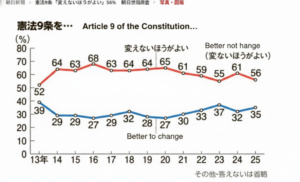
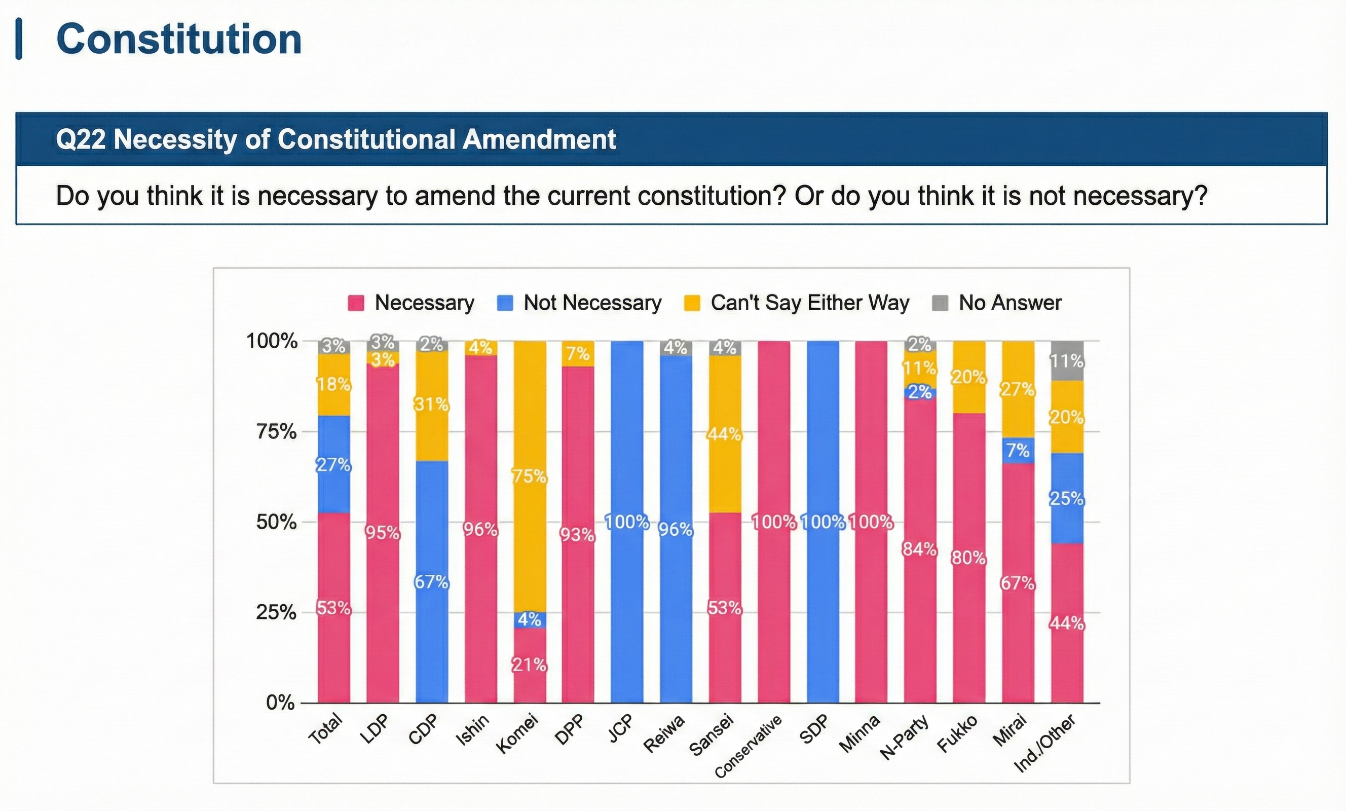
The Japanese public’s view on this inevitable national security debate is a critical factor. According to the latest results of the joint public opinion survey conducted by Asahi Shimbun and the University of Tokyo (released May 1, 2025), 56% of respondents said that Article 9 of the Constitution “should not be revised,” exceeding those who said it “should be revised.” In 2024, 37% said it “should be revised” when respondents were shown the full text of Article 9 and asked whether it should be revised. This is the same proportion as in the 2023 survey. In addition, 53% said that “the Constitution needs to be revised,” with many citing “changes in the domestic and international security environment” as the reason. Finally, 80% agreed with the view that “Japan has been able to avoid going to war because of Article 9.” In 2022, 56% said constitutional revision was “necessary,” the highest since the mail-in surveys began in 2013; however, regarding Article 9 itself, a majority—59%—said it “should not be revised.” More detailed articles and past series on these surveys can be found on Asahi Shimbun’s special feature page on the Constitution. Also, the revision of Article 9 was discussed at the Tokushima Bar Association in 2022, during the event “Considering the Issue of Constitutional Revision in the Context of International Affairs.”
The sequential survey results reveal an underlying fear that even minor revisions to any part of Article 9 could lead to broader changes. They also help explain why support for preserving the Constitution (pro-constitution or anti-revision) remains higher than support for amendment (pro-amendment), since 80% of respondents agreed that Article 9 has served as a safeguard preventing Japan’s involvement in warfare. If Japan is to meet its international obligations and strengthen its national security in the face of growing regional threats, or Article 9 advocates cannot simply reject all efforts to revise the Constitution, despite the complex dynamics of political and public opposition. According to the 2025 Military Strength Ranking by Global Fire Power, Japan ranks 8th. Although this ranking refers to “military power,” in Japan’s case, it is not a military force but the Self-Defense Forces, which operate under the doctrine of exclusive self-defense; therefore, the ranking reflects Japan’s “defense capability.” As expected, the United States ranks first. Considering that the top ranks are occupied by major military powers or countries facing tense relations with neighboring states, one factor contributing to the ranking is economic strength. Japan is, after all, the world’s third-largest economy by GDP. Its strong economic foundation allows it to allocate significant funds to defense. Another key factor is access to advanced weaponry. The cutting-edge equipment purchased from the United States is extremely high-performance and significantly enhances Japan’s defense capabilities.
6.7.3. Overview of Article 9 of the Constitution of Japan
Article 9 of the Constitution of Japan consists of two clauses: Article 9 (1), which stipulates the “renunciation of war (jus ad bellum),” and Article 9 (2), which provides for the “non-possession of armed forces” and the “denial of the right of belligerency (jus in bello).” Because of Article 9, the Constitution of Japan is often referred to as the “Peace Constitution.” Many people may believe that Article 9 is unique to Japan and a constitutional provision Japan can proudly present to the world; however, it is not unique and is widely adopted by many national constitutions that contain provisions similar to Article 9 (1).[14] Article 9 (1) was created based on international legal instruments such as the 1928 Kellogg–Briand Pact and the 1945 United Nations Charter. It reflects principles of the international legal framework that regulate the use of force among nation-states; however, Article 9 (2) “impact[s] on the rights and obligations of Japanese armed forces as a matter of international law.”[15]
6.7.3.1. Summary of the Complex and Ongoing Debates on Article 9
Renunciation of War in International Law:
- Article 9 stipulates that the state renounces war as a means of settling international disputes.
- This further clarifies within the Japanese Constitution the international principle that the use of armed force should not be employed to resolve disputes between states.
Relationship with the Right of Self-Defense Forces:
- Although Article 9 prohibits the “war potential for settling international disputes,” the government interprets that “the minimum necessary level of force for self-defense” may be maintained.
- For this reason, Japan maintains the Self-Defense Forces (SDF).
- The use of the minimum necessary force to defend Japan, as an exercise of the right of self-defense, is not considered to violate Article 9.
- However, the use of armed force that exceeds what is minimally necessary—such as occupying foreign territory—is regarded as a violation of Article 9 and is not permitted.
Denial of the “Right of Belligerency”:
- Article 9 (2) states, “the right of belligerency of the state will not be recognized.”
- The “right of belligerency” refers not only to the right to engage in hostilities but also to powers recognized under international law for warring states, such as killing, destruction, and occupation.
- Acts of killing or destruction carried out in the exercise of self-defense are considered distinct from the exercise of belligerent rights, which include occupying an adversary’s territory.
The “Ashida Amendment” and the Right of Belligerency:
- The phrase in Article 9 (2)—“to accomplish the aim of the preceding paragraph”—is said to have been inserted with the intent of allowing the maintenance of forces for self-defense (the so-called Ashida Amendment).[16]
- However, during the Diet deliberations, no explanation was given that the amendment had such a purpose.
- This “Ashida Amendment” later became one of the grounds used to support the constitutionality of the Self-Defense Forces.
6.7.3.2. Consideration of Five Aspects for Article 9 Amendment
6.7.3.2.1. Clarification of the Definition of Renunciation of War
It is believed that the phrase “renunciation of war” was first explicitly articulated in the so-called “MacArthur Note No. 4” (February 3, 1946) in its second principle. Behind this were international developments led primarily by the United States—such as the Atlantic Charter of August 1941 (the principle of demilitarizing aggressor nations) and the Potsdam Declaration of July 1945 (the permanent removal of militarists’ power and influence, the dismantling of Japan’s ability to wage war, and the complete disarmament of the Japanese military)—as well as the pacifist ideas of then-Prime Minister Shidehara Kijūrō. Although there is debate over who originally proposed the idea, “it is generally considered to have been a ‘joint creation’ of Japan and the United States.”[17]
6.7.3.2.2. Clarification of the Right of Belligerency
Article 9(1) affirms that Japan renounces war out of a sincere commitment to achieving international peace based on justice and order. This reflects Japan’s commitment to leading the promotion of global peace through trust and cooperation among nations. With respect to the interpretation of the “right of belligerency,” in Article 9, the Japanese government distinguishes this right—which historically allowed unlimited wartime actions except for humanitarian constraints—from constitutionally permitted self-defense, which is inherently limited by necessity and proportionality. Also, the Japanese government has expressed its views on the meaning of the provision denying belligerent rights in Article 9 of the Constitution in a relatively detailed explanation as follows: “Article 9(2) states, ‘the right of belligerency of the state will not be recognized.’” The term “right of belligerency” here does not mean the right to engage in combat. Rather, it refers to a collective term for the various rights that belligerent states possess under international law, including the right to kill or destroy enemy forces, to occupy enemy territory, to administer occupied territories, to inspect neutral vessels, and to capture enemy vessels.
6.7.3.2.3. Self-Defense Forces
On the other hand, Japan is naturally permitted to use the minimum necessary force to defend the nation when exercising the right of self-defense. This exercise of self-defense is considered separate from the exercise of belligerent rights.”[18] Before the UN Charter outlawed war,[19] states possessed an unrestricted right to wage war. After the Charter,[20] the legitimate use of force became limited to self-defense and UN-authorized measures, both of which impose legal limits on belligerent rights. Thus, the “right of belligerency” denied by Article 9 is fundamentally different from the restricted rights associated with lawful self-defense under modern international law and from Japan’s constitutionally limited right of self-defense.
6.7.3.2.4. Ashida Amendment
There are various interpretations of the so-called “Ashida Amendment.” A document prepared by the Secretariat of the House of Representatives Commission notes the following explanation: Ashida stated that he sought “to make clear that the motive for deciding to renounce war and demobilize the armed forces stemmed solely from the desire for harmony among humanity and the aspiration for world peace.”[21] He explained that the reason for adding the phrase “to accomplish the aim of the preceding paragraph” at the beginning of Article 9(2) was to express the idea that both Article 9 (1) and (2) “arise from the Japanese people’s peaceful aspirations.”[22] However, Kawakami argues that the “Ashida Amendment” cannot serve as a basis for claiming that the Self-Defense Forces are constitutional.[23] Shinoda interprets Article 9 as not denying the right of self-defense, nor prohibiting the maintenance of the means necessary to exercise that right.[24] Kenji Matsuyama examines the debate from an international law perspective. He concludes that the Japanese government’s asserted right of self-defense differs from the right of belligerency that Article 9 prohibits.[25] Martin offers a perspective, noting that “the existence of the SDF [in Japan] is a reality that cannot be realistically reversed.”[26]
6.7.3.2.5. Civilian Control
The Constitution of Japan renounces war in Article 9 and, in Article 66, establishes “civilian” control by entrusting the operation of the Constitution to civilian authorities. As Japan has shifted its policies toward a more active posture in “exercising collective self-defense,”[27] and as the Self-Defense Forces have developed into a modern, large-scale military organization by global standards, it has become critical to reexamine the nature of “civilian control” prescribed in the Constitution—that is, the system of civilian oversight of the military. Japan’s fundamental defense policy is grounded in the Constitution of Japan and is based on 1) “exclusively defense-oriented policy” (senshu bōei), adherence to the 2) Three Non-Nuclear Principles, and 3) ensuring civilian control over the military. According to the Defense White Paper 2022 (Reiwa 4, 2022), “Japan has consistently adhered to an exclusively defense-oriented posture under the Constitution, following the fundamental principle of not becoming a military power that could threaten other countries. While maintaining the Japan-U.S. security alliance, ensuring civilian control, and upholding the Three Non-Nuclear Principles, Japan has efficiently developed a highly effective and integrated defense capability.” Also, the civilian control is defined as “Civilian control, also known as ‘civilian control of the military,’ referring to the principle in democratic states that politics takes precedence over the military, or that the military is subject to democratic political oversight.
The Diet, as the representative body of the people, deliberates and decides on matters such as the number of Self-Defense Forces personnel and major organizational structures. It also approves actions such as defense mobilization.
Under the Constitution, the Prime Minister and other Ministers of State who make up the Cabinet must be civilians. The Prime Minister, representing the Cabinet, holds the supreme authority to command and supervise the Self-Defense Forces. At the same time, the Minister of Defense, who is the minister responsible exclusively for national defense, oversees all SDF affairs. In addition, the Cabinet includes the National Security Council, which deliberates on important matters related to Japan’s national security.
Although the system of civilian control is in place, for it to function effectively, it remains essential for the public to maintain a strong interest in national defense and to continue efforts in both political and administrative operations. As the Defense White Paper concludes, “even though Japan has a formal system of civilian control over the military, such as laws, institutions, procedures, it remains imperative that 1) the public must stay interested and engaged in national defense issues and 2) political leaders and government administrations must continue to make steady efforts. Otherwise, the system will not actually work well, since if citizens become indifferent, political leaders may face less scrutiny, and civilian oversight can weaken. Also, civilian control requires active management, transparency, accountability, and proper decision-making. If the political or administrative side becomes careless or passive, the system could fail in practice. Thus, a system on paper is not enough—civilian control works only if the public pays attention and the government consistently maintain and strengthens the oversight mechanisms.”
Shibata Isaku provides a detailed chronological account of the mechanisms of civilian control in Japan, including Articles 81-83 of the Self-Defense Forces Act, and notes that “the relationship between Article 9 and the realities of warfare—whether wars are formally declared or not—is unclear. For that reason, even if Japan’s administrative system contains mechanisms for civilian control, those mechanisms inevitably take on characteristics shaped by this ambiguity.”[28]
References:
- Kawakami, Akihiro. “The Formation of Article 9 of the Constitution (I)” Kenpō 9-jō no Seiritsu (I). Jichisōken 460 (February 2017): 1-27.
- Kawakami, Akihiro. “The Formation of Article 9 of the Constitution (II)” Kenpō 9-jō no Seiritsu (II). Jichisōken 461 (February 2017): 18-44.
- Kawakami, Akihiro. “The Formation of Article 9 of the Constitution (III)” Kenpō 9-jō no Seiritsu (III). Jichisōken 462 (February 2017): 98-123.
- Kawakami, Akihiro. “The Formation of Article 9 of the Constitution (IV)” Kenpō 9-jō no Seiritsu (IV). Jichisōken 463 (February 2017): 31-65.
- Matsuyama, Kenji. “Denials of Belligerent Rights in Article 9 of the Constitution and Belligerent Rights under International Law” Kempō dai-kyūjō no kōsenken hinin kitei to kokusaihōjō no kōsenken. Reference Refarensu, 742 (2012): 37–56.
- Shinoda, Hideaki. “An Exploration of the Relationship between International Law and the Constitution of Japan: Critical Examinations of the Flaws of Traditional Interpretations of Article 9 by Constitutional Lawyers” Gendai Kokusai-hō to Nihonkoku Kenpō no Seigōsei no Kaimei: Jūrai no Kenpōgaku Tsūsetsu no Kyūjō Kaishaku no Mondaiten. Hiroshima Peace Science 41 (2019): 85–102.
- Shibata, Isaku. “A Study on the Civilian Control concerning the Constitution of Japan, Article 66th” Shibirian Kontorōru ni Kansuru Ichi Kōsatsu: Nihonkoku Kenpō Dai 66-jō Dai 2-kō ni Kanrenshite, Journal of Studies on Humanities and Public Affairs of Chiba University [Chiba Daigaku Jinbun Kōkyōgaku Kenkyū Ronshū) 40 (2020): 130–45.
- Martin, Craig, “Kenpō 9-jō o Saisei Saseru Tame no Kaiseiron – Naze, Dono Yō ni 9-jō o Kaisei Suru no Ka” [Change It to Save It: Why and How to Amend Article 9] (March 10, 2017). Ritsumeikan Heiwa Kenkyū Dai 18-gō (2017) (18 Ritsumeikan J. Peace Studies (2017)).
- Shinoda. Hideaki. Kenpōgaku no Yamai [The Malady of Constitutional Studies] Tōkyō: Shinchōsha, 2019.
- Kawakami, Akihiro, “Kenpō Seiritsu no Genten to Anpo Hōsei “Seiritsu” to iu Genten kara Kangaeru Heiwa” [Reflecting on Peace by Considering the Roots of the Japanese Constitution and Present-Day Security-Related Legislation] Sōgō Ningenngaku 10 (2016): 102-124.
- Yanagisawa, Asobu “Nihon koku Kenpō no Genzai: Sengo Nihon ni Okeru Kenpō to “Jieiken” Rongi no Hensen” [The Japanese Constitution Today: Changes in the Debate on the “Right of Self-Defense” in Post-war Japan] 10 Sōgō Ningenngaku (2016): 125-141.
6.7.4. Abolishment of Article 9 ~ Constitutionalism and Constitution~
In Part II of “The Project of Constitutionalism,”[29] Professor Tatsuo Inoue analyzes the practical implications of constitutionalism by focusing on three key issues within the Japanese legal and political system: 1) The debate surrounding the abolishment or revision of Article 9 of the Constitution, 2) The control of penal power (the state’s authority to impose punishment), 3) Judicial reform.[30] Inoue’s discussion on the potential abolishment of Article 9 serves as a central case study for testing the fundamental principles and limits of constitutionalism in modern Japan. In his theory, the greatest obstacle to establishing constitutionalism in postwar Japan is the persistent neglect of the contradiction between Article 9 of the Constitution and the Self-Defense Forces (SDF) and the Japan-U.S. security framework.
The SDF—one of the world’s most heavily armed organizations—does not constitute “military forces.” The notion that Article 9 restricts military forces is an outright falsehood. On the contrary, because Article 9 exists, the Constitution is premised on the idea that “military forces”—or, more precisely, to cite the text of Article 9, “land, sea, and air forces, as well as other war potential”—do not exist, and that “the right of belligerency of the state” is not recognized. As a result, the Constitution cannot contain even the minimal norms necessary to control military forces, such as civilian control over the use of force, advance Diet approval procedures for military action, or a military justice system. Consequently, the reality of the SDF and the security framework—both of which function as de facto military forces—has expanded outside the constitutional order.
The Constitution of Japan itself faces a serious dilemma, as it does not—and cannot—establish “norms for controlling military forces.” Inoue explains that “norms for controlling military forces” refers to provisions designed to regulate the misuse of military power, such as civilian control, prior approval by the Diet, and legal foundations for military law (including authorization to enact laws of war and to establish a military justice system). Martin also emphasizes the need to clarify the role of judicial review in enforcing the provision.[31] Inoue concluded that “the persistent continuation of a situation in which constitutional control over the most dangerous form of state violence—military force—is lacking stems from a poor and distorted understanding of constitutionalism as an endeavor to embody and develop the rule of law within the Constitution. This impoverished understanding is found not only among the public and politicians but also among intellectuals, including legal scholars and legal professionals.”
Inoue raises concern that Japan remains in a situation in which the Constitution does not adequately control or regulate the most dangerous power a state can possess—military force. He argues that this persistent problem stems from a widespread misunderstanding of what constitutionalism truly means. Constitutionalism is meant to realize and advance the rule of law through the Constitution, which requires that 1) government power be limited, 2) the use of force be legally defined and constrained, and 3) the Constitution clearly regulates how the military operates. However, Inoue contends that this understanding of constitutionalism is weakened in Japan. Indifference or misunderstanding is found across society—the general public, politicians, intellectuals, and even legal experts, such as scholars and lawyers. As a result, Japan’s lack of clear constitutional control over military force persists because many, including specialists, do not fully grasp or promote the idea that the Constitution must strictly limit state power and enforce the rule of law in military affairs.
Inoue emphasizes that the failure to regulate military force under the Constitution properly is not merely a legal issue; it is rooted in a fundamental misunderstanding of the very purpose of constitutionalism. His stance on constitutionalism is tied to the philosophical and constitutional implications of arguments for deleting Article 9. Komamura touches on Inoue’s proposal to delete Article 9, noting that “the argument for deleting Article 9 calls for boldly removing the article and entrusting security policy to political decisions reached through democratic deliberation and fair political competition. This is a constitutional amendment proposal vigorously developed by legal philosopher Inoue Tatsuo…this proposal is an attempt to reconsider Article 9 within the broader context of an ambitious philosophical project: confronting head-on the fundamental question in legal conceptual theory regarding unjust laws, applying its philosophical answer to redefining the rule of law, and thereby philosophically reorganizing the Constitution as an ‘enterprise toward justice.”[32]
References
- Inoue, Tatsuo. Rikken-shugi to iu Kuwadate. Tokyo: University of Tokyo Press, 2019.
- Komamura, Keigo. “Rikken Shugi to 9-jō Kaiken” [Constitutionalism and Article 9 Revision]. Hōgakukan Kenpō Kenkyūjo Law Journal 27 (2023): 117–134.
- Inoue, Tatsuo. Kenpō no Namida: Riberaru no koto wa kirai de mo, Riberarizumu wa kirai ni naranai de kudasai” [Tears of the Constitution: Even if You Hate Liberals, Don’t Hate Liberalism] (2) Tōkyō: Mainichi Shinbun Shuppan, 2016.
6.7.5. Further Consideration on the Japanese Constitution’s Article 9 Amendment
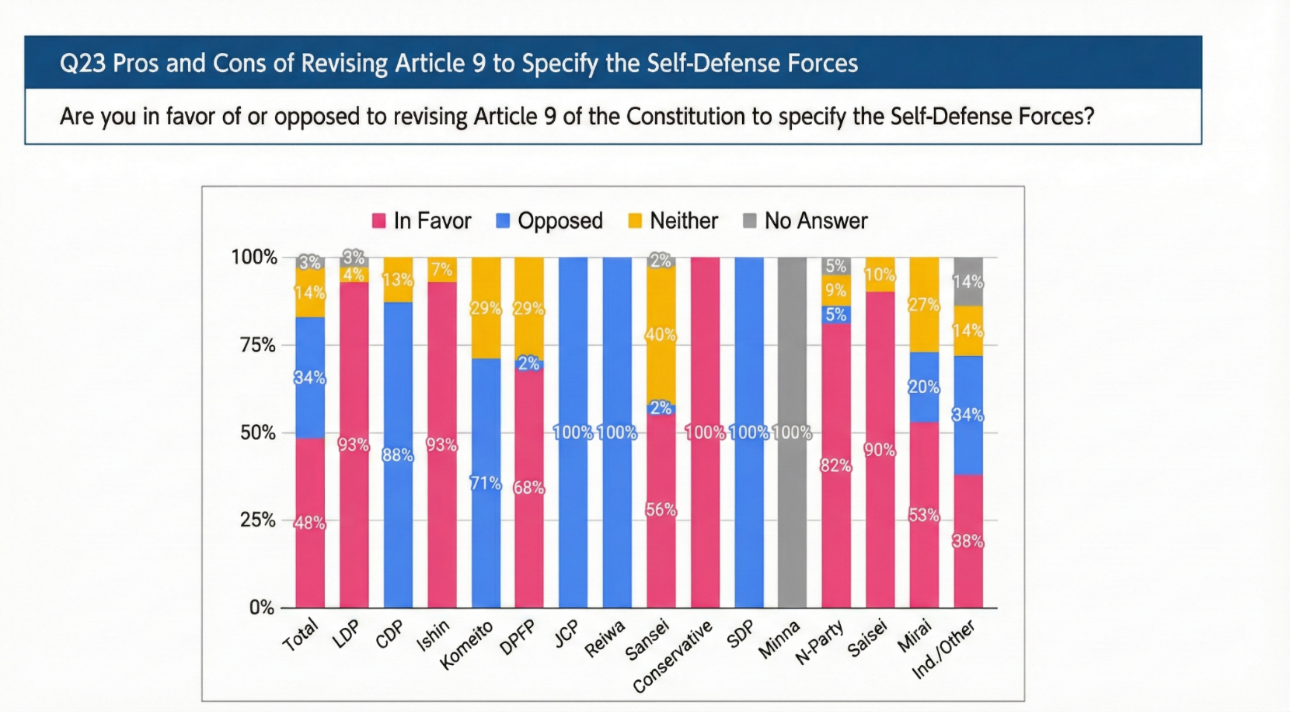
An NHK (Japan Broadcasting Corporation) survey of candidates in the 2025 House of Councillors’ election revealed significant political polarization over the revision of Article 9 of the Japanese Constitution to specify the Self-Defense Forces (SDF) explicitly.[33] The results, organized across thirteen major political parties, highlight the anticipated division on this core issue. The survey shows a clear split along partisan lines: 48% of candidates support revision, among them 93% are from the LDP (Liberal Democratic Party) and Ishin (Japan Innovation Party), 56% are from Sansei, and 82% are from the Conservative Party. 34% of candidates oppose revision. Among them, 100% are candidates from JCP (Japanese Communist Party) and Reiwa Shinsengumi, 88% are from CDP (Constitutional Democratic Party), and 53% are from SDP (Social Democratic Party). 14% of candidates answered Neither. Among them, 40% are Sansei and 27% are from the SDP (Social Democratic Party). 4% of candidates had no answer. Among them, 10% were from the SDP (Social Democratic Party).
The results confirm that the issue is heavily polarized: the ruling coalition and its allies (LDP, Ishin) show overwhelming support, while traditional opposition parties (JCP, Reiwa, CDP) demonstrate overwhelming opposition. Even amid the prevalent debate fatigue surrounding complex, ongoing disputes and a sense of indifference or misunderstanding regarding constitutional amendment, the discussion must continue to address the fundamental contradiction between the Constitution’s text and Japan’s current security posture. As Craig Martin argues, “that simply maintaining the status quo is no longer in the best interest of the constitutional order or the normative power of Article 9 itself.”[34] Given the current geopolitical landscape and domestic needs, Japan must address Article 9, whether through amendment, reinterpretation, or deletion. A renewed perspective on constitutionalism is essential for these debates. As Keigo Komamura states, “Constitutionalism means governing based on a constitution… and for that reason it is defined by placing the limitation of political power at its core.”[35] To uphold the very purpose of constitutionalism, future debates across society must ensure that 1) dividing powers among branches of government to maintain balance, 2) protecting individual rights, and 3) requiring government actions to be based on law and not arbitrary decisions.
6.7.6. Reading for Western Researchers
- Martin, Craig, Change It to Save It: Why and How to Amend Article 9 (December 10, 2016). 18 Ritsumeikan Journal of Peace Studies (2017)
- Martin, Craig, The Legitimacy of Informal Constitutional Amendment and the ‘Reinterpretation’ of Japan’s War Powers (December 30, 2016). Fordham International Law Journal, Vol. 40, No. 2, 2017
- Martin, Craig, Binding the Dogs of War: Japan and the Constitutionalizing of Jus Ad Bellum (November 6, 2008). University of Pennsylvania Journal of International Law, Vol. 30, pp. 267-357, 2008, U of Penn Law School, Public Law Research Paper No. 08-44
- Richter, Jeffrey P. “Japan’s ‘Reinterpretation’ of Article 9: A Pyrrhic Victory for American Foreign Policy?” 101 Iowa Law Review 1223–1262 (2016)
6.7.7. Exhibits
6.7.7.1. Results of a Public Opinion Survey Regarding the Proposed Revision of Article 9
6.7.7.2. Survey Results:[36] Article 9 Revision and the SDF 2025 House of Councillors’ Election Candidates (Thirteen Parties)
There are additional survey results as well.
[1] This thorough revision was largely developed based on the classes of the Kyoto Seminar in February 2014. A special note of appreciation to all faculty members for their excellent instruction at the 2014 Japanese Law Seminar in Kyoto.
[2] Promulgated on November 3, 1946, effective on May 3, 1947.
[3] Carolyn S Stevens, Disability in Japan (New York: Routledge, 2013), 83.
[4] The Basic Act for Persons with a Disability 1970 (Shōgaisha Kihon Hō) or Fundamental Law for Countermeasures for Mentally and Physically Handicapped Persons, the Law for the Promotion of Employing People with a Disability (Shōgaisha no Koyō no Sokushin nado ni Kansuru Hōritsu), the Six Laws of Welfare (Fukushi Roppō), and the Services and Supports for Persons with Disabilities Act 2005 (Shōogaisha Jiritsu Shien Hō).
[5] Stevens, Disability in Japan, 61-62.
[6] Neoliberalism is a policy model—bridging politics, social studies, and economics—that seeks to transfer control of economic factors to the private sector from the public sector. It tends towards free-market capitalism and away from government spending, regulation, and public ownership.
[7] Shōgaish Jiritsu Shien Hō Amended in 2012 as the Act on the Comprehensive Support for the Daily and Social Life of Persons with Disabilities.
[8] Shōgai wo Riyū to Suru Sabetsu no Kaishō no Suishin ni kanruru Hōritsu.
[10] An integration into mainstream society.
[11] Heyer, Rights Enabled, 2.
[12] My sincere gratitude is extended to Professor Craig Martin (Washburn University School of Law) for his extensive research on Article 9. I also thank Professor Mark Levin (William S. Richardson School of Law, University of Hawai’i at Mānoa) for introducing me to Professor Martin’s scholarship.
[13] Craig Martin, “Binding the Dogs of War: Binding the Dogs of War: Japan and the Constitutionalizing of Jus Ad Bellum,” 30 University of Pennsylvania Journal of International Law (2008):355.
[14] Hideaki Shinoda, “The Constitution’s Preamble and Article 9,” in Japan’s Foreign Policy in Transition: From Normalization to a Global Power, ed. Glenn D. Hook and Rikki Kersten (Abingdon, Oxon; New York: Routledge, 2019), 73.
[15] Craig Martin, “Change It to Save It: Why and How to Amend Article 9,” 18 Ritsumeikan Journal of Peace Studies (2017): 5.
[16] E-Rondan.
[17] House of Representatives Research Commission on the Constitution, Subcommittee on Security and International Cooperation. Basic Materials on “Article 9 of the Constitution (Renunciation of War, Non-Maintenance of Armed Forces, Denial of the Right of Belligerency) — Constitutional Issues Concerning the Overseas Deployment of the Self-Defense Forces.” Shugenshi No. 33, (July 3, 2003): 4.
[18] Kenji Matsuyama, “‘Right of Belligerency’ in Article 9 of the Constitution of Japan and Belligerent Rights in International Law.” The Reference. vol. 62, no. 11, National Diet Library, (2012): 30.
[19] Before the UN Charter (pre-1945): States were considered legally free to wage war whenever they chose. War was accepted as a legitimate tool of national policy. Because war itself was lawful, the full set of “belligerent rights”—the rights a state has during war—could also be exercised without restriction. These included things like occupying enemy territory, detaining enemy soldiers, blockading ports, and stopping neutral ships. War was legal → full belligerent rights.
[20] After the UN Charter (post-1945): The UN Charter fundamentally changed international law by outlawing war and prohibiting states from using force, except in two specific cases: 1) Self-defense (Article 51) and 2) UN-authorized collective action (such as Security Council mandates). Because the use of force is now lawful only in these limited contexts, belligerent rights are also legally restricted. In other words: 1) States cannot claim the full set of wartime rights simply by calling something “war.” 2) Even when force is permitted (self-defense or UN action), they can exercise only the minimum necessary and legally justified rights tied to those purposes—not the unlimited belligerent rights that existed before 1945. War is illegal → only restricted uses of force are allowed → belligerent rights are limited accordingly.
[21] Basic materials on “Article 9 of the Constitution (renunciation of war, non-maintenance of armed forces, denial of the right of belligerency) — Constitutional issues concerning the overseas deployment of the Self-Defense Forces”] (Shugenshi No. 33).
[22] Basic materials on “Article 9 of the Constitution,” 1.
[23] 11 Akihiro Kawakami, “The Formation of Article 9 of the Constitution (II)” Kenpō 9-jō no Seiritsu (II) ]. Jichisōken 461 (February 2017): 41.
[24] Hideaki Shinoda, “An Exploration of the Relationship between International Law and the Constitution of Japan: Critical Examinations of the Flaws of Traditional Interpretations of Article 9 by Constitutional Lawyers” Gendai Kokusai-hō to Nihonkoku Kenpō no Seigōsei no Kaimei: Jūrai no Kenpōgaku Tsūsetsu no Kyūjō Kaishaku no Mondaiten. Hiroshima Peace Science 41 (2019): 87.
[25] Kenji Matsuyama, “‘Right of Belligerency’ in Article 9 of the Constitution of Japan and Belligerent Rights in International Law,” 41.
[26] Craig Martin, “Change It to Save It: Why and How to Amend Article 9,” 31.
[27] Petition calling for the strong rejection of the enactment of the ten revised security-related bills, including the Act on Armed Attack Situations, which would enable the exercise of the right of collective self-defense, and the International Peace Support Act, which would allow Japan to provide logistical support to foreign militaries overseas. On May 14, 2025, the government approved at a Cabinet meeting a set of so-called security-related bills, including amendments to the Act on Armed Attack Situations, which would enable the exercise of the right of collective self-defense.
[28] Isaku Shibata, “A Study on the Civilian Control concerning the Constitution of Japan, Article 66th” Shibirian Kontorōru ni Kansuru Ichi Kōsatsu: Nihonkoku Kenpō Dai 66-jō Dai 2-kō ni Kanrenshite, Journal of Studies on Humanities and Public Affairs of Chiba University Chiba Daigaku Jinbun Kōkyōgaku Kenkyū Ronshū) 40 (2020): 131.
[29] Inoue, Tatsuo. Rikken-shugi to iu Kuwadate. Tokyo: University of Tokyo Press, 2019.
[30] I would like to thank Professor Fumiaki Kobayashi (Meiji University) for his guidance in introducing me to Professor Inoue’s scholarship.
[31] Craig Martin, “Change It to Save It: Why and How to Amend Article 9,” 0.
[32] Keigo, Komamura, “Rikken Shugi to 9-jō Kaiken” [Constitutionalism and Article 9 Revision]. Hōgakukan Kenpō Kenkyūjo Law Journal 27 (2023): 126.
[33] The chat of the survey results in Exhibit.
[34] Craig Martin, “Change It to Save It: Why and How to Amend Article 9,” 4.
[35] Keigo, Komamura, “Rikken Shugi to 9-jō Kaiken” [Constitutionalism and Article 9 Revision], 117.
[36] I am grateful to Professor Aamir Abdullah, Reference and Instructional Services Librarian (William S. Richardson School of Law, University of Hawai’i at Mānoa), for his guidance and assistance in generating the chart in English.