
Legal Research in Costa Rica
By Roger A. Petersen
Roger A. Petersen is an Attorney at Law and a member of both the Costa Rican Bar and Florida Bar Association. He is the author of The Legal Guide to Costa Rica and a partner with P Law Group of San Jose, Costa Rica.
Published September/October 2025
(Previously updated in April 2010, March 2015, and in July/August 2018)
Table of Contents
- 1. Introduction to Costa Rica
- 2. A Brief History
- 3. The Constitution of Costa Rica
- 4. The Structure of Government
- 4.1. The National Government
- 4.1.1. Executive Branch
- 4.1.2. Legislative Branch
- 4.1.2.1. The Legislative Commissions
- 4.1.2.2. The Ombudsman (Defensoría de Los Habitantes)
- 4.1.3. Judicial Branch
- 4.2. The Local Government
- 4.3. The National Registry System
- 4.4. Political Parties and Elections
- 4.1. The National Government
- 5. Costa Rica Primary Legal Resources
- 5.1. Legislation
- 5.2. The Codes
- 5.3. General Laws
- 5.4. Case Law
- 5.5. International Treaties
- 6. Secondary Legal Resources
- 6.1. Government Internet Sites
- 6.1.1. Office of the President
- 6.1.2. Ministers
- 6.1.3. Other Government Sites
- 6.1.4. Digital Government
- 6.2. Costa Rican Law Schools
- 6.3. Costa Rican Bar and Legal Associations
- 6.4. Other Professional Licensing Associations
- 6.1. Government Internet Sites
- 7. Libraries
- 7.1. Law Libraries
- 7.2. General Libraries
- 7.3. Newspapers
- 7.4. Texts and Magazines
- 7.5. Books
- 7.6. Magazines
- 7.7. Sources of General Information
1. Introduction to Costa Rica
Costa Rica is a democratic republic that is located in Central America. To the north, it borders Nicaragua and to the south, it borders Panama. The west coast borders the Pacific Ocean, and the east coast borders the Caribbean Sea.
| Capital: | San José |
|---|---|
| Population: | Approximately 5.1 million people (49.8% male and 50.2% female) |
| Language: | Spanish |
| Form of Government: | Democratic Republic |
| Area: | The country has a territory of 51,000 km2 (about 19,730 square miles) |
| Literacy Rate: | 96.3% |
| Life Expectancy: | 78.57 males and 83.53 Females |
| Official Religion: | Catholic |
| National Emblems: | Flower: Guaria Orchid. Tree: Guanacaste Tree. Bird: Yiguirro |
2. A Brief History
Costa Rica was discovered by Christopher Columbus on his fourth voyage to the New World in 1502. Since Costa Rica had no resources to exploit, the Spaniards had little interest in the colony, and the first viable settlement was established in 1562 when Juan Vasquez de Coronado founded the city of Cartago. Costa Rica acquired its independence from Spain in 1821 and ratified its first Constitution in 1825. Throughout the late 1800s and early 1900s, the country struggled between military dictatorships and democracy. However, the most defining moment in modern Costa Rican history occurred in 1948, when a brief but impactful civil war broke out following disputed presidential elections. This revolution led to a significant turning point. José Figueres Ferrer, leader of the victorious forces and founder of the National Liberation Party (Partido Liberación Nacional-PLN), abolished the Costa Rican military and drafted a new Constitution in 1949. This groundbreaking move redirected national resources toward education, healthcare, and infrastructure, and it established Costa Rica’s strong tradition of civilian governance, democratic institutions, and respect for human rights. Since then, Costa Rica has remained one of the most stable and democratic nations in Latin America.
3. The Constitution of Costa Rica
Costa Rica is governed by the Constitution of 1949 (Constitución Politica de la República de Costa Rica). The Constitution established the separation of powers between the legislative, executive, and judicial branches of government. In 1989, the Constitution was amended to create a Constitutional branch within the Supreme Court of Costa Rica. This fourth chamber (Sala IV) has specific jurisdiction over matters that involve the Constitution and violation of constitutional rights. The reader can obtain more information about the Constitutional Court on its website.
4. The Structure of Government
4.1. The National Government
4.1.1. Executive Branch
The Executive branch is made up of the President of the Republic, who serves as both the Chief of State and Head of Government. The President is elected by popular vote for a four-year term through a general national election. To win outright in the first round, a candidate must receive at least 40% of the vote; otherwise, a runoff election is held between the two leading candidates. In Costa Rica, presidential re-election is permitted, but only non-consecutively, meaning a former president may run for office again after sitting out at least one full term.
There are two vice-presidents and twenty cabinet officers who are appointed by the President.
4.1.2. Legislative Branch
The Unicameral Legislative Assembly or Asamblea Legislativa holds fifty-seven seats. Members are elected by direct popular vote to serve four-year terms. The Legislature has two ordinary sessions (May 1-July 31 and September 1-November 30).
The Legislature has its own library (Biblioteca de La Asamblea Legislativa) where users can obtain more information about the Legislative branch, statistical information, and legislative documentation.
4.1.2.1. The Legislative Commissions
The Legislature has six permanent commissions, which are responsible for evaluating proposed laws. The six permanent commissions are (1) Fiscal and Financial Affairs, (2) Agricultural Affairs, (3) Economic Affairs, (4) Judicial Affairs, (5) Social Affairs, and (6) Government and Administration.
In addition, they also have fifteen permanent special commissions as follows: (1) Environmental, (2) Municipal Affairs, (3) Science and Technology, (4) Youth and Adolescence, (5) Tourism, (6) Constitutional Issues, (7) Public Expenditure, (8) Women’s Affairs, (9) Human Rights, (10) Honors, (11) Books and Documents, (12) Government Nominating Commission; (13) Drafting, (14) International Relations and Commercial Relations, and (15) Security and Narcotrafficking.
There are also special commissions that may be created on an ad hoc basis to address a specific matter related to a bill, analysis, or investigation, and they have a set timeframe to fulfill the assigned objective.
You can find out more about the Legislative Commissions on their website.
4.1.2.2. The Ombudsman (Defensoría de Los Habitantes)
Established by Law No. 7319 in 1992, the Defensoría de los Habitantes is Costa Rica’s Office of the Ombudsman, created to protect and promote the fundamental rights and interests of all individuals in their interactions with public institutions. It is an independent body that operates under the oversight of the Legislative Assembly, rather than the Executive Branch, ensuring its autonomy from the government in power.
The Defensoría has the authority to investigate complaints against public authorities, institutions, and services, either at the request of any person or organization, or on its own initiative. Its role includes ensuring transparency, fairness, and accountability in public administration and defending human rights.
Importantly, the services of the Defensoría are completely free of charge and accessible to all individuals, regardless of nationality or legal status. Over the years, it has become a respected institution in Costa Rican civil society, playing an important role in upholding good governance and the rule of law.
4.1.3. Judicial Branch
The Judicial Branch (Poder Judicial) of the Costa Rican government is made up of the Supreme Court, Appellate Courts, and Trial Courts, which are charged with the administration of justice. The administrative rules for the judicial branch are set forth in the Ley Orgánica del Poder Judicial.
The Supreme Court is divided into four Chambers as follows: Chamber I (Sala Primera) is presided over by seven magistrates, and it has jurisdiction over all civil and administrative matters. Chamber II (Sala Segunda) is presided over by five magistrates and has appellate jurisdiction over civil matters including family law, estates, and labor law. Chamber III (Sala Tercera) is presided over by five magistrates and hears only criminal appeals. Chamber IV is the Constitutional Chamber of the Supreme Court known as Sala Constitucional or Sala IV, and it is composed of seven magistrates.
This Constitutional Court is responsible for safeguarding constitutional rights and ensuring the supremacy of the Constitution. It has exclusive jurisdiction over a range of constitutional matters, including:
- Writs of Habeas Corpus–to protect personal freedom against unlawful detention.
- Constitutional Complaints (Recursos de Amparo)–to protect fundamental rights such as health, education, and freedom of expression.
- Constitutional Challenges (Acciones de Inconstitucionalidad)–to review and annul laws or regulations that violate the Constitution.
- Judicial Review of Administrative Actions–to ensure that acts by public authorities comply with constitutional principles.
- Resolution of Constitutional Conflicts–such as jurisdictional disputes between branches of government or public institutions.
Any individual can access Sala IV directly and free of charge to file a claim.
Each of the Chambers of the Supreme Court has a web site to provide general information to the general public or to search case law as follows:




4.2. The Local Government
Costa Rica is divided into seven Provinces: San José, Alajuela, Cartago, Heredia, Guanacaste, Puntarenas, and Limon. Each of the provinces is in turn divided into Cantons (84), and each Canton is divided into Districts (492).
San José: twenty Cantons, Alajuela: sixteen Cantons, Cartago: eight Cantons, Heredia: ten Cantons, Guanacaste: eleven Cantons, Puntarenas: thirteen Cantons, Limon: six Cantons.
The Cantons are in turn divided into territorial areas headed by a Municipal government. There are eighty-four Municipal governments in Costa Rica. You can see the complete Political Subdivision of Costa Rica by clicking on this link: The Political Subdivision of Costa Rica
The names and contact information for many of the Municipalities in Costa Rica are available at the Municipal Government Directory. You can also view additional information about local Municipal governments from the Planning Office of the Costa Rican Government web site (MidePlan). At the same site, you can locate information on the budget and population of various local governments. The Union of Local Governments provide municipal government with a centralized platform to promote efficiency and transparency at the local level.
The Municipal Advisory Institute (Instituto de Fomento y Asesoría Municipal-IFAM) is a centralized government unit that provides technical assistance, financing, and institutional coordination for municipal governments. Their web page contains all relevant Municipal law and regulations, as well as maps on the population and divisions of each municipal territory in Costa Rica.
The Municipal government is administered by a Mayor (Alcalde) who is appointed by the Municipal Council (Consejo Municipal), who is elected by popular vote every four years and can be reelected.
The following Municipal governments have web pages that provide general information and regulations: Municipality of San Jose, which governs the metropolitan San Jose area which is the capital city of Costa Rica. The next three largest cities of Costa Rica are Alajuela, Heredia, and Cartago, and you can access their local government web pages here: Municipality of Alajuela; Municipality of Heredia; Municipality of Cartago. Other Municipal governments that have web sites include:
- In the Province of San José: Municipality of Belen; Municipality of Escazú; Municipality of Curridabat; Municipality of Montes de Oca; Municipality of Santa Ana; Municipalidad de Desamparados; Municipalidad de Alajuelita; Municipalidad de Moravia.
- Province of Alajuela: Municipality of San Ramon; Municipality of San Carlos; Municipalidad de Naranjo; Municipalidad de Grecia.
- Province of Cartago: Municipalidad de Cartago; Municipalidad de Paraiso; Municipalidad de Turrialba; Municipalidad de Oreamuno.
- Province of Heredia: Municipalidad de Heredia; Municipalidad de Barva; Municipalidad de Santa Barbara; Municipalidad de Santo Domingo; Municipality of Sarapiqui.
- Province of Guancaste: Municipalidad de Liberia; Municipalidad de Santa Cruz; Municipalidad de Cañas; Municipalidad de Tilaran; Municipalidad de Nicoya; Municipalidad de Carillo; Municipalidad de la Cruz; Municipalidad de Nandayure.
- Province of Puntarenas: Municipalidad de Cobano; Municipalidad de Esparza; Municipalidad de Osa; Municipalidad de Garabito; Municipalidad de Buenos Aires; Municipalidad de Montes de Oro.
- Province of Limon: Municipalidad de Limon; Municipalidad de Siquirres; Municipalidad de Pococi; Municipalidad de Talamanca.
4.3. The National Registry System
The Ministry of Justice operates the Costa Rican National Registry (Registro Nacional). The National Registry plays a vital role in the Costa Rican legal system because it is responsible for receiving and recording all documents that relate to real estate transactions, corporations, powers of attorney, trademarks, security interests, and more. The organization of the National Registry is as follows:
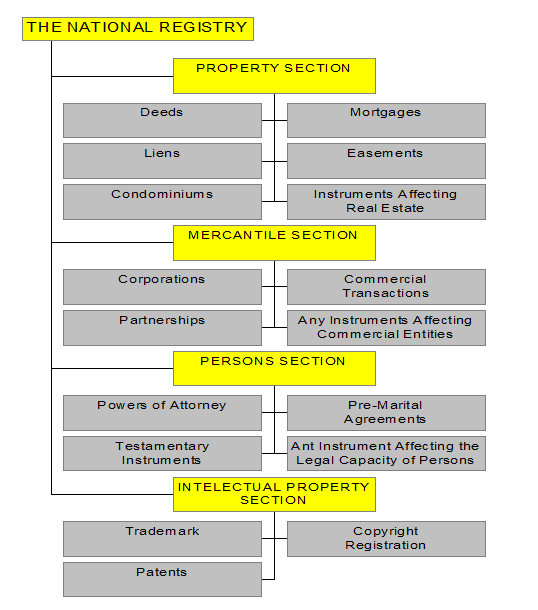
The public can access the National Registry’s database online. If you’re looking for information on real estate, vehicles, survey maps, and more, you can perform searches directly through the Registry’s search page. The system offers basic searches free of charge, and for a fee, you can obtain official online certifications using a credit card. To use the platform, you must first create an account by registering with your email address. A tutorial video is available to guide you through the registration process and how to navigate the system.
Additionally, the National Registry serves as the official repository for corporate records. Once logged in through the RNP Digital platform, you can also search the company registrar.
4.4. Political Parties and Elections
In Costa Rica, there are national presidential and legislative elections every four years.
The most recent general elections in Costa Rica were held in February 2022, with the next elections scheduled for February 2026. Since no candidate received the required minimum of 40% of the vote, a runoff election was held in April 2022 between José María Figueres of the National Liberation Party and Rodrigo Chaves of the Social Democratic Progress Party. Rodrigo Chaves won the runoff with 52.85% of the vote, while Figueres received 47.15%.
In the first round of the 2022 election, a total of twenty-five political parties qualified to present presidential candidates. The results by political party that led to the runoff were as follows:
| Political Party | Percentage of Votes (%) |
|---|---|
| Liberación Nacional | 27.28% |
| Progreso Social Democratico | 16.78% |
| Nueva Republica | 14.88% |
| Liberal Progresista | 12.4% |
| Unidad Social Cristiana | 12.4% |
| Frente Amplio | 8.73% |
| Costa Rica Justa | 0.95% |
| Fuerza Nacional | 0.79% |
| Unidos Podemos | 0.79% |
| Acción Ciudadana | 0.66% |
| Accesibilidad Sin Exclusión | 0.59% |
| Republicano Social Cristiano | 0.58% |
| Nueva Generación | 0.56% |
| Restauración Nacional | 0.53% |
| Justicia Social Costarricense | 0.32% |
| Unión Liberal | 0.32% |
| Unión Costarricense Democrática | 0.32% |
| Alianza Demócrata Cristiana | 0.27% |
| Encuentro Nacional | 0.22% |
| Nuestro Pueblo | 0.16% |
| Integración Nacional | 0.14% |
| Movimiento Social Demócrata Costarricense | 0.1% |
| De Los Trabajadores | 0.09% |
| Pueblo Unido | 0.07% |
| Movimiento Libertario | 0.07% |
You can view the complete Presidential elections information and breakdown in detail at the web site of the Costa Rican Elections Committees (Tribunal Supremo de Elecciones).
The 2022 presidential election in Costa Rica marked a significant break from the country’s traditional political landscape. Voters overwhelmingly rejected the established political parties, signaling widespread dissatisfaction with the status quo. The most significant outcome was the election of Rodrigo Chaves, a candidate from the newly formed Social Democratic Progress Party. The party not only secured the presidency but also won ten seats in the fifty-seven-member National Legislative Assembly.
As a result of this political shift, the composition of the Legislative Assembly became more fragmented, with seats divided among six different political parties as follows
Liberación Nacional (PLN) 19
Progreso Social Democrático (PPSD) 10
Unidad Social Cristiana (PUSC) 9
Nueva República (NR) 7
Liberal Progresista (PLP) 6
Frente Amplio (FA) 6
The primary source for electoral information in Costa Rica is the Supreme Elections Tribunal (Tribunal Supremo de Elecciones) which oversees registering political parties and administering elections.
5. Costa Rica Primary Legal Resources
5.1. Legislation
The laws passed by the Costa Rican legislature are the primary source of law. Once a law has been approved by the Legislature, it must be published in the official gazette known as La Gaceta. The record of all laws published by the Gazette may be searched via the Internet at the site of the National Printing Office.
In addition to the laws passed by the legislature, the Costa Rican government may issue regulations (Reglamento) to a specific law. Furthermore, the President and other government Ministries may issue Decrees (Decreto) regarding specific topics. Whether it is a law, a regulation, or a decree, all must be published in the official gazette before they become binding.
A record of all laws, executive decrees, and regulations in existence in Costa Rica is available from the National Legislation System database (SCIJ–Sistema Costarricense de Informacion Juridica) where the user can search the database based upon different types of search criteria. The following link takes you to the search window for the database.
5.2. The Codes
Many of the laws passed by the legislature are compiled into Codes, each of which governs a particular area of the law. Costa Rica is a civil law system and as such is heavily influenced by the French (Napoleonic Code) system and the Spanish civil law system, which established written codification of its laws, which are referred to as Codes. The codes can be viewed in their entirety through the Costa Rican Judicial Information System (Sistema Costarricense de Información Juridica / SCIJ).
- The Civil Code (Código Civil): Governs contracts, property, obligations, capacity of persons. and succession.
- The Code of Civil Procedure (Código Procesal Civil): Defines the procedures required to litigate before the Costa Rican civil courts.
- The Commercial Code (Código de Comercio): Regulates commercial transactions, negotiable instruments, bankruptcy, and corporate entities.
- The Labor Code (Código de Trabajo): Governs employer and employee relationship and obligations.
- The Family Code (Código de Familia): Sets forth the laws regarding marriage, divorce, paternity, guardianship, and adoption.
- The Penal Code (Código Penal): Establishes the criminal offenses which are punishable by law.
- The Code of Criminal Procedure (Código Procesal Penal): Defines the procedures that are to be followed before the criminal courts.
- The Administrative Procedural Code (Código Procesal Contencioso Administrativo): Sets forth the administrative procedures that must be adhered to by the Costa Rican government and the Court procedures to be followed to review administrative decisions.
- The Municipal Code (Código Municipal): This code regulates the actions of the Municipal (local) governmental entities.
Most of the legal Codes indicated above are also available in print form from Editorial Investigaciones Juridicas, S.A. or Editorial Juricentro, S.A., San José, Costa Rica.
5.3. General Laws
All laws passed in Costa Rica can be found through the SINALEVI database described above or through the Legislative Assembly Law Directory, where they maintain online access to all laws by reference number.
At the site of the Office of the Attorney General (Procuraduría General de la Republica), through the Costa Rican Judicial Information network (Sistema Costarricense de Informacion Juridica -SCIJ), one can search for the full text of the laws based upon the specific area of the law. The following laws are specifically covered: Agrarian Laws, Administrative Laws, Environmental Law, Customs Laws, Civil Laws, Labor Laws, Immigration Laws, Municipal Laws, Criminal Laws, Family Laws, Constitutional Laws, Tax Laws, Commercial Laws, Elections Laws, Notary Laws, Mining Laws, Urban Planning Laws, Transit Law, Human Rights Laws, and Banking Laws.
5.4. Case Law
All Costa Rican case law has been centralized on the website of the judicial branch via their Nexus.PJ database, which is a judicial search system of the Judiciary of Costa Rica. It allows users to access court rulings, case law, and other legal documents. The case law database includes decisions from the Costa Rica Supreme Court, Appellate Courts, and Trial Courts.
Additionally, users can search for active court cases using the Judicial Branch’s online consultation system, provided they have the corresponding case file number.
5.5. International Treaties
Treaties play an important role in Costa Rican legislation, since Article 7 of the Costa Rican Constitution provides that treaties which have been ratified and approved by the National Legislature are superior to national law. All treaties are filed with the Treaty Assessment Office (Oficina Asesora de Tratados) of the Costa Rican Ministry of Foreign Relations. For more information on treaties, you can visit the website of the Ministry of Foreign Relations and in more detail, you can view the bilateral agreements on the Organization of American States website. For commercial bilateral agreements, you can view the information form the Ministry of Foreign Commerce.
6. Secondary Legal Resources
6.1. Government Internet Sites
The Costa Rican government has made significant advances in using the Internet to disseminate information to its citizens. Through a wide range of official websites, government institutions provide citizens, residents, and businesses with direct access to essential information, digital services, and legal resources.
6.1.1. Office of the President
The official website of the President of Costa Rica now includes video clips and audio of selected speeches and presentations.
6.1.2. Ministers
- Ministry of Economic Industry & Commerce
- Ministry of Foreign Trade
- Ministry of Foreign Affairs
- Ministry of Public Security
- Ministry of National Planning & Economic Policy
- Ministry of Agriculture
- Ministry of Science, Innovation, Technology & CommunicationsMinistry of Public Works
- Ministry of Health
- Ministry of Education
- Ministry of Energy and Environment
- Ministry of Justice
- Ministry of the Treasury
- Ministry of Labor
- Ministry of Housing
- Ministry of Culture, Youth and Sports
- Ministry of Women’s Issues
6.1.3. Other Government Sites
- Comptroller General
- Office of the Attorney General
- Bank and Financial Institution Regulators (SUGEF)
- Costa Rican Institute of Tourism (in English)
- National Insurance Institute
- Social Security Administration (CCSS)
- National Emergency Commission
- Costa Rican Electricity Institute (ICE)
- Central Bank of Costa Rica
- Department of Immigration (DGME)
6.1.4. Digital Government
Trámite ¡YA! is a digital platform developed by the Costa Rican government with the goal of facilitating the initiation and monitoring of certain government applications and procedures without the need to visit government offices. For the time being, it is mostly used to create new legal entities for use in Costa Rica under the Crear Empresa platform and by the Department of Immigration for immigration applications.
In addition, the government through the Central Bank has widened the ability of the population to use digital signature when interacting with the government. The digital signature (Firma Digital) in Costa Rica is a legally recognized technological tool that ensures the authenticity, integrity, and legal validity of electronic documents. The individuals must obtain a digital signature certificate through one of the authorized providers which include: Banco de Costa Rica; Banco Promerica; Banco BAC.
6.2. Costa Rican Law Schools
In Costa Rica, there is one public law school, the University of Costa Rica, School of Law, and sixteen private law schools. The Costa Rican Bar Association does not have a supervisory role in the law school curriculum and as such, the quality of law school education varies from school to school. The following are links to some public and private law schools in Costa Rica.
- Universidad de Costa Rica
- Universidad Autónoma de Centro America (U.A.C.A.)
- Universidad Escuela Libre de Derecho (Ulibre)
- Universidad Latina de Costa Rica
- Universidad Latinoamericana de Ciencia y Technologia
- Universidad La Salle (Ulasalle)
- Universidad Fidelitas
- Universidad Hispanoamericana
- Universidad Internacional de las Americas
- Universidad San Juan de la Cruz
- Universidad Católica
6.3. Costa Rican Bar and Legal Associations
- Costa Rican Bar Association (Colegio de Abogados y Abogadas) – To practice law in Costa Rica, one must be admitted as an Attorney to the Costa Rican Bar Association. A law library is available at the facilities of the Bar Association located in the capital city of San Jose (Zapote).
- National Notary Directorate (Dirección Nacional de Notariado) – In a civil law system, such as Costa Rica, the Notary Public plays an important function within the legal system. To be a Public Notary in Costa Rica, you must be a licensed Attorney and authorized before the National Notary Directorate. The Directorate was created by the Notary Code (Código Notarial) in 1998 and oversees the oversight and regulation of the Notary system in Costa Rica.
6.4. Other Professional Licensing Associations
In order to carry out your profession in Costa Rica and depending on the field of work, it may require a license or membership to a professional association in Costa Rica. The following is the list of Costa Rican professional associations known locally as Colegios:
- Association of Biologists (Colegio de Biólogos)
- Association of Medical Doctors and Surgeons (Colegio de Médicos y Cirujanos)
- Association of Public Accountants–CPA (Colegio de Contadores Públicos)
- Association of Professionals in Computer Science (Colegio de Profesionales en Informatica)
- Association of Pharmacists (Colegio Farmacéuticos)
- Ass0ciation of Architects and Engineers (Colegio Federado de Ingeniero y Arquitectos CFIA)
- Association of Professionals in Economics (Colegio de Profesionales en Ciencias Economicas)
- Association of Veterinarian Doctors (Colegio de Veterinarios)
- Association of Masters and Professors in Arts and Sciences and Philospohy
- Association of Dental Surgeons (Colegio de Cirujanos Dentistas de Costa Rica)
- Association of Journalists (Colegio de Periodistas)
7. Libraries
7.1. Law Libraries
- The University of Costa Rica has an extensive collection on Costa Rican Law. The catalog of the University library may be searched via the internet.
- The Fernando Coto Albán Judicial Library is located on the first floor of the Costa Rican Supreme Court.
- The Francisco Echeverria Law Library (Biblioteca Francisco Echeverria) at the Costa Rican Bar Association.
7.2. General Libraries
- The Library of the National Assembly (Biblioteca de la Asamblea Legislativa) also has a vast collection of legal material.
- The National Library (Biblioteca Nacional) – The National Library of Costa Rica is located in the capital city of San Jose.
- The Library of the National Museum (Museo de Costa Rica) is located in the National Museum of Costa Rica.
7.3. Newspapers
- La Nación: The largest daily circulation newspaper in Costa Rica
- La Republica
- La Prensa Libre
- CRHoy.Com: A digital newspaper
- Diario Extra
- El Financiero: A financial news source
7.4. Texts and Magazines
7.5. Books
- The Legal Guide to Costa Rica: Written in English, it is a summary of Costa Rican laws and procedures including general information on living and doing business in Costa Rica. The book also has sample forms translated into English.
- The Ticos: Culture and Social Change in Costa Rica, by Mavis Hiltunen Biesanz.
- Expolibro, S.A. and Juricentro, S.A. are legal bookstores in Costa Rica that carry printed material on Costa Rican law.
- Manual de Derecho Sucesorio (Probate Manual), Francisco Luis Vargas Soto published by Juricentro, S.A. 2010.
- Derecho Penal (Criminal Law), Jose Alberto Rojas Chacon published by Juricentro, S.A. 2009.
- Manual de Derecho Notarial (Notary Manual), Herman Mora Vargas published by Investigaciones Jurídicas, S.A. 1999.
- La Funcion Notarial (Notary Law), Herman Mora Vargas published by Investigaciones Juridicas, S.A. 2013.
- Código Civil de Costa Rica y Jurisprudencia. Editorial Juridica Continental, 2012.
- El Arbitraje en el Derecho Costarricense (Arbitration Laws in Costa Rica), Sergio Artavia Barrantes, published by Editorial Dupas, 2000.
- Tratado de los Bienes (Analysis of Costa Rican Civil Law as it relates to property), Alberto Brenes Córdoba, Editorial Juricentro, S.A., 1981.
- Tratado de las Pesonas (delves into the legal status of individuals, exploring the concept of legal personality and its implications within the legal system), Alberto Brenes Córdoba, Editorial Juricentro, S.A., 1998.
7.6. Magazines
- Magazine of Legal Sciences (Revista de Ciencias Juridicas): Published by the University of Costa Rica
- Boletin Juridico Virtual IUS Doctrina: Published by the University of Costa Rica, provides legal and case analysis
7.7. Sources of General Information
- CostaRicaLaw.com: Legal information in English
- U.S. Embassy in Costa Rica: Information on Costa Rica
- Costa Rica Embassy in United States: Consular Services
- The CIA Factbook on Costa Rica
- U.S. Department of State Country Information