
Global Warming: A Comparative Guide to the E.U. and the U.S. and Their Approaches to the U.N. Framework Convention on Climate Change and the Kyoto Protocol
By Deborah Paulus-Jagrič
Deborah Paulus-Jagrič holds a J.D. and an M.S.L.I.S. She was Project Librarian for Breaking the Logjam: Environmental Reform for the New Congress and Administration from 2007-09, and worked on Breaking the Logjam: Environmental Protection That Will Work, by David Schoenbrod, Richard B. Stewart & Katrina M. Wyman (Cambridge: Yale Univ. Press, 2010), in a variety of capacities. Her latest article, A New Land Initiative in Nevada, 17 (1) N.Y.U. Environmental Law Journal 398 (2008), co-authored with Kai S. Anderson, appeared in ELJ’s symposium issue for the Breaking the Logjam Conference.

Table of Contents
- 1. Introduction
- 2.Background on the UN Framework Convention on Climate Change (UNFCCC)
- 3. Kyoto Protocol: Adopted at COP-3
- 3.1. Overview
- 3.2. Marrakesh Accords
- 3.2.1. Kyoto’s “Flexibility” Mechanisms
- 3.2.2. LULUCF
- 3.3. COP-12
- 3.4. COP-13
- 3.5. COP-14
- 3.6. COP-15
- 3.6.1. Pre-COP-15
- 3.6.2. COP-15 Outcome
- 3.6.3. Post-COP-15
- 3.7. COP-16
- 3.7.1. Post-COP-16
- 3.8. COP-17
- 3.9. Finding Relevant Documents
- 3.9.1. IPCC’s Assessment Reports
- 4. The United States
- 4.1. The Clinton Administration, 1993-2001
- 4.2. The Bush Administration & Climate Change, 2001-2008
- 4.2.1. Asia-Pacific Partnership on Clean Development & Climate
- 4.2.2. Religion & Climate Change
- 4.2.3. Post-Midterm Elections, 2006-2008
- 4.2.4.Political Interference with Climate Research & Other Sciences
- 4.2.5. Arctic Animals Endangered by Global Warming
- 4.2.5.1. Polar Bears
- 4.2.5.2. Penguins
- 4.2.6. Massachusetts v. EPA
- 4.3. The 2008 Presidential Campaign
- 4.4. The Obama Administration, 2009-2012
- 4.4.1. GHG Legislation
- 4.4.1.1. House of Representatives
- 4.4.1.2. Senate
- 4.4.1.3. Congress as a Whole
- 4.4.2. GHG Regulations: EPA & Mass. v. EPA
- 4.4.2.1. California Waiver
- 4.4.2.2. Regulatory “End Run” Around Congress: EPA’s Endangerment Finding
- 4.4.2.2.1. Mobile Sources
- 4.4.2.2.2. Stationary Sources
- 4.4.2.3. “Climategate”
- 4.4.2.4. Legislation To Prevent the “End Run”
- 4.4.2.4.1. Legislation Against GHG Regulation in the 112th Congress
- 4.4.2.5. Lawsuits Challenging the EPA Endangerment Finding
- 4.4.2.6. Business, ENGO & State Reactions to EPA Regulation of GHG
- 4.4.2.7. EPA’s Defense of the Endangerment Finding & GHG Regulation
- 4.4.3. Obama Administration and Energy
- 4.4.3.1. Offshore Drilling
- 4.4.3.2. The Deepwater Horizon Disaster
- 4.4.3.2.1. Overview: Amount, Path, & Stopping the Oil
- 4.4.3.2.2. Congressional Response
- 4.4.3.2.3. Liability
- 4.4.3.2.4. Executive Branch Response
- 4.4.3.2.5. Environmental Effects
- 4.4.3.3. Midterm Elections, 2010
- 4.4.1. GHG Legislation
- 4.5. California: State, County & City Actions to Reduce GHG Emissions
- 4.6. Other States’ Actions To Reduce GHG Emissions
- 4.7. State Actions That Will or Would Have Increased GHG Emissions
- 4.7.1. Alaska
- 4.7.2. Arizona
- 4.7.3. Minnesota and South Dakota
- 4.7.4. New Mexico
- 4.7.5. South Dakota
- 4.7.6. Texas
- 4.8. Domestic/International Businesses & Climate Change
- 4.9. Extra-Political Progress (or lack thereof) Reducing GHG Emissions
- 5. The European Union
- 6. The Rest of the World
- 7. Online Scientific Resources Relating to Global Climate Change
- 8. Online Legal & Policy Resources about Global Climate Change
- 9. Innovative or Alternative Technologies
1. Introduction:
I began this guide in the fall of 2006, just prior to a number of significant climate-related events. The Twelfth Conference of the Parties to the UNFCCC and the Second Meeting of the Parties to the Kyoto Protocol (COP-12/MOP-2) were held in Nairobi in November 2006; in February 2007, the IPCC’s Fourth Assessment Report was released, which found it all but certain that human activities are responsible for climate change. Discussions of climate change were everywhere, and I was confident that U.S. hostility towards the Protocol would change with the administration. However, in early 2011, over two years into the Obama Administration, there is no progress either on national climate change regulation or on a successor protocol that we might consider ratifying; if anything, the 2010 midterm elections seem to have brought environmental backsliding on a variety of fronts. Nevertheless, a story does emerge from all this, if a different one than I hoped it would be.
Approach & sources: This is not a traditional research guide. It is a continuously updated narrative of the efforts of the U.S. government’s 4 branches and 50 states to follow much of the rest of the world and enact greenhouse gas (GHG) emissions controls. However, the U.S. Congress can’t decide whether global warming is happening at all; if it is, whether it is a natural or an anthropogenic phenomenon; and if the latter, whether the consequences of maintaining the status quo will be sufficiently devastating to justify the effort and expense of change.
I use the terms “global warming” and “climate change” interchangeably, although in scientific literature the former often refers to surface temperature changes and the latter to the effects of excessive CO2 and other GHGs in the atmosphere. I briefly summarize the UNFCCC and the Kyoto Protocol; discuss the important work that U.S. states, cities and businesses have initiated to address climate change (and, hopefully, to compel federal action); and am actively following the legislative and administrative repercussions of Massachusetts v. EPA. Comparisons to the E.U. and the rest of the world are also included.
My primary sources of electronic information are email alerts from Grist; the N.Y. Times (see below); and BBC News updates for climate change news from the E.U. and the E.C., all of which are freely available; the BNA International Environment Daily; the BNA Daily Environment Report; the BNA World Climate Change Report; the BNA Environment Reporter; and BNA’s U.S. Law Week. Online subscribers to BNA publications can use the embedded links when included, or search the BNA archives. I have relied on a blog entitled Warming Law: Changing the Climate in the Courts for updates on global warming law suits following Mass. v. EPA. [1] I have linked some law review articles to HeinOnline, but if the user is not a subscriber the links will not work. Remember that articles from online publications may over time become unavailable, and titles of online and print articles often differ, making the switch from internet to database or paper access less than seamless. Congressional committee hearings are sometimes archived on committee web pages, but not always, and database access may be necessary.
On Mar. 28, 2011, the N.Y. Times began charging for access to NYTimes.com. The first 20 items (articles, blogs, videos, whatever) viewed in a month are free; after that the fee is $15-35 per month, depending on mode of access. The digital subscriptions page says that although viewing links from search engines will count toward the limit, after you’ve used up your free items, you will have a new limit of 5 items from any given search engine. I assume that the existing links to the N.Y. Times will still work, and I will continue to add them as long as my own free access permits.
In 2010, I added a long discussion (§ 4.4.3.2.) of the BP offshore oil rig disaster in the Gulf of Mexico, but its relationship to the topic of this guide is a bit procrustean. I am debating whether it should be broken out into another guide, say, on non-GHG-specific problems with conventional energy, but have left it here as a cautionary tale, at least for now.
I am grateful to my colleague Mirela Roznovschi, who created and maintains Globalex, for the opportunity to write on this subject.
2. Background on the U.N. Framework Convention on Climate Change (UNFCCC)
Greenhouse gases (“GHG”), such as water vapor, carbon dioxide, ozone, and methane, trap heat and thereby warm the atmosphere. Emissions of greenhouse gases are increasing, and it is anticipated that the subsequent increases in global temperature will have severe effects on precipitation, ocean levels, extinction of species, and more. In 1988, the World Meteorological Organization and the United Nations Environment Programme (UNEP) created the Intergovernmental Panel on Climate Change (IPCC) “as an effort by the United Nations to provide the governments of the world with a clear scientific view of what is happening to the world’s climate” (see IPCC History); its role is “to assess on a comprehensive, objective, open and transparent basis the scientific, technical and socio-economic information relevant to understanding the scientific basis of risk of human-induced climate change, its potential impacts and options for adaptation and mitigation.” (See Principles Governing IPCC Work) The panel’s First Assessment Report, released in 1990, [2] stated the belief of 400 scientists that global warming was real, and urged that steps be taken to avoid any further damage to the environment. See § 3.8.1. IPCC’s Assessment Reports.
After that, Europe in particular and other countries as well, began to call for action on climate change; in response, the UN, on Dec. 21, 1990, created the Intergovernmental Negotiating Committee for a Framework Convention on Climate Change (INC). During the negotiation sessions, the U.S. often took strong positions, particularly against enforceable reduction targets and timetables, claiming scientific uncertainty and the adverse effect on the U.S. economy.
The United Nations Framework Convention on Climate Change (hereafter UNFCCC), U.N. Doc. A: AC237/18 (1992), 1771 U.N.T.S. 164, reprinted in 31 I.L.M. 851 (1992), was adopted by the INC on May 9, 1992, and was opened for signature in Rio de Janeiro, at the United Nations Conference on Environment and Development (UNCED), otherwise known as the “Earth Summit,” June 4th to 14th, 1992; it remained open for signature in New York until June 19, 1993, by which date it had been signed by 166 countries. Portugal was the 50th nation to ratify the treaty, enabling it to enter into force on March 21, 1994.[3] The UNFCCC has been ratified, accepted, or approved by a total of 194 countries.[4]
The UNFCCC was signed by the George H.W. Bush administration in Rio on June 12, 1992, and the U.S. Senate ratified it unanimously on Oct. 15, 1992.[5] The original, authentic Convention was deposited with the Secretary-General of the United Nations. (See UNFCCC art. 19 & art. 26.) Parties to the Convention agreed to consider climate change in such matters as agriculture, industry, energy, natural resources, and activities involving sea coasts, in an attempt to slow the process of global warming.
The Conference of the Parties (COP) is the ‘supreme body’ of the Convention; it is the highest decision-making authority, an association of all the countries that are Parties to the Convention. The COP meets every year, unless the Parties decide otherwise, to review progress on the Convention. (See UNFCCC art. 7, 1771 U.N.T.S. at 176, reprinted in 31 I.L.M. at 860.)
Developed nations are referred to in the UNFCCC as “Annex I” nations, as they are listed in the first annex to the Convention, along with 12 “economies in transition,” the EIT parties. The developed countries in Annex I were also members of the OECD in 1992. “Annex II” parties are only those OECD members of Annex I; EIT parties are not so considered. “Non-Annex I Parties to the Convention” are primarily developing countries. Several (48) of these Parties are classified as least developed countries (LDCs) and are recognized as being especially vulnerable, either to the economic effects of reducing emissions, or to climate change itself. The UNFCCC placed the greatest responsibility for reducing emissions on parties included in Annex I, who agreed to contain emission levels at 1990 rates by the year 2000. (See UNFCCC art. 4 (2) (a) & (b), 1771 U.N.T.S. at 171-72, reprinted in 31 I.L.M. at 856-57.) However, the Convention did not impose binding limits on emissions.
Under the UNFCCC articles 4 and 12, all parties are required to “[d]evelop, periodically update, publish and make available to the Conference of the Parties, in accordance with Article 12, a national inventory of anthropogenic emissions by sources and removals by sinks of all greenhouse gases not controlled by the Montreal Protocol.” [Art. 4 (1) (a)] [6] The initial “progress reports” were to be communicated by Annex I Parties within six months of the entry into force of the Convention for that Party; within three years for non-Annex I parties; and at the discretion of the least developed countries. UNFCCC Art. 12(a) states that the inventories shall use “comparable methodologies to be promoted and agreed upon by the Conference of the Parties.” These national communications shall also include detailed descriptions of the policies and measures that each party has adopted to implement its commitment under the Convention.
The U.S.’s Climate Action Reports are our national communications required by the UNFCCC. The United States submitted the first U.S. Climate Action Report (USCAR) to the UNFCCC Secretariat in 1994, the second in 1997, and the third in 2002; they are available from depository libraries. The Fourth U.S. Climate Action Report-2006 is available electronically from the State Department; the Fifth U.S. Climate Action Report 2010 was available in early 2010.
Under Articles 4 and 12 of the Convention and various decisions of the COP, Annex 1 Parties are also required to submit to the secretariat annual inventories of anthropogenic GHG emissions not already controlled by the Montreal Protocol. The IPCC Guidelines for National Greenhouse Gas Inventories were first accepted in 1994, published in 1995, and revised in 1996. The Revised 1996 IPCC Guidelines were reaffirmed by COP-3 in Kyoto which stated that they “should be used as ‘methodologies for estimating anthropogenic emissions by sources and removals by sinks [7] of greenhouse gases in calculation of legally-binding targets during the first commitment period.” They were published in three volumes which are available on the Web: Volume 1 gives Reporting Instructions on how to prepare and transmit national inventory data consistently; volume 2 is the Workbook, with instructions to assist experts to start developing inventories if they do not have them already; and volume 3 is the Reference Manual, with methods to estimate emissions for a wider range of GHG and lists of source types for each.
The nearly-500-page, 15th annual Inventory of U.S. Greenhouse Gas Emissions and Sinks: 1990-2008 (April 2010, U.S. EPA #430-R-10-006) is available from the EPA, which also has a web archive of earlier editions. It shows a drop in overall emissions of 2.9% from 2007 to 2008; however, emissions are still 13.5% higher than they were in 1990.
EPA began seeking public comment on the annual Inventory of U.S. Greenhouse Gas Emissions and Sinks: 1990-2009 draft report in Feb. 2011. The final report (U.S. EPA #430-R-11-005) was issued in April 2011 and showed a 6.1% decrease in emissions during 2009, although total emissions grew by more than 7.3% from 1990 to 2009, attributed to a decrease in fuel and electricity usage across all economic sectors; 2009 emissions represent the lowest total U.S. annual GHG emissions since 1995. (Leora Falk, Monitoring: U.S. Emissions Dropped 6.1 Percent in 2009 But Remain Above 1990 Levels, EPA Says, 42 BNA Environment Reporter 853 (April 22, 2011)).
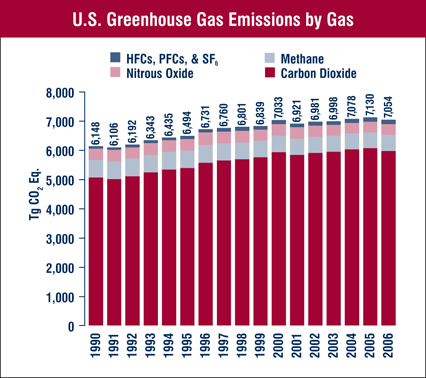
Reference: Inventory of U.S. Greenhouse Gas Emissions and Sinks: 1990-2006, USEPA #430-R-08-005
The UNFCCC also established two subsidiary bodies:
- The Subsidiary Body for Scientific and Technological Advice (SBSTA), which gives the COP timely advice on scientific, technological and methodological matters relating to climate change and its effects; established by UNFCCC art. 9.
- The Subsidiary Body for Implementation (SBI), which gives advice to the COP on implementation of the Convention; established by UNFCCC art. 10.
Both subsidiary bodies meet twice a year.
As the Convention did not contain binding emissions limits, the member countries almost immediately decided that the Convention’s commitments were not enough. In March/April of 1995, the Convention’s first Conference of the Parties in Berlin [8] adopted the “Berlin Mandate,” [9] which called for adoption of a protocol to the UNFCCC that would contain more stringent ways for Annex I Parties to limit greenhouse gas emissions. [10] The Parties also set up a new subsidiary body, the Ad Hoc Group on the Berlin Mandate (AGBM) at COP-1 to negotiate a protocol to the Convention; its first meeting was in the summer of 1995. A fourth subsidiary body, the Ad Hoc Group on Article 13 (AG13), was also established to explore options for conflict resolution. [11]
In July, 1996, at COP-2 in Geneva, the parties instructed the representatives “to accelerate negotiations on the text of a legally-binding protocol or another legal instrument to be completed in due time for adoption at the third session of the Conference of the Parties… [that] should fully encompass the remit of the Berlin Mandate,” especially the commitments for Annex I Parties. In the “Geneva Ministerial Declaration,” published in an Annex to the Report of the Conference of the Parties on page 71, members endorsed the Second Assessment Report of the Intergovernmental Panel on Climate Change as “currently the most comprehensive and authoritative assessment of the science of climate change, its impacts and response options now available.” Further, the members encouraged accelerated negotiations on the text of a protocol to be adopted at COP-3, in accordance with the Berlin Mandate.
3. Kyoto Protocol: adopted at COP-3
3.1. Overview
After negotiations described as “tough, grueling and long” (144 Cong. Rec. S196 (Jan. 29, 1998)), the Kyoto Protocol was adopted in Dec., 1997, at COP-3. [12] It was open for signature from the middle of March, 1998, to the middle of March, 1999. So far 193 parties (of the FCCC’s 194) have ratified, acceded to, approved of, or accepted it; see Status of Ratification. However, only Annex I Parties to the UNFCCC, 22 countries and the EU-15, are required to reduce their GHG emissions under it; their individual targets are found in the Protocol’s Annex B.
The COP to the Convention also serves as the Meeting of the Parties (MOP) to the Kyoto Protocol. (Kyoto Protocol art. 3, reprinted in 37 I.L.M. at 38.) Both bodies issue decisions and resolutions.
The Protocol set mandatory targets for GHG emissions for Annex I Parties, and specifically excluded developing country parties from any obligations. Annex A lists the greenhouse gases it covers: carbon dioxide, methane, nitrous oxide, hydro fluorocarbons, perfluorocarbons, and sulfur hexafluoride, as well as the sectors/source categories that emit them. According to article 3.1, Annex I Parties would ensure that their overall emissions of those gases would be reduced “by at least 5 per cent below 1990 levels in the commitment period 2008 to 2012.” [13] However, article 3.8 allows any Annex I Party to use 1995 as a base year for the last 3 gases. [14] Also, a “degree of flexibility” was built into articles 3.5 & 3.6 for Annex I Parties in transition to a market economy regarding the base year they use, if 1990 is considered too strict.
Although under the protocol, Annex I countries were required to reduce their greenhouse gas emissions from 1990 levels by an average of 5.4% during the first compliance period, 2008–2012, by the end of 2008, Annex I nations had reduced their overall emissions by only 1.2%, with most of the reductions coming from former Soviet bloc countries whose economies had collapsed after the 1990 benchmark year. [15]
The Secretariat: Both the UNFCCC and the Kyoto Protocol are served by the Climate Change Secretariat. The mandate of the Secretariat is laid out in Article 8 of the Convention. Its main functions are:
- To make arrangements for sessions of the various Convention and Protocol bodies;
- To monitor implementation of commitments made by the Parties under these agreements;
- To assist the implementation of those commitments;
- To maintain registries of Parties’ emissions that are traded under emissions trading schemes; and
- To coordinate with the secretariats of other relevant international bodies and conventions.
The Secretariat has been located in Bonn, Germany, since August of 1996.
Entering into force: Article 25 of the Protocol provides two conditions that must be satisfied before the Protocol could enter into force: First, at least 55 Parties to the Convention must ratify, accept, approve, or accede to the Protocol; there must be enough Annex I Parties to account for at least 55% of carbon dioxide emissions in 1990. The Protocol would enter into force 90 days after both conditions were satisfied. As the U.S. was responsible for 36% of 1990’s GHG emissions, its ratification was considered essential to the Protocol’s implementation, and there was dismay in the international community when the U.S. failed to do so. [16] However, Russia, responsible for 17% of 1990 GHG emissions, ratified on Nov. 18, 2004, [17] and the Protocol came into effect on Feb. 16, 2005; the total percentage of Annex I Parties GHG emissions is 63.7%. The original, authentic Protocol was deposited with the Secretary-General of the United Nations. [18]
Compliance with the Protocol: The Compliance Committee began operation in March 2006; it has two branches, enforcement and facilitative. If the enforcement branch determines that a Party is not in compliance with its obligations under the Protocol, it will “require the Party to make up the difference between its emissions and its assigned amount during the second commitment period, plus an additional deduction of 30%. In addition, it shall require the Party to submit a compliance action plan and suspend the eligibility of the Party to make transfers under emissions trading until the Party is reinstated.” The facilitative branch assists Parties in meeting their obligations under the Protocol.
COP-4 (held in Buenos Aires, Argentina), in 1998; COP-5 (held in Bonn, Germany), in 1999; COP-6 (held in The Hague, The Netherlands), in 2000; and COP-6b, the resumed session (held in Bonn, Germany), [19] in July, 2001, all continued work on the details of the Protocol. Negotiations at the second Bonn conference resulted in a compromise that permitted the Protocol to go forward. The U.S. did not take part in the negotiations. [20]
3.2. The Marrakesh Accords
The “Marrakesh Accords,” adopted in October/November, 2001, at COP-7, [21] in Marrakesh, Morocco, addressed the actual operation of the Protocol, including its three “flexibility,” or free-market mechanisms, [22] which were proposed by the U.S. delegation:
- the clean development mechanism
- joint implementation
- emissions trading.
Flexibility mechanisms enable countries that cannot meet their emissions reductions to purchase or acquire the right to emit from other countries. It was necessary to establish these mechanisms before the Kyoto Protocol could enter into force. Decisions of the COP/MOP on the Mechanisms are available online.
The Marrakesh Accords also established several expert groups:
- The Consultative Group of Experts (CGE) assists developing countries prepare reports on climate change.
- The Least Developed Country Expert Group (LEG) gives advice to undeveloped countries.
- The Expert Group on Technology Transfer (EGTT) works to share technology with less developed countries.
3.2.1. Kyoto’s “Flexibility” Mechanisms
The Clean Development Mechanism (CDM) under the Protocol’s article 12 allows developed nations to pay for projects that cut emissions in developing nations, for which efforts they receive credits that they can apply to meeting their own emissions targets.
A project to clean up a Chinese factory that emits the GHG HFC-23, trifluoromethane, illustrates problems with the program. HFC-23 is a Freon-type refrigerant that will soon be banned in industrial nations because it depletes the ozone layer. Cleaning up that factory under the CDM enables chemical companies to expand existing factories that produce HFC-23 for use in cheap, inefficient appliances to be sold in India and China, which have no responsibilities under the Kyoto Protocol; the factory will still function, although in violation of the Montreal Protocol to the Vienna Convention for the Protection of the Ozone Layer, which requires it and other factories like it to be phased out. (Keith Bradsher, Outsize Profits, and Questions, in Effort to Cut Warming Gases, N.Y. Times, Dec. 21, 2006.)
The Joint Implementation Mechanism (JI) under the Protocol’s article 6 is similar to the CDM; it allows developed countries to receive “emissions reduction units” for financing projects to mitigate climate change in other developed countries that are “economies in transition,” that is, formerly Communist countries.
Emissions trading under the Protocol’s article 17 allows Annex I Parties to purchase the right to emit from other countries that have not used up their emission limits.
The European Emissions Trading Scheme, the largest of its kind in the world, discussed infra § 5.2., and carbon trading in general, is not uncontroversial. Analysts estimate that the UK’s most polluting industries earned millions of pounds in windfall profits in 2005 from over-allocation of emissions permits. Groups such as the Durban Group for Climate Justice, a group of international organizations that met in South Africa in 2004, reject the free market approach to climate change. The Durban Declaration of Climate Change rejects carbon trading and its attempt to “commodify” natural resources. [23]
In May 2007, the World Bank issued a report entitled State and Trends of the Carbon Market 2007, by Karen Capoor and Philippe Ambrosi. The report showed that the global market for CO2 emissions credits doubled in 2006 to $30.1 billion: $24.4 billion was generated by the EU’s Emissions Trading Scheme (see infra), $5.3 billion through the CDM, and $141 million through JI. [24]
3.2.2. Land-Use, Land-Use Change and Forestry
COP-7 in Marrakesh also adopted Decision 11/CP.7, regarding the principles to govern Land-Use, Land-Use Change and Forestry (LULUCF). Decision 11/CP.7, among other things, recommended that draft decision -/CMP.1 on Land use, Land-use change and Forestry be adopted by the first session of the COP serving as the Meeting of the Parties of the Kyoto Protocol. (This was COP-11 in 2005, see infra; it did adopt the LULUCF decision.) The Decision also made various requests to the SBSTA in its section 2, and several “invitations” to the IPCC in its section 3. This work was based on a 2000 Special Report on Land Use, Land-Use Change & Forestry by the Intergovernmental Panel on Climate Change, [25] which in turn was based on the Protocol itself. Article 3.3 of the Protocol says that “net changes in greenhouse gas emissions from sources and removals by sinks resulting from direct human-induced land use change and forestry activities, limited to afforestation, reforestation, and deforestation [26] since 1990…shall be used to meet the commitments in this Article of each Party included in Annex I.” Article 3.4 of the Protocol states that at the first COP/MOP session (in 2005) Parties should “decide upon modalities, rules and guidelines as to how and which additional human-induced activities related to changes in greenhouse gas emissions and removals in the agricultural soil and land use change and forestry categories, shall be added to, or subtracted from, the assigned amount for Parties included in Annex I, …” LULUCF activities provide a relatively low cost way for Parties to offset their GHG emissions. [27]
The World Summit on Sustainable Development was held in Johannesburg in 2002; the U.S. Secretary of State Colin Powell, one of the U.S. representatives, was roundly criticized by environmental groups that disagreed with the U.S.’s failure to ratify the Kyoto Protocol. [28]
COP-8 was held in New Delhi, India, in 2002; COP-9 was held in Milan, Italy, in 2003; and COP-10 was held in Buenos Aires, Argentina, in 2004. COP-11 was held in Montreal, Canada, from Nov. 28 to Dec. 9, 2005; it also marked the entry into force of the Kyoto Protocol and was the first COP that served as the Meeting of the Parties to the Protocol.
Among other things, COP-11 established the Ad Hoc Working Group on Further Commitments for Annex I Parties under the Kyoto Protocol (AWG). [29] The AWG’s first session was held in Bonn from May 17 to May 25, 2006; its second session was held in Nov. 6-14, 2006, in Nairobi.
3.3. COP-12
In preparation for COP-12, the UN issued its annual report on Oct. 30, 2006, which was compiled from data that all 41 Annex I Parties to the UNFCCC submitted to the secretariat. The report, entitled Greenhouse Gas Emissions Data for 1990-2004 for Annex I Parties, showed that since 2000, emissions had increased slightly, in both EIT and non-EIT Parties; also, the number of Parties with emissions decreases had declined to seven nations (the UK, Monaco, Lithuania, Ireland, Iceland, Germany, and Czech Republic) from 23 of the 41 since 2000. [30] One of the report’s conclusions was that “industrialized countries will need to intensify their efforts to reduce greenhouse gas emissions.” [31]
COP-12 was held from Nov. 6-17, 2006, in Nairobi, Kenya, in conjunction with the second meeting of the Parties to the Kyoto Protocol (COP-12/MOP-2). A press release issued the first day of the Conference was entitled: Nairobi United Nations Climate Change Conference opens with warning that climate change may be most serious threat ever to face humankind. One of the major goals of the Conference was to work on a global agreement for the time period after the Kyoto Protocol runs out in 2012. Another was to help poorer African countries adapt to climate change. [32] The UN released its Report on the African Regional Workshop on Adaptation just before the meeting opened; the report anticipates that the effects of climate change on Africa will be particularly severe. [33]
COP-12/MOP-2 participants pledged to review the effectiveness of the Kyoto Protocol in 2008 as required under its Article 9 to determine whether it adequately deals with increases in GHG emissions. Negotiators “assur[ed] developing nations that the effort will not include consideration of new mandatory requirements on their greenhouse gas emissions.” It was also agreed to conduct another review, required by the protocol’s Article 3.9, to determine whether more severe emissions cuts will be required after the first compliance period ends in 2012. [34]
Meetings of the subsidiary bodies and the Ad Hoc Working Group on Further Commitments for Annex I Parties under the Kyoto Protocol were held in Bonn from May 7-18, 2007, in preparation for COP-13/ MOP-3 to be held in Bali in December 2007. Delegates continued to discuss extending the Kyoto Protocol, which expires in 2012. [35] A high-level meeting of heads of state was proposed on May 8 by U.N. Secretary General Ban Ki-moon to discuss the post-Kyoto era; it would be held in New York in September, in preparation for the Bali meeting. [36]
The fourth session of the Ad Hoc Working Group on Further Commitments for Annex I Parties under the Kyoto Protocol and the fourth workshop under the dialogue on long-term cooperative action to address climate change by enhancing implementation of the Convention was held in Vienna, Austria, Aug. 27-31, 2007. About 1000 delegates agreed to set GHG emissions cuts between 25 and 40 percent below 1990 levels in the successor pact to the Kyoto Protocol. [37]
3.4. COP-13
COP 13 & the Conference of the Parties serving as the Meeting of the Parties to the Kyoto Protocol (CMP) 3, opened Dec. 3, 2007, in Nusa Dua, Bali, Indonesia. Observers hoped for a political breakthrough in international climate change negotiations and a timetable for a successor agreement to the Kyoto Protocol, which expires in 2012. [38] The conference continued until December 14th. Before it opened, leaders from 150 global companies endorsed a legally binding framework to address climate change in The Bali Communiqué, in the belief “that tackling climate change is the pro-growth strategy. Ignoring it will ultimately undermine economic growth.” [39] Signatories included Shell, Coca-Cola, Dupont, British Airways, Rolls Royce, and many more. In a letter to Yvo de Boer, the head of the U.N. Climate Change Secretariat, Rep. Edward Markey, Chairman of the House Select Committee on Energy Independence and Global Warming, stated that “…President Bush’s avoidance of action is not the status quo here in America,” and that “…Congress, the states, cities, and Americans from coast to coast [were] looking to act immediately on global warming.” [40] Finally, a rough and vague Road Map was agreed to, “which consists of a number of forward-looking decisions that represent the various tracks that are essential to reaching a secure climate future. The Bali Road Map includes the Bali Action Plan, which charts the course for a new negotiating process designed to tackle climate change, with the aim of completing this by 2009.” The U.S. reluctantly agreed to the proposal. [41] A Papua New Guinea representative said to the U.S. in apparent desperation and in unusually strong language that was applauded by the delegates: “We seek your leadership. But if for some reason you are not willing to lead, leave it to the rest of us. Please, get out of the way.”[42] Work proceeds to draft a successor agreement by 2009. [43]
A hearing was held before the Senate Foreign Relations Committee entitled: International Climate Change Negotiation: Bali and the Path Toward a Post-2012 Climate Treaty on Jan. 24, 2008. James Connaughton, chairman of the White House CEQ and a top environmental adviser to the Bush administration, said that he continued to oppose mandatory limits on U.S. GHG emissions, and reiterated the administration’s well-known position that it would not commit to international goals unless major developing countries did also. [44]
Three months after the Bali conference, talks opened in Bangkok, Thailand, from March 31st to April 4th, 2008, in an attempt to advance the Bali Road Map. Sessions of the Ad hoc Working Group on Long-term Cooperative Action under the Convention (first session) and the Ad hoc Working Group on further Commitments for Annex I Parties under the Kyoto Protocol (first part of the fifth session) also took place. [45] Yvo de Boer, executive secretary of the UNFCCC, noted that only about a year and a half was left to forge a complex and controversial agreement. [46]
Another meeting of 17 nations that account for 80% of global GHG emissions was held in Paris later in April, 2008, led by the U.S. Many delegates (as well as environmentalists, scientists and lawmakers) criticized President Bush’s speech on April 16th, where he called for US emissions to slow down over the next decade, stop by 2025, and begin to reverse after that; he reiterated his endorsement of coal and nuclear power and his antipathy to raising taxes. Other nations took consolation from the fact that Bush would soon be leaving office. [47] Two more meetings were held to prepare for the July 7-9th Group of Eight summit. [48]
3.5. COP-14
COP-14 and the Conference of the Parties Serving as the Meeting of the Parties to the Kyoto Protocol (CMP-4) took place in Poznań, Poland, on Dec. 1-12, 2008. It concluded with a “clear commitment from governments to shift into full negotiating mode next year in order to shape an ambitious and effective international response to climate change, to be agreed in Copenhagen at the end of 2009. Parties agreed that the first draft of a concrete negotiating text would be available at a UNFCCC gathering in Bonn in June of 2009.” (It was not.) President-elect Barack Obama did not attend, as he did not assume office until Jan. 20, 2009.
3.6. COP-15
3.6.1. Pre-COP-15
A prelude to COP-15, the World Business Summit on Climate Change was one of a series of meetings during 2009 designed to press governments to take the radical measures that will be needed in Copenhagen; it was held there from May 24th-26th. “The Copenhagen Call,” a powerful if concise statement (4 pages), sets out the six elements business believes are required to forge an effective new global climate treaty, was issued at its conclusion.
In July, 2009, Hans Joachim Schellnhuber, chair of an advisory council known by its German acronym, WBGU, spoke at a conference at New Mexico’s Santa Fe Institute and released a study entitled: Solving the climate dilemma: The budget approach, which, as reported by Mark Hertsgaard of Grist, “has monumental implications for the pivotal meeting in December in Copenhagen, where world leaders will try to agree on reversing global warming.” The WBGU study (unlike the IPCC, which says rich industrial countries must cut emissions 25 to 40 percent compared with 1990 by 2020) says: “the United States must cut emissions 100 percent by 2020—in other words, quit carbon entirely within 10 years. Germany and other industrial nations must do the same by 2025 to 2030. China only has until 2035, and the world as a whole must be carbon free by 2050. The study adds that big polluters can delay their day of reckoning by “buying” emissions rights from developing countries, a step the study estimates would extend some countries’ deadlines by a decade or so. Needless to say, this timetable is light-years more demanding than what the world’s major governments are talking about in the run-up to Copenhagen.”
Intersessional Informal Consultations were held in Bonn from August 10-14, as a prologue to the ad-hoc working group meetings to be held in Bangkok later this fall. They resulted in little progress and a warning from the director general of the UNFCCC, Yvo de Boer, that if the speed of progress does not increase, an agreement on a successor to the Kyoto Protocol in Copenhagen in December will not be possible. [49]
Climate meetings sponsored by the U.N., the Ninth Ad-hoc Working Group on the Kyoto Protocol (AWG-KP) and the Seventh Ad-hoc Working Group on Long-term Cooperative Action (AWG-LCA) under the UNFCCC, were held in Bangkok from Sept. 28th to Oct. 9th, 2009. The U.S. envoy, Jonathan Pershing, warned that it would be difficult for the U.S. to make international commitments in Copenhagen prior to the enactment of domestic climate legislation. (See infra.) There was conflict between rich and poor nations over proposals to require developing nations to control emissions after 2012. Delegates from Mexico said that the U.S. delegation had become an “obstacle” to a final agreement, and the EU was also criticized. [50]
On Sept. 22, 2009, “nearly 100 world leaders accepted UN Secretary-General Ban Ki-moon’s invitation to participate in an historic Summit on Climate Change in New York … to mobilize political will and strengthen momentum for a fair, effective, and ambitious climate deal in Copenhagen this December.”
However, on Oct. 20, 2009, less than two months before COP-15 in Copenhagen, the N.Y. Times reported that hopes are not high that the major differences among the major GHG emitters will be resolved before the meeting or that it will produce a comprehensive new treaty. [51] The following day, Oct. 21, 2009, India and China signed a 5-year agreement to cooperate on climate issues and to “ensure a fair and equitable outcome at Copenhagen.” See infra, under India.
On the Copenhagen climate negotiations, see Lavanya Rajamani, Addressing the ‘Post-Kyoto’ Stress Disorder: Reflections on the Emerging Legal Architecture of the Climate Regime, 58 International and Comparative Law Quarterly 803 (Oct. 2009), which argues “that one of the most significant factors hindering substantive progress on a post-2012 climate agreement is what is characterized here as the ‘post-Kyoto stress disorder’, a lack of trust amongst some developing countries that industrialized countries will, given current and past form, honour their commitments, and/or take the lead in the new climate agreement.”
A final round of U.N.-sponsored climate change talks prior to Copenhagen was scheduled in Barcelona, Nov. 2-6, 2009. The chairman of the Ad-hoc Working Group on Long-term Cooperative Action did not believe that Copenhagen’s COP-15 meeting (Dec. 7-18) will produce a successor protocol to Kyoto even if Barcelona has a positive outcome, because of a lack of willingness to compromise on emissions reduction targets and the financial issues. [52] On Nov. 4, 2009, it was announced that key government and U.N. officials admitted that arriving at a successor protocol is probably unlikely but might happen next year if a legally binding framework, rather than a treaty, is agreed to in Copenhagen. [53]
On the 6th of November, the Barcelona talks ended with the U.S. and Europe repeating demands that the existing Kyoto treaty be scrapped in favor of a single new international treaty; poorer nations disagreed. “The 130 developing countries represented by the G77 group said today they would walk out of Copenhagen if rich countries did not offer far deeper emission cuts and more money.” [54] The Africa Group boycotted the discussions on Nov. 4th. [55] Ambassador Lumumba Di-Aping of Sudan, chair of the Group of 77, the largest intergovernmental organization of developing states in the United Nations (with 130 members, despite its name), repeatedly criticized industrialized nations for condemning poorer nations to environmental disaster. [56] The U.S. Chamber of Commerce issued a report on Nov. 12th entitled The Prospects for Copenhagen: More Realism Can Smooth the Way, that pointed out the obstacles to a successful outcome to COP-15. [57]
The Council on Foreign Relations held a symposium on Nov. 10, 2009, in Washington, entitled: Countdown to Copenhagen: What’s Next for Climate Change?, but the panelists were not optimistic about Copenhagen’s outcome. The first secretary at the Chinese embassy in Washington stated that industrialized nations were responsible for getting the world in the condition it is in and should bear the majority of the costs that developing nations will have to spend to remedy it. None of the participants expected specific emissions limits to be set in Copenhagen. [58]
However, the news that the Kerry-Boxer bill had been reported out of the Senate Environment and Public Works Committee the day before, Nov. 5, 2009 (see infra, § 4.4.1.2.), was moderately encouraging and representatives “from the United Nations, European Union, G-77, and even the laggard United States all confirmed that a fair, ambitious, and legally binding global agreement is still absolutely possible to achieve next month.” [59] EU environment ministers will meet again Nov. 23rd in Brussels to work on still-unresolved issues before Copenhagen. [60]
The Center for Public Integrity launched the International Consortium of Investigative Journalists in 1997 and began a project in July 2009 entitled The Global Climate Change Lobby to uncover the special interests attempting to influence negotiations leading to the pivotal December talks on a climate change treaty in Copenhagen and involved reporters in eight of the major economies deemed essential to a successful treaty: Australia, Brazil, Canada, China, the European Union, India, Japan, and the United States, and which account for 65% of global GHG emissions. In Nov. 2009 they report that global attempts to craft a pivotal new climate treaty in Copenhagen this December are being stymied by a far-reaching, multinational backlash led by fossil fuel industries and other heavy carbon emitters, according to an eight-country report by the International Consortium of Investigative Journalists. [61] The web site has an interactive map with emissions data from 2005 [in 2009] with GHG emissions per capita, cumulative emissions from the mid-19th century, current emissions, and emissions’ intensity, that is, per unit of GDP.
On Monday, Nov. 16, 2009, environment ministers from 44 countries (including Brazil, China, India, and the U.S.) met in Copenhagen for a 2-day meeting to discuss the upcoming COP-15 and the difficult issues that have had the 192 UNFCCC members deadlocked for two years. Danish Climate Minister Connie Hedegaard will present a concise (5-8 page) draft proposal for a binding political agreement. [62]
On Nov. 20, 2009, Rajendra Pachauri, chairman of the IPCC, said the gap between developed and developing nations appeared to be widening as Copenhagen approaches, partly because of U.S. reluctance to bring a specific emissions reduction target to the negotiations, which would have carried a great deal of credibility. Other UN officials, including Secretary-General Ban Ki-moon and Yvo de Boer, were less pessimistic. [63]

COP-15 will be held at the Bella Center outside of Copenhagen. A climate-friendly car is parked outside.
At the Asia-Pacific Economic Cooperation summit meeting in Singapore in mid-Nov. 2009, President Obama and other world leaders acknowledged that it was unrealistic to expect a legally binding new climate treaty to emerge at Copenhagen in December as originally intended, given the conflicts between the 192 nations involved. They decided that it made more sense to make the COP-15 goal a less specific “politically binding” agreement and to postpone the difficult issues until 2010. One of the major reasons was the lack of progress on U.S. climate legislation; see supra § 4.4.1. [64] An EU official said that “it had been clear for months that Copenhagen was not going to yield a breakthrough and that there was plenty of blame to go around.” [65] It was announced in Singapore that “the United States has embraced the Danish proposal for finalizing an interim international climate agreement in Copenhagen in December.” (Emphasis supplied.) President Obama traveled to China after that meeting, and at the summit that followed with Hu Jintao the “United States and China announced … a package of cooperative agreements on clean energy and climate change that are remarkable in both breadth and ambition. The cluster of seven initiatives, partnerships, action plans, and research centers covers a range of low-carbon energy strategies from electric cars to energy efficiency technologies.” [66]
President Obama announced in November that he may attend the Copenhagen conference in Dec. 2009 if his being there would be helpful. He believed a satisfactory framework convention could be worked out, despite the fact that the Senate will probably not pass climate legislation before the meeting; see supra § 4.4.1.2., and § 3.6. [67]
On Nov. 25, 2009, the president announced that he will attend COP-15 on his way to Oslo to receive his Nobel Prize. He will deliver a speech in Copenhagen on Dec. 9th at the beginning of the conference, offering a tentative U.S. reduction of GHG emissions “in the range of 17 percent below 2005 levels by 2020,” according to the White House, and 80% by mid-century, the same reduction in the House bill passed in June. [68] But then, on Dec. 4th, 2009, the White House announced that the president will attend COP-15 on Dec. 18th, the final day of the conference and the “high-level segment of the negotiations,” to signal his commitment to pushing the negotiations forward. [69]
For academic commentary, see, e.g., David B. Hunter, International Climate Negotiations: Opportunities and Challenges for the Obama Administration, 19 Duke Envtl. L. & Pol’y F. 247 (Spring, 2009).
3.6.2. COP-15 Outcome
COP-15 nearly collapsed on the last day and might have done so but for the intervention of President Obama; even so, it was not viewed as an unqualified success. The interim agreement, the Copenhagen Accord, FCCC/CP/2009/L.7 (Dec. 18, 2009), vaguely reiterated well-known “commitments”; among other things, funds for mitigation, adaptation and forest conservation were promised; a High Level Panel was established to study potential sources of revenue; the Copenhagen Green Climate Fund was established to support projects, policies and other activities in developing countries related to mitigation; a Technology Mechanism was established to accelerate technology development and transfer. Committed parties are required under the Accord to submit national action plans for emission reductions by the end of January, 2010; the plans must be consistent with the agreement’s stated goal of limiting global temperature increases from carbon pollution from increasing to more than 2 degrees Celsius (3.6 degrees Farenheit) over pre-industrial levels. [70]
Leaders from developing countries, including Brazil, South Africa, India, and China (the so-called “BASIC” nations, a really terrible acronym), with the personal encouragement of President Obama, participated in finalizing this agreement; it is the first time developing nations have agreed to binding emissions reductions in an international agreement. Furthermore, the Accord “includes a compromise between the United States and China to verify pollution reductions according to rigorous and transparent guidelines depending on the source of financing for the reductions. All reductions are subject to ‘international consultation and analysis.’” [71]
Hopefully the Accord will morph into a binding legal agreement by the end of 2010. It was accepted by 188 of the 192 attending countries by the end of the meeting, and only five—Bolivia, Cuba, Nicaragua, Venezuela, and Sudan—refused it. However, “[a]s of Jan. 11, only four countries—Australia, Canada, the Maldives, and Papua New Guinea—had officially stated they support the document and one, Cuba, had declared it does not support it. Countries have until Jan. 31 to state a preference one way or the other, although the UNFCCC Secretariat indicated that this was not a hard deadline.” [72]
According to U.S. Climate Action Network, a total of 73 countries – 40 Annex I and 33 non-Annex I countries – have submitted targets to the Secretariat; of these, 64 were “associated” with the Accord. Thirty-five more, are “associated” with the Accord without having, so far at least, submitted targets. (That means a total of 99 countries are “associated.”) Thirteen more countries (including Brazil, China and India, despite their importance in finalizing the agreement, supra) have expressed support for the Accord but are not “associated” with it, for a tentative total of 112 “associated” or “supportive” countries. [73]
For commentary on COP-15, see James Hansen et al., Target Atmospheric CO2: Where Should Humanity Aim?, 2 Open Atmos. Sci. J. 217 (2008) & James Hansen, Never-give-up fighting spirit: lessons from a grandchild, GRIST, Dec. 1, 2009.
Stockholm Environment Institute & Potsdam Institute for Climate Impact Research, A Copenhagen Prognosis: Towards a Safe Climate Future: A Synthesis of the Science of Climate Change, Environment and Development (2009). (“This report presents a concise diagnosis of the state of the biosphere and observed trends and offers a treatment plan that is consistent with a 2°C warming threshold, equity and economic development.”)
GRIST’s Copenhagen Hub Page has many useful links to understanding the conference.
Joseph E. Aldy & Robert N. Stavins, Post-Kyoto International Climate Policy: Implementing Architectures for Agreement (Cambridge University Press, 2010).
Joseph E. Aldy & Robert N. Stavins, Post-Kyoto International Climate Policy: Summary for Policymakers (Cambridge University Press, 2009).
Opinion: Copenhagen Accord pledges are paltry: Current national emissions targets can’t limit global warming to 2 °C, calculate Joeri Rogelj, Malte Meinshausen and colleagues — they might even lock the world into exceeding 3 °C warming, 464 Nature 1126 (April 22, 2010) (“In the worst case the Copenhagen Accord pledges could permit emission allowances to exceed business-as-usual projections.” The report also suggested that many countries, including the EU and China, pledged lower reductions than they have already been achieving. [74])
3.6.3. Post-COP-15
On Jan. 7, 2010, the Congressional Research Service issued a report entitled Greenhouse Gas Emissions: Perspectives on the Top 20 Emitters and Developed Versus Developing Nations. It suggests a new, more flexible approach, after the inability to come up with a binding successor agreement in Copenhagen, that would focus on major emitters, which the 2005 data from the World Resources Institute says are China (19.1%), and the U.S. (18.3%): “no other country emits more than 6 percent of total emissions, the report said, although the European Union’s 27 collective nations accounted for 13.4 percent of world emissions.” The 1992 UNFCCC placed responsibilities on industrialized nations to reduce emissions, but the developing world now, almost 20 years later, emits more than industrialized nations. [75]
By Jan. 20, 2010, Yvo de Boer had spoken to 15 or 20 countries after the conference about their intentions, and concluded that there was no guarantee that a treaty would be concluded this year. He stated in a webcast press conference that these countries anticipated that they would “forge an agreement this December on how to tackle climate change and then discuss further how to ‘package that outcome’ as a treaty” in 2011. [76]
On Feb. 18, 2010, two months after COP-15, Yvo de Boer, executive secretary of the U.N. Framework Convention on Climate Change, announced he would resign on July 1st; he had held office since September 2006. GRIST said “De Boer had come under fire for the outcome of the Dec. 7-19 UNFCCC negotiations in Copenhagen, which ended in near-chaos as world leaders scrabbled to find a face-saving deal.” [77]
Christiana Figueres, a Costa Rican diplomat, will replace him; she was selected on May 15th and approved on May 17, 2010. She will be the first UNFCCC director from the developing world. (Eric J. Lyman & Leora Falk, International Issues: Costa Rican Diplomat Chosen to Head U.N. Climate Secretariat, Succeeding de Boer, WCCR, May 17, 2010))
On Feb. 23, 2010, Mr. de Boer said that the Copenhagen Accord “could evolve into a broader agreement on goals and content by the end of the Mexico negotiations…[b]ut the development of a full treaty will have to come after that.” [78] He remains hopeful that a binding treaty will be in force before the Kyoto Protocol expires at the end of 2012. See infra § 3.7. COP-16 on other early attempts to lower expectations for the Cancun meeting.
The U.S. is under pressure to pass climate change legislation in 2010 in preparation for a successor agreement to Kyoto. However, the news that several Democratic Senators (Sen. Chris Dodd (D-Conn.) & Sen. Byron Dorgan (D-N.D.)) will not seek re-election in November 2010 makes it uncertain whether Democrats will be able to maintain their necessary 60-vote filibuster-proof majority. [79]
Then, on Jan. 19, 2010, a special election was held in Massachusetts to fill Edward Kennedy’s Senate seat, which he had held from 1962 until his death in 2009. Surprisingly to many, Republican Scott Brown neatly defeated Martha Coakley, thus ending the Democrats’ 60-seat Senate majority and putting climate change legislation (and health care reform) in jeopardy. See infra.
A report released by the U.N. Environment Program on Feb. 23, 2010, entitled Information Note: How Close Are We to the Two Degree Limit?, concluded that current GHG reduction plans are insufficient to keep global temperatures from rising above 2 degrees Celsius (3.6 degrees Fahrenheit), as agreed at COP-15. [80]
See Harvard Project on International Climate Agreements (“Drawing upon leading thinkers in Australia, China, Europe, India, Japan, and the United States, the Project conducts research on policy architecture and key design elements of a post-2012 international climate policy regime.”)
The midyear sessions of the Subsidiary Bodies to the United Nations Framework Convention on Climate Change are being held in Bonn from May 31 to June 9th, and the Ad-hoc Working Groups on the Kyoto Protocol and on Long-term Cooperative Action from June 1 to the 11th. They are the most important negotiations since COP-15, and the last under Yvo de Boer, see supra. (Eric J. Lyman, International Issues: Midyear Climate Change Talks to Continue Work on Draft Proposals for Kyoto Successor, WCCR, May 27, 2010.)
3.7. COP-16
COP-16 will be held in Cancun, Mexico, Nov. 29th to Dec. 10th, 2010. [81] However, in Feb. 2010, with the meeting over nine months away, officials were already trying to lower expectations that it would result in a binding climate treaty, especially after high hopes for Copenhagen were so nearly dashed. Todd Stern, the U.S. special envoy on climate change, said passage of U.S. climate legislation was crucial if the U.S. hoped to exert influence over other countries to reduce their emissions. [82] Then in March, BusinessWeek reported that since the Copenhagen talks, shares in renewable-energy stocks have sunk, and that a binding, global treaty on climate change was not a reasonable expectation for Cancun, especially as the U.S. Congress appears to be bogged down with other issues; the current state of the world economy doesn’t help. (Alex Morales & Jeremy van Loon, Cancun Climate Talks Get Dim Prognosis for Success, BUSINESSWEEK, Mar. 18, 2010.)
At the Eighth Leaders’ Representative Meeting of the Major Economies Forum on Energy and Climate in New York in September, 2010, Todd Stern reiterated those warnings; he thinks it is unlikely that a climate treaty will be concluded in November. The meeting included representatives from Australia, Brazil, Britain, Canada, China, the European Union, France, Germany, India, Indonesia, Italy, Japan, Mexico, Russia, South Africa, South Korea, and the United States, which are responsible for 80% of the world’s carbon emissions. (Agence France-Presse, Don’t expect much from Cancun climate summit, U.S. negotiator says, GRIST, Sept. 21, 2010.)
The U.N. Climate Change Conference began Oct. 4, 2010, in Tianjin, China, and ended Oct. 9th. Attended by 3,100 delegates and observers from 177 countries, it was the last opportunity to make progress on a successor to the Kyoto Protocol before Cancun. To quote from Science:
“With any progress toward a new accord elusive, the two biggest greenhouse gas emitters—China and the United States—fired broadsides at each other. The lead U.S. negotiator in Tianjin, Jonathan Pershing, criticized China and other major developing nations for refusing to implement a stringent program of monitoring, reporting, and verifying their carbon emissions. ‘These elements are at the heart of the deal, and the lack of progress on them gives us concern,’ Pershing told reporters. China, meanwhile, scolded the United States for using the Asian nation as a scapegoat for its own foot-dragging on addressing climate change. The United States ‘has no measures or actions to show for itself,’ said Su Wei, director of the powerful National Development and Reform Commission’s climate change department, who reiterated China’s view that the United States must take ‘historical responsibility’ for rising atmospheric CO2 levels. In the toxic atmosphere, delegates made only modest progress on issues such as a plan to pay nations to preserve forests.” (Richard Stone, Climate Talks Still at Impasse, China Buffs Its Green Reputation, 330(6002) Science 305 (Oct. 15, 2010); see also, Chris Buckley, Climate talks marred by bickering, progress on finance, Reuters, Oct. 9, 2010; Tini Tran, Climate Talks In Tianjin, China Make Little Progress, Huffington Post, Oct. 6, 2010; Eric J. Lyman, Climate Change: U.N. Climate Talks Focus on Target To Limit Global Temperature Rise by 2050, 192 BNA Daily Environment Report A-3 (Oct. 6, 2010))
President Obama will travel to India in early November 2010, to meet with Prime Minister Manmohan Singh. The head of the IPCC, Rajendra K. Pachauri, speculates that if the U.S. and India were to enter into agreements regarding the transfer of clean energy technologies, it might encourage progress later on in Cancun. (Dean Scott, International Issues:
Head of U.N. Climate Science Panel Says U.S., India Could Help Global Talks With Accord on Clean Energy, WCCR, Oct. 26, 2010.)
At an early COP-16 session, Japan announced that it would not sign on for a second commitment period for the Kyoto Protocol after the first expires in 2012 unless China and the U.S. join the agreement; without the latters’ cooperation the protocol can never hope to achieve meaningful carbon reductions. Several countries condemned Japan’s move, others applauded it, including Russia which made a similar declaration. Some developed nations hope to move to a system of voluntary, non-binding, reductions pledges in the future. (Andrew Light, Has Japan killed the Kyoto Protocol? Does it matter?, Climate Progress, Dec. 7, 2010.)
The Cancun Agreements give participating countries another year to decide whether to extend the Kyoto Protocol. They set up a new fund to assist poor countries adapt to climate change, create new mechanisms for sharing clean energy technology, provide compensation for the preservation of tropical forests, make Copenhagen’s emissions reduction pledges stronger, include ways for developing nations to report and verify their emissions reductions, which the U.S. has favored, and make progress on Reducing Emissions from Deforestation and Degradation (aka REDD). (John M. Broder, Climate Talks End With Modest Deal on Emissions, N.Y. Times, Dec. 11, 2010; Dean Scott and Eric J. Lyman, Climate Change: Cancun Talks End With Agreement to Push For Greater Emissions Cuts, Verify Actions, BNA Int’l Environment Reporter, Dec. 11, 2010, including links to the full texts of the Outcome of the work of the Ad Hoc Working Group on Long-term Cooperative Action, and the Outcome of the work of the Ad Hoc Working Group on Further Commitments for Annex I Parties under the Kyoto Protocol; Robert Stavins, What Happened (and Why): An Assessment of the Cancun Agreements, Belfer Center, J.F.K. School of Government, Harvard University, Dec, 13, 2010.)
On Mar. 21, 2011, the U.N. climate secretariat released GHG reductions pledges by industrialized and developing nations; 25% to 40% reductions by 2020, compared to 1990 levels, were established by the Cancun Agreements. The U.S. pledged a 17% cut by 2020 from 2005 levels, but after the midterm elections of 2010, that pledge is unlikely to be fulfilled. (Dean Scott, International Issues: U.N. Climate Secretariat Releases Action Plans From Industrialized, Developing Countries, WCCR, Mar. 21, 2011.)
3.7.1. Post-COP-16
The Ninth Informal Meeting on Further Actions Against Climate Change took place in Tokyo in March, 2011. Japan does not want to extend the Kyoto Protocol, as it said at Cancun, supra, as the Protocol covers only 27 % of global emissions, but favors setting reduction targets for all major emitters, including the U.S. and China. (Toshio Aritake, Climate Change: Informal Climate Change Meeting Shows Divisions Over Post-2012 Framework, Aid, BNA Int’l Environment Reporter, Mar. 7, 2011.)
3.8 COP-17
COP-17 was held in Nov. 2011, in Durban, South Africa. It concluded on December 11th with a tentative agreement to work toward a new treaty that treats all countries equally, once Kyoto expires. China and India remain adamantly opposed, claiming a legally binding treaty that did so would stifle their economic growth. (John M. Broder, U.N. Climate Talks End With Deal for New Emissions Treaty, N.Y. Times, Dec. 11, 2011.) The participants agreed to adopt a “universal legal agreement” on climate change no later than 2015. A new group, the Ad Hoc Working Group on the Durban Platform for Enhanced Action, was created to work on the agreement. Also, a second commitment period under the Kyoto Protocol will begin January 1, 2013. (PRESS RELEASE: Durban conference delivers breakthrough in international community’s response to climate change, Dec. 11, 2011.)
3.9. Finding Relevant Documents
The web page of the United Nations Framework Convention on Climate Change serves both the Convention and the Kyoto Protocol by transmitting official documents and reports and other related information. It provides the latest data and is an invaluable resource for anyone researching in this area. The guide entitled Feeling the Heat included in the Essential Background section provides a useful introduction to global climate change, information on how the international community is responding, and background on the UNFCCC and the Kyoto Protocol.
Reports from COP/MOP sessions back to 1997 can be found under Meetings/Meetings Archive or you can do an Advance Search in Documentation/Documents on the UNFCCC Web page.
3.9.1. IPCC’s Assessment Reports: The Intergovernmental Panel on Climate Change (IPCC) was “established by the WMO and the UNEP to assess scientific, technical and socio-economic information relevant for the understanding of climate change, its potential impacts and options for adaptation and mitigation.” In February 2011, the first 4 assessment reports, and other IPCC publications, were available online in pdf.
IPCC Fourth Assessment Report: Climate Change 2007 (“AR4”): Working Group I’s contribution to the Fourth Assessment Report deals with the “Physical Science Basis” of climate change. The other three sections are from Working Group II, “Impacts, Adaptation and Vulnerability,” Working Group III, “Mitigation of Climate Change,” and the Synthesis Report. [83]
The report, in which 1200 scientists from over 100 countries participated, concluded that “global warming is ‘unequivocal’ and that human activity is the main driver….” The article pointed out that this is the first report “in which the group asserts with near certainty — more than 90 percent confidence — that carbon dioxide and other greenhouse gases from human activities” are responsible for the warming. (Elisabeth Rosenthal & Andrew C. Revkin, Science Panel Says Global Warming Is ‘Unequivocal’, N.Y. Times, Feb. 3, 2007, A1; Richard Black, Humans Blamed for Climate Change: Global climate change is “very likely” to have a human cause, an influential group of scientists has concluded, BBC News, Feb. 2, 2007.)
At the conference in Paris where the report was released, the U.S. government favored developing technology to block sunlight or refract it away from the earth with giant orbiting mirrors, and is on record as having wanted such a proposal included in the summary for policymakers. [84] See Geoengineering, infra § 9, Innovative Technologies to Reduce GHG.
The secretary of the DOE, the chief of NOAA, and the administrator of the EPA said that despite the findings in AR4, the Bush administration continued to reject mandatory measures to reduce U.S. GHG emissions, despite the fact that Congress was forging ahead with proposals to enact them. [85]
Indeed, President Bush’s fiscal 2008 budget, released Feb. 5, 2007, shortly after AR4 came out, cut funding for the U.S. Climate Change Science Program by 7% from fiscal 2007 levels. Climate change research at NOAA, NASA and the EPA would be cut as well. The DOE had a slight increase in climate change research funding. [86]
AR4 states at page 8 that “[p]aleoclimate information supports the interpretation that the warmth of the last half-century is unusual in at least the previous 1300 years. The last time the polar regions were significantly warmer than present for an extended period (about 125,000 years ago), reductions in polar ice volume led to 4 to 6 metres of sea level rise.” Achim Steiner, the executive director of the U.N. Environment Program, stated: “Anyone who would continue to risk inaction on the basis of the evidence presented here will one day in the history books be considered irresponsible.” [87]
However, a report by Stefan Rahmstorf, et. al, Recent Climate Observations Compared to Projections, 316 (5825) SCIENCE 709 (Feb. 1, 2007), suggested that “[t]he data available for the period since 1990 raise concerns that the climate system, in particular sea level, may be responding more quickly to climate change than our current generation of models indicates.”
The second part of AR4, entitled Impacts, Adaptation, and Vulnerability was released on Friday, April 6, 2007. [88] Although some areas in the northern hemispheres will temporarily benefit from global warming, poorer nations that are already at risk from climate changes are likely to suffer the most. [89] The report recommended prompt adjustment in vulnerable regions of the world, which include the Arctic, sub-Saharan Africa, small islands, and Asian river deltas. [90]
The third section of AR4, entitled Mitigation of Climate Change was released on May 4, 2007, in Bangkok. The report showed that GHG emissions have increased 70% between 1970 and 2004. They will continue to grow unless consumption is seriously curtailed. However, the report concludes that emissions stabilization can be achieved at costs, projected at 3% global GDP, that do not disrupt the global economy. [91]
Fifth Assessment Report (AR5) is underway in Feb. 2011 and will be finalized in 2014.
4. The United States
4.1. The Clinton Administration (1993-2001)
As noted supra, the U.S. signed and ratified the UNFCCC in 1992 during the George H.W. Bush administration.
Shortly after taking office, President Bill Clinton announced on Earth Day, April 21, 1993, “the Nation’s commitment to reducing our emissions of greenhouse gases to their 1990 levels by the year 2000.” [92] However, in the 1994 mid-term elections, the Democrats lost control of both houses of Congress for the first time in 40 years, and after that the president was unable to persuade the Republican Congress to cooperate with his good intentions. [93] Our subsequent lack of national consensus on climate change was a disappointment to environmentalists. [94]
In 1995, COP-1 met in Berlin, adopted the Berlin Mandate as discussed supra § 2., and began negotiating a Protocol that would set enforceable reductions in emissions, for Annex I parties only. The U.S. agreed to the Berlin Mandate, despite misgivings about the exclusion of developing country parties (the “non-Annex I” parties). [95]
At COP-2 in Geneva, in July 1996, the U.S. representative, Timothy Wirth, Under Secretary for Global Affairs at the Department of State, reversed the U.S.’s earlier position and announced support for binding national emissions limits. [96] At the December session of the AGBM, parties agreed to submit draft protocol proposals by the middle of January, 1997, as under the UNFCCC’s Article 17, proposals had to be communicated to the Parties at least 6 months before the Conference of the Parties at which they would be discussed.
Clinton and Gore were reelected in the November 1996 election.
In January, 1997, the U.S. State Department produced a draft protocol that contained specific caps on the greenhouse gases countries could emit during specific periods of time, based on 1990 emissions; it was a kind of international emissions trading scheme. Its attempt to encompass developing countries was deleted from the final draft protocol. [97] In March, 1997, the AGBM met to discuss the proposals.
In June, 1997, the U.S. Senate held hearings to discuss the protocol to the UNFCCC, and whether the Senate should pass its Resolution 98, also known as the “Byrd-Hagel Resolution,” which advised the president not to sign the Protocol. [98] The appendix to the report, S. Rpt. 105-54, that accompanied Senate Resolution 98 contained the testimony given at those hearings. The primary reasons the Senate gave for the U.S. not to sign included the protocol’s exemption of all 129 developing country parties from any obligations under the protocol. The Senate considered that omission “inconsistent with the need for global action on climate change and … environmentally flawed.” Also, the Senate “strongly” believed that “serious harm to the United States economy…” could result if the U.S. did join. [99] Resolution 98 was passed by the Senate 95-0 on July 25, 1997. Senator Byrd, one of its co-authors, elaborated on those two reasons in the Congressional Record about six months later, referring to the Protocol several times as a “work in progress” and a “partly painted” canvas. [100]
On Oct. 22, 1997, President Clinton spoke at the National Geographic Society where he outlined three elements of a “comprehensive framework…which…will enable us to build a strong and robust global agreement”: 1) the U.S. would commit to the “binding and realistic target” of lowering emissions to 1990 levels between 2008 and 2012; 2) the U.S. would “embrace flexible mechanisms” for meeting those limits, including a joint implementation system; and 3) the first two elements were conditioned on the participation of industrialized and developing nations in addressing global climate change. The president also outlined six elements of a plan to “provide incentives and lift roadblocks” to increase companies’ and individuals’ involvement. [101]
As noted supra, the Kyoto Protocol was adopted on Dec. 11, 1997, at COP-3, after about 30 months of delicate negotiations. [102] In February of 1998, the Senate Committee on Foreign Relations held a hearing entitled Implications of the Kyoto Protocol on Climate Change. The testimony noted that the Protocol as adopted the previous December “fails—fails—to meet either of the requirements of Senate Resolution 98. It fails to meet the minimum criteria set unanimously by the U.S. Senate,” referring to the Senate’s complaints in Resolution 98 that the Protocol exempted non-Annex I parties and would cause serious damage to the U.S. economy. [103]
In fact, U.S. Vice-President Gore did sign the Protocol on Nov. 12, 1998, and agreed to make greenhouse gas emission cuts of 7% below 1990 levels. [104] The signature was largely symbolic, as it was extremely unlikely, after the Byrd-Hagel Resolution passed so decisively, that the Senate would ratify it. [105]
4.1.1. The Former Clinton Administration: Subsequent Developments
At the last moment, in December 2005, former U.S. president Bill Clinton was added to the schedule as a speaker at COP-11 in Montreal, much to the consternation of the Bush administration, which told organizers of the conference that allowing Clinton to speak would “scuttle” any hopes of the U.S. signing onto the Kyoto Protocol. [106] Mr. Clinton spoke anyway, at the request of conference officials, and called the Bush administration’s opposition to the Protocol on the basis that it would harm the U.S. economy “flat wrong.” [107]
In 2005, former President Clinton launched the Clinton Global Initiative (CGI), which “reflects his belief that governments need collaboration from the private sector, non-governmental organizations, and other global leaders to effectively confront the world’s most pressing problems.”
At CGI’s 2010 Annual Meeting in New York, Sept. 20th-23rd, Secretary of State Hillary Clinton announced the formation of a public-private partnership, The Global Alliance for Clean Cookstoves, which includes pledges of $50.82 million in donations from the U.S. Department of State, the U.S. Agency for International Development, the Department of Energy, the Department of Health and Human Services, the Centers for Disease Control, and the Environmental Protection Agency, with cooperation from international nonprofits, foundations, U.N. agencies, governments, local NGOs, women’s groups, and corporate leaders. The group’s purpose is to create market-based solutions that will simultaneously reduce health problems, provide security for women, and lessen the impact of traditional stoves on the environment. The initial goal is to provide stoves to 100 million homes, as “traditional cookstoves in developing nations rely on biomass, including wood, dung, and coal. They produce unfiltered toxic smoke that harms the nearly 3 billion people who have no alternatives for cooking fuel. … Biomass cooking also accounts for 20 percent of the world’s emissions of black carbon, which some scientists believe is the second largest contributor to climate change after carbon dioxide.” But its “broader aim is to establish a sustainable market for clean cookstoves and cleaner fuel that would provide new economic opportunities for sustainable communities.”
On Aug. 2, 2006, former President Clinton launched the Clinton Climate Initiative, as part of the William J. Clinton Foundation, in order to “make a difference in the fight against climate change in practical and measurable ways.” The Initiative joined with the Large Cities Climate Leadership Group (a group of 23 cities world wide, formed in 2005 to reduce urban carbon emissions) to help large cities combat global warming; the group is now called C40 Cities. [108]
Since his defeat in the 2000 presidential election, former Vice-President Al Gore has made a name for himself as an environmentalist. His 2006 film, “An Inconvenient Truth,” devoted to the risks of global warming, debuted at the Sundance festival and was a critical success, even earning Academy Awards for best documentary feature and best original song, I Need to Wake Up, by Melissa Etheridge, in January 2007. [109]
Al Gore was also nominated for the Nobel Peace Prize in February 2007, [110] and on Oct. 12, 2007, it was announced that he and the IPCC would share the prize, for their efforts to raise awareness of man-made global warming. However, a White House spokesperson said that the award would not impact administration policy regarding climate change. [111]
4.2. The Bush Administration & Climate Change (2001-2006)
The Bush administration was known to have many connections with the oil industry, and Mr. Bush was not expected to favor environmental efforts. Indeed, President Bush made it clear on June 11, 2001, in his Remarks on Global Climate Change, I Public Papers of the President 634 (June 11, 2001), that he would not support the Kyoto Protocol, as it was “fatally flawed in fundamental ways,” that it unfairly exempted most of the world, and that it was not in the economic interests of the United States. [112] Former Vice-President Gore’s signature had little effect without ratification, but the signature did mean that the U.S. must not work against the Protocol, or prevent other nations from ratifying.
The president directed a Cabinet-level review of climate change science in March of 2001; the preliminary findings were released on June 11, 2001, in a report entitled Climate Change Review (2001), which in 2011 is no longer available on the web and is not owned by any U.S. library. The report included an overview of U.S. actions to address climate change, an extremely critical analysis of the Kyoto Protocol, a discussion on advancing the science and technology of climate change and “building partnerships within the Western Hemisphere and with other like-minded countries.”
In the course of writing the report, President Bush’s working group requested that the National Academy of Sciences write a review of the state of climate change science, in hopes that it would counterbalance the conclusions of the IPCC’s research. It was released in June of 2001, in time for the president to refer to it in his June 11, 2001 speech. However, the report largely agreed with the IPCC’s conclusions. (Naomi Oreskes, Beyond the Ivory Tower: The Scientific Consensus on Climate Change, 306 (5702) Science 1686, Dec. 3, 2004.) The NAS report was written by the Committee on the Science of Climate Change of the National Research Council, and was entitled: Climate Change Science: An Analysis of Some Key Questions (Washington, D.C.: NAP, 2001).
The National Climate Change Technology Initiative (NCCTI) was also launched on June 11, 2001. The Climate Change Technology Program (CCTP), a multi-agency effort to develop climate change technology, was established in the Department of Energy to implement the NCCTI. CCTP was reviewed at workshops in 2005, and in May 2006 a report was issued, entitled Results of a Technical Review of the U.S. Climate Change Technology Program’s R&D Portfolio. The report concluded that the program is “doing very little in terms of novel, pushing-the-envelope technology development,” such as carbon sequestration, zero emission agricultural practices, more efficient power transmission and conducting, and “bio-inspired” fuels. [113]
The president’s Clear Skies Initiative, a proposed revision of the Clean Air Act announced on February 2002, submitted to Congress in July 2002, and to each of the Congresses that followed, [114] sought to reduce GHG “intensity” by 18% by 2012 and was advertised as “a better alternative to the Kyoto Protocol.” According to some, however, it actually “would weaken existing emission reduction targets for sulfur dioxide, mercury, and nitrogen oxides under the Clean Air Act by allowing three times more toxic mercury emissions, 50 percent more sulfur emissions, and hundreds of thousands more tons of nitrogen oxides.” [115] It has not been enacted.
The Senate Environment Committee
Sen. James Inhofe (R/OK), chairman (in December 2006) of the Senate Committee on Environment and Public Works, is on record as believing that global warming is “the greatest hoax ever perpetrated on the American people” [116] and an overly media-hyped issue. (He also wanted to abolish the EPA, established by President Richard Nixon.)
Monday, Sept. 25, 2006, Senator Inhofe gave a speech debunking media coverage of global warming, entitled “Hot & Cold Media Spin Cycle: A Challenge To Journalists Who Cover Global Warming.” On Sept. 28, 2006, he gave a follow-up speech called “America Reacts to Speech Debunking Media Global Warming Alarmism” in which he discussed CNN’s criticism of his earlier speech.
On Dec. 6, 2006, the Environment Committee held a hearing on Climate Change and the Media. In his opening remarks, Senator Inhofe said that the media are “advocates for hyping scientifically unfounded climate alarmism.” [117]
Several pieces of climate-change legislation were introduced in the 109th Congress, which ended in December 2006. Several died in Senator Inhofe’s committee, including the following:
- S. 342, the Climate Stewardship Act of 2005: A subsequent incarnation of S. 139, the Climate Stewardship Act of 2003 (introduced by McCain and cosponsored by Lieberman, it was the first major climate bill in the Senate), S. 342 provided for a program of scientific research on abrupt climate change, to accelerate the reduction of greenhouse gas emissions in the United States by establishing a market-driven system of greenhouse gas tradable allowances, to limit greenhouse gas emissions in the United States and reduce dependence upon foreign oil, and ensure benefits to consumers from the trading in such allowances.
- S. 1151, the Climate Stewardship and Innovation Act of 2005, also known as the ‘McCain-Lieberman’ bill: S. 1151 provided for a program to accelerate the reduction of greenhouse gas emissions in the United States by establishing a market-driven system of greenhouse gas tradable allowances, to limit greenhouse gas emissions in the United States and reduce dependence upon foreign oil, to support the deployment of new climate change-related technologies, and ensure benefits to consumers.
However, Senator McCain (R – Ariz.) said on Nov. 16, 2006, that he and Senator Lieberman (ID – Conn.) would reintroduce a bill in the 110th Congress that would mandate cutting GHG and ensure a vote in the Senate “despite pledges made by Sen. James Inhofe (R – Okla.) to block a vote on any legislation that mandates carbon caps.” [118] That was the Climate Stewardship and Innovation Act of 2007; it would cap global-warming emissions from utilities, industry, and transport at 2004 levels by 2012 and then gradually decrease emissions to about 30 percent of 2004 levels by 2050. [119]
- S. 3698, the Global Warming Pollution Reduction Act: A bill to amend the Clean Air Act to reduce emissions of carbon dioxide, and for other purposes.
On Feb. 14, 2002, President Bush launched his Clear Skies and Global Climate Change Initiatives; its goal was to reduce U.S. GHG “intensity” by 18% over the next 10 years. [120] Two voluntary programs were begun to implement it as an alternative to the mandatory efforts of the Kyoto Protocol that the administration believes would harm the economy. [121] One program, the Climate Leaders Program, is run by the U.S. Environmental Protection Agency; the other, Climate VISION (Voluntary Innovative Sector Initiatives: Opportunities Now), is run by the Department of Energy.
However, a report published by the General Accounting Office in April of 2006, entitled Climate Change: EPA and DOE Should Do More to Encourage Progress Under Two Voluntary Programs, concluded that many of the U.S. companies participating in the programs have failed to set goals for cutting emissions. Neither agency has a means to punish firms that have not set goals. [122]
Climate Change Science Program
Also in 2002, President G.W. Bush launched the U.S. Climate Change Science Program (USCCSP) to coordinate climate change research at 13 departments and agencies, including EPA, NOAA, and the DOE; it incorporates the U.S. Global Change Research Program (USGCRP), established under the Global Change Research Act of 1990, Pub. L. No. 101-606, 104 Stat. 3096, during the presidency of George H.W. Bush, and the Climate Change Research Initiative, established by President George W. Bush in 2001.
An over-200-page report was issued in July 2003 by the Climate Change Science Program and the Subcommittee on Global Change Research, entitled The Strategic Plan for the U.S. Climate Change Science Program.
Under the Global Change Research Act of 1990 (§ 107 of the original act), the USCCSP is required to submit an annual report to Congress. These reports, entitled Our Changing Planet, have been posted on the U.S. Global Change Research Information Office Web page since 2004. The report for fiscal 2010 and the latest, as of November 2009, were posted on Oct. 28, 2009.
The Climate Change Science Program also produces the National Assessment required by the Global Change Research Act of 1990; its § 106 states that at least every 4 years the U.S. Global Change Research Program (known as the U.S. Climate Change Science Program since 2002) shall prepare and submit to the President and Congress an assessment to analyze the effects of climate change on the environment, the economy, human health and safety, and project major trends for the future.
The first National Assessment, entitled: Climate Change Impacts on the United States: U.S. National Assessment of the Potential Consequences of Climate Variability and Change, was issued in October, 2000; the update to it was due in November, 2004. See Letter of April 14, 2005, from Senators John McCain and John F. Kerry, entitled Climate Change Assessment: Administration Did Not Meet Reporting Deadline.
On Nov. 14, 2006, the Center for Biological Diversity, Greenpeace, and the Friends of the Earth sued the Bush administration, claiming it had violated the Global Change Research Act by refusing to produce the overdue 2004 National Assessment. The case, Center for Biological Diversity, et al. v. Dr. William Brennan, et al., No. 06-CV-7062 (SBA), was filed in U.S. District Court for the Northern District of California. [123] The case was decided in favor of the plaintiffs in an order filed on Aug. 21, 2007. It was reported that: “District Judge Saundra Armstrong in Oakland, California, said the U.S. government ‘unlawfully withheld action’ required under the Global Change Research Act of 1990 to update a research plan and scientific assessment of climate change. The law mandates the research plan should be revised every three years and the assessment every four years. The last research plan was in 2003 and the last assessment was published in 2000. Greenpeace International and two other environmental groups who say the U.S. government suppresses science on climate change sued in November seeking a court order to produce the reports. ‘As the research plan is now more than a year overdue, the court orders that a summary of the revised proposed research plan be published in the Federal Register no later than March 1 [2008],’ Armstrong said in the order today. The scientific assessment must be produced by May 31 [2008], she said.” [124] Brendan Cummings, one of the attorneys who argued the case for the CBD, stated: “Today’s ruling is a stern rebuke of the administration’s head-in-the-sand approach to global warming.” [125]
Scientific Assessment of the Effects of Global Change on the United States was in fact released in May 2008, and Global Climate Change Impacts in the United States was released in June 2009. Compiled by NOAA, NASA, the Pentagon, the National Science Foundation, the Department of State and eight other federal agencies, the report concluded that: “Global temperature has increased over the past 50 years. This observed increase is due primarily to human-induced emissions of heat-trapping gases.” [126]
The National Assessment was a constant source of controversy for the Bush Administration. [127] See infra § 4.2.4., Political Interference with Climate Research and other Sciences, Hearings in the House of Representatives.
On May 10, 2007, EPA announced, at 72 (90) Fed. Reg. 26628-26629 (May 10, 2007), the formation of two committees to provide advice on two USCCSP programs. The committees are the Adaptation for Climate-Sensitive Ecosystems and Resources Advisory Committee, to work on a study entitled: “Preliminary Review of Adaptation Options for Climate-Sensitive Ecosystems and Resources,” and the Human Impacts of Climate Change Advisory Committee, to work on a study entitled: “Analyses of the Effects of Global Change on Human Health and Welfare and Human Systems” study.
On Nov. 5, 2007, Senators John Kerry (D-Mass.) and Olympia Snowe (R-Maine) introduced the Kerry-Snowe Global Change Research Improvement Act of 2007, S. 2307, to revise the USCCRP, which has not been significantly amended since 1990, to include consideration of state and local climate change issues. (Dean Scott, Kerry, Snowe Introduce Senate Proposal To Revamp U.S. Climate Change Research, 214 BNA DAILY ENVIRONMENT REPORT A-5, Nov. 6, 2007.) It was referred to the Senate Committee on Commerce, Science, and Transportation and reported out of committee on May 22, 2008, by Senator Inouye with amendments and written report S. Rep. No. 110-341. It was placed on the Senate Calendar but failed to pass.
The Feinstein-Snowe Resolution
On Feb. 16, 2005, the day the Kyoto Protocol took effect, Senator Dianne Feinstein (D/CA) and thirteen co-sponsors introduced S. J. Res. 5, Expressing the sense of Congress that the United States should act to reduce greenhouse gas emissions. The resolution was referred to the Senate Committee on Foreign Relations on the same day. The resolution states, inter alia, that 141 nations have ratified the Kyoto Protocol, and that the U.S. is the only member of the “Group of 8” that has not. (The G8 includes Canada, France, Germany, Italy, Japan, the U.K. the U.S., and Russia, since 1997.) It cited major scientific organizations that have “issued statements acknowledging the compelling scientific evidence of human modification of climate,” including the IPCC, and concluded that it was in the best interest of the U.S. to “play an active role in any international discussion on climate policy,” but it stopped short of recommending that the U.S. sign the Kyoto Protocol. Ms. Snowe made a statement in support at 151 CONG. REC. S1708 (Feb. 18, 2005), but no action was taken, and the resolution expired at the end of the 109th Congress.
The lead co-sponsor of the Resolution, Olympia J. Snowe (R/ME), was co-chairman of the International Climate Change Taskforce, which released a report entitled Meeting the Climate Challenge in January, 2005.
The Sense of the Senate on Climate Change
On June 22, 2005, Senator Jeff Bingaman introduced with 12 co-sponsors Senate Amendment 866 to H.R. 6, a bill to ensure jobs for our future with secure, affordable, and reliable energy. The Bingaman Sense of the Senate on Climate Change amendment, 151 CONG. REC. S7089 (June 22, 2005), stated:
Congress finds that–(1) greenhouse gases accumulating in the atmosphere are causing average temperatures to rise at a rate outside the range of natural variability and are posing a substantial risk of rising sea-levels, altered patterns of atmospheric and oceanic circulation, and increased frequency and severity of floods and droughts; (2) there is a growing scientific consensus that human activity is a substantial cause of greenhouse gas accumulation in the atmosphere; and (3) mandatory steps will be required to slow or stop the growth of greenhouse gas emissions into the atmosphere.
It is the sense of the Senate that, before the end of the first session of the 109th Congress, Congress should enact a comprehensive and effective national program of mandatory, market-based limits on emissions of greenhouse gases that slow, stop, and reverse the growth of such emissions at a rate and in a manner that–(1) will not significantly harm the United States economy; and (2) will encourage comparable action by other nations that are major trading partners and key contributors to global emissions.
The measure was defeated by roll call vote of 44 to 53 on June 22, 2005. Senator James Inhofe, among others, spoke extensively against the measure, at 151 CONG. REC. S7034-35, S7037, emphasizing the uncertainty of climate science and the potential damage to the economy. H.R. 6 became the Energy Policy Act of 2005, Pub. L. No. 109-58.
4.2.1. Asia-Pacific Partnership on Clean Development & Climate
The Bush administration established the Asia-Pacific Partnership on Clean Development and Climate in July 2005. Member nations include Australia, Canada, China, India, Japan, the Republic of Korea, and the United States. [128] The APP was formed to “accelerate the development and deployment of clean energy technologies”; it “will be consistent with and contribute to Partners’ efforts under the UNFCCC and will complement, but not replace, the Kyoto Protocol.” The first meeting was held in Sydney, Australia, in January 2006. In April 2006, in Berkeley, California, Task Forces in the following major energy-intensive sectors in Partner economies –
Aluminum,
Buildings and Appliances,
Cement,
Cleaner Fossil Energy,
Coal Mining,
Power Generation and Transmission,
Renewable Energy and Distributed Generation, and
Steel
– met to begin developing Task Force Action Plans. In a later meeting in October 2006, in Korea, nearly 100 individual projects aimed at reducing greenhouse gas emissions over the last few years were endorsed. [129]
4.2.2. Religion & Climate Change: In January 2006, evangelical Christian members of the Evangelical Climate Initiative signed a statement entitled: Climate Change: An Evangelical Call to Action, suggesting that the Bush administration was losing some of its core supporters on the issue of climate change. The movement, according to the group’s Web site, has been in existence since about 2002. [130] Since then, the National Association of Evangelicals has agreed to collaborate, but the Interfaith Stewardship Alliance, launched by the Traditional Values Coalition as “an alternative to radical left-leaning environmentalism,” and other conservative Christian groups have criticized the alliance. [131]
In April 2007, the Church of England published a pamphlet entitled How Many Lightbulbs Does it Take to Change a Christian, encouraging Christians to help stop climate change.
On May 22, 2007, over 20 Christian, Jewish and Muslim groups, including the National Association of Evangelicals, sent a letter to President Bush and Congress urging action on climate change. The letter was published in two Capital Hill newspapers, Politico and Roll Call. [132]
The Vatican held a conference on climate change in April 2007; a papal encyclical was debated.[133]
On Oct. 15, 2007, officials in the Vatican called environmental damage “an ‘abuse’ of ‘God’s creation,’” and announced that it would install solar panels on the roof of the Paul VI auditorium. [134] It will also plant a 37-acre forest in Hungary to offset the GHG emissions produced by the Vatican. These actions will hopefully influence governments of the world’s Catholic countries. [135]
On Nov. 30, 2009, the Dalai Lama called for action on climate change for the first time, in Sydney, Australia. [136]
In an address to foreign ambassadors on Jan. 11, 2010, Pope Benedict said that he regretted that “economic and political resistance to combating the degradation of the environment” prevented a successful outcome at COP-15 in Copenhagen, and expressed his hope that this year would bring a comprehensive agreement on climate change. [137]
Court decisions have found that to criticize evolution in the public schools is a violation of the separation of church and state. Opponents of evolution among evangelical Christians are getting around that by insisting that global warming be debated along with evolution, the origin of the universe and other allegedly controversial issues, thus encouraging academic freedom in general. States with either enacted or unenacted legislation or pending bills to that effect include Texas, Kentucky, Oklahoma and South Dakota. [138]
Republican Sen. Lindsey Graham of South Carolina, who in late 2009 and early 2010 was working with Senators Kerry and Lieberman (both Democrats) on a climate change and energy bill (see infra § 4.4.1.2. GHG legislation: Senate), has been roundly criticized by conservatives for doing so. However, in March 2010, the Christian Coalition (with 2.5 million conservative Republican supporters) came out in support of Graham and climate change legislation. [139]
For academic commentary, see, e.g., Stephen M. Johnson, Is Religion the Environment’s Last Best Hope? Targeting Change in Individual Behavior Through Personal Norm Activation, 24 Journal of Environmental Law and Litigation 119 (2009).
These issues continued over into the Obama administration. A symposium entitled “Evangelicals, Science, and Policy: Toward a Constructive Engagement” took place at the February 2011 annual meeting of the American Association for the Advancement of Science. (Sara Reardon, Can Science and Religion Get Along?, ScienceNOW, Feb. 19, 2011).
4.2.3. Post-Midterm Elections, 2006-2008
In November 2006, Democrats won a narrow majority in the House and the Senate, which meant that the chairmanships of important environmental and energy committees would change. [140] Articles in the popular press warned against excessive optimism and cautioned that it would still be difficult, for example, to enact tougher automobile fuel-economy standards. [141] Nevertheless, on Nov. 29, 2006, the day of oral arguments on Mass. v. EPA, union representatives of over 10,000 EPA scientists, engineers, specialists and support staff members, filed a mass petition calling for Congress to take immediate action against global warming, and for an end to political interference with climate change scientists. See infra § 4.2.4. Political Interference with Climate Science.
At the 2007 World Economic Forum in Davos, Switzerland, British Prime Minister Tony Blair was optimistic that a major shift in the U.S. attitude toward climate change was pending. Senator John McCain spoke also, claiming that Congress would act soon on climate change legislation. [142] However, Rep. John Dingell (D-Mich.), the new chair of the House Energy and Commerce Committee, has expressed resistance to burdensome GHG legislation; Rep. Joe Barton (R-TX), the outgoing chair and the new minority leader on that committee, is unabashedly skeptical of the science on climate change. Rep. Henry Waxman (D-CA) is the new chairman of the House Government Reform Committee; Senator Jeff Bingaman (D-NM) is the new chair of Energy and Natural Resources; and Senator Barbara Boxer (D-CA) will chair Environment and Public Works. The latter three have all supported legislation to reduce GHG emissions. [143]
Surprisingly enough to Democrats, on Jan. 4, 2007, at the start of the 110th Congress, Senator Ted Stevens (a Republican from Alaska, and an ardent supporter of drilling in the Arctic National Wildlife Refuge) introduced S. 183, the Improved Passenger Automobile Fuel Economy Act of 2007, that would require passenger cars sold in the U.S. to get an average of 40 MPG by model year 2017. [144] It was referred to the Senate Committee on Commerce, Science, and Transportation. The bill would “remove the legal ambiguity that for years has inhibited the Secretary of Transportation” … from raising the CAFE (Corporate Average Fuel Economy) standards, and would thus lower prices at the gas pump, limit our dependence on foreign oil, and “significantly reduce greenhouse gas emissions.” [145] It would also establish market-based initiatives for GHG reduction. However, the bill finally reported back to the Senate by the Commerce Committee on May 8, 2007, was S. 357, the “Ten-in-Ten Fuel Economy Act,” which would if enacted only boost fuel economy to at least 35 MPG by model year 2019, and which also would give the Department of Transportation the option to permit a lower standard if it determined that the costs of the new rules outweighed the benefits. [146] It did, however, eliminate the “SUV loophole” by not distinguishing between passenger cars and light trucks, and would be the first major revision of fuel economy standards since the 1970s. Environmentalists were not enthusiastic, though they admitted that it was at least a start, and auto manufacturers were even less so, calling the new standards “unattainable” and lamenting the loss of the SUV .[147] In June 2007 auto manufacturers continued to object to an increase in fuel economy standards and to attempt to convince lawmakers to grant them an “escape hatch” in case the rules were too expensive to meet. [148]
Fuel economy is taken much more seriously in Europe, where 113 vehicle models get at least 40 mpg (combined city and country), an increase of 27 models from 2005. The U.S., on the other hand, which had 5 such models in 2005, has only 2 in 2007: the Honda Civic and the Toyota Prius. Astonishingly, “nearly two-thirds of the 113 highly fuel-efficient models that are unavailable to American consumers are either made by U.S.-based automobile manufacturers or by foreign manufacturers with substantial U.S. sales operations, such as Nissan and Toyota. These cars sold in Europe meet or exceed U.S. safety standards, so there is no reason why they shouldn’t be made available to U.S. consumers,” said the president of the Civil Society Institute, which (with others) conducted a study entitled American Voters and 40 MPG Fuel Standards: What They Want Congress to Do Now, in June 2007. [149]
Sen. James Inhofe (R-OK), former chairman of the Senate Committee on Environment and Public Works, handed over the chairmanship to Barbara Boxer (D-CA) in January 2007. [150] Senator Boxer has called the Bush administration’s record on global warming “dismal, worse than dismal,” [151] and said that “her priority will be to begin ‘a very long process of extensive hearings’ on global warming, which started in January 2007. She cited California’s legislation requiring automakers to reduce emissions see infra as ‘an excellent role model.’” [152]
Senator Boxer has added two global warming subcommittees to Environment and Public Works. She will chair the Subcommittee on Public Sector Solutions to Global Warming, Oversight, and Children’s Health Protection [originally Public Sector Solutions to Global Warming, Oversight, Children’s Health Protection, and Nuclear Safety], and Sen. Joseph Lieberman (I-Conn.) will head the Subcommittee on Private Sector and Consumer Solutions to Global Warming and Wildlife Protection. [153]
House Speaker Nancy Pelosi co-sponsored (with 112 other representatives) H.R. 5642, the Safe Climate Act of 2006, in June of 2006, that would cap GHG emissions in 2010 and then reduce them. [154] It was referred to the House Subcommittee on Energy and Air Quality on July 17, 2006 where it died at the end of the 109th Congress. In March 2007, Representative Henry Waxman reintroduced the Safe Climate Act, now H.R. 1590, with 128 cosponsors, but House Speaker Pelosi was not among them; she decided not to cosponsor any climate change bill introduced in the House after her election as Speaker of the House on Jan. 4, 2007, to preserve her impartiality. [155] H.R. 1590 would reduce total U.S. greenhouse gas emissions to 80% below 1990 levels by 2050 by freezing total U.S. greenhouse gas emissions at 2009 levels in 2010; in 2011, the legislation would mandate a 2% annual reduction in emissions to 1990 levels by 2020, and 5% annual reductions beginning in 2021.
Speaker Pelosi established a select House committee to gather scientific information to improve public awareness of climate change, [156] called the House Select Committee on Energy Independence and Global Warming. [157] On March 9th, 2007, Pelosi named Rep. Ed Markey (D-Mass.) as chairman. On the same day, Rep. Markey issued a statement that the select committee “will conduct hearings and investigations, gather information, and develop recommendations to cut dependence on foreign oil and reduce greenhouse gas emissions linked to global warming.” [158] However, as a Select Committee, it lacks real power. The Editor in Chief of Science magazine wrote in July 2007: “[The committee’s] impotence was a concession to John Dingell (D-MI), the congressman from Ford and Chevy, who heads the powerful Energy and Commerce Committee and wanted no threat to its authority.” [159] In the January 2007 press release announcing the new committee, supra, Speaker Pelosi said she hoped to have global warming legislation through committees with jurisdiction over energy, environment and technology policy by July 4th, 2007.
In January 2007, the National Oceanographic and Atmospheric Administration (NOAA) acknowledged that human activities were contributing to warmer temperatures. [160]
On Jan. 12, 2007, Representative Nick J. Rahall, II, and 198 co-sponsors, introduced H.R. 6, the “Creating Long-Term Energy Alternatives for the Nation Act of 2007” or the “CLEAN Energy Act of 2007.” The bill (one of several major climate-related bills introduced in the new 110th Congress [161]) would roll back tax and other forms of relief for the oil and gas industry, [162] and steer the resulting funds toward energy efficiency and renewable energy sources. [163] The related House Resolution 66, reported from the Rules Committee, providing for consideration of H.R. 6 with 3 hours of general debate, was passed on Jan. 18, and H.R. 6 was enacted as Pub. L. No. 110-140 on Dec. 19, 2007. (See infra for discussion of H.R. 2420, and Energy & CAFE standards in the 110th Congress.)
On Jan. 16, 2007, Senators Biden and Lugar reintroduced S. Res. 30, “[e]xpressing the sense of the Senate regarding the need for the United States to address global climate change through the negotiation of fair and effective international commitments.” It was referred to the Committee on Foreign Relations, like its predecessor, which was not voted on. If passed, it would “essentially reverse a 1997 sense-of-the-Senate resolution that warned the Clinton administration against signing the Kyoto Protocol, which would have required mandatory greenhouse gas emissions reductions by the United States.” [164] See Byrd-Hagel Resolution, S. Res. 98, supra. It was approved by the Foreign Relations Committee on March 29th, [165] reported back to the Senate without an amendment or a written report, and placed on the Senate Legislative Calendar under General Orders, Calendar No. 101; as of mid-April 2007, it was thought that S. Res. 30 might be considered by the Senate by Memorial Day, [166] but it was not passed.
The 110th Congress began with several relevant bill introductions, including:
- S. 280, the McCain-Lieberman bill, aka the Climate Stewardship and Innovation Act of 2007, to cut emissions back to 2004 levels by 2012
- S. 309, the Global Warming Pollution Reduction Act, to cut GHG 80% below 1990 levels by 2050
- S. 317, the Electric Utility Cap and Trade Act of 2007, which would cap GHG emissions from power plants at 2001 levels in 2015 and require a 1% additional reduction each year through 2020.
- To search for other legislation, go to Thomas, for legislative information from the Library of Congress, or to GPO Access, from the Government Printing Office.
In his State of the Union Address, Jan. 23, 2007, President Bush offered several modest energy proposals: an increase in renewable fuels, [167] primarily ethanol, and increasing mileage standards for cars and trucks (the Corporate Average Fuel Economy or “CAFE” standards) by about 4% a year. Democrats and environmental groups were disappointed that emissions from stationary sources that burn fossil fuels were not mentioned. [168]
On Jan. 24, 2007, the day after the State of the Union address, President Bush issued Executive Order 13423, Strengthening Federal Environmental, Energy, and Transportation Management, ordering that all agencies improve their energy efficiency and reduce their GHG emissions by 3% or 30% annually through the end of fiscal 2015, relative to that agency’s energy use in fiscal year 2003; that they use renewable sources of energy and generate it themselves where feasible; that agencies with 20-vehicle or more motor fleets reduce their petroleum consumption by 2% annually through the end of fiscal year 2015 and increase the non-petroleum-base fuel consumption by 10% annually; and more. [169]
On Feb. 8, 2007, the House Committee on Science and Technology held hearings entitled The State of Climate Change Science 2007, coordinated with the release of the IPPC’s Fourth Assessment Report. Testifying were Dr. Susan Solomon of NOAA, Dr. Kevin Trenberth of the National Center for Atmospheric Research, Dr. Richard Alley of the Department of Geosciences, Pennsylvania State University, and Dr. Gerald Meehl of the National Center for Atmospheric Research.
On March 20, 2007, the House Committee on Energy and Commerce held a hearing entitled Climate Change: Perspectives of Utility CEOs. The executives were not opposed to mandatory carbon emissions limits, but were predictably concerned about increased utility charges. [170] Also on that date, Rep. Henry Waxman, with 127 cosponsors, introduced H.R. 1590, the “Safe Climate Act,” which calls for 80 percent cuts from 1990 GHG emissions levels by 2050. It was referred for consideration to the Subcommittee on Energy and Air Quality on March 21st, and never re-emerged. Twenty-one pages long, it referred to the findings of the IPCC; said that the U.S. Congress should participate in UNFCCC negotiations; that the CAA should be amended and that the EPA should promulgate GHG emissions targets beginning in 2010, GHG emissions not to exceed those of 2009; in 2011, emissions should be reduced by 2% per year so that by 2020 emissions don’t exceed those of 1990; starting in 2021 emissions should be reduced by 5% per year so that by 2050 emissions are 20% lower than they were in 1990. It also sketched out an emissions trading scheme.
On March 21, 2007, a joint hearing entitled Perspectives on Climate Change was held before the House Energy and Commerce Subcommittee on Energy and Air Quality, and the House Science and Technology Subcommittee on Energy and the Environment. Testifying were former vice president Al Gore, [171] and Bjørn Lomborg, adjunct professor, Copenhagen Consensus Center, Copenhagen Business School. Later that day, Mr. Gore also testified in front of the Senate Committee on Environment and Public Works. Mr. Gore had many recommendations for Congress, including an immediate freeze on CO2 emissions, a moratorium on new coal-fired power plants that cannot capture and sequester CO2, a carbon tax on industries, banning incandescent light bulbs, and tightening fuel economy standards for cars and trucks. [172] Predictably, Democrats received his proposals favorably, but only a few Republicans joined them, albeit cautiously. Other Republicans, especially Senator Inhofe (R-OK) and Representative Barton (R-TX), were critical. [173]
On March 28, 2007, Senator Durbin (D-IL) and Senator Hagel (R-Neb) introduced the Global Climate Change Security Oversight Act, S. 1018, that would, if enacted, require federal intelligence agencies to collaborate on a National Intelligence Estimate to evaluate the effect of predicted climate-related disasters on U.S. national security. Shortly thereafter, on April 16th, a report entitled National Security and the Threat of Climate Change was released by the CNA Corporation’s Military Advisory Board, which consisted of 11 retired 3- and 4-star admirals and generals, a former NASA administrator, and other experts. General Gordon R. Sullivan, chairman of the MAB, stated that: “We found that climate instability will lead to instability in geopolitics and impact American military operations around the world.” He appeared before the House Select Committee on Energy Independence and Global Warming on April 18th. [174] Three members of CNA’s Military Advisory Board testified again on May 9, 2007, before the Senate Foreign Relations Committee. One of them, retired Air Force Gen. Charles Wald, ranked climate change among the top three security threats to the U.S., and stated that: “This is one of the most dangerous times in our history.” [175] On May 11th, 2007, the House of Representatives passed a provision in the 2008 Intelligence Authorization Act, H.R. 2082, that would require intelligence agencies to prepare a National Intelligence Estimate on the geopolitical effects of global climate change and the potential impacts on national security. The White House was not enthusiastic. [176]
As of April 23, 2007, the House Energy and Commerce Committee had held 11 hearings and heard testimony from over 50 witnesses, in an effort to develop climate change legislation that would be even-handed in the burdens it distributed on industries. The committee anticipated submitting the legislation in the fall of 2007. [177]
On May 14, 2007, President Bush, apparently in response to the Supreme Court decision in Mass. v. EPA, issued Executive Order 13432, entitled: Cooperation Among Agencies in Protecting the Environment with Respect to Greenhouse Gas Emissions From Motor Vehicles, Nonroad Vehicles, and Nonroad Engines to ensure that the Departments of Transportation, Energy, Agriculture, and the Environmental Protection Agency work together to protect the environment against vehicular GHG emissions “in a manner consistent with sound science, analysis of benefits and costs, public safety, and economic growth.” [178]
On June 12, 2007, the U.S. Senate began debates on a new energy bill, which Speaker Pelosi wanted to have enacted by July 4th. [179] In October of 2007, no legislation had been enacted, but Congress was still trying. See below. On Oct. 3d, the House of Representatives issued the first in a series of Climate Change Legislation Design White Papers, to “focus the discussion” in Congress as it attempts to enact a climate change bill; the first was entitled “Scope of a Cap-and-Trade Program.”
On Oct. 18, 2007, Senators Lieberman (chair of the Environment and Public Works Subcommittee on Private Sector and Consumer Solutions to Global Warming and Wildlife Protection) introduced the America’s Climate Security Act of 2007, S. 2191, aka the “Lieberman-Warner bill,” which would, in its section 9004, Retention of State Authority, refrain from preempting states from enacting GHG standards more stringent than the federal ones. [180] It would also cap the nation’s GHG emissions and would make a gradual transition from free distribution of allowances to an auction-based system. [181] A hearing on the bill was held on Wednesday, Oct. 24, 2007, before the Senate Committee on Environment and Public Works to which the bill was referred. Testimony was presented by Kevin Anton, President of Alcoa Materials Management; Frances Beinecke, President of Natural Resources Defense Council; Dr. William R. Moomaw, Director of Tufts University Institute for the Environment; Will Roehm, Vice President of the Montana Grain Growers Association; and Paul Cicio, Executive Director of Industrial Energy Consumers of America. On Nov. 1, 2007, after modifications that procured more support, [182] the bill was cleared by the Senate Subcommittee on Private Sector and Consumer Solutions to Global Warming and Wildlife Protection and reported back to the full committee, [183] the first of the many global warming bills introduced in the 110th Congress to be endorsed by any congressional body. [184] Senator Boxer, chair of the Environment and Public Works Committee, said that she hopes to schedule a full committee vote before the December U.N. climate change meeting in Bali, [185] and indeed, S. 2191 was reported by the Senate Environment and Public Works Committee with an amendment in the nature of a substitute in an 11-8 vote on Dec. 5, 2007 [186]; a tough time, including a possible filibuster, was anticipated in the Senate, but Sen. Lieberman (I/D-Conn.) predicted that enough Republicans would support the legislation to provide the 60 votes needed to break it. [187] James E. Rogers, president and CEO of Duke Energy Corp., one of the world’s largest emitters of CO2, criticized the bill in January, 2008, for directing where the proceeds from an emissions allowance auction should be spent. [188]
In March 2008, the EPA completed an economic analysis of S. 2191 and found it relatively favorable to U.S. businesses. [189] But shortly thereafter, energy companies and other business interests launched an attack against it, claiming it would cost millions of jobs, send energy prices into the stratosphere and drain paychecks; others have said that the opposition has failed to take the increase in green energy into consideration. [190] But at the end of April, the Energy Information Administration (EIA is the statistical arm of the Energy Department) determined that the bill would have a relatively minor impact on the economy, only reducing GDP by about 0.3% in 2030, despite calling for a reduction in U.S. GHG emissions of almost 70% by 2050. [191] Unsurprisingly, on May 5, 2008, the American Petroleum Institute issued a report entitled Addendum to Impact Assessment of Mandatory GHG Control Legislation on the Refining and Upstream Segments of the U.S. Petroleum Industry that concluded the bill would “increase the cost of refining petroleum, sending many of those operations and their jobs overseas and raising already-escalating fuel costs for consumers.” [192]
S. 2191 was placed on the Senate Calendar in May 2008. [193] On May 6, 2008, two EPA specialists, Laurie Williams and Allan Zabel, sent an open letter to each member of Congress, expressing the opinion that a cap-and-trade program, such as the one in S. 2191, is inferior to a carbon tax. [194] In any case, S. 2191 did not pass the Senate.
On May 20th, Senator Boxer introduced a tougher climate bill, S. 3036, but later supported the earlier bill because it had more general support and a greater likelihood of passing. On June 6, 2008, the Lieberman-Warner Climate Security Act of 2008 (S. 3036) died in the Senate after failing to get the 60 votes needed to limit a filibuster, as Sen. Lieberman had hoped. [195]
The Pew Center on Global Climate Change has a 2-page document on their Web site which neatly and clearly summarizes the major GHG proposals. Published on Nov. 26, 2007 and entitled Economy-wide Cap-and-Trade Proposals in the 110th Congress, it includes legislation introduced as of November 16th.
The Bush Administration held its own climate-change conference for the world’s largest economies in Hawaii, Jan. 30-31, 2008. Australia, Brazil, Britain, Canada, China, the European Union, France, Germany, India, Indonesia, Italy, Japan, Mexico, Russia, South Africa, South Korea, and the United Nations have been invited to send delegates. [196] (The January meeting is a follow-up to one held in Washington, D.C., in September 2007. [197]) The administration’s approach, focusing on voluntary reductions, has met with skepticism from ENGOs and others. [198] On July 9, 2008, Bush and other leaders of the G8 signed a “commitment” to cutting GHG emissions 50% by 2050, with no interim targets and no mechanism for achieving the goal. And on July 11, 2008, the administration said it would not use the Clean Air Act to regulate GHG emissions, the Supreme Court decision in Mass. v. EPA notwithstanding. See David Malakoff, Climate Change: Bush Takes a Final Swipe, and Salute, at CO2 Emission Curbs, 321 (5887) Science 324 (July 18, 2008).
Energy & CAFE standards in the 110th Congress (2007-2009): On May 23, 2007, the House Foreign Affairs Committee approved H.R. 2420, the International Climate Cooperation Re-engagement Act of 2007, which would have required U.S. negotiators to launch talks aimed at securing U.S. participation in binding GHG reduction agreements that would also include Brazil, China and India, to prevent a gap in Kyoto Protocol requirements after 2012; the bill would have created within the Department of State an Office on Global Climate Change, headed by an Ambassador-at-Large for Global Climate Change to advise the president on these matters and advance the country’s goals; it would have provided clean energy assistance to foreign countries; and created an international clean energy foundation. [199]
According to thomas.loc.gov, the text of H.R. 2420 was “generally incorporated” in H.R. 3221, the New Direction for Energy Independence, National Security, and Consumer Protection Act; as enacted (Pub. L. No. 110-289), H.R. 3221 was a bill to provide needed housing reform.
Anything that survived of H.R. 2420 was incorporated into H.R. 6, the Energy Independence & Security Act of 2007, which was agreed to by the House of Representatives by a 235-181 vote (Roll no. 1140) on Thursday, Dec. 6, 2007. [200] (The White House had sent a letter to Nancy Pelosi threatening to veto it on Dec. 3, 2007. [201]) The bill would eliminate $13.5 billion in tax breaks given to the 5 largest U.S. oil companies; the proceeds would be used to encourage development of renewable energy sources. Auto manufacturers would be required to boost fuel economy by 40% to an average of 35 mpg by 2020, the first increase in fuel economy standards for automobiles since they were enacted in 1975 (and a relatively minor improvement, compared to foreign car manufacturers, see supra). On Friday, Dec. 7th, Senate Republicans prevented Democrats from bringing up the bill for a vote. That is, the Senate ended debate on a motion to agree to the House amendments to the Senate amendments to H.R. 6 by a 53 to 42 vote, and requiring the negotiations to begin all over again. [202] The major sticking points were the requirement that utilities generate 15% of their electricity from renewable sources, and some of the tax provisions. H.R. 6 was eventually signed into law on Dec. 19, 2007; as enacted (Pub. L. No. 110-140) the bill retained the 40% increase in the national fuel economy standard in its § 102 (b)(2)(A), which prescribed “a combined fuel economy average for model year 2020 of at least 35 miles per gallon for the total fleet of passenger and non-passenger automobiles manufactured for sale in the United States for that model year.” [203] Unfortunately, it retained the tax breaks to oil companies, the elimination of which would have funded renewable energy sources, and did not impose new taxes on them .[204] It will also gradually phase out incandescent light bulbs in favor of CFLs by 2014. However, environmental advocates on Jan. 17, 2008, said: “Growth in vehicle travel may wipe out any greenhouse gas emissions reductions that will be realized from newly enacted requirements to increase automobile fuel efficiency.” [205]
On Mar. 13, 2008, the American Energy Independence and Security Act of 2008, S. 2758, was introduced to open the Arctic National Wildlife Refuge to oil drilling if oil reaches $125 per galleon for 5 consecutive days; its sponsors were Alaska Senators Lisa Murkowski and Ted Stevens. However, few believed the bill to have significant support, and it did not emerge after referral to the Committee on Energy and Natural Resources. [206]
Shortly before leaving office, in November 2008, the Bush EPA was working to finalize air-quality rules that would weaken CAA protections for “Class 1 areas” near national parks and wilderness areas and “ease the way for the construction of at least two dozen coal-fired utilities within 186 miles of 10 national parks.” This despite the fact that 5 of the EPA’s 10 regional administrators formally dissented from the decision, and 4 others criticized it in writing; all but 2 of the regional administrators objecting to the proposed rule are political appointees .[207]
4.2.4. Political Interference with Climate Research & Other Sciences
Hearing transcripts are located on committee Web sites for a while but they are not archived there. I give the links to hearings when updating, but eventually they will not work. Later, some hearings will be on this website, from the 104th Congress (1995-96) to current, or on LexisNexis Congressional (by subscription only). (Committee reports are here from the 104th Congress (1995-1996) to current. Bills are also; the Bill Text feature covers the 101st Congress (1989) to current; Bill Summary and Status covers the 93rd Congress (1973) to current.)
UCS & GAP Reports:
- On Jan. 3, 2007, the day before the opening of the 110th Congress, the Union of Concerned Scientists issued a report entitled Smoke, Mirrors & Hot Air: How ExxonMobil Uses Big Tobacco’s Tactics to “Manufacture Uncertainty” on Climate Change. Alden Meyer, the Union of Concerned Scientists’ Director of Strategy and Policy stated, “ExxonMobil needs to be held accountable for its cynical disinformation campaign on global warming. Consumers, shareholders and Congress should let the company know loud and clear that its behavior on this issue is unacceptable and must change.” [208]
- In late January 2007, just as the IPCC was preparing to release the Fourth Assessment Report, see infra, the Union of Concerned Scientists and the Government Accountability Project released a 92-page report based on a 2006 survey UCS made of over 1600 federal climate scientists (with 308 respondents), over 40 interviews GAP held with climate scientists and agency officials, and various FOIA documents. Entitled Atmosphere of Pressure: Political Interference in Federal Climate Science, the report asserts, e.g., that nearly half of all respondents (46%) were aware of or had personally experienced government pressure to eliminate the words “climate change,” “global warming” or similar terms from their communications; 25% were aware of or personally experienced scientists resigning from or removing themselves from a project because of pressure to change the results of their research; and 58% had personally experienced one or more of such incidents within the last 5 years, for a total of at least 435 incidents of political interference. [209]
- In April 2008 the UCS released a report entitled Interference at the EPA: Science and Politics at the U.S. Environmental Protection Agency. The report showed that 889 of nearly 1,600 EPA staff scientists experienced political interference in their work over the previous five years.
Hearings in the House of Representatives: Atmosphere of Pressure, supra, was presented on Tuesday, Jan. 30, 2007, at a hearing held by the House Committee on Oversight and Government Reform, chaired by Rep. Henry Waxman (D-CA), entitled Allegations of Political Interference with the Work of Government Climate Change Scientists, 110th Cong. (2007). Testifying were Francesca T. Grifo, Ph.D., from the Union of Concerned Scientists; Rick Piltz, from the Government Accountability Project; Dr. Drew T. Shindell, a climate researcher at NASA’s Goddard Center; and Roger A. Pielke, Jr., University of Colorado, Boulder. A transcript is no longer (on Dec. 3, 2009) on the committee Web site, as noted above; it is, however, available from GPO Access or LexisNexis Congressional.
Rick Piltz had resigned in protest as senior associate with the Climate Change Science Program in 2005 over “efforts by industry groups and White House officials to weaken or delete language in official reports on global warming.” [210] At that time he sent a memo entitled On Issues of Concern About the Governance and Direction of the Climate Change Science Program to the CCSP explaining his motives. In his 2007 testimony, Mr. Piltz expressed concern over the politicization of the National Assessment of the Potential Consequences of Climate Variability and Change (the “National Assessment”), discussed supra § 4.2., The Bush Administration & Climate Change, Climate Change Science Program.
In his opening statement and in his Memo to Committee Members Regarding CEQ Documents, Mr. Waxman discussed the difficulties the committee, under his leadership and that of his predecessor, had when it requested what he characterized as routine documents from the White House’s Council on Environmental Quality. The CEQ repeatedly refused to produce more than a few documents although the committee scaled back the request several times and extended its deadlines. The documents had been viewed in camera by staff members so there was no doubt that they were relevant to attempts by administration officials to “mislead the public by injecting doubt into the science of global warming and minimizing the potential dangers.” Mr. Waxman noted that the CEQ chief of staff is Phillip Cooney, a former lobbyist for the American Petroleum Institute, and not a scientist.
House Hearings continued in the House Committee on Oversight and Government Reform entitled Allegations of Political Interference with Government Climate Change Science on Mar. 19, 2007. In his opening statement, Chairman Waxman stated that the documents produced since the earlier hearing on Jan. 30th suggested that “there may have been a concerted effort directed by the White House to mislead the public about the dangers of global climate change.” Testifying were Mr. Philip Cooney, former Chief of Staff, White House Council on Environmental Quality; Dr. James Hansen, Director, Goddard Institute for Space Studies, National Aeronautics and Space Administration; Mr. George Deutsch, former public affairs officer, National Aeronautics and Space Administration; Mr. James Connaughton, Chairman, White House Council on Environmental Quality; and Dr. Roy Spencer, University of Alabama in Huntsville. Mr. Cooney, who worked for the American Petroleum Institute before joining the CEQ in 2001, defended the 181 alterations he made to climate reports while working at CEQ. [211] A transcript is available through LexisNexis Congressional but on Dec. 3, 2009, it was not on GPO Access.
The House Committee on Natural Resources held a hearing entitled Endangered Species Act Implementation: Science or Politics? on May 9, 2007. One witness, Jamie Rappaport Clark, testified that the current administration has “undermined the scientific integrity of its [ESA] programs with political interference and slowly starved the program of needed resources.” The hearing was held the week after Julie MacDonald, former deputy assistant secretary for fish, wildlife and parks, resigned over allegations that she “bullied federal scientists,” among other things. [212] A transcript is available through LexisNexis Congressional but is not available on GPO Access as of Dec. 3, 2009.
Senate Hearing: The Senate Committee on Commerce, Science, and Transportation, chaired by Senator Daniel K. Inouye (D-Hawaii), held similar hearings, entitled Climate Change Research and Scientific Integrity, on Wednesday, Feb. 7, 2007. Opening statements were made by majority Senators Inouye, the committee Chairman, and Kerry; no one spoke from the minority. Testifying were Mr. William Brennan, Acting Director, USCCSP, who praised the Bush administration and claimed that the FAR could not have been possible without it; Dr. Richard Anthes, President of the University Corporation for Atmospheric Research, whose remarks centered on the decrease in budgets of NASA and NOAA; Mr. Thomas R. Knutson, a research meteorologist at NOAA who stated that NOAA’s Public Affairs staff had occasionally and unreasonably interfered with interviews he and others had given; Dr. James R. Mahoney, an Environmental Consultant for several organizations, who described the 6 levels of NOAA peer review of released documents or media communications aimed at reducing or eliminating errors or misrepresentations; Rick Piltz, Director of Climate Science Watch, Government Accountability Project, who also testified at the House hearing on Jan. 30th, supra, and who was the most outspoken on the subject; and Dr. F. Sherwood Rowland, a Professor of Chemistry and Earth System Science. A transcript is available through LexisNexis Congressional, but not from GPO Access.
Additional examples:
In early 2006, the director of the NASA Institute for Space Studies located at Columbia University in New York City, Dr. James Hansen, a leader in climate-change research, “complained that he had been harassed by White House appointees as he tried to sound the global-warming alarm.”[213]
- Among the complaints against the Bush administration appointee to lead the World Bank, Paul Wolfowitz, is that he “watered down” or removed references to climate change in an important environmental strategy paper presented to the bank’s shareholder governments in September 2006, in an effort to promote the administration’s policy on climate, which contradicted bank policy. [214]
- The Smithsonian Institution was accused of underemphasizing the effects of climate change on the Arctic in a 2006 exhibit entitled “Arctic: A Friend Acting Strangely” by rewriting the script in a way that made climate change science appear uncertain and by deleting scientific interpretations of some research. A former administrator did not claim that the Bush administration influenced the Institute, but believed that it acted on its own, out of fear that the exhibit would upset Congress or the White House. [215]
- On Oct. 23, 2007, the testimony of the director of the Centers for Disease Control, Julie Gerberding, before the Senate Environment and Public Works Committee on the projected health effects of climate change was altered by the White House OMB. The White House claimed her statements did not coincide with the position of the IPCC; CDC scientists were outraged. [216]
- In December 2007 (during the Bali Conference), the House Oversight and Government Reform Committee issued a report entitled Political Interference with Climate Change Science Under the Bush Administration, the result of 16 months of investigations. The committee inspected over 27,000 pages of documents from the White House Council on Environmental Quality (CEQ) and the Commerce Department, held two investigative hearings, and deposed or interviewed key officials. They concluded: “The White House exerted unusual control over the public statements of federal scientists on climate change issues. It was standard practice for media requests to speak with federal scientists on climate change matters to be sent to CEQ for White House approval. By controlling which government scientists could respond to media inquiries, the White House and agency political appointees suppressed dissemination of scientific views that could conflict with Administration policies. The White House and political appointees also edited congressional testimony regarding the science of climate change.” [at page 4.] “There was a systematic White House effort to minimize the significance of climate change by editing climate change reports. CEQ Chief of Staff Phil Cooney and other CEQ officials made at least 294 edits to the Administration’s Strategic Plan of the Climate Change Science Program to exaggerate or emphasize scientific uncertainties or to deemphasize or diminish the importance of the human role in global warming.” [217] [at page ii.] The GOP response accused Democrats of “deep animus toward the Bush administration.” [218]
- In early May, 2008, it was alleged that a NOAA regulation to require ships to reduce their speed at certain times of the year to protect endangered right whales (only 350-400 remain) along the East Coast has been delayed by the White House OMB and the Office of the Vice President since February 2007. [219]
- On May 19, 2008, the House Committee on Oversight and Government Reform received documents and testimony that showed that “EPA career staff unanimously supported granting California’s request for a waiver to enforce its greenhouse gas emissions standards for cars and trucks. [See infra.] EPA Administrator Stephen Johnson also supported granting the petition, at least in part, until he communicated with the White House.”[220] The last page of a 20-page memorandum entitled EPA’s Denial of the California Waiver and released on the 19th, stated: “It appears that the White House played a significant role in the reversal of the EPA position. This raises questions about the basis for the White House actions. The Clean Air Act contains specific standards for considering California’s petition. It would appear to be inconsistent with the President’s constitutional obligation to faithfully execute the laws of the United States if the President or his advisors pressured Administrator Johnson to ignore the record before the agency for political or other inappropriate reasons.”
- On May 20, 2008, the Senate Environment and Public Works Committee approved (10 to 9) the Reducing Global Warming Pollution from Vehicles Act of 2008, S. 2555, which would require the president to approve California’s CAA waiver request (which the president apparently pressured EPA Administrator Johnson to deny); it did not pass, however. [221] The related House bill was H.R. 5560, the Right to Clean Vehicles Act, which never emerged from the Subcommittee on Energy and Air Quality.
Commentary includes: Robert F. Rich & Kelly R. Merrick, Use and Misuse of Science: Global Climate Change and the Bush Administration, 14 Virginia Journal of Social Policy & the Law 223 (2007).
Seth Shulman, Undermining Science: Suppression and Distortion in the Bush Administration (Berkeley: University of California Press, 2006).
Sidney A. Shapiro, “Political” Science: Regulatory Science After the Bush Administration, 4 Duke J. Const. Law & Pub. Pol’y 31 (2009).
Michele Estrin Gilman, The President as Scientist-in Chief, in Symposium, Presidential Power in the 21st Century, 45 Willamette L. Rev. 565 (spring, 2009).
4.2.5. Arctic Animals Endangered by Global Warming
Image courtesy of the U.S. Fish and Wildlife Service, National Digital Library
4.2.5.1. Polar Bears: In 2004, the Center for Biological Diversity’s Climate, Air, and Energy Program started a petition that was eventually filed on Feb. 16, 2005, to give polar bears Endangered Species Act protection as a result of climate change. [222] When the Department of the Interior’s Fish and Wildlife Service failed to respond, the Center filed a law suit, Center for Biological Diversity et al. v. Norton, in December, 2005, in the U.S. District Court for the Northern District of California. On Dec. 21, 2005, the Interior Department released a 262-page report entitled Range-Wide Status Review of the Polar Bear (Ursus maritimus) on the effect of human activities on Arctic warming and the bears’ survival, despite the department’s having denied for months that it had analyzed human activities on polar bears. [223] On Dec. 27, 2006, in order to settle the suit, the Service proposed to list the polar bear as “threatened” under the ESA; the polar bear report was not cited in the listing. [224] Comments were accepted until April 9th, 2007, with a final decision on the listing required by Jan. 9, 2008. Kassie Siegel, climate director at the Center for Biological Diversity, stated: “As far as we can determine, it is the first admission by the administration in a legally meaningful context of the reality of global warming.” [225]
“Once listed, federal agencies will be obligated to ensure that any action they authorize, fund, or carry out will not jeopardize the Polar Bears’ continued existence or adversely modify its critical habitat, and the USF&WS will be required to prepare a recovery plan for the Polar Bear, specifying measures necessary for its protection.” [226]
On Feb. 13, 2007, the Center for Biological Diversity and Pacific Environment sued the federal government in U.S. District Court for the Northern District of California in San Francisco, claiming that the Fish and Wildlife Service did not fully consider the effects of global warming and oil and gas exploration on polar bears and other marine mammals when it wrote the regulations in Title 50, part 18, subpart J, entitled Nonlethal Taking of Marine Mammals Incidental to Oil and Gas Exploration, Development, and Production Activities in the Beaufort Sea and Adjacent Northern Coast of Alaska (aka “the incidental take rules,” 71 Fed. Reg. 43926 (Aug. 2, 2006)); the plaintiffs claimed that the regulations violated the Marine Mammal Protection Act and NEPA. (Center for Biological Diversity v. Kempthorne, No. 08-35402 (Dec. 2, 2009)). The suit focused on the regulatory term “incidental taking.” [227]
Subpart J was added in August of 2006, in response to a 2002 request by the Alaska Oil and Gas Association and a 2004 request from BP Exploration (Alaska), Inc., that the Fish and Wildlife Service “promulgate regulations for non-lethal incidental take of small numbers of Pacific walrus and polar bears for a period of 5 years….” [228] That means that the companies wanted a regulatory procedure (they would request a “Letter of Authorization” or LOA) that would permit them to disturb marine mammals’ activities, such as “migration, breathing, nursing, breeding, feeding, or sheltering.” [229]
Venue was transferred to Alaska at some point in the proceedings, and the Alaska Oil and Gas Association intervened on the side of defendant/appellees. The District Court gave summary judgment to defendants, upholding the regulations, and plaintiffs appealed. On Dec. 2, 2009, Judge Jerome Ferris of the 9th Circuit Court of Appeals affirmed the district court. (Robert C. Cook, Endangered Species: Ninth Circuit Affirms Beaufort Sea Take Rule For Alaskan Polar Bears, Pacific Walruses, WCCR, Dec. 4, 2009.)
Two companion bills were introduced in the first session of the 110th Congress: H.R. 2327, the Polar Bear Protection Act of 2007, on May 15, 2007, and S. 1406, by the same name, on May 16, 2007. Neither was reported back to Congress by the committees to which they had been referred.
On Sept. 7, 2007, the U.S. Geological Survey released New Polar Bear Finding, the results of 9 studies on the effects of climate change on polar bears. The studies were to determine whether the bears should be regulated under the Endangered Species Act. [230] The reports concluded that two-thirds of the current population of 22,000 polar bears would disappear by 2050, regardless of any mitigating steps that may be taken to reduce global warming. [231]
Although a final decision on the listing was due on Jan. 9, 2008, the FWS postponed the decision for a few weeks on Jan. 7th. [232] Representative Edward Markey (D-MA) introduced H.R. 5058 on Jan. 17, 2008, “To prohibit the Secretary of the Interior from selling any oil and gas lease for any tract in the Lease Sale 193 Area of the Alaska Outer Continental Shelf Region until the Secretary determines whether to list the polar bear as a threatened species or an endangered species under the Endangered Species Act of 1973, and for other purposes.” [233] It was referred to the House Committee on Natural Resources, where it died.
On Jan. 17, 2008, the International Fund for Animal Welfare released a report entitled: On Thin Ice: The Precarious State of Arctic Marine Mammals in the United States Due to Global Warming, a comprehensive report commissioned to gauge the effects of unprecedented climate change on polar bears and other ice-dependent marine mammals within the United States.
On Mar. 10, 2008, NRDC, the Center for Biological Diversity, and Greenpeace sued the Bush administration for missing the January 2008 deadline for a final decision on whether to list the polar bear under the ESA. [234] On April 28, 2008, Judge Claudia Wilkin issued an injunction in Center for Biological Diversity v. Kempthorne, N.D. Cal., No. 08-1339, ordering the Department of the Interior to publish the listing decision in the Federal Register by May 15th; in documents filed on April 17th the Department had said it needed until June 30th to decide. [235] Kassie Siegel (see supra) hypothesized that the delay was connected to the Bush administration’s plan to issue offshore petroleum leases in one of the two areas the bears live. [236]
Interior Secretary Dirk Kempthorne announced that polar bears would be listed as “threatened” under the ESA, a lower level of protection than “endangered.” The Center for Biological Diversity, Greenpeace and the Natural Resources Defense Council filed papers on May 16, 2008, to reject the decision. [237]
On May 15, 2008, the final rule, entitled Endangered and Threatened Wildlife and Plants; Determination of Threatened Status for the Polar Bear (Ursus maritimus) Throughout Its Range [emphasis supplied], was published at 73 Fed. Reg. 28212, to be codified at 50 C.F.R. Part 17. FWS also finalized a rule in December 2008 under the ESA’s § 4 (d) that said it would not regulate either GHG emissions or oil development to protect polar bears. CBD challenged the rule in court, in an attempt to raise its status from “threatened” to “endangered.”
In early 2009 Interior Secretary Salazar announced that the Obama Administration would retain the Bush Administration’s decision, claiming that the ESA was not the right statute to regulate climate change and that a comprehensive climate policy (which has yet to materialize in fall, 2010) was imminent. (Alan Kovski, Endangered Species: Interior Department Plans to Stick With Regulation on Limited Protections for Polar Bears, WCCR, May 8, 2009.)
A report published online on April 29, 2010, by Péter K. Molnár, Andrew E. Derocher, Gregory W. Thiemann & Mark A. Lewis, entitled: Predicting survival, reproduction and abundance of polar bears under climate change, in Biological Conservation, predicts that polar bear populations will plummet suddenly after reaching a “tipping point.” (Matt Walker, Polar bears face ‘tipping point’ due to climate change, BBC News, May 25, 2010.)
A draft economic report released by FWS on May 26, 2010, concluded that dedicating 187,166 square miles of marine territory and Alaska coastline as critical habitat for threatened polar bears would impose only minimal costs of about $53,900 per year over 29 years. The Service proposed the designation in October, 2009. (Yereth Rosen, Endangered Species: Draft Analysis Concludes Habitat Designation for Polar Bears to Impose Only Minor Costs, WCCR, May 26, 2010.)
On Nov. 24, 2010, the FWS designated 187,157 square miles of “critical habitat” for polar bears living on Alaska’s disappearing sea ice, which could affect new oil and gas projects although it does not overtly bar them. (Agence France-Presse, Feds designate ‘critical’ polar bear habitat in Arctic, GRIST, Nov. 24, 2010; Final Rule, Endangered and Threatened Wildlife and Plants; Designation of Critical Habitat for the Polar Bear (Ursus maritimus) in the United States, 75 Fed. Reg. 76086 (Dec. 7, 2010).)
On Jan. 5, 2011, Mr. Young of Alaska introduced H.R. 39, the Polar Bear Delisting Act, to rescind the bears’ status as a threatened species. It has no co-sponsors.
“Polarbeargate”: A 2006 article, entitled: Observations of mortality associated with extended open-water swimming by polar bears in the Alaskan Beaufort Sea, by Charles Monnett and Jeffrey S. Gleason, 29 (8) Polar Biology 681 (July 2006), and cited by Al Gore in his 2006 book An Inconvenient Truth: The Planetary Emergency of Global Warming and What We Can Do About It (Rodale Press), became the focus of a February, 2011, investigation by the Interior Department, possibly into the lead author’s scientific misconduct, although the allegations have not been disclosed. Dr. Monnet was placed on administrative leave by his employer, BOEMRE, which is responsible for approving oil development in Alaska. (Sara Reardon, Suspended Polar Bear Researcher Defended by Advocates, ScienceInsider, July 29, 2011; Virginia Morell, Senator Inhofe Has Questions About Polar Bear Researcher Charles Monnett, ScienceInsider, Aug. 10, 2011; Kassie Siegel, Putting an Arctic Scientist on Ice, HuffingtonPost, Aug. 11, 2011; Editorial, A Polarizing Polar Bear Investigation, N.Y. Times, Aug. 12, 2011.))
4.2.5.2. Penguins: In Sept. 2008 the FWS settled a lawsuit by the Center for Biological Diversity after it failed to list twelve species of penguins under the ESA as requested in 2006; the agency proposed to list seven of the twelve as threatened or endangered by Dec. 19, 2009, which it did not do. (Listing was denied to emperor and northern rockhopper penguins despite scientific evidence that they are threatened by climate change.) On Mar. 9, 2010, the CBD and the Turtle Island Restoration Network filed in the District Court for the Northern District of California a lawsuit, Center for Biological Diversity et al v. Salazar et al., 3:10-cv-00992-SC, accusing the FWS of delaying the listing of the seven species. If the listing happens it would complicate the approval of fishing permits, and compel federal agencies to assess the impact of GHG emissions on penguins and attempt to mitigate the potential harm to them. [238] The groups also intend to challenge the denial of ESA listing to the emperor and northern rockhopper penguins. [239]
4.2.6. Massachusetts v. EPA, 549 U.S. 497 (2007): The long history of this case began in October, 1999, when 19 organizations filed a rulemaking petition asking EPA to regulate GHG emissions from new vehicles; that background and the agency’s rational for not doing so are discussed at 549 U.S. 510-14. In July 2002, a coalition of 11 states led by Massachusetts’ Attorney General Reilly wrote a letter to President Bush requesting that the federal government regulate GHGs. When that failed, in June 2003, AG Reilly filed a lawsuit on behalf of Massachusetts, Connecticut and Maine, arguing that EPA had failed to regulate CO2 as the agency was required to do under the Clean Air Act. In August, 2003, the EPA reversed its earlier position, denying that CO2 was an air pollutant subject to regulation under the CAA [240] and denying its legal authority to regulate GHG emissions. The EPA also denied a four-year old petition for rulemaking [241] that requested that it regulate GHG emissions from new motor vehicles, as it was required to do under the CAA, Pub. L. No. 101-540, 104 Stat. 2399, 2473, § 202, codified at 42 U.S.C. § 7521. In October 2003, 12 states, 3 cities, and 10 environmental groups filed suit in the Court of Appeals for the D.C. Circuit challenging the EPA’s position.[242] The case was consolidated as Massachusetts, et al. v. EPA, et al., the EPA being joined by 10 states and several auto industry associations. A three-judge panel of the D.C. Circuit issued three opinions, only one of which favored the petitioner states. On Aug. 29, 2005, AG Reilly unsuccessfully requested that the full court rehear the case. On Mar. 2, 2006, AG Reilly filed a petition of certiorari to the United States Supreme Court which was granted on June 26, 2006. Oral argument in Massachusetts, et al. v. EPA, No. 05-1120, was held on Nov. 29, 2006, [243] at which the threshold issue was whether petitioner states had standing to sue at all. The Bush administration argued that the alleged damage suffered was too generalized to be addressed by a court. [244] But even if the case failed, after Democratic successes in the mid-term elections, it seemed reasonable to assume that legislative controls on carbon emissions were inevitable. [245]
The case came down on April 2, 2007, in a 5-4 decision in favor of petitioners. The opinion was written by Justice Stevens; two dissents, by Chief Justice Roberts and Justice Scalia, were joined by the other conservative justices. The majority held that petitioners had standing to sue; that greenhouse gases were air pollutants within the Clean Air Act’s broad definition, and that therefore the EPA has the statutory authority to regulate their emission from new motor vehicles; and that as the agency’s rationale for not regulating was not reasonably related to the statute, it was arbitrary, capricious or otherwise not in accordance with law. The court recommended that if the agency cannot show that CO2 is not implicated in global warming, the agency should regulate it. The Chief Justice’s dissent focused on standing, which he would have denied; Justice Scalia thought the court should not interfere with an executive agency’s discretion. [246] The decision may push Democrats in Congress to pass new legislation to curb or cap GHG emissions in the U.S., but it was considered inevitable that U.S. emissions will be regulated one way or the other. [247] Although Mr. Bush stated on April 3rd that he considered the measures he has taken to address global warming to be sufficient, the opinion was welcomed by Congress and the states, 40 of which have filed at least 300 bills addressing GHGs and climate change. [248] However, one academic commentator, speaking from his long experience dealing with the Clean Air Act, had no faith that EPA would do anything significant in the near term, at least not until legislation is enacted; he also distrusted Congress’s ability to make the tough choices necessary to deal with the problem. [249] Governor Schwarzenegger was confident that the EPA would now grant California’s request for a Clean Air Act §209 (a) waiver of federal preemption, entitling California to set its own emissions standards for motor vehicles. [250] See discussion infra of Cal. Code Regs. Tit. 13 § 1961.1, entitled Greenhouse Gas Exhaust Emission Standards and Test Procedures.
4.2.6.1. Federal Response to Mass. v. EPA, 2007-2008: EPA Administrator Stephen Johnson was questioned on April 24, 2007, at a hearing before the Senate Environment and Public Works Committee about EPA regulation of CO2 emissions now that it has the authority, but he resisted providing a timetable. Senator Boxer (D-CA), the chairperson of the committee, sees “no excuse for delay.” Senator Inhofe (R-OK) and other Republican senators encouraged Johnson to resist the pressure. [251] The hearing was entitled “The Implications of the Supreme Court’s Decision Regarding EPA’s Authorities with Respect to Greenhouse Gases under the Clean Air Act.” Also testifying were Carol M. Browner and William K. Reilly, former EPA administrators; David Doniger, former director of climate change policy at the EPA and policy director of NRDC’s climate center; Peter Glaser; and Ann R. Klee, former General Counsel of the EPA. Administrator Johnson did say that he had signed a notice of public hearing and request for comments that day about California’s proposed GHG standards. The notice appeared on April 30, 2007, at 72 (82) Fed. Reg. 21260 and announced a public hearing, “Examining the Case for the California Waiver,” which was held on May 22, 2007, before the Senate EPW Committee. [252] Testifying were the Honorable Edmund G. Brown Jr., Attorney General of the State of California [253]; Professor Jonathan H. Adler, Director of the Center for Business Law and Regulation at Case Western Reserve University School of Law; and the Honorable Alexander B. Grannis, Commissioner of the NYS Department of Environmental Conservation. The EPA had its own public hearing on the waiver on the same day, [254] and another hearing was held on May 30th in Sacramento, at which more than 50 waiver proponents spoke and auto makers reiterated that California’s emissions limits would have no impact on global warming. [255]
On April 25, 2007, Governor Schwarzenegger spoke to EPA Administrator Johnson by telephone and wrote a letter to the agency notifying it of the state’s intent to sue if the agency failed to act within 6 months of the decision in Mass. v. EPA, on California’s Dec. 21, 2005, request for a waiver of federal preemption. If the EPA actually took 6 months, the waiver would have been pending for nearly 2 years. [256] In response, EPA spokeswoman Jennifer Wood said that she anticipated a decision would come at the end of the public comment period that ended June 15th. [257] In an op-ed piece in the Washington Post on May 21, 2007, entitled Lead or Step Aside, EPA: States Can’t Wait on Global Warming, Governor Schwarzenegger and Jodi Rell, Republican governor of Connecticut, expressed their frustration with the administration and said that federal inaction on global warming “borders on malfeasance.”
On June 1, 2007, Representative Rick Boucher, Democrat of Virginia (representing a coal-producing part of the state) and chairman of the House Energy and Commerce Sub-Committee on Energy and Air Quality, and Michigan Representative John Dingell, a Democratic ally of automobile manufacturers, drafted a provision to a new energy bill that would prohibit the EPA from issuing California’s waiver of federal preemption at all, and would limit the EPA’s power to set federal climate change rules, effectively overruling at least part of Mass. v. EPA, and giving the NHTSA the exclusive authority to regulate vehicle emissions. [258] Speaker Nancy Pelosi (D-CA) stated in response: “Any proposal that affects California’s landmark efforts to reduce greenhouse gas emissions or eliminate the EPA’s authority to regulate greenhouse gas emissions will not have my support.” [259] A hearing was held on June 7th before the Subcommittee on Energy and Air Quality on the Discussion Draft Concerning Alternative Fuels, Infrastructure, and Vehicles. [260] Included in the record was a letter from the Attorneys General of 14 states and the Corporation Counsel of New York City, dated June 6, 2007, strongly objecting to the elimination of California’s forty-year-old Clean Air Act right to enact more stringent emissions limits than the federal government, and pointing out that most of the existing technological innovations to reduce automobile emissions have come about because of California’s standards. [261] Governors from eight of the interested states, including California and New York, wrote a letter to Mr. Boucher on June 7th, likewise objecting at his efforts to preempt their efforts. [262] Also on June 7th, Representative Dingell responded to the Attorneys General and NYC’s Corporation Counsel with his own letter, referring to “a number of factual inaccuracies” in theirs. [263] Dingell says that the discussion draft would not change California’s power to regulate any vehicle emissions except GHGs, which he confuses with fuel efficiency. (“As a result of the Supreme Court’s interpretation of the Clean Air Act [in Mass. v. EPA, we now have two Federal regulatory schemes assigning two different Federal agencies authority using two different standards to regulate essentially the same thing–fuel efficiency and greenhouse gas emissions.”) He states that: “For more than 32 years, CAFE has the distinction of being the only effective constraint on greenhouse gas emissions throughout the entire economy.” Those old enough to remember know that the CAFE standards had nothing to do with GHG emissions in 1975, or since; they were enacted to increase fuel efficiency after the Arab oil embargo of the early 1970s and (supposedly) to reduce America’s dependence on foreign oil. Scientists were concerned about climate change then, but legislators were not. To this reader, there is a great deal of difference between regulating what comes out of a vehicle’s tail pipe and the amount of fuel it uses to travel a given number of miles. Obviously, a vehicle that emits few pollutants or GHGs and that uses less gas to get from point A to point B is better for the environment than a low-emitting vehicle that uses a lot of fuel, or the other way around. But the issue of which agency is regulating what is perfectly clear.
On June 8th, 2007, EPA Administrator Stephen Johnson announced at a hearing before the Select Committee on Energy Independence and Global Warming entitled Massachusetts v. U.S. EPA: Implications of the Supreme Court Verdict that he would neither decide whether to regulate GHG emissions from vehicles, nor make a decision on California’s waiver of federal preemption until late in 2008. [264] When the chairman of the committee, Representative Markey, encouraged him to act more expeditiously, Johnson defended his position. [265] Washington Representative Inslee called Johnson’s response “grossly unsatisfactory,” but California Attorney General Jerry Brown claimed not to be surprised by Johnson’s “obfuscation and dissembling,” and was apparently resigned to a law suit, as promised by Governor Schwarzenegger on April 25, 2007, in his letter providing 180-day notice of intent to sue under the CAA and APA. [266] See supra. Governor Schwarzenegger responded to Johnson’s testimony by letter dated June 13, 2007. He referred to his April 25th letter and said that a law suit “now appears to be inevitable.” [267] As a result of political pressure from state officials, Johnson reversed his earlier position and promised to make a decision by the end of 2007. [268]
Representative Waxman (D-CA), head of the House Oversight and Government Reform Committee, claimed that a DOT official made phone calls urging members of Congress to submit negative comments to the EPA to help block California’s GHG emission rules. (The comment period ended June 15, 2007, see supra.) Acting DOT General Counsel Rosalind Knapp denied that such lobbying violates anti-lobbying rules regarding federal employees as they did not apply to contacts between executive branch officials and members of Congress. [269]
By the time the comment period ended, the EPA had received 60,000 comments on California’s global-warming rules. Legislation has been introduced into Congress to force the EPA to act on the state’s waiver request. [270] On July 12, 2007, Senators Boxer (D-CA) and Nelson (D-FL) introduced S. 1785, which would require the EPA to make a decision on California’s GHG emission rules within 30 days of its enactment, but would not force the agency to grant the state’s request for a waiver. [271]
In August 2007, the Congressional Research Service released a report entitled: California’s Waiver Request to Control Greenhouse Gases Under the Clean Air Act; it concluded that California has a strong case that it has met the conditions for approval of its waiver request. [272]
The EPA, according to Paul Argyropoulos, senior policy adviser in the EPA’s Office of Transportation and Air Quality, is formulating new regulations on GHG emissions from mobile sources that will parallel the California rules, as yet (as of mid-October, 2007) unapproved. The EPA rules will allegedly be proposed before the end of 2007, but the amount of reduction is still undecided. [273] However, on Nov. 5, 2007, California filed the afore-promised lawsuit (California v. U.S. Environmental Protection Agency) in U.S. District Court for the District of Columbia, accusing the EPA of unreasonably delaying its decision on its waiver, originally requested on Dec. 23, 2005. The 14 states that adopted California’s GHG emissions regulations from mobile sources filed motions to intervene. [274]
In December 2007, the EPA declined, for the first time, to grant California’s request for a waiver of federal preemption under the CAA. “California Attorney General Jerry Brown Jr. blasted the EPA’s actions, saying ‘It is completely absurd to assert that California does not have a compelling need to fight global warming by curbing greenhouse gas emissions from cars. There is absolutely no legal justification for the Bush administration to deny this request—Governor Schwarzenegger and I are preparing to sue at the earliest possible moment.’”[275] In his Dec. 19, 2007 denial, Johnson rescinded his promise to issue proposed GHG regulations before the end of 2007 as they were not necessary after new energy legislation was enacted raising CAFE standards to 35 mpg by 2020. On Dec. 20, 2007, NRDC filed a FOIA request for documents relating to the waiver denial, and Rep. Waxman (D-CA), chair of the House Oversight and Government Reform Committee, opened an investigation and asked Johnson to provide the committee with relevant documents. [276] The EPA missed a January 2008 deadline for submission of those documents to the Committee, and on Jan. 15th Waxman announced that he planned to depose seven key EPA officials. [277] Also on Dec. 20th, Senator Barbara Boxer, chair of the Senate Committee on Environment and Public Works Committee, requested documents from the EPA on the waiver by Jan. 7th, and in letters sent to her Jan. 4 & Jan. 11, 2008, EPA claimed to be striving to collect the documents and to comply with the request but had not yet produced them. On Jan. 10th, Johnson did not appear at a field hearing about the waiver denial, and neither did any other EPA official. [278] On Jan. 11th, Senator Boxer stated: “The Administrator’s continuing refusal to cooperate with the Committee’s oversight of the EPA is absolutely unacceptable. What started off as foot-dragging is looking suspiciously like a cover-up. What is Stephen Johnson trying to hide? The Administrator will be appearing before the Committee on Jan. 24th. If all of the documents are not forthcoming before that hearing, it will further demonstrate his contempt for Congress and the American people.” [279]
In a Jan. 18, 2008, letter to Senator Boxer’s committee, the EPA “invoked attorney-client privilege and a desire to protect agency staff confidentiality as reasons for redacting the documents requested by the committee.” For example, “a committee aide said that … 16 pages of a 43-page EPA PowerPoint presentation on the decision were left blank.” The EPA letter suggested that the agency will publish a formal decision document on California’s waiver request in the Federal Register that will include its rational for the denial [280]; it should appear by the end of February, 2008, and until it is published, the waiver is not technically denied. [281] The pages of the PowerPoint that were revealed showed that EPA staffers believed that the waiver application should have been approved, and that if it was not, that the agency would probably lose in a lawsuit to overturn the decision, which had already been filed. [282]
On Jan. 2, 2008, California and 15 other states sued to overturn the denial in U.S. Court of Appeals for the Ninth Circuit, claiming that the EPA’s decision was “flawed and reverses decades of agency practice, according to state Attorney General Jerry Brown.” [283] The case is California v. EPA, 9th Cir., No. 08-70011. [284] The case was dismissed on July 25, 2008, as the agency’s action was not held to be a reviewable final action of the Administrator under the Clean Air Act, and again in the D.C. Circuit on Oct. 8, 2008; however, the case was mooted by the agency’s granting of the state’s waiver on July 8, 2009. See supra, under the Obama Administration.
A full committee hearing of the Senate Environment and Public Works Committee, entitled “Oversight of EPA’s Decision to Deny the California Waiver,” was held on Jan. 24, 2008; EPA Administrator Johnson testified. Chairman Boxer’s opening remarks included the following: “The purpose of today’s hearing is to continue the Environment and Public Works Committee’s investigation into the unconscionable decision by the EPA Administrator to deny California and the other states the opportunity to cut global warming pollution from motor vehicles. … It’s not just California that suffers. Fourteen other states have adopted California’s standards, or are in the process of adopting them. Another four are moving toward adopting the California standards. Altogether, those 19 states represent more than 152,000,000 Americans – a majority of the U.S. population.” Johnson said at the hearing that the EPA will comply with Mass v. EPA and issue a rulemaking on GHG emissions from mobile sources, but did not say when, and defended his decision. [285] He had stated at the end of December that a rulemaking might not be necessary after the energy bill (Pub. L. No. 110-140) was enacted on the 19th. [286] The attorneys general from 18 states threatened further legal action on Jan. 23d if the EPA did not issue the rulemaking by Feb. 27, 2008 as required by Mass. v. EPA, and as the agency promised to do by the end of 2007. [287] Senator Boxer, on Jan. 24, 2008, introduced S. 2555, the “Reducing Global Warming Pollution from Vehicles Act of 2008,” to reverse Johnson’s decision by amending § 209 of the Clean Air Act. [288] The bill has 17 original bipartisan cosponsors, all from states that either have already adopted the California standard or are considering doing so, and has been referred to the Environment and Public Works Committee. [289]
On Feb. 27, 2008, EPA refused to provide a timetable for compliance with Mass. v. EPA, [290] but on the 29th it issued California State Motor Vehicle Pollution Control Standards; Notice of Decision Denying a Waiver of Clean Air Act Preemption for California’s 2009 and Subsequent Model Year Greenhouse Gas Emission Standards for New Motor Vehicles, published at 73 (45) Fed. Reg. 12156 on Mar. 6, 2008, explaining its rationale for denying the waiver request.
On March 6, 2008, another bill was introduced in the House to overturn the EPA’s waiver decision. H.R. 5560, entitled the ‘Right to Clean Vehicles Act,’ which would “permit California and other States to effectively control greenhouse gas emissions from motor vehicles,” had 60 supporters.
At a March 13, 2008, hearing before the House Select Committee on Energy Independence and Global Warming, Administrator Johnson would not commit to issuing a CAA finding of endangerment from CO2 emissions, because it would trigger burdensome requirements on emitting facilities. On the same day, Representative Henry Waxman issued a subpoena to compel the EPA to issue unredacted documents related to its denial of California’s waiver request. [291]
For continuing developments re. EPA & GHG regulation in the Obama Administration, see infra § 4.4.2.
For academic commentary on Mass. v. EPA, see, e.g.:
Jonathan H. Adler, Massachusetts v. EPA Heats Up Climate Policy No Less Than Administrative Law: A Comment on Professors Watts and Wildermuth, 102 Northwestern University Law Review Colloquy 32 (2007).
Anne E. Carlson, Federalism, Preemption, and Greenhouse Gas Emissions, 37 U.C. Davis L. Rev. 281 (2003).
Committee Report: Report of the Climate Change and Emissions Committee, 30 Energy L. J. 563 (2009), sec. II.A., California’s Waiver to Implement State-Level Vehicle GHG Standards.
Lisa Heinzerling, Climate, Preemption, and the Executive Branches, in Symposium, Federalism and Climate Change: The Role of the States in a Future Federal Regime, 50 Ariz. L. Rev. 925 (2008).
Lisa Heinzerling, Climate Change in the Supreme Court, 38 Environmental Law 1 (Winter, 2008). (Written by the lead author of the winning briefs in Mass. v. EPA, this article provides an insider’s perspective on the choices that went into bringing and briefing the case.)
4.3. The 2008 Presidential Campaign
Climate change was an issue for candidates of both parties in 2008. Al Gore’s winning the Nobel Peace Prize with the IPCC (see supra) in fall of 2007 gave Democrats a chance to highlight their attempts to raise CAFE standards and pass legislation to curtail GHG emissions. Rudolph Giuliani and Mitt Romney came out in favor of “clean coal” technology; John McCain has proposed legislation to establish a cap-and-trade program and raising CAFE standards; Mike Huckabee and Sam Brownback have tried to appeal to religious conservatives with a spiritual approach. All the Republican candidates were in favor of nuclear power. Fred Thompson suggested that we need more research in the area. [292]
John McCain choose first-term Alaska governor Sarah Palin as his running mate, described by Greenpeace’s Alaska Global Warming Campaigner, Melanie Duchin, as having “one of the most anti-environment records of any governor in the United States.”[293] See infra § 4.7.1. Alaska.
4.4. The Obama Administration, 2009-2012
On Nov. 13, 2007, the Environmental Appeals Board ruled (In Re Deseret Power Electric Cooperative EPA EAB, PSD Appeal No. 07-03, 11/13/08) that the EPA must reconsider its refusal to impose limits on CO2 emissions when it granted a permit for a new coal-fired power plant in Utah. The Sierra Club applauded the decision, saying that it “gives the Obama Administration a clean slate” to regulate GHG emissions from such sources under the CAA after Mass. v. EPA. [294]
President Obama referred to the importance of dealing with global climate change in his inaugural address on Jan. 20, 2009, as he was sworn in as 44th president of the United States, [295] and included a GHG cap-and-trade system in his Feb. 26 proposed budget summary. [296] This cap-and-trade proposal “shifts the baseline for cutting annual U.S. greenhouse gas emissions from 1990—the measuring stick he used in his presidential campaign—to 2005 levels, which if implemented would mean more modest reductions by mid-century.” However, it “sent a clear signal to the environmental community that he intended to follow through on his pledge for mandatory controls on U.S. emissions.”[297]
On Earth Day, April 22, 2009, President Obama and Interior Department Secretary Ken Salazar announced new guidelines clearing the way for major offshore wind projects. It represented “the biggest federal step forward to date for clean energy in the United States.” [298]
After Chancellor Merkel spoke to a joint session of Congress (see infra § 4.4.1.3.) on Nov. 3, 2009, President Obama hosted an E.U.-U.S. summit and told European Commission President Jose Manuel Barroso, E.U. foreign policy chief Xavier Solana, and Fredrik Reinfeldt, Prime Minister of Sweden and the current E.U. president, that it was “imperative for us to redouble our efforts in the weeks between now and the Copenhagen meeting to assure that we create a framework for progress in dealing with [a] potential ecological disaster.” [299]
4.4.1. GHG legislation:
The Center for Public Integrity’s web site, The Climate Change Lobby, reports that the number of climate change lobbyists in Washington has mushroomed from 2003 to 2008. They estimate an increase of more than 300 percent in the number of lobbyists on climate change in just five years, or about four climate lobbyists for every member of Congress.
For academic commentary on U.S. climate change legislation, see, e.g., Victor B. Flatt, Taking the Legislative Temperature: Which Federal Climate Change Legislative Proposal Is “Best”?, 102 Nw. U. L. Rev. Colloquy 123 (Dec. 2007).
Jonathan Hiskes, UN chief will pressure senators on climate bill, Grist (Oct. 26, 2009).
4.4.1.1. House of Representatives: On May 21, 2009, the House Energy and Commerce Committee approved H.R. 2454, Waxman-Markey’s American Clean Energy and Security Act (aka “ACES”) by a vote of 33 to 25. [300] The committee’s web page said on May 28th: “The American Clean Energy and Security Act will create millions of new clean energy jobs, save consumers hundreds of billions of dollars in energy costs, enhance America’s energy independence, and cut global warming pollution. To meet these goals, the legislation has four titles:
* A clean energy title that promotes renewable sources of energy, carbon capture and sequestration technologies, clean electric vehicles, and the smart grid and electricity transmission.
* An energy efficiency title that increases energy efficiency across all sectors of the economy, including buildings, appliances, transportation, and industry.
* A global warming title that places limits on emissions of heat-trapping pollutants. This legislation would cut global warming pollution by 17% compared to 2005 levels in 2020, by 42% in 2030, and by 83% in 2050. These are science-based targets and within the range agreed to by USCAP.
* A title that protects U.S. consumers and industry and promotes green jobs during the transition to a clean energy economy.”
On June 26, 2009, the House of Representatives passed H.R. 2454 by a vote of 219-212. EDF stated that the bill: Establishes a cap-and-trade program to spur investment in clean energy technologies and new manufacturing jobs, sets a declining cap on greenhouse gas emissions at 17% below 2005 levels by 2020 and 83% by 2050, and costs only about a postage stamp a day for the average household, according to an analysis by the nonpartisan Congressional Budget Office. [301] However, it passed by just one vote more than the simple majority of 218 needed to pass legislation in the House. [302] It was placed on the Senate Legislative Calendar on July 7, 2009, as General Order 97. [303]
On Oct. 27, 2009, a consultant with Wood Mackenzie, Alan Gelder, stated that H.R. 2454 as drafted “poses a disruptive threat to the U.S. refining industry,” because it would force refiners to purchase most of their emissions credits, thus giving an advantage to imported oil. [304]
4.4.1.2. Senate: The American Clean Energy Leadership Act of 2009 (S. 1462) was approved by the Senate Energy and Natural Resource Committee and reported out of committee on July 16, 2009; see S. Rep. No. 111-48. In April 2010, Senator Harry Reid is considering amending this bill with broader climate change provisions. [305]
On Sept. 30, 2009, S. 1733, The Clean Energy Jobs and American Power Act, aka the “Kerry-Boxer bill,” was introduced in the Senate. It would “require U.S. power plants and other operations to cut their greenhouse gas emissions 20 percent by 2020 from 2005 levels.” [306] The Senate Environment and Public Works Committee marked up climate change legislation in November. [307]
On Oct. 23, 2009, EPA’s Office of Atmospheric Programs released a comparative analysis of the two leading House & Senate bills, entitled Economic Impacts of S. 1733: The Clean Energy Jobs and American Power Act of 2009. EPA estimated that the impacts of S. 1733 would be similar to those for the House-passed climate bill, H.R. 2454. The average loss in consumption per household “will be relatively low, on the order of hundreds of dollars per year….” [308] The same day, Senator Boxer, Chairman of the Senate Committee on Environment and Public Works, released a new version of S. 1733; hearings were held Oct. 27th , 28th and the 29th.
Analysts from the Pew Center on Global Climate Change warned at the end of October, that the lack of progress on S. 1733 will hamper the negotiations in Copenhagen in Dec. 2009, as the meeting’s success hinges on what the U.S. will offer by way of a commitment. They suggested lowering expectations, rather than raising them, say, by looking for a strong interim agreement instead of a new binding GHG reduction agreement. [309]
Senator Boxer stated at the end of October 2009 that the target of a 20% emissions reduction by 2020 in the Senate’s bill (the House bill only stipulates 17% reduction) is feasible given that emissions have fallen by 8% over the last 2 years due to the economic downturn; however, the bill needs the support of Democrats from coal states who have expressed concern about the steepness of the target. [310]
Three days of hearings began on Oct. 27, 2009, before the Senate Environment and Public Works Committee, entitled Legislative Hearing on S. 1733, Clean Energy Jobs and American Power Act. Senator James M. Inhofe of Oklahoma, ranking Republican on the committee and a global warming skeptic, and Senator Max Baucus, Democrat of Montana, expressed serious doubts about the costs of and potential benefits from the bill. [311] Climate legislation is running into serious opposition not only from Inhofe, but also Bob Stallman, President of the American Farm Bureau Federation, which is, according to Grist, probably the nation’s most potent agribusiness interest group. [312] On Oct. 30th, Senator Boxer revealed the version of the bill reported by the committee, the revised chairman’s mark. On Nov. 3, the committee began debate on S. 1733, although all seven Republican members boycotted the proceedings, claiming that they wanted EPA to finish a more detailed cost analysis, although the economics are nearly the same as for the House bill, Waxman-Markey, supra. [313] Senate Democrats reported the bill out of committee on an 11 to 1 vote on Nov. 5, 2009, a “modest step forward,” but progress nonetheless. [314] The vote against was cast by Sen. Max Baucus (D-Mont.), who wants China to make similar cuts and believes the bill’s 20% target is unreasonable. [315]
Senator Baucus chairs the Senate Finance Committee, one of four other committees (the other 3 are Agriculture, Nutrition, and Forestry; Commerce, Science, and Transportation; and Foreign Relations) with jurisdiction over portions of the bill. The Finance Committee will begin hearings on S. 1733 on Nov. 10, 2009. However, Baucus has already stated that the emissions cuts are too deep for him to support; he says no date has been set for a Finance markup of the bill, and doubts that Senate floor debate or a floor vote will happen this year. [316]
On Nov. 17, 2009, Senate Majority Leader Harry Reid (D-Nev.) announced that the Senate will act in early 2010 on legislation to battle climate change; thus the U.S., as expected, will not have adopted climate legislation by the Copenhagen meeting in December 2009.[317]
The Republican side of the Senate Environment and Public Works Committee was
empty Tuesday, Nov. 4, 2009, during climate talks.[318] Committee chair Senator
Barbara Boxer sits in the left front corner. GRIST maintains that part of the bill’s
problem is a lack of senatorial willingness to cooperate with her.[319]
Meanwhile, on Wednesday, Nov. 4, 2009, Senators John Kerry (D-Mass), Lindsey Graham (R-S.C.) and Joe Lieberman (I-CT) announced that they were working with the Senate to produce a compromise bill that could conceivably get 60 votes in the Senate. [320] On Mar. 17, 2010, the senators discussed an 8-page outline of their proposal with industry leaders and some of the details were leaked; it was projected that a full outline would be released Tuesday, Mar. 23d. Although it was not, the three announced that they will soon begin discussions with a larger group of Senate colleagues. Points rumored to be in the bill: preemption of EPA regulation of GHGs from stationary sources under the CAA; it would match H.R. 2454’s 17% cut in emissions by 2020 from 2005 levels [321]; it would exempt plants that emit 25,000 tons of GHG per year or less from participation in the program. Senator Kerry insisted that their bill will have both climate and energy provisions; it will not be limited to energy. They hope it will pass the Senate in 2010, although that seems unlikely given the recent battle over health care legislation and the upcoming midterm elections. [322]
On Friday, Mar. 19, 2010, after the health care legislation was passed, Sen. Tom Udall and 21 other Senate Democrats sent a letter to Harry Reid expressing support for passing climate and energy legislation this year. [323]
After attending a briefing on the new bill Mar. 26-29th, energy efficiency experts were concerned that it would not contain provisions providing emissions allowances to states to fund energy efficiency or renewable energy programs. On April 1st it was announced that Kerry, Graham, and Lieberman were aiming to unveil the bill during the week celebrating the 40th anniversary of Earth Day on April 22. [324]
Seven state attorneys general wrote a letter April 5, 2010, to Senators Graham, Kerry and Lieberman, urging them to avoid preempting state, local or regional programs to control GHG emissions, such as RGGI (see infra § 4.6.), in their new climate and energy bill. The senators have hinted that their bill might preempt EPA from regulating new or modified stationary sources; it might also preempt independent state and regional efforts, which have been permitted under federal environmental laws as long as they are at least as stringent as federal standards. [325] On April 21, 2010, Senator Voinovich (R-Ohio) said he would only support their bill if it included his amendment preempting EPA or any other federal agency, as well as any state or local government, from regulating GHG emissions through programs or laws independent of a federal climate change program; it would give the DOT exclusive authority for regulating GHG from mobile sources, despite the joint EPA/NHTSA rule finalized April 1st (see infra § 4.4.2.2.1.). States were opposed to preemption, and at least one Senator believed that coal states supported it. [326]
On April 20th, the release date of the Graham, Kerry and Lieberman bill was estimated to be Monday, April 26th. Then on Saturday, April 24th, Senator Graham announced in an angry letter [327] to the other two senators that he was withdrawing his support for the bill, as democrats had decided to take up immigration reform before the energy/climate bill and he didn’t feel that Congress could deal with both issues at once. [328] This was in reaction to Arizona’s enactment of a stringent anti-immigration bill the previous week, which spurred the apparent action by Senate Majority Leader Harry Reid. (“Apparent” because, as of April 26, 2010, he had not stated that immigration would take precedence, and indeed has expressed his commitment to addressing climate, energy, and immigration in this session; in fact, on April 27th, Reid stated that as the climate bill is further along in the legislative process, it would take precedence over immigration reform. [329]) Graham’s decision means the bill is indefinitely postponed; furthermore, his withdrawal of support may mean endorsement by other Republican senators and Senate passages once it is introduced are both in doubt. [330] On the 26th, Senator Graham said he will not reconsider his decision; aides to Lieberman and Kerry stated that they will proceed with or without him. One possibility would be to submit the draft bill to EPA for cost analysis (a process that could take 5-6 weeks) before introducing it sometime in June; a description of the draft bill (not the actual text) was given to EPA on the 28th. [331] Senator Kerry stated that he viewed Graham’s defection as only a “temporary setback.” On April 28th, over a hundred businesses, including wind and solar energy companies, encouraged the Senate to forge ahead with a climate bill. [332] One commentator felt that the lack of U.S. climate legislation could doom the chances of an international deal this year on a successor to the Kyoto Protocol. [333]
Earlier, on Friday, April 23, 2010, House Speaker Nancy Pelosi said that she believed there was enough time this year for Congressional action on immigration, climate and energy, as well as financial reform, and Sen. Barbara Boxer agreed. [334]
On April 27th, 31 environmental groups including Defenders of Wildlife, Environment America, and the National Wildlife Federation sent a letter to senators encouraging bipartisan support of the legislation, and on April 28th a group of 175 clean energy companies (joining the businesses mentioned above) wrote a letter to Harry Reid, encouraging him to move forward with the bill. [335]
Finally, on May 12, 2010, a “discussion draft” of the Kerry/Lieberman “American Power Act” was unveiled, promising generous free GHG emissions allowances to industry until 2016 and to manufacturers until 2026, as well as preemption of state and EPA GHG regulation.[336] It also, in reaction to the Deepwater Horizon disaster at the end of April, see infra § 4.4.4.2., offered states the option to veto offshore drilling projects within 75 miles of their shorelines, if they could cause environmental damage.[337]
In July 2010 it appeared possible that a bill would be brought to the Senate by Democrats before the end of the month, thus before the August recess and the November elections, despite their not having enough votes to pass it and (as of the 21st) apparently not even having a viable draft bill. However, Senator Reid believes the bill will have an oil spill response title; a clean-energy and job-creation title; a tax package from the Senate Finance Committee; and a section that deals with GHG emissions from the electric utility industry, which primarily burns coal and generates the majority of U.S. carbon emissions. (David Roberts, Is a ‘utility-only’ cap-and-trade bill worth passing?, GRIST, June 21, 2010; Jonathan Hiskes, Against odds, Democrats will bring climate bill to Senate floor, GRIST, July 14, 2010.)
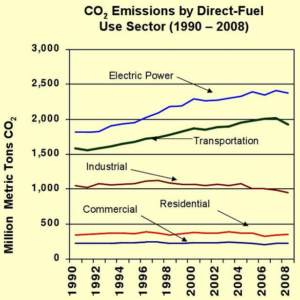
(Graph from the U.S. Energy Information Administration, via GRIST, supra)
On Thursday, July 22, 2010, Senator Reid announced that there would in fact not be a climate bill this session. Instead there would be a measure focused on the Gulf oil disaster (see infra § 4.4.4.1.1.) to ensure, among other things, that BP pays for cleanup, and tightening energy standards. Carol Browner, director of the White House Office of Energy and Climate Change Policy, said “everyone was disappointed.” (Carl Hulse & David M. Herszenhorn, Democrats Call Off Climate Bill Effort, N.Y. Times, July 22, 2010; Jonathan Hiskes, The climate bill’s dead. Really dead, GRIST, July 22, 2010.)
The World Resources Institute released a new report the next day (Nicholas Bianco & Franz Litz, with Madeline Gottlieb & Thomas Damassa, Reducing Greenhouse Gas Emissions in the United States Using Existing Federal Authorities and State Action (July 2010)), on what states and localities can do in lieu of congressional action. (Jonathan Hiskes, State and EPA climate action become key as Senate gives up, GRIST, July 23, 2010.)
See Ryan Lizza, The Political Scene: As the World Burns: How the Senate and the White House missed their best chance to deal with climate change, The New Yorker, Oct. 11, 2010, for the inside scoop on the Kerry, Graham, and Lieberman climate change bill and its intersection with the Deepwater Horizon oil spill in April 2010, infra.
However, Assistant EPA Administrator Gina McCarthy said on Oct. 11, 2010, at a panel discussion at Columbia University, that she believes Congress will eventually pass a climate bill; she noted the difficulties in a democracy of reaching a consensus, especially during difficult economic times. In the meantime, another participant noted that climate action plans have been adopted by 38 states so far, and 41 states, 10 Canadian provinces, six Mexican provinces, and four native sovereign nations participate in a voluntary Climate Registry for emissions measurement and reporting. Additionally, 3 regional GHG emissions trading programs—in the Northeast, Midwest, and West—have 33 state participants or observers. (John Herzfeld, Legislation: Eventual Passage of Climate Change Bill Still Seen as Possible, EPA Official Says, WCCR, Oct. 12, 2010.)
4.4.1.3. Congress as a whole: Chancellor Angela Merkel spoke to a joint session of Congress on Nov. 3, 2009, the first German chancellor to do so since Konrad Adenauer in 1957, to mark the 20th anniversary of the fall of the Berlin wall. She received many standing ovations, except when she spoke in favor of a climate change agreement in Copenhagen, and then many Republicans remained seated. [338]
4.4.2. GHG regulations: EPA & Mass. v. EPA
4.4.2.1. California waiver of federal preemption: On Wednesday, July 8, 2009, the EPA issued a decision “withdraw[ing] and replac[ing] the EPA’s prior denial of the CARB’s Dec. 21, 2005 waver request, which was published in the Federal Register on Mar. 6, 2008.” The denial was published at 73 Fed. Reg. 12156-12169 (2008) and discussed infra, under Mass. v. EPA. The 91-page notice granting CARB’s waiver request, was entitled California State Motor Vehicle Pollution Control Standards; Notice of Decision Granting a Waiver of Clean Air Act Preemption for California’s 2009 and Subsequent Model Year Greenhouse Gas Emission Standards for New Motor Vehicles, and published at 74 Fed. Reg. 32744 on July 8, 2009.
4.4.2.2. Regulatory “end run” around Congress:
EPA’s Endangerment Finding: Under Mass. v. EPA, see infra § 4.6., EPA is required to determine whether emissions from cars and trucks endanger public health and welfare; an endangerment finding would require the agency to regulate those emissions.
On April 24, 2009, EPA proposed a finding that GHG emissions endanger public health and welfare, and that emissions from cars and light trucks cause or contribute to the endangerment, entitled Proposed Endangerment and Cause or Contribute Findings for Greenhouse Gases Under Section 202(a) of the Clean Air Act; the Agency reported receiving over 300,000 comments on the proposal.[339]
On Nov. 9, 2009, EPA sent a draft endangerment finding to the White House OMB, which had 90 days to review it; it must be finalized before the agency can issue the final emissions standards that were proposed in September 2009, see infra. [340] An endangerment finding would be the legal basis for proposed regulation of car and light truck GHG emissions as well as emissions from new and modified stationary sources, see infra. [341]
Despite the “Climategate” controversy, see infra § 4.4.2.3., the endangerment finding was released on Dec. 7, 2009, at a news conference, the day COP-15 opened in Copenhagen, which enabled the president to show UN delegates there that the U.S. is finally moving aggressively to curb emissions. [342] The finding was published on Dec. 15, 2009, at 74 Fed. Reg. 66,496, with a Feb. 16th deadline for filing lawsuits challenging it (see infra § 4.4.2.5.). EPA took final action on GHG emissions from cars and light trucks on April 1, 2010, see infra. [343]
4.4.2.2.1. Mobile Sources: On May 19, 2009, President Obama announced a new National Fuel Efficiency Policy intended to increase fuel economy and reduce GHG emissions for all new cars and trucks sold in the U.S. The policy “represents an unprecedented collaboration between the Department of Transportation (DOT), the Environmental Protection Agency (EPA), the world’s largest auto manufacturers, the United Auto Workers, leaders in the environmental community, the State of California, and other state governments.” EPA Administrator Jackson said: “A supposedly ‘unsolvable’ problem was solved by unprecedented partnerships.” [344]
California “has agreed to defer to the proposed national standard through model year 2016. The 2016 endpoint of the two standards,” California’s and the new federal standard, “are essentially the same, although the national standard is using an attribute-based approach (consistent with the new CAFE), while California’s standard used the older approach of vehicle type. The national program ramps up slightly more slowly than the California program envisioned, but does get to the same fleet average endpoint. The national program also results in a greater total amount of greenhouse gas reductions than what a California program would have delivered, even with the 14 states who they said they would join the California program, according to the official.” [345] President Obama also said in his remarks: “I want to applaud California and Governor Schwarzenegger and the entire California delegation for their extraordinary leadership. They have led the way on this, as they have in so many other efforts to protect the environment.”
A direct result of this policy was a notice of intent to conduct a joint rulemaking,[346] jointly announced by DOT Secretary Ray LaHood and EPA Administrator Lisa P. Jackson; the details were elaborated on in September,[347] and the Proposed Rulemaking To Establish Light-Duty Vehicle Greenhouse Gas Emission Standards and Corporate Average Fuel Economy Standards was published on Sept. 28, 2009.[348] This rule (expected to be finalized March 31, 2010[349] (see infra)) would be the first federal limitation on global warming pollution. It would cover model years 2012 through 2016 and would, in the words of Secretary LaHood, “[b]ring about a new era in automotive history.” Administrator Jackson stated, “[t]hrough that partnership [with American automakers], we’ve taken the historic step of proposing the nation’s first ever greenhouse gas emissions standards for vehicles, and moved substantially closer to an efficient, clean energy future.”[350] Senate Foreign Relations Chairman John Kerry approved the message the administration was sending to the international community slightly over 2 months before COP-15 in Copenhagen, where U.S. leadership will be critical in drafting a successor protocol to Kyoto.
On Oct. 30, 2009, EPA promulgated the Mandatory Reporting of Greenhouse Gases rule (74 Fed. Reg. 56,260; 40 C.F.R. Subpart 98), which required 31 industry sectors, covering 85% of total U.S. GHG emissions, to track and report their emissions to inform future policy decisions. Under the rule, suppliers of fossil fuels or industrial GHGs, manufacturers of vehicles and engines, and facilities that emit 25,000 metric tons or more per year of GHG emissions are required to submit annual reports to EPA. It is first such rule in the U.S. and had an effective date of Dec. 29, 2009.
- The rule was promulgated under the fiscal year 2008 omnibus appropriations bill, Pub. L. No. 110-161, approved by Congress in Dec. 2007, which amended the CAA to establish a GHG reporting program at EPA.
- The rule was challenged before the end of 2009 by the American Chemistry Council (American Chemistry Council v. EPA, D.C. Cir., No. 09-1325) and other groups (the Energy Recovery Council (No. 09-1326), the American Petroleum Institute and National Petroleum Refiners Association (No. 09-1328), the Fertilizer Institute (No. 09-1329), the American Public Gas Association (No. 09-1331), and Utility Air Regulatory Group (No. 09-1333)). The cases were consolidated, and EPA reached an agreement in July 2010 that was published in the Federal Register: Notice of Proposed Settlement Agreements; Request for Public Comment, 75 Fed. Reg. 42085 (July 20, 2010). Comments will be accepted until Aug. 19th. Two lawsuits filed Dec. 29, 2010, were not included in the settlement: Environmental Defense Fund v. EPA, D.C. Cir., No. 09-1334, and Kinder Morgan CO2 Co. LP, v. EPA, D.C. Cir., No. 09-1332. (Steven D. Cook, Climate Change: Settlement Announced in Industry Litigation Against Greenhouse Gas Reporting Rule, 137 BNA Daily Environment Report A-10 (July 20, 2010))
- On Mar. 22, 2010, amendments were proposed to the rule to collect data from the oil and natural gas sector, industries that emit fluorinated gases, and from facilities that inject and store carbon dioxide (CO2) underground for the purposes of geologic sequestration or enhanced oil and gas recovery. EPA also proposes that all facilities in the reporting program provide details of their corporate ownership. Public hearings took place in April 2010.
Despite the flurry of proposed regulations, the administration would prefer that Congress pass legislation to limit GHG emissions in lieu of a regulatory approach, but the president has encouraged EPA to move forward with regulations to hopefully goad Congress into acting and to offer as an indication of the U.S.’s sincerity at the Copenhagen COP-15 conference in December. [351]
On Wednesday, Dec. 9, 2009, EPA Administrator Lisa Jackson spoke in Copenhagen, describing the endangerment finding as offering a dual path, complimentary to legislation, to cutting GHG emissions as: “… not an either/or moment. This is a “both/and” moment.” [352]
In her response to the Feb. 19, 2010, Rockefeller Letter, see infra, on Feb. 22, 2010, Administrator Jackson wrote:
“You asked in your letter what the result would be if Senator Lisa Murkowski’s resolution of disapproval [see infra] … were enacted. One result would be to prevent EPA from issuing its greenhouse gas standard for light-duty vehicles, because the endangerment finding is a legal prerequisite of that standard. The impacts of that result would be significant. In particular, it would undo an historic agreement among states, automakers, the federal government, and other stakeholders. California and at least thirteen other states that have adopted California’s emissions standards likely would enforce those standards within their jurisdictions, leaving the automobile industry without the explicit nationwide uniformity that it has described as important to its business.” [footnotes omitted]

From EPA homepage: DOT, EPA Set Aggressive National Standards for Fuel Economy and First Ever Greenhouse Gas Emission Levels For Passenger Cars and Light Trucks
The historic joint final rule establishing light-duty vehicle GHG emission standards and corporate average fuel economy standards was announced on April 1, 2010, by EPA, acting under the Clean Air Act, and the Department of Transportation’s National Highway Traffic Safety Administration (NHTSA), regulating Corporate Average Fuel Economy (CAFE) standards under the Energy Policy and Conservation Act. (See EPA’s Regulatory Impact Analysis.) The official version was not published until May 7th, at 75 Fed. Reg. 25324–25728. Starting with 2012 model year vehicles, the rule requires automakers to improve fleet-wide fuel economy and reduce fleet-wide GHG emissions by approximately five percent every year. By 2016, new cars will have to get an average of 35.5 miles per gallon, from 26 mpg today, and will emit no more than 250 grams per mile of CO2. The rule will add about $1000-$1300 to the cost of a new car, but petrol savings are expected to more than cancel out those projected costs [353]: the rules could potentially save the average buyer of a 2016 model year car $3,000 over the life of the vehicle. Nationally, it will conserve about 1.8 billion barrels of oil, and reduce nearly a billion tons of GHG emissions over the lives of the vehicles covered. EPA Administrator Lisa Jackson described the final rule as “a win-win program for our economy and our environment,” [354] and stressed, again, that there would be no regulation of stationary sources this year [355]; as the new auto emission standards will not formally “take effect” until the 2012 model year begins (that is, no earlier than Jan. 2, 2011), the introduction of power plant regulations will be delayed until early 2011. [356] The rule moves up the goals of a 2007 energy law requiring a 35 mpg standard after 2020. [357] (Discussed supra, under Energy & CAFE standards in the 110th Congress; & infra, § 4.6 Other States’ Actions to Reduce GHG Emissions, Mass. v. EPA.)
In a speech at Andrews Air Force Base on Mar. 31, 2010, President Obama said: “[J]ust a few months after taking office, I also gathered the leaders of the world’s largest automakers, the heads of labor unions, environmental advocates, and public officials from California and across the country to reach a historic agreement to raise fuel economy standards in cars and trucks. And tomorrow [April 1, 2010], after decades in which we have done little to increase auto efficiency, those new standards will be finalized, which will reduce our dependence on oil while helping folks spend a little less at the pump.” [358]
U.S. EPA Administrator Lisa P. Jackson and Transportation Secretary Ray LaHood held a press conference call Thursday April 1, 2010, at 12:00 p.m. to discuss the administration’s historic “clean cars” rule. Unfortunately, the conference call was available to credentialed media only.
This author is of the opinion that the truly historic and unprecedented coalition formed among federal agencies, California and the 14 other states that had already signed onto California’s emissions standard, auto manufacturers, ENGOs, unions and others, was not acknowledged or appreciated by the media to the extent it deserves. This was a huge achievement of the Obama Administration, at the very least on par with health care reform.
A coalition of industry groups (which has already challenged EPA’s endangerment finding and GHG rules, see infra § 4.4.2.2.2.) challenged the light-duty vehicle GHG & CAFE standards in Coalition for Responsible Regulation v. EPA, D.C. Cir., No. 10-1092, filed on May 7th. (Steven D. Cook, Climate Change: Industry Coalition Challenges EPA Rule Limiting Vehicle Greenhouse Gas Emissions, 90 BNA Daily Environment Report A-1, May 12, 2010.) Southeastern Legal Foundation v. EPA, D.C. Cir., No. 10-1094, filed May 11, 2010, joined this case, and on May 17, 2010, 14 House Republicans also joined the suit. The executive director of the SLF told BNA that the rules they challenged in their interrelated lawsuits are based upon science about which “strong doubts have been raised.” (Steven D. Cook, Litigation: House Republicans Join Lawsuit to Overturn Greenhouse Gas, Fuel Economy Standards, WCCR (May 17, 2010); see infra § 4.4.2.3. “Climategate”).
These appear to be huge litigations; see infra, 4.4.2.2.2. Stationary Sources. Petitions, motions and filings are on Lexis, Westlaw and Pacer in Feb. 2011.
On May 21, 2010, President Obama instructed the NHTSA and EPA to begin developing first-ever standards for fuel economy and greenhouse gas emissions from medium- and heavy-duty trucks for model years 2014-2018, as well as new standards for cars and light trucks for model years 2017-2025, as the current standards recently promulgated, see supra, expire in 2016. (Memorandum of May 21, 2010, Improving Energy Security, American Competitiveness and Job Creation, and Environmental Protection Through a Transformation of Our Nation’s Fleet of Cars And Trucks, 75 Fed. Reg. 29399 (May 26, 2010); Steven D. Cook, Climate Change: Obama Orders EPA, Transportation Agency To Set Fuel, Emissions Rules for Trucks, Cars, 98 Daily Environment Report A-4 (May 24, 2010); Notice of intent to conduct a joint rulemaking, 2017 and Later Model Year Light Duty Vehicle GHG Emissions and CAFE Standards, 49 CFR Parts 531 and 533, RIN 2127–AK79, 75 Fed. Reg. 62739-62750 (Oct. 13, 2010)). See infra, Canada.
As instructed, EPA and the NHTSA signed a notice of intent (see Notice of Upcoming Joint Rulemaking to Establish 2017 and Later Model Year Light Duty Vehicle GHG Emissions and CAFE Standards) on Sept. 30, 2010, “to propose stringent federal greenhouse gas and fuel economy standards” for model years 2017-2025. (Standards are currently set through 2016, with cars and light trucks scheduled to achieve 35.5 mpg and an emissions limit of 250 grams per mile of carbon emissions. See supra.) A 3% emissions cut would give a 47 mpg fuel standard; a 6% annual cut in emissions would result in a standard of 62 mpg. The increased cost of automobile production would be more than offset by fuel savings. The agencies plan to issue a proposed rule setting new fuel economy standards and emissions limits by Sept. 30, 2011, and a final rule by July 31, 2012. (Steven D. Cook, Breaking News: Administration Opens Door for Standards As High as 62 Miles Per Gallon in 2025, BNA Daily Environment Report (Oct. 1, 2010))
Also as instructed in May 2010, on Oct. 25, 2010, EPA and NHTSA proposed rules that would require medium- & heavy-duty trucks and buses to reduce GHG emissions and get up to 20% better gas mileage for the 2014-2018 model years. This will be the first time that trucks and buses, which are responsible for 20% of transportation fuel usage, have had any fuel or emissions standards at all; typically they get a truly abysmal 6-7 mpg. According to the EPA: “This comprehensive national program is projected to reduce GHG emissions by about 250 million metric tons and save 500 million barrels of oil over the lives of the vehicles produced within the program’s first five years.” Secretary LaHood pointed out that shrinking fuel costs benefit not only the environment but also small business owners and consumers. Manufacturers are not upset, but environmentalists were hoping for tougher standards. (Ted Robbins, Government Proposes Better Gas Mileage For Trucks, NPR’s Morning Edition, Oct. 25, 2010; Press Release, DOT, EPA Propose the Nation’s First Greenhouse Gas and Fuel Efficiency Standards for Trucks and Buses: A win for the environment, economy and energy efficiency, Oct. 25, 2010; Darren Goode, Trucking industry gives initial praise to proposed carbon, efficiency controls, The Hill, Oct. 25, 2010.) The proposed rule, Greenhouse Gas Emissions Standards and Fuel Efficiency Standards for Medium- and Heavy-Duty Engines and Vehicles, was published at 75 Fed. Reg. 74152 on Nov. 30, 2010; comments were accepted for 60 days, until Jan. 31, 2011. As part of the regulatory process, NHTSA has proposed a draft Environmental Impact Statement (EIS) for its proposed fuel efficiency standards, comparing them with other regulatory alternatives. Comments can be submitted on the draft EIS until Jan. 3, 2011.
Transportation industry, state, and environmental groups (including Ford Motor Co.) submitted mostly positive comments on the medium- & heavy-duty truck GHG & mileage rules; energy industry groups opposed the mobile source rules primarily because they will trigger GHG emissions standards for new and modified stationary sources under the CAA’s PSD program. (Steven D. Cook, Climate Change: Comments Mostly Positive on Truck Proposal Except Those by EPA Regulation Opponents, 24 BNA Daily Environment Report A-9, Feb. 4, 2011; Dean Scott, Climate Change: Industries Target EPA Regulatory Authority Over Power Plant Emissions, Other Sources, WCCR, April 5, 2010.)
In Jan. 2011, EPA announced that EPA, DOT, and CARB would work together to promulgate standards for cars and light-duty trucks for model years 2017-2025 by Sept. 1, 2011, signifying continuing collaboration and a dedication to providing car manufacturers with the regulatory certainty they need. (News Release, EPA, DOT and California Align Timeframe for Proposing Standards for Next Generation of Clean Cars, EPA, Jan. 24, 2011.)
In July, the administration and car makers were still heavily debating what the standard should be. EPA is proposing that new cars and trucks should get as much as 56.2 m.p.g. by 2025 but industry questions whether consumers will accept having to spend only about half as much money on petrol as they do today. Currently the U.S. has “the world’s most lenient vehicle emissions and mileage standards, lagging as much as 10 m.p.g. behind the rest of the world.” (John M. Broder, Carmakers and White House Haggling Over Mileage Rules, N.Y. Times, July 3, 2011.)
Quite surprisingly, and to the delight of ENGOs, carmakers acquiesced to an increase nearly that high, 54.5 m.p.g. by 2025, or a 5% annual increase in fuel economy for cars from 2017-2025. However, the improvements are more modest for SUVs and light trucks: 3.5% a year through 2021, and then a 5% increase over the next four years. (Bill Vlasic, Carmakers Back Strict New Rules for Gas Mileage, N.Y. Times, July 28, 2011; News Release, President Obama Announces Historic 54.5 mpg Fuel Efficiency Standard: Consumers will save $1.7 trillion at the pump, $8K per vehicle by 2025, EPA, July 29, 2011; see also, Driving Efficiency: Cutting Costs for Families at the Pump and Slashing Dependence on Oil, July 29, 2011.)
4.4.2.2.2. Stationary Sources: On Oct. 27, 2009, EPA proposed a “tailoring rule” to limit prevention-of-significant-deterioration provisions to sources that emit more than 25,000 tons per year of carbon dioxide or other GHGs for 5 years, which would limit the number of sources potentially subject to the regulation, entitled: Prevention of Significant Deterioration and Title V Greenhouse Gas Tailoring Rule, 74 Fed. Reg. 55292. However, states complained that many more sources would be covered by PSD under the 25,000 ton rule than previously thought, and in March 2010, Administrator Jackson offered to raise the threshold to 75,000 tons for the first 2 years. Also, for the first 6 months of 2011 it will only apply to sources that are already subject to criteria air pollutant standards for other pollutants. In the second half of 2011, however, PSD would apply to all sources (about 1700) that emit over 75,000 tons.[359]
On Mar. 25, 2010, EPA announced that the tailoring rule will not be finalized by the Mar. 31, 2010, deadline originally set by the agency,[360] but on April 7th EPA announced that it was expected to be finalized by the end of April.[361] On April 22, 2010, a final version of the tailoring rule was sent to the OMB, typically the last step before a significant agency action.[362]
The final PSD & Title V Greenhouse Gas Tailoring Rule was announced on May 13, 2010, limiting (for the first 6 months of 2011), as promised, PSD requirements to sources that are already subject to them for other pollutants. The final rule was published on June 3, 2010, at 75 Fed. Reg. 31514, triggering a 60-day period for opponents to file legal challenges in the D.C. Circuit Court of Appeals. (Steven D. Cook, Emissions Reduction: Publication of Greenhouse Gas Tailoring Rule Launches 60-Day Period for Legal Challenges, WCCR, June 2, 2010.) Starting in July 2011, the rule will apply to new sources that emit over 100,000 tons of C02/year, and to modified sources emitting over 75,000 tons/year. The PSD provisions in the CAA require new and modified sources of air pollution to use the best available control technology (BACT).[363] A summary of the permitting burdens with and without the tailoring rule is available on EPA’s web site. A timeline of permitting steps, see infra, is also available on the EPA web page.
Vis-à-vis the 60-day opportunity to file challenges, on June 3d, the Southeastern Legal foundation (in its 4th challenge thus far in 2010 to EPA regulation of GHG under the CAA), 14 House Republicans, and 15 Georgia businesses and organizations challenged the tailoring rule and EPA’s ability under the CAA to exempt smaller sources from PSD emissions requirements. (Southeastern Legal Foundation v. EPA, D.C. Cir., No. 10-1131 (June 3, 2010); Steven D. Cook, EPA: EPA Sued Over Greenhouse Tailoring Rule Limiting Scope of Emissions Controls, WCCR, June 3, 2010.)
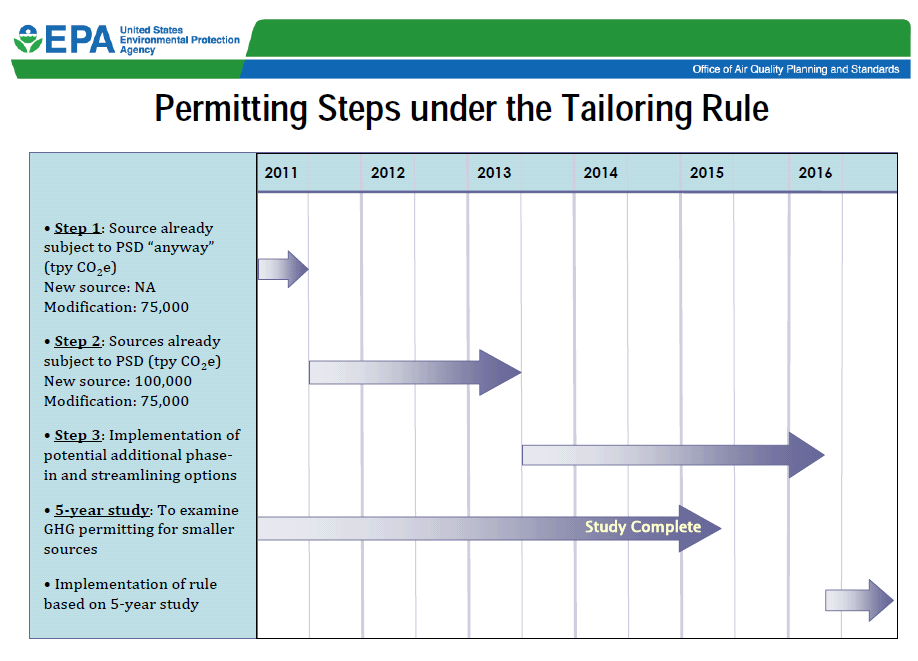
On Monday, Mar. 29, 2010, EPA issued a final rule entitled Reconsideration of Interpretation of Regulations that Determine Pollutants Covered by Clean Air Act Permitting Programs, published at 75 Fed. Reg. 17004 (April 2, 2010) in which Administrator Jackson announced formally what she had suggested in her Feb. 22d letter, supra, that large new or modified stationary GHG sources would not be required to obtain federal pollution permits before Jan. 2, 2011.[364]
On April 2, 2010, the regulation (which postponed regulation of stationary sources to give industry more time to comply and which may apply only to sources emitting over 25,000 or more tons per year, when the tailoring rule is finalized, see supra) was challenged in the D.C. Circuit by mining and agricultural groups in Coalition for Responsible Regulation v. EPA, D.C. Cir., No. 10-1073. The petition for review questions EPA’s right to regulate GHG emissions from stationary sources under Mass. v. EPA and the CAA. (Dean Scott, Climate Change: Industries Target EPA Regulatory Authority Over Power Plant Emissions, Other Sources, 64 BNA Daily Environment Report A-6, April 6, 2010.) The lawsuit was subsequently joined by another group, in Southeastern Legal Foundation v. EPA, D.C. Cir., No. 10-1083, filed April 15, 2010. (Steven D. Cook, Climate Change: Industry Coalition Challenges EPA Rule Limiting Vehicle Greenhouse Gas Emissions, 90 BNA DAILY ENVIRONMENT REPORT A-1, May 12, 2010; Steven D. Cook, Litigation: House Republicans Join Lawsuit to Overturn Greenhouse Gas, Fuel Economy Standards, WCCR (May 17, 2010)).
In contrast to the 13 lawsuits filed by industry groups challenging the April rule and EPA’s right to regulate GHG emissions under the CAA, see infra § 4.4.2.5., the Center for Biological Diversity filed a lawsuit, Center for Biological Diversity v. EPA, D.C. Cir., No. 10-1115, on May 28, 2010, to prevent EPA from delaying the regulation of stationary sources past Jan. 2, 2011. (Steven D. Cook, Climate Change: Environmental Group Sues EPA to Prevent Delays in Greenhouse Gas Emissions Limits, 104 BNA Daily Environment Report A-5 (June 2, 2010.))
After the worst mine disaster in 40 years at the Upper Big Branch mine in West Virginia killed 29 miners in early April 2010 (Ian Urbina, No Survivors Found After West Virginia Mine Disaster, N.Y. Times, April 9, 2010), coal mining executives testified at a hearing entitled The Role of Coal in a New Energy Age before the House Select Committee on Energy Independence and Global Warming on April 14th. Chairman Edward Markey (D-Mass.) urged industry representatives to end both their resistance to EPA regulation of GHG emissions from stationary sources and their challenges to climate science, but the leaders still maintained that EPA’s efforts constituted a “war on coal.”[365]
EPA proposed a confidential business information rule on July 7, 2010, at 75 Fed. Reg. 39,094, that said it would release all non-confidential emissions information to the public but would protect confidential business information. On Jan. 21, 2011, the agency sent the nearly final rule to the OMB for review. (Steven D. Cook, Reporting: EPA Sends OMB Final Rule to Designate Public, Confidential Greenhouse Gas Data, WCCR, Jan. 24, 2011.)
Eighty-seven new Republican members of the House were sworn in on Jan. 5th as the 112th Congress convened, a few days after EPA’s official start to regulation of GHG from stationary sources on Sunday, Jan. 2, 2011. According to the N.Y. Times, Republican Representative Fred Upton, who will apparently be chairman of the House Energy and Commerce Committee, said “he was not convinced that greenhouse gases needed to be controlled or that the E.P.A. had the authority to do so,” and proposed a moratorium on all GHG regulations until the courts have settled whether it is legal for the government to do so. (John M. Broder, E.P.A. Limit on Gases to Pose Risk to Obama and Congress, N.Y. Times, Dec. 30, 2010.) (See infra § 4.4.2.4.)
4.4.2.3. “Climategate”: However, while the endangerment finding was in process in fall 2009, on Nov. 17, 2009, more than 1000 hacked emails dating back 13 years between climate scientists at the University of East Anglia’s Climatic Research Unit and their colleagues at other universities appeared on internet blogs, indicating that climate scientists were actively manipulating scientific data to fit their models. [366] Climate skeptics called for an inquiry and labeled the controversy “Climategate”; it was labeled “Swifthack” by proponents, referring to the attack on Senator Kerry in 2004. (Walsh, Has ‘Climategate’ Been Overblown?, Time, Dec. 7, 2009.) Dr. Rajendra Pachauri, IPCC head, said the matter could not be ignored and will be investigated.[367] Professor Phil Jones, head of the CRU, stepped down during the inquiry.
This controversy affected the discussion in the U.S., as Senator Inhofe and other Republicans called on EPA Administrator Lisa Jackson to delay the proposed endangerment finding at a Dec. 2 hearing of the Environment and Public Works Committee (ostensibly about TSCA), as the emails called into question the science behind the finding. Jackson refused, saying the evidence is overwhelming.
At a House hearing on the administration’s view of climate science before the Select Committee on Energy Independence and Global Warming in early December 2009, Rep. Sensenbrenner (R-Wis) stated the hacked emails show “systemic suppression of dissenting opinion among scientists in the climate change community… [and] possible criminal activity….” John Holdren, of the White House Office of Science and Technology Policy, said the evidence of climate change was “overwhelming.” [368] However, a Time Magazine article stated: “In the weeks since the e-mails first became public, many climate scientists and policy experts have looked through them, and they report that the correspondence does not contradict the overwhelming scientific consensus on global warming, which has been decades in the making. ‘The content of the stolen e-mails has no impact whatsoever on our overall understanding that human activity is driving dangerous levels of global warming,’ wrote 25 leading U.S. scientists in an open letter to Congress on Dec. 4. ‘The body of evidence that underlies our understanding of human-caused global warming remains robust.’” (Walsh, Has ‘Climategate’ Been Overblown?, Time, Dec. 7, 2009.)
A letter to Nature in the Jan. 7, 2010, issue, entitled Climate e-mails: man’s mark is clear in thermometer record, by Hans von Storch & Myles Allen, 463 Nature 25 (Jan. 7, 2010), explains that: “The thermometer record [since 1850] [as opposed to “proxy reconstructions of temperature over the past millennium, which are based on indirect evidence such as tree rings”] shows unequivocally that Earth is warming, and provides the main evidence that this is caused by human activity. This crucial record remains unchallenged.”
Senator Inhofe, not to be deterred, released an 84-page report on Feb. 23, 2010, entitled: ‘Consensus’ Exposed: The CRU Controversy, and a press release: Senate EPW Minority Releases Report on CRU Controversy: Shows Scientists Violated Ethics, Reveals Major Disagreements on Climate Science. Inhofe appears to be trying to find a way to criminalize the 17 key researchers involved with the IPCC Assessment Reports. The allegations came up at a full committee hearing entitled, “Hearing on the President’s Proposed EPA Budget for FY 2011.”
As a result of the scandal, IPCC chair Rajendra K. Pachauri announced on Feb. 27, 2010, that the IPCC would “establish an independent committee to review the procedures associated with drafting and assembling the panel’s assessment reports.”[369] On March 9th, Science reported that the InterAcademy Council, representing 15 nations’ national science academies and co-chaired by Robbert Dijkgraaf, a Dutch mathematical physicist, would appoint a panel of scientists to investigate the IPCC and the mistakes in the FAR; the report is expected to be complete by August 2010.[370]
On Mar. 11, 2010, congressional leaders received a letter entitled U.S. Scientists and Economists’ Call for Swift and Deep Cuts in Greenhouse Gas Emissions, signed by 2,026 U.S. climate scientists and economists (including 8 Nobel Prize winners in science or economics, 32 members of the National Academy of Sciences, 10 members of the National Academy of Engineering, 11 recipients of the MacArthur Fellowship, 3 National Medal of Science Recipients, and more than 100 members of the Intergovernmental Panel on Climate Change, which shared the 2007 Nobel Peace Prize). It stated that the science of global warming is indisputable (in response to “climategate”), and urged Congress to require immediate and deep cuts in GHG emissions. It recommended emissions cuts “‘on the order of 80 percent below 2000 levels by 2050’ and [suggested] that the first step should be reductions on the order of 15 to 20 percent below 2000 levels by 2020.” [371] EPA regulation of GHG emissions was not mentioned. However, on the same date, a Gallup poll conducted March 4-7, 2010, revealed that political conservatives are now significantly less convinced than they were 2 years ago that the effects of global warming are already taking place (30% down from 50%). [372] Views of liberals were only slightly different. On Mar. 13, 2010, federal agencies received a letter signed by 252 climate scientists, mostly from leading U.S. institutions and universities and including some IPCC scientists, discussing the comparatively few errors in the IPCC’s Fourth Assessment Report and the efforts by Congress and the media to discredit the entire report based on those errors.
Members of Parliament investigating climate scientists at the UEA’s CRU found no evidence in March 2010 that climate data had been manipulated or withheld, and the reputations of its scientists remain intact. It said that in future climate science must be “transparent and irreproachable.”[373]
Climategate is given as one of the reasons fewer Britons (26% down from 41%) now view anthropogenic climate change as an important social issue. In the U.S., 48% of those polled, up from 41% in 2009, think the issue has been exaggerated. (Elisabeth Rosenthal, Climate Fears Turn to Doubts Among Britons, N.Y. Times, May 25, 2010.)
On Wednesday, July 7, 2010, a British panel led by Muir Russell and commissioned by the University of East Anglia, exonerated scientists involved in the controversy, although it stopped short of a complete vindication; it criticized a perceived lack of openness in responses to requests for backup data. Phil Jones, see supra, was reinstated to a job similar to the one he had resigned from during the investigation of the CRU. It was the 5th review of the controversy to come to that conclusion, and the most comprehensive. The report stated that “we did not find any evidence of behavior that might undermine the conclusions of the I.P.C.C. assessments.” (Justin Gillis, British Panel Clears Climate Scientists, N.Y. Times, July 7, 2010; Leora Falk, International Issues: Board Says U.K. Scientists Acted Properly, But University Should Be More Open About Research, WCCI, July 7, 2010.) The previous week, Michael Mann was exonerated by two reviews by Pennsylvania State University. (Justin Gillis, Climate Scientist Cleared of Altering Data, N.Y. Times, July 1, 2010; Leora Falk, Research: Penn State Panel Clears U.S. Scientist of Allegations of Climate Research Misconduct, WCCR, July 2, 2010.)
For additional information, see the following:
Al Gore’s op-ed in the Feb. 27, 2010, N.Y. Times, We Can’t Wish Away Climate Change, discussing Climategate and “Himalayagate” (see infra); the heavy snowfalls in the Northeastern U.S. that global warming detractors have used to further discredit climate science and scientists; and the “political paralysis that is now so painfully evident in Washington [that] has thus far prevented action by the Senate — not only on climate and energy legislation, but also on health care reform, financial regulatory reform and a host of other pressing issues.”
Australian author Clive Hamilton wrote several articles on “climate cyber-bullying” in February 2010: Bullying, lies and the rise of right-wing climate denial (2/22); Who is orchestrating the cyber-bullying? (2/23); and Manufacturing a scientific scandal (2/25).
Douglas Fischer & The Daily Climate, Cyber Bullying Intensifies as Climate Data Questioned: Researchers must purge e-mail in-boxes daily of threatening correspondence, simply part of the job of being a climate scientist (Mar. 1, 2010).
4.4.2.4. Legislation intended to prevent the “end run”: Months before EPA’s endangerment finding was issued, H.R. 391 was introduced by Rep. Marsha Blackburn and 152 cosponsors on Jan. 9, 2009, to provide that GHGs are not subject to the Clean Air Act. But EPA GHG regulations were considered inevitable after the release of its endangerment finding in Dec. 2009, which was a precondition to any such EPA regulation.[374] However, with the Democrats’ loss of their filibuster-proof majority in the Senate, climate change legislation seemed increasingly unlikely in 2010, and for that matter, so does EPA regulations.
On Dec. 15, 2009, H. Res. 974 was introduced by Rep. Rodney Alexander urging EPA Administrator Jackson to reevaluate the endangerment finding, issued “under the pretense of the Supreme Court decision in Massachusetts v. EPA,” as it was “unacceptable” to the House of Representatives. A bill, H.R. 4396, was introduced the next day, Dec. 16, 2009, by Earl Pomeroy (D-N.D.), to block EPA from regulating GHG emissions by amending GHGs out of the Clean Air Act. It has 5 cosponsors. [375] Also on Dec. 16th, H.J. Res. 66 was introduced by Rep. Jerry Moran, also disapproving the EPA endangerment finding.
Senator Lisa Murkowski (R-AK) said on Jan. 20, 2010, that she plans to introduce a resolution of disapproval to prevent the EPA’s regulation of GHG emissions, rather than make a floor amendment to a bill (H.J. Res. 45) to raise the federal debt limit. (Apparently it was learned that the Murkowski amendment was written in collaboration with several dirty energy lobbyists. [376]) Under the Congressional Review Act, a resolution of disapproval can get to the Senate floor very quickly, and only requires 51 votes to pass; it would, according to an EDF email, “permanently bar the Environmental Protection Agency from requiring polluters to cut their emissions of greenhouse gases.”
According to Warming Law, since the fall of 2009 Murkowski has been “seeking collaborators in Congress to amend the Clean Air Act so that it cannot be used to tackle greenhouse gases. … If successful, Murkowski’s efforts would effectively negate the Obama Administration’s progress over the past year toward complying with the Supreme Court’s 2007 ruling in Massachusetts v. EPA. …”[377] On Jan. 21, 2010, the senator introduced the disapproval resolution to the Senate, ostensibly to avoid the “economic train wreck” she believes would result if EPA regulated GHG under the CAA. [378] On Feb. 23d the resolution (S. J. Res. 26) had 40 co-sponsors, of whom 37 are republicans and 3 (Landrieu from Louisiana, Lincoln from Arkansas, and Nelson from Nebraska) are democrats; it was referred to the Committee on Environment and Public Works on Jan. 21st. The resolution reads:
“Resolved by the Senate and House of Representatives …, That Congress disapproves the rule submitted by the Environmental Protection Agency relating to the endangerment finding and the cause or contribute findings for greenhouse gases under section 202(a) of the Clean Air Act (published at 74 Fed. Reg. 66496 (Dec. 15, 2009)), and such rule shall have no force or effect.”
With 41 votes including herself, Murkowski is still shy of the 51 she would need in the Senate to invoke expedited procedures for overturning unpopular federal rules under the Congressional Review Act of 1996 (as opposed to 60 needed to avoid a filibuster); but even if she got 51 she still would need the House and the President to approve the resolution, as the latter especially is highly unlikely to do. According to Republican aides she plans to petition the EPW Committee by the end of February to force the release of the resolution, which she can do with the votes she has. She is looking to bring the resolution up for a vote in mid-March, 2010, but as of March 16th that had not yet happened. Senate newby Scott Brown (R-Mass) has not signed on. [379]
On May 27, 2010, EDF reported that S. J. Res. 26 will move to a vote in the Senate on June 10th after Senator Murkowski reached a unanimous consent agreement with Senator Reid. (Robin Bravender, Sen. Murkowski’s EPA Resolution on Greenhouse Gases Slated for June 10 Vote, N.Y. Times, May 25, 2010.) On that date the Senate voted 47-53 (Record Vote Number: 184) against Senator Lisa Murkowski’s resolution. See the discussion at 156 Cong. Rec. S4788-4836 (June 10, 2010); a letter from 1800 scientists to the Senate urging senators to oppose efforts to overturn EPA’s endangerment finding is at p. S4793; Senator Kerry’s statement is at p. S4821-24; Senator Lieberman’s at p. S4824-25; letters from car manufacturers opposing the resolution because of its impact on the joint EPA/NHTSA regulation of GHG emissions from light-duty cars and trucks and fuel economy standards [discussed supra] are at p. S4833-34.
On Feb. 19th eight U.S. Senators wrote a letter to EPA Administrator Jackson asking about the agency’s plans for regulating GHG in 2010 (known as the “Rockefeller Letter” after Senate Commerce, Science, and Transportation Chairman Jay Rockefeller (D-W.Va.)).
Back in the House, Rep. Ike Skelton (D-Mo.) introduced a bill on Feb. 2, 2010, that would block EPA regulation of greenhouse gas emissions by removing them from 42 U.S.C. § 7602(g) of the Clean Air Act. Skelton’s bill (H.R. 4572) was co-sponsored by 13 representatives including Collin Peterson (D-Minn.), chairman of the House Agriculture Committee, and referred to the Energy and Commerce Committee. [380] Later in the month, on Feb. 25th, Mr. Skelton introduced H.J. Res. 76 with 31 co-sponsors, identical to Murkowski’s S. J. Res. 26, supra.
On Mar. 2, 2010, House Energy and Commerce ranking Republican Joe Barton (Texas) introduced another joint resolution, H.J. Res. 77, also identical to Murkowski’s S. J. Res. 26 and disapproving the EPA endangerment finding. It has 105 co-sponsors, including House Minority Leader John A. Boehner (Ohio); Darrell Issa (Calif.), ranking Republican on the House Oversight and Government Reform Committee; and Frank Lucas (Okla.), ranking Republican on the House Agriculture Committee. [381]
On Mar. 4, 2010, Sen. Jay Rockefeller introduced S. 3072 (the Stationary Source Regulations Delay Act) which would suspend for 2 years “any Environmental Protection Agency action under the Clean Air Act with respect to carbon dioxide or methane pursuant to certain proceedings, other than with respect to motor vehicle emissions, and for other purposes”; that is, it would prevent EPA from regulating stationary sources of GHG emissions but leave rules on vehicle emissions alone. There were no cosponsors. On the same date, a companion bill, H. R. 4753, aka the ‘‘Stationary Source Regulations Delay Act,’’ was introduced in the House by Rep. Nick Rahall (D-W.Va.) and 6 co-sponsors. [382]
On July 26, 2010, a White House official announced that President Obama would veto any such postponement of EPA’s authority to regulate GHG emissions from new and modified stationary sources, which is set to begin Jan. 2, 2011; Senator Reid has promised a floor vote on S. 3072 before the August recess. (Steven D. Cook & Dean Scott, Legislation: Obama Would Veto Bill to Delay EPA Limits on Greenhouse Gases, White House Aide Says, WCCR, July 26, 2010.) That didn’t happen, and in September 2010 Senator Reid agreed to a floor vote on S. 3072 in the lame duck session, but Senator Rockefeller acknowledged that the bill was unlikely to pass. (Darren Samuelsohn, Jay Rockefeller: Anti-EPA climate bill won’t pass, GRIST, Sept. 29, 2010.) On Dec. 17, 2010, Senator Rockefeller announced he was temporarily abandoning his attempt to bring the bill to the floor, but intends to reintroduce it in the 112th Congress, which opens in January 2011.
4.4.2.4.1. Legislation against GHG regulation in the 112th Congress: Early in the 112th Congress (Jan. 5-6, 2011), several bills were introduced with the clear intention of preventing EPA from regulating GHG. See, e.g., H.R. 97, the Free Industry Act, by Rep. Blackburn (R-Tenn.) and 122 cosponsors; H.R. 153, the Ensuring Affordable Energy Act by Rep. Poe with 53 cosponsors, and H.R. 199, the Protect America’s Energy and Manufacturing Jobs Act of 2011 by Rep. Capito (R-WV) and 5 cosponsors, which would delay EPA regulation of GHG for 2 years. (John M. Broder, E.P.A. Faces First Volley From the House, N.Y. Times green, Jan. 6, 2011; Jean Chemnick, Congressional Review Act Might Not Be an Option to Fight EPA’s Greenhouse Gas Regs, N.Y. Times, Jan. 6, 2011.)
Senator Rockefeller, true to his word, introduced S. 231, the EPA Stationary Source Regulations Suspension Act on Jan. 31, 2011, with 6 cosponsors, which is nearly identical to S. 3072, supra, his earlier bill, which died in the 111th Congress. On the same day, Republican Senator Barrasso of Wyoming introduced S. 228, the Defending America’s Affordable Energy and Jobs Act, with 18 cosponsors, which would not only block EPA from regulating GHG under the CAA, but would prevent other federal agencies from considering climate change when they implement statutes such as the ESA or NEPA. (Ben Geman, Senate Republicans offer sweeping plan to block climate rules, E2 Wire, Jan. 31, 2011.) Both bills were referred to the Committee on Environment and Public Works. (Dean Scott, Climate Change: Rockefeller Reintroduces EPA Suspension Bill; Some Democrats Fear Lost Energy Leverage, 22 BNA Daily Environment Report A-8, Feb. 2, 2011.) Another is S. 15, introduced Jan. 15, 2011, by Senator Vitter with no cosponsors, to prohibit the regulation of CO2 emissions by EPA or any other agency until China, India, and Russia implement similar reductions. H.R. 750 is the companion bill to S. 228, introduced Feb. 16th by Rep. Walberg with 6 cosponsors. According to the N.Y. Times, at least one of these bills would also weaken the EPA’s traditional ability to regulate ground-level air pollutants like soot and mercury. (Editorial: Clean Air Under Siege, N.Y. Times, Feb. 5, 2011.)
On Feb. 2, 2011, House Energy and Commerce Committee Chairman Upton (R-Mich.) released a discussion draft of the Energy Tax Prevention Act of 2011 which would amend the CAA to bar EPA from regulating GHG emissions. Cosponsors are Sen. Inhofe (R-Okla.), of the Senate Environment and Public Works Committee, and Rep. Whitfield (R-Ky.), chair of the House Energy and Commerce Subcommittee on Energy and Power, which will hold a hearing on Feb. 9th. (Press Release: Upton, Whitfield, Inhofe Unveil Energy Tax Prevention Act to Protect America’s Jobs & Families, Feb. 2, 2011.) Among other things, the draft bill would repeal the endangerment finding (74 Fed. Reg. 66496 (Dec. 15, 2009) (see § 4.4.2.2.)); the GHG Tailoring Rule (75 Fed. Reg. 31514 (June 3, 2010) (see § 4.4.2.2.2.)); or any federal action “under this Act [CAA] occurring before the date of enactment of this section that applies a stationary source permitting requirement or an emissions standard for a [GHG] due to concerns regarding possible climate change.” This draft is considered, in early Feb. 2011, to be the leader of the pack. Critics said Upton and Inhofe were siding with polluters over the environment and public health. (Dean Scott, Climate Change: Upton Unveils Draft Bill to Strip EPA Of Authority Over Greenhouse Gas Emissions, 23 BNA Daily Environment Report A-13, Feb. 3, 2011; Darryl Fears, House GOP readies bill to prohibit EPA from regulating carbon emissions, Wash. Post, Feb. 3, 2011.)
On Feb. 9, 2011, Administrator Jackson testified before the House Energy and Commerce Committee’s Subcommittee on Energy and Power about the Upton bill. (Her opening statement was on EPA’s web page on that date; re. the endangerment finding, she said: “Chairman Upton’s bill would, in its own words, repeal that scientific finding. Politicians overruling scientists on a scientific question—that would become part of this Committee’s legacy.”)
On Feb. 18, 2011, the House approved 2 amendments to H.R. 1, its proposed spending measure to fund the government through 2011. One would ban EPA from regulating GHG and was introduced by 3 Republican Representatives from Texas. It was approved 249–177 and fulfills a promise made by Republicans during the midterm elections (although 13 Democrats also voted for it); the other (§ 4014 on page 374 of H.R. 1) would restrict EPA’s Environmental Appeals Board permitting authority in Alaskan waters. (Amena H. Saiyid, Budget: House Approves Amendments to Block EPA On Greenhouse Gases, Offshore Permitting, 35 BNA Daily Environment Report A-6, Feb. 22, 2011; Steven D. Cook, Climate Change: Ohio Senator Asks President to Consider Economic Impact of Climate Regulations, 40 BNA Daily Environment Report A-6, Mar. 2, 2011.) If enacted, H.R. 1 would cut EPA financing by $3 billion, or 30%. (Climate rules bill flags ‘EPA bureaucrats’, UPI, Mar. 3, 2011.)
On Mar. 11th, Secretary Jackson testified before the House Energy and Commerce Committee’s Energy & Power and Environment & Economy Subcommittees on the President’s Fiscal Year 2012 budget proposal for EPA. She defended EPA’s 40+ year record and discussed Rep. Upton’s efforts to eliminate portions of the CAA. Regarding the joint EPA/DOT regulation of GHG from cars and trucks, and given the increase in oil prices as a result of unrest in Africa and the Middle East, she could not understand why Congress would want to massively increase our dependence on foreign oil. (EPA News Release, Mar. 11, 2011.)
On Mar. 3rd, 2011, identical bills (final versions of Upton’s Feb. 2nd draft, supra) were introduced—H.R. 910, with Upton as sponsor and Whitfield as one of 34 cosponsors, including several Democrats, was referred to the Energy & Commerce Committee; S. 482, with Inhofe as sponsor and 43 (so far only Republican) cosponsors, was referred to Environment & Public Works—to prevent EPA from regulating GHG under the CAA; it would nullify the endangerment finding and EPA’s mandatory GHG reporting regulations but leave the EPA/DOT vehicle standards in place. (Dean Scott, Climate Change: Bill Introduced to Bar EPA Emissions Rules; Upton Locks Down Some Democratic Support, 43 BNA Daily Environment Report A-10, Mar. 4, 2011.)
On Mar. 8, 2011, a hearing was held before the Energy and Power Subcommittee on the Energy Tax Prevention Act of 2011. The committee chair, Mr. Whitfield, said in his opening statement: “H.R. 910 is not about global warming science, it is about stopping regulations certain to do more harm than good, regardless of how one interprets the science.”
The subcommittee is expected to approve the bill later in the week. (John M. Broder, At House E.P.A. Hearing, Both Sides Claim Science, N.Y. Times, Mar. 8, 2010.) It did so on Mar. 10th; the full Energy & Commerce Committee is expected to pass it early in the week of Mar. 14th and the House before the end of the month. Then the Senate will have its say, and then, should it pass, the President.
4.4.2.5. Lawsuits challenging the EPA endangerment finding: As noted above, EPA’s Dec. 2009 endangerment filing had a deadline of Feb. 16, 2010, for filing lawsuits challenging it, and critics wasted no time, partly due to “climategate,” discussed supra. On Dec. 23, 2009, “a coalition of coal-mining companies and beef producers … challenged the endangerment finding in a petition filed with the D.C. Circuit Dec. 23. Sixteen states have moved to intervene in support of EPA in that case (Coalition for Responsible Regulation Inc., et al. v. EPA, D.C. Cir., No. 09-1322, motion to intervene filed Jan. 21, 2010).” [383]
The new Republican attorney general of one of those states, Arizona, filed a motion to withdraw his support of EPA’s regulation of GHG on Jan. 27, 2011, and the D.C. Cir. granted it the following day. (William H. Carlile, Attorney General Reverses Arizona’s Course, Drops Support of EPA in Climate Case, 23 BNA State Environment Daily A-4, Feb. 3, 2011.)
On behalf of 13 House Republicans (John Linder, Phil Gingrey, Lynn Westmoreland, Tom Price, Paul Broun, Nathan Deal, and Jack Kingston (all of Ga.), Dana Rohrabacher (R-Calif.), John Shimkus (R-Ill.), Steve King (R-Iowa), Michele Bachmann (R-Minn.), Joe Barton (R-Texas) and Kevin Brady (R-Texas)) and 17 associations and companies, the Southeastern Legal Foundation filed a lawsuit on Feb. 10, 2010, in the Court of Appeals for the D.C. Circuit challenging the endangerment finding. The Foundation had filed a petition for reconsideration of the finding in December and is filing a supplemental filing the week of Feb. 8th, 2010, showing scientific errors and fraud. The lawsuit, Linder v. EPA, No. 10-1035, claims that the scientific basis for the endangerment finding is “flawed, based on questionable and potentially fraudulent data, and certainly does not rise to the level of certainty necessary to upend the American economy, toss millions out of work, and which promises little or no climate change benefit over the next half-century.” [384]
U.S. Chamber of Commerce v. EPA, D.C. Cir., No. 10-1030, was filed on Feb. 12, 2010; and on Feb. 16, 2010, more lawsuits were filed in the D.C. Cir., just meeting the deadline for challenging the endangerment finding: State of Texas, et al. v. EPA, No. 10-1041; American Iron and Steel Institute v. EPA, No. 10-1038; National Association of Manufacturers, et al. v. EPA, [385] No. 10-1044. [386] Other suits filed on the 16th alone in the D.C. Circuit, from PACER, are: Commonwealth of Virginia v. EPA, No. 10-1036; Gerdau Ameristeel Corp. v. EPA, No. 10-1037; State of Alabama v. EPA, No. 10-1039; Ohio Coal Association v. EPA, No. 10-1040; Utility Air Regulatory Group v. EPA, No. 10-1042; Competitive Enterprise Institute, et al. v. EPA, No. 10-1045; and Portland Cement Association v. EPA, No. 10-1046.
In addition to Texas, Virginia and Alabama, about 13 other states have also sued EPA in the D.C. Circuit challenging the endangerment finding; however, as the finding imposes no requirements in and of itself, petitioners may have a problem establishing standing to sue at all. [387] (The Virginia Attorney General announced April 1, 2010, that it will also challenge the GHG emissions limits for cars and light trucks finalized on that date (see supra § 4.4.2.2.1.) in the same lawsuit, Virginia v. EPA, No. 10-1036, filed on Feb. 16th. [388])
According to Warming Law, four additional petitions for review were filed in the D.C. Circuit challenging the finding: National Mining Assoc. v. EPA, No. 10-1024; Peabody Energy Co. v. EPA, No. 10-1025; American Farm Bureau Fed. v. EPA, No 10-1026; and Alliance for Natural Climate, et al. v. EPA, No 10-1049, for a total of 17, not including the state suits mentioned supra. On June 16th, a 3-judge panel of the D.C. Circuit put the cases on hold until 14 days after EPA’s decision on the (at least) 10 separate administrative petitions for reconsideration of the finding that have been filed directly with EPA, to allow the agency to complete its administrative review. (Hannah McCrea & Matthew Cagle, Update on the Bazillion Legal Challenges Facing the EPA over Greenhouse Gases, Warming Law, July 16, 2010.)
On April 15, 2010, attorneys general from Alabama and Virginia filed a motion in the D.C. Circuit to force EPA to reopen its endangerment finding and hold public hearings on the science it used; as the agency had relied on information from the University of East Anglia’s Climate Research Unit, which was involved in “Climategate,” see supra, the premise was that the endangerment finding was flawed and needed to be reexamined. [389]
On July 30, 2010, EPA announced that it had rejected 10 petitions, including the one filed by the state of Texas, and on Sept. 7, 2010, the state of Texas challenged the EPA rejection. (Texas v. EPA, C.C. Cir., No. 10-1281.) It joined four other challenges to the rejection which were filed in August, including one by the U.S. Chamber of Commerce. The deadline for filing challenges is Oct. 12th. (Steven D. Cook, Climate Change: Texas Files Second Lawsuit Against EPA Over Greenhouse Gas Endangerment Finding, BNA State Environment Daily, Sept. 14, 2010.)
See infra, § 4.4.2.7., EPA’s Defense of the Endangerment Finding & GHG Regulation
4.4.2.6. Business, ENGO & State Reactions to EPA’s GHG Regulation: On Mar. 10, 2010, nearly 100 manufacturing, coal and agricultural organizations sent a letter to all senators urging them to pass the Murkowski resolution. [390]
Mississippi Gov. Haley Barbour (R) drafted and circulated a letter rejecting Jackson’s offer to delay regulating GHGs as insufficient, and “strongly urg[ing] Congress to stop harmful EPA regulation of greenhouse gas emissions that could damage…” the U.S. economy. [391] The letter was signed by Barbour and 19 of his fellow governors (17 Republicans and 2 Democrats) and sent to Nancy Pelosi, Harry Reid, John Boehner and Mitch McConnell on Mar. 10, 2010. [392]
On Mar. 30, 2010, the Affordable Power Alliance released a study entitled Potential Impact of the EPA Endangerment Finding on Low Income Groups and Minorities hypothesizing that EPA regulation of GHGs would impact minorities disproportionately and have a negative effect on the U.S. economy as a whole.[393]
4.4.2.7. EPA’s Defense of the Endangerment Finding & GHG Regulation
On April 28, 2010, Administrator Jackson spoke at a hearing before the House Energy and Environment Subcommittee of the Committee on Energy and Commerce entitled “Clean Energy Policies That Reduce Our Dependence on Oil.” In her remarks in defense of the Dec., 2009, endangerment finding and the April 1st joint rulemaking with the NHTSA, supra, she stated:
“My endangerment finding in December satisfied the prerequisite in the Clean Air Act for establishing a greenhouse gas emissions standard for cars and light trucks of Model Years 2012 through 2016. So I was able to issue that final standard earlier this month, on the same day that Secretary of Transportation Ray LaHood signed a final fuel efficiency standard for the same vehicles.
“Using existing technologies, manufacturers can configure new cars and light trucks to satisfy both standards at the same time. And vehicles complying with the federal standards will automatically comply with the greenhouse gas emissions standard established by California and adopted by 13 other states. This harmonized and nationally uniform program achieves the goal the President announced last May.
“Moreover, the EPA and DOT standards will reduce the lifetime oil use of the covered vehicles by more than 1.8 billion barrels. That will do away with more than a billion barrels of imported oil, assuming the current ratio of domestic production to imports does not improve. The standards also will eliminate more than 960 million metric tons of greenhouse gas pollution.
“But if Congress now nullified EPA’s finding that greenhouse gas pollution endangers the American public, that action would remove the legal basis for a federal greenhouse gas emissions standard for motor vehicles. Eliminating the EPA standard would forfeit one quarter of the combined EPA-DOT program’s fuel savings and one third of its greenhouse gas emissions cuts. California and the other states that have adopted California’s greenhouse gas emissions standard would almost certainly respond by enforcing that standard within their jurisdictions, leaving the automobile industry without the nationwide uniformity that it has described as vital to its business.
…
“EPA’s recent work on vehicles and fuels shows that enhancing America’s energy security and reducing America’s greenhouse gas pollution are two sides of the same coin.”
In response to motions to stay EPA’s GHG regulation filed by the state of Texas, the Coalition for Responsible Regulation, the National Association of Manufacturers, and other petitioners (in Coalition for Responsible Regulation v. EPA and Southeastern Legal Foundation v. EPA, nos. 09-1322, 10-1073, 10-1092, & 10-1131), a brief was filed on Oct. 28, 2010, by the EPA & the DOJ, in defense of climate change science, the endangerment finding, and EPA’s GHG regulation decisions. (Steven D. Cook, Climate Change: Government Brief Defends Climate Science, Greenhouse Gas Rules in U.S. Appeals Court, 209 BNA Daily Environment Report A-4, Nov. 1, 2010.)
On Dec. 10, 2010, the D.C. Circuit ruled that EPA’s endangerment finding and its climate rules promulgated after it (see supra § 4.4.2.2.) can be enforced despite the ongoing legal challenges to them. The ruling was in response to a request by plaintiffs in Coalition for Responsible Regulation Inc., et al. v. EPA, supra, that the rules be stayed pending court review. (Margaret Cronin Fisk & Tom Schoenberg, EPA Allowed to Enforce Climate Change Rules With Suit Pending, Bloomberg, Dec. 11, 2010; Appeals Court gives green light to EPA carbon pollution standards, rejects claims of polluters and climate-science deniers, Climate Progress, Dec. 12, 2010; Leslie Kaufman, A Surge in Lawsuits Challenging E.P.A. on Climate, N.Y. Times green blog, Nov. 3, 2010, and report cited, Growth of U.S. Climate Change Litigation: Trends & Consequences, Deutsche Bank Climate Change Advisors, Nov. 3, 2010; Steven D. Cook, Climate Change: Court Denies Stay of EPA Climate Rules, Lets EPA Move on Mobile, Stationary Sources, 237 BNA Daily Environment Report A-13, Dec. 13, 2010; Carolyn Whetzel, Regulatory Policy: EPA Not Overstepping Authority With Rules Limiting Greenhouse Gases, McCarthy Says, 42 BNA Environment Report 853 (April 22, 2011))
4.4.3. Obama Administration and Energy
In his Feb. 1, 2010, budget request for 2011, President Obama upped the DOE’s budget to $28.4 billion; tried, again, to eliminate over $2.7 billion in tax subsidies for oil, coal and natural gas companies; increased the federal loan guarantee program to construct new nuclear reactors; cut fossil energy programs and increased renewable energy and energy efficiency programs [394]; and cut funding for EPA (as part of a broader freeze in nondefense discretionary spending), but increased funding for climate change programs, including $21 million to implement the mandatory GHG reporting rule for the largest GHG emitters. [395]
On Feb. 18, 2010, two years after the initial request was made by the Sierra Club, NRDC and the International Center for Technology Assessment, the White House Council on Environmental Quality made an announcement to the effect that it saw “…no basis for excluding greenhouse gas emissions from…” agencies’ consideration of the environmental effects of their actions under NEPA. CEQ released on that date three draft guidance documents in conjunction with the 40th anniversary of NEPA in an attempt to “modernize and reinvigorate” the act. The first was entitled: DRAFT NEPA GUIDANCE ON CONSIDERATION OF THE EFFECTS OF CLIMATE CHANGE AND GREENHOUSE GAS EMISSIONS, “for public consideration and comment on the ways in which Federal agencies can improve their consideration of the effects of greenhouse gas (GHG) emissions and climate change in their evaluation of proposals for Federal actions under the National Environmental Policy Act (NEPA), 42 U.S.C. §§ 4321 et seq.” This notice was published on Feb. 23rd at 75 Fed. Reg. 8046; comments are requested until May 24, 2010. The second was: ESTABLISHING AND APPLYING CATEGORICAL EXCLUSIONS UNDER THE NATIONAL ENVIRONMENTAL POLICY ACT, published on Feb. 23rd at 75 Fed. Reg. 8045, with comments accepted until April 9th. The third was: DRAFT GUIDANCE FOR NEPA MITIGATION AND MONITORING, published Feb. 23rd at 75 Fed. Reg. 8046; comments accepted until May 24, 2010. Each of the draft documents stated: “The NEPA Draft Guidance documents are available here,” but, in line with the anniversary, the CEQ updated its NEPA web page to provide more information, [396] and the documents are in fact on the New CEQ NEPA Guidance page. EPA also launched its Rulemaking Gateway on the same day, in order to provide greater transparency in its regulatory process. [397]
In April 2010, Senator Inhofe introduced the NEPA Certainty Act (S. 3230), with 6 Republican sponsors, to insure that federal agencies should not consider GHG emissions when assessing the environmental impacts of their actions, as such considerations would be too expensive and environmentally ineffective. [398]
Green Stimulus Spending: Passage of the Emergency Economic Stabilization Act of 2008, Division A of Pub. L. No. 110–343, aka the “Troubled Assets Relief Program” or TARP, and the American Recovery and Reinvestment Act of 2009, Pub. L. No. 111-5, which dedicated $112 billion to climate-related initiatives, or three times the budget these programs would have had without the stimulus. (See Breakdown of U.S. Green Stimulus (TARP and American Recovery Plan), World Resources Institute, EarthTrends Delivered, from HSBC, Building a green recovery: Governments allocate USD470bn – and counting…., May 2009.)
The ‘Green House’? Solar News: On Oct. 6, 2010, the administration announced that solar panels (and a solar hot water heater) will once again grace the White House roof, for the first time since the Reagan Administration removed the ones installed by Jimmy Carter. (Glenn Hurowitz, White House approves solar for roof and California desert, GRIST, Oct. 5, 2010; Ari Natter, Solar Power: White House to Install Solar Panels as Government Seeks Sustainable Energy Use, WCCR, Oct. 5, 2010.)
4.4.3.1. Offshore Drilling: On Mar. 31, 2010, the Obama Administration announced that it will open the Atlantic, Gulf, and Alaskan coasts to offshore oil and natural gas drilling in what GRIST called “a stunning concession to fossil-fuel companies.” (Jonathan Hiskes, Obama will open large sections of Southeast and Alaskan coasts to offshore drilling, GRIST, Mar. 31, 2010.) The map below, brazenly, though respectfully and gratefully, copied from the N.Y. Times, compares the new areas of exploration and protection to existing areas of exploration (note the approximate location (at the red star) of the Deepwater Horizon disaster, infra). The actual amounts of fuel that might be found are not known, [399] and several states may object given the ecologically sensitive nature of their coastlines. The reason given for the move was the national security interest in reducing oil and gas imports. Inevitably, it drew criticism not only from environmentalists, but also from Republicans, who claim he did not go far enough, and some Democrats as well. [400]
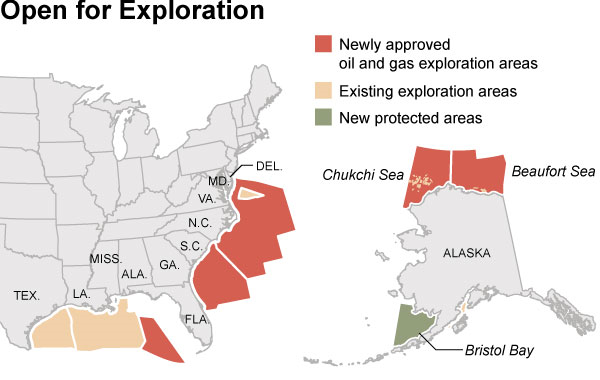
© N.Y. Times Co., 2009. Image from John M. Broder, Obama to Open Offshore Areas to Oil Drilling for First Time, N.Y. Times, Mar. 31, 2010; star added by author.
4.4.3.2. The Deepwater Horizon Disaster
4.4.3.2.1. Overview: Less than a month after the announcement lifting the moratorium on offshore drilling, see supra § 4.4.3.1., the oil rig Deepwater Horizon exploded on April 20, 2010, about 50 miles off the coast of Louisiana in the Gulf of Mexico, killing 11 of its 126-member crew instantly, and sank two days later. The accident threatened to become the largest environmental disaster in American history and was referred to on May 12th as a “perfect ecological storm” by a research scientist at the Living Marine Resources Cooperative Science Center at NOAA. (Steven D. Cook, Oil Spills: Impact of Gulf Spill Could Last Decades, Witnesses Tell Senate Environment Panel, 90 BNA Daily Environment Report A-7 (May 12, 2010); Tom Philpott, So long and thanks for all the fish: Gulf of Mexico: from magnificent resource to industrial sacrifice zone, GRIST, April 29, 2010.) The rig was owned by Transocean Limited, the world’s largest offshore drilling contractor; leased by British Petroleum (BP); Halliburton performed “cementing” operations; Cameron International manufactured the blowout protector (the “BOP”, a critical backup device that failed to shut off the flow of oil on the Deepwater Horizon). (Who will be held responsible for Deepwater Horizon?, Oil & Gas Financial Journal, May 4, 2010.) On May 19th it was revealed that another company, Schlumberger Ltd., the world’s largest oilfield services company, had had a crew on the Deepwater Horizon that departed only hours before the rig exploded and sank; the crew had been performing “wireline services” for BP. (Braden Reddall, Schlumberger says its crew left Horizon day of fire, Reuters India, May 20, 2010.)
- Transocean Ltd. owns about half of the about 50 deepwater drilling platforms in the world; it is currently the target of tax inquires in Norway, Brazil, and the U.S. (Barry Meier, Owner of Exploded Rig Is Known for Testing Rules, N.Y. Times, July 7, 2010.)
The Wall Street Journal reported on April 28, 2010, that the Deepwater Horizon lacked a $500,000 remote control shut-off switch, called an “acoustic trigger,” which is required by two other major oil-producing nations (Norway and Brazil, but not the UK where BP is based) as a last-resort protection against underwater spills; it did have a switch that should have cut off the flow automatically, but it failed to function. The U.S. has considered requiring “acoustic triggers,” but the industry questioned their cost and effectiveness. (Russell Gold, Ben Casselman, Guy Chazan & Jeff Fick, Leaking Oil Well Lacked Safeguard Device, WSJ, April 28, 2010.)
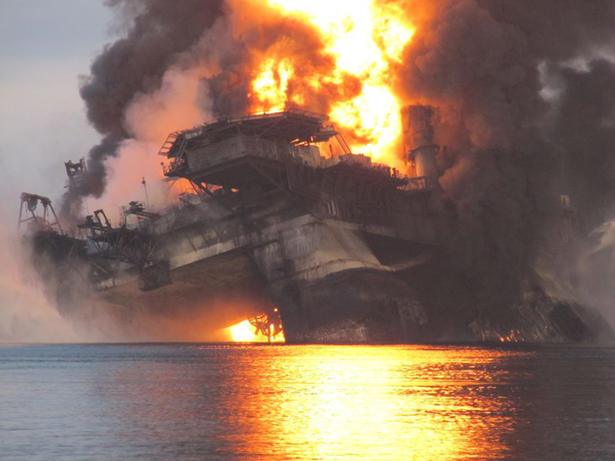
“The Deepwater Horizon’s rig goes boom, killing 11 people and starting a massive and ongoing oil leak. If the Minerals Management Service [see infra] had been a functional, independent oversight agency, this disaster would likely have never happened.” (Photo: U.S. Navy. See Tom Laskawy, The federal MMS: a wholly owned subsidiary of the oil industry, GRIST, May 14, 2010.)
BP is responsible for the cleanup, or at least all “legitimate” compensation claims; there is a $75 million cap on compensation to claimants in the Oil Pollution Act of 1990, 33 U.S.C. §§ 2701 et seq., which BP has said it will not consider a limit. BP and the Coast Guard have tried dumping chemical dispersants into the water in hopes that they will break up the oil into small droplets (Tom Philpott, What are we dumping into the Gulf to ‘fix’ the oil spill?, GRIST, May 3, 2010, at: Tom Philpott, Bad medicine: Chemical dispersants being used in Gulf clean-up are potentially toxic, GRIST, May 6, 2010), and igniting the oil on the surface. (See Controlled Burn Approved for May 5) They have also tried to contain the oil with booms, and skimming it from the surface.
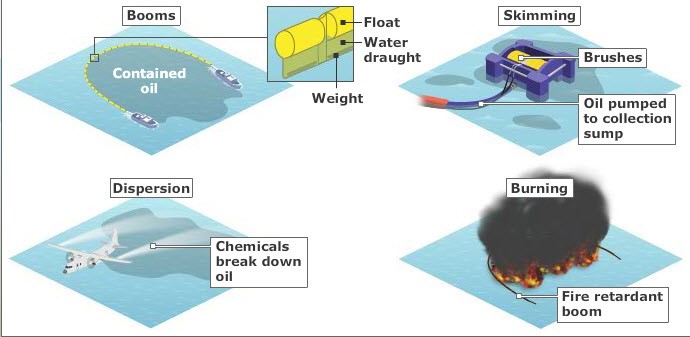 Thanks to BBC Gulf of Mexico oil well disaster.
- A Website was created to consolidate the government’s efforts, entitled the Deepwater Horizon Response: The Official Site of the Deepwater Horizon Unified Command. Agencies and businesses included are: BP, Transocean, the Coast Guard, MMS, EPA, NOAA, DOI, Department of Homeland Security, Defense Department, Fish & Wildlife Service, National Park Service, State Department, U.S. Geological Survey, CDC & OSHA.
-
- RestoreTheGulf.gov replaced deepwaterhorizonresponse.com in July 2010. BP largely supported the first site since April, and will contribute to the costs of the new one.
- The White House’s site is: www.whitehouse.gov/deepwater-bp-oil-spill
- EPA created a Web page at: http://www.epa.gov/bpspill/ to track its efforts at containment and cleanup.
- NOAA’s IncidentNews page is http://www.incidentnews.gov/incident/8220
- The BBC has an interactive guide on Stopping the Oil.
- The New York Times has a topic entitled Gulf of Mexico Oil Spill (2010).
- See also Jonathan L. Ramseur, Oil Spills in U.S. Coastal Waters: Background, Governance, and Issues for Congress, Congressional Research Service, April 30, 2010.
-
Erin Aigner, Joe Burgess, Shan Carter, Joanne Nurse, Haeyoun Park, Amy Schoenfeld & Archie Tse, Tracking the Oil Spill in the Gulf (updated), N.Y. Times, Aug. 2, 2010.
Amount of oil: [NB: A barrel of oil contains 42 gallons; this report uses both gallons and barrels to follow cited sources.]
Shortly after the explosion it was estimated that 5,ooo barrels (or about 210,000 gallons) of oil a day were pouring into the Gulf of Mexico from three leaks over 5000 feet under water; efforts to cap the leaks continued unsuccessful. High winds and seas made containment difficult if not impossible, potentially forcing oil into sensitive fishing grounds and nesting areas.
Initial estimates of the amount of oil were underestimated. The N.Y. Times reported on May 13th that 10 times as much oil may be escaping, although BP maintained that the leak is impossible to measure and declined the help of two Woods Hole Oceanographic Institution scientists with experience in volume measuring. However, the 5000-barrel estimate was calculated using a technique not recommended for large oil spills. (John M. Broder, Campbell Robertson & Clifford Krauss, Amount of Spill Could Escalate, Company Admits, N.Y. Times, May 4, 2010; Justin Gillis, Size of Oil Spill Underestimated, Scientists Say, N.Y. Times, May 13, 2010; Tom Philpott, Spill-rate lowballing reflects badly on government cleanup oversight, GRIST (referring to an NPR story), May 14, 2010.)
On May 19th, Thad Allen, the National Incident Commander for the Deepwater Horizon Response team, established the Flow Rate Technical Team, a multi-agency group including the MMS, NOAA, DOE, Coast Guard, & the U.S. Geological Survey, in response to speculation that BP’s 5000-barrel-per-day estimate was too low. The group’s purpose is to determine the rates at which the oil flowed at different times since the explosion, and to compute the total outflow. (Brendan Demelle, Breaking: Federal Flow Rate Technical Team Established To Determine Extent of BP Oil Spill, EnergyBoom, May 20, 2010.) BP agreed to cooperate, and the group announced that it should have a preliminary report by the week of May 24th. (Oil spill flow rate estimates to be completed next week, NewsWatch: Energy, May 22, 2010.)
On Thursday, May 20th, Steve Wereley, an associate professor of mechanical engineering at Purdue University, spoke on CNN’s American Morning and analyzed video footage recently released by BP (see infra, May 19th hearing before the House Subcommittee on Energy and the Environment); he estimated that as much as 20,000 to 100,000 barrels (840,000 – 4,200,000 gallons) could be escaping. (Video: How much oil is gushing into the Gulf?, May 20, 2010.)
On Friday, May 21st, BP denied estimates that the well was gushing up to 50,000 barrels a day, 10 times as much as their estimate, based on the size of the broken pipe. (Steve Gelsi, New estimates on Gulf spill rate due Saturday, BP says, MarketWatch, May 21, 2010.)
The Flow Rate Technical Team’s report, Estimated Leak Rates and Lost Oil from the Deepwater Horizon Spill, May 27, 2010: Interim Report to the Flow Rate Technical Group, was released on Thursday. It found that the well was gushing between 12,000 and 25,000 barrels per day, far above BP’s highest estimate. The company’s motivations appear to have been financial, as the amount of liability is directly linked to the size of the spill, under the Clean Water Act and the Oil Pollution Act of 1990. Thus, according to the report’s estimates, BP could owe between $444 million and $2.1 billion in fines for the oil spilled thus far, far over the $75 million cap in the 1990 Act. (Press Release: Markey: Flow Rate Report Shines Light on BP’s Financial Liability, True Size of Spill: Chairman Markey Releases Documents Showing BP Low-balled Flow Rate; Lower Spill Estimate Means Lower Financial Liability for Company, House Special Committee on Energy Independence and Global Warming, May 27, 2010; see infra, Liability.) It is possible that up to 30 million gallons of oil have escaped so far, contrasted to the Exxon Valdez spill in Alaska in 1989, our worst oil spill thus far (though not the worst on record), which released 11 million gallons. (Greg Bluestein & Seth Borenstein, Gulf oil spill now bigger than Exxon Valdez, Yahoo News, May 27, 2010; Press Release: Flow Rate Group Provides Preliminary Best Estimate Of Oil Flowing from BP Oil Well, Dept. of Interior, May 27, 2010; Media Advisory: USGS Director McNutt to Hold News Media Teleconference to Discuss Updates on the Oil Flow Rate, DOI, May 27, 2010; Tom Zeller, Jr., Estimates Suggest Spill Is Biggest in U.S. History, N.Y. Times, May 27, 2010. These articles show a wide range of estimates, and illustrate the high degree of uncertainty that remained even after the disaster had continued for 37 days.)
On Tuesday, June 15th, the government updated its estimate of the amount of escaping oil to 60,000 barrels or about 2.5 million gallons of oil a day, meaning that “an amount equal to the Exxon Valdez spill could be gushing from the well about every four days.” As BP is capturing about 15,000 barrels a day, the amount of escaping oil is about 45,000 barrels [1,890,000 gallons] a day. (Justin Gillis, Estimates of Oil Flow Jump Higher, N.Y. Times, June 15, 2010.
On August 2nd, the most precise estimates so far concluded that the Gulf disaster is the largest of its kind so far, having released 5 million barrels of oil, or 210,000,000 gallons, of which about 800,000 barrels, or 33,600,000 gallons, were captured. Previously the Mexican rig Ixtoc I had claimed that dubious title in 1979, at 3.3 million barrels, or 13,869,000 gallons. Experts said that the flow in the Gulf had decreased over time and was down to about 53,000 barrels a day before the well was capped on July 15th but had started at about 62,000 barrels a day. (Campbell Robertson & Clifford Krauss, Gulf Spill Is the Largest of Its Kind, Scientists Say, N.Y. Times, Aug. 2, 2010.)
On Aug. 4th, NOAA claimed that 74% of the 4.9 million barrels of oil believed to have escaped from the ruptured well had disappeared, either due to cleanup efforts, evaporation or natural degradation. But on Aug. 18th, scientists from the University of Georgia believed that most of the oil—70 to 79%—was still there and would be for years to come. (Agence France-Presse, Scientists say figures on spilled oil in Gulf too low, GRIST, Aug. 18, 2010.) Then on Aug. 24, 2010, an article published in Sciencexpress concluded that “the dispersed hydrocarbon plume stimulated deep-sea indigenous γ-proteobacteria that are closely related to known petroleum-degraders.” Thus, possibly because of the relatively light and volatile nature of the oil, the small oil particle size, the low overall concentrations in the plume, the fact that oil has leaked naturally for millennia in the Gulf and that new species of cold-water microorganisms have adapted to such leaks, it was possible that the oil was degrading rapidly. (Terry C. Hazen, et al., Deep-Sea Oil Plume Enriches Indigenous Oil-Degrading Bacteria, Science, Aug. 24, 2010; Priyanka, New species of microbe in Gulf degrading oil faster—study, Money Times, Aug. 25, 2010.)
- See Timothy J. Crone & Maya Tolstoy, Magnitude of the 2010 Gulf of Mexico Oil Leak, 330 (6004) Science 634 (Oct. 29, 2010) (using “optical plume velocimetry to estimate the velocity of fluids issuing from the damaged well both before and after the collapsed riser pipe was removed.”)
Path of the oil: On May 2nd, the oil was about 9 miles off the southeastern coast of Louisiana, and by May 3rd it had reached the Chandeleur Islands, which are a part of the Breton National Wildlife Refuge and an important migrating point for many birds on their way south. (Ed Pilkington, Deepwater Horizon oil spill: turtle deaths soar amid fight to save wildlife: Tests take place to determine cause of deaths, as locals hope booms along coastline will protect commercial fisheries, The Guardian, May 3, 2010.)
Oil gushed into the Gulf during nesting season for sea turtles and birds. Tar balls were sighted on Alabama’s beaches on May 10th, and on May 11th, oil reached the Louisiana coast. (Video: Oil has reached Louisiana coast, says marine biologist: Oil washes ashore on the Louisiana mainland, according to marine biologist Rick Steiner, while US military planes spray chemical dispersant in an attempt to break up the BP slick, guardian.co.uk, May 11, 2010.)
A little over a month after the rig collapsed, oil had affected about 50 miles of the Louisiana coast. (Campbell Robertson & Elisabeth Rosenthal, Agency Orders Use of a Less Toxic Chemical in Gulf, N.Y. Times, May 20, 2010 (“Local and state officials here voiced desperation…with oil from the BP spill showing up on shore as tar balls, sheens and gooey slicks.”))
In mid-May it appeared that the oil already in the water might be headed for (or may already be in) an ocean current that could carry it around the Florida peninsula and up the east coast. (Jeffrey Collins & Jason Dearen, BP hopes to siphon up to half of oil in Gulf, AP, May 17, 2010). This possibility was under discussion at a hearing on Monday May 17th before the Senate Homeland Security and Governmental Affairs Committee entitled “The Gulf Coast Catastrophe: Assessing the Nation’s Response to the Deepwater Horizon Oil Spill.” (Tom Doggett & Ayesha Rascoe, UPDATE 1-US Coast Guard prepares for oil in south Florida: Oil getting closer to “Loop Current,” Reuters, May 17, 2010; John M. Broder, Scientists Warn Oil Spill Could Threaten Florida, N.Y. Times, May 17, 2010 (independent scientists warn that oil from a huge underwater plume could reach the Florida Keys in about 2 weeks [see supra] but NOAA’s administrator says that the oil will be very dilute by the time it gets there and will not make much of an environmental impact); Gulf oil now in powerful Loop Current, scientists say: The first oil from the Gulf of Mexico spill has entered an ocean current that could take it to Florida and up the east coast of the US, scientists say, BBC News, May 19, 2010 (the European Space Agency’s satellite images suggest the oil could reach the coral reefs of the Florida Keys in 6 days; the spill is visible to astronauts and cosmonauts aboard the International Space Station.)) On Thursday, June 3d, 15 days later, the BBC reported that an oil slick “containing thousands of tar balls – heavy globs of decayed oil – [wa]s only seven miles (11km) from Pensacola on the Florida ‘panhandle’….” It was projected that oil could reach the Florida shore by June 4th (BP to fund oil barriers off Louisiana coast, BBC News, June 3, 2010.), and it did. (Melissa Nelson & Jay Reeves, Cap collects some Gulf oil; crude washes into Fla., AP, June 4, 2010; Drew Douglas, Florida: Tar ‘Patties,’ Balls Reach Northwest Florida; Oil Slick Expected to Hit State Shortly, BNA State Environment Daily (June 7, 2010))
However, a hopeful note was struck in early June, when scientists found that the Loop Current was forming a large circular eddy called the “Loop Current Ring,” a deviation from its normal path, where the oil could be sequestered for months, possibly lessening its impact on coastal ecosystems. (Drew Douglas, Florida: Tar ‘Patties,’ Balls Reach Northwest Florida; Oil Slick Expected to Hit State Shortly, BNA State Environment Daily (June 7, 2010); Mark Schrope & Janet Fang, Researchers track path of oil from rig spill, 465 Nature 532 (June 3, 2010.)
On May 12th, scientists from the National Institute for Undersea Science and Technology aboard the research ship Pelican discovered an underwater plume about 10 kilometers wide, presumably originating from the well, hovering about 100 meters above the sea floor. Tests are being conducted the week of the 17th to confirm that the plume is in fact oil from the Deepwater Horizon. The plume could pose a threat to deep corals and other species, which may be exacerbated by the use of underwater dispersants, see below. (Mark Schrope, Oil cruise finds deep-sea plume: Nature reports from the research ship Pelican as scientists map the hidden extent of the Deepwater disaster, 465 Nature 274 (May 18, 2010))
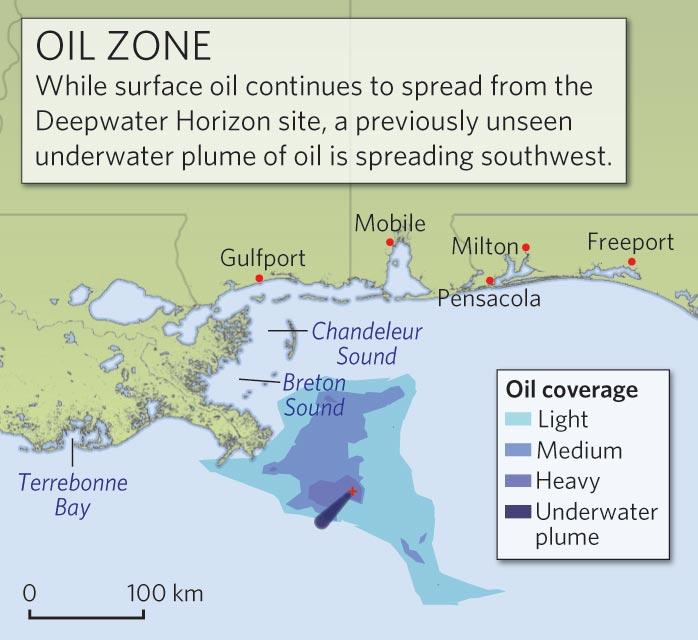
Map from Mark Schrope, Oil cruise finds deep-sea plume: Nature reports from the research ship Pelican as scientists map the hidden extent of the Deepwater disaster, Nature, May 18, 2010.
Over the July 4th weekend, a small number of tar balls washed up on Texas beaches near Galveston, meaning that oil from the broken well has touched every Gulf state. However, Hurricane Alex from the week of June 28th may have been responsible and the oil may not indicate that more is to come. (Juan A. Lozano, Officials say BP spill now hitting all Gulf states, July 6, 2010.) The oil in Texas seems to have been an anomaly (it may have escaped from a cleanup vessel), but over the holiday weekend tar balls appeared in Lake Pontchartrain, driven by strong east winds that are expected to continue. (Campbell Robertson, Effects of Spill Spread as Tar Balls Are Found, N.Y. Times, July 6, 2010.)
Stopping the oil: On May 5th, BP used remotely controlled vehicles to cut an underwater pipe from which oil was gushing and install a valve, which stopped one of the three leaks but did not appreciably reduce the flow of oil. (NPR Staff and Wires, One Oil Leak Capped As Dome Heads To Spill Site, May 5, 2010.) Then BP constructed a 4-story, 100-ton containment dome it planned to lower over the leaks to funnel about 85% of the escaping oil to a tanker on the surface, although it was unsure whether it would work at these depths. (Ian Urbina, Justin Gillis & Clifford Krauss, On Defensive, BP Readies Dome to Contain Spill, N.Y. Times, May 3, 2010; Harry R. Weber, Giant box being loaded on boat bound for Gulf, Yahoo News, May 5, 2010; Harry Weber & Tamara Lush, BP brings in the big box to deal with oil disaster, AP, May 6, 2010; Clifford Krauss, For BP, a Battle to Contain Leaks and an Image Fight, Too, N.Y. Times, May 6, 2010.) Indeed, over the weekend of May 8-9th, the dome failed to function because ice crystals built up inside it; work on a relief well to divert the oil had begun on May 2d, but will take several months to complete. (Gulf Oil Spill Containment Attempt Fails, Environment News Service, May 10, 2010.)
On Wednesday, May 12th, BP officials and scientists met with Energy Secretary Steven Chu and Interior Secretary Ken Salazar in Houston and informed them that underwater equipment was being installed by 10 robotic submersibles that could possibly shut off the gushing oil within weeks rather than the months it would take for relief wells to alleviate the situation. Options include a “junk shot” to clog the BOP with shredded tires and golf balls; another is installing a second BOP; another is called a “top kill” or a “dynamic kill” and involves pumping heavy mud through the failed BOP and then covering it with cement to stop the flow; another is installing a valve to stop the flow (Henry Fountain & Matthew L. Wald, BP Says Leak May Be Closer to a Solution, N.Y. Times, May 12, 2010); another option is installing a smaller containment dome than the one that previously failed, hopefully by the end of the week of the 10th. (Steve Gorman, BP to try new fix as oil spill threatens Gulf, Yahoo News, May 13, 2010.)
On Saturday May 15th, EPA and the Coast Guard approved the use of underwater dispersants to prevent the oil from reaching the surface. (Press Release, Coast Guard and EPA approve use of dispersant subsea in further effort to prevent oil from reaching U.S. shoreline.)
On Sunday, May 16th, BP finally reported a modicum of success. They inserted a tube into the pipe from which most of the oil is escaping, and began to divert the oil to a tanker on the surface. This is only a temporary measure, however, as they still need to stop the flow altogether. (Shaila Dewan, BP Reports Some Success in Capturing Leaking Oil, N.Y. Times, May 16, 2010; US says BP move to curb oil leak ‘no solution’, BBC News, May 17, 2010.) BP’s claims as to how much oil is actually being siphoned off vary widely, from 3000 to 5000 barrels a day, from what was originally (and probably inaccurately, see supra) estimated as a 5000-barrel-per-day leak. (Matthew Bigg, U.S. to check BP spill size, heavy oil comes ashore, Reuters, May 20, 2010; CNN Wire Staff, EPA tells BP to find new dispersant, CNN, May 20, 2010.)
BP decided to try to “kill” the well by May 22nd or 23rd. (Matthew L. Wald & Tom Zeller, Jr., Fishing Ban Is Expanded as Spill’s Impact Becomes More Evident, N.Y. Times, May 18, 2010.) On the 21th that attempt was postponed until at least the 25th (Greg Bluestein, BP delays attempt to plug leak with mud: White House taps Graham, Reilly to lead investigative panel, MSNBC, May 21, 2010; Nancy J. Moore & Linda Roeder, Oil Spills: BP Prepares for ‘Top Kill’ Procedure In Hopes of Shutting Down Gulf Oil Flow, 98 Daily Environment Report A-14 (May 24, 2010)), and postponed again until Wednesday the 26th. BP estimates “probability of success between 60 percent and 70 percent.” (Campbell Robertson, Clifford Krauss & John M. Broder, Oil Hits Home, Spreading Arc of Frustration, N.Y. Times, May 24, 2010; Clifford Krauss & Matthew L. Wald, BP Prepares for ‘Top Kill’ Procedure to Contain Spill, N.Y. Times, May 25, 2010.)
- The Coast Guard gave final approval for the “top kill” (Greg Bluestein & Mike Baker, Coast Guard OKs ‘top kill’ plan to stop oil geyser, Yahoo News, May 26, 2010) and the attempt was finally made at 1 p.m. Central time on Wednesday the 26th. The company won’t know for several days if the procedure was successful. (Clifford Krauss & Robbie Brown, BP Attempts ‘Top Kill’ Method to Seal Oil Well in Gulf, N.Y. Times, May 26, 2010.) BP also agreed, under government pressure, to keep its live video stream active during the procedure. (Robert Mackey, BP Agrees to Show ‘Top Kill’ Live, N.Y. Times, May 26, 2010.)
- Thursday it appeared as if the procedure might succeed, according to BP executives and Admiral Thad W. Allen of the Coast Guard, the leader of the government effort. When the pressure inside the well is zero, it will be sealed with concrete. (‘Top kill’ method ‘stops BP oil leak’ in Gulf of Mexico: BP has stopped the flow of oil and gas from a ruptured well into the Gulf of Mexico, a US official told local media, BBC News, May 27, 2010; Clifford Krauss & John M. Broder, ‘Top Kill’ Effort Seems to Be Working, U.S. Says Cautiously, N.Y. Times, May 27, 2010.) However, BP in fact had stopped pumping at 11 p.m. Wednesday, when it appeared that much of the mud was escaping or being forced away by the gushing oil. It resumed pumping Thursday night, injecting solid objects such as golf balls and shredded tires as well as heavy drilling fluids to staunch the flow. This combination of the “junk shot” with the “top kill” technique appeared on Friday to be working, but the company said it would be another 48 hours before they would be certain of success. (Clifford Krauss & John M. Broder, BP Resumes Work to Plug Oil Leak After Facing Setback, N.Y. Times, May 27, 2010; Clifford Krauss & John M. Broder, Oil Flow Is Stemmed, but Could Resume, Official Says, N.Y. Times, May 28, 2010.)
- BP announced on May 29th that the “top kill” attempt had failed. By June 1, BP’s stock had fallen an additional 15%. (Jad Mouawad & John Schwartz, Cleanup Costs and Lawsuits Rattle BP’s Investors, N.Y. Times, June 2, 1010.)
Next they will try another containment dome approach. Submarine robots will try to cut off the 21” riser pipe and then a cap will be positioned over it to try to capture most of the oil and funnel it to boats on the surface; this technique will increase the flow of oil from the broken pipe, at least initially. (Leslie Kaufman & Clifford Krauss, BP Prepares to Take New Tack on Leak After ‘Top Kill’ Fails, N.Y. Times, May 29, 2010.) It is called a “lower marine riser package (LMRP) cap containment system.” (Susanne Pagano, Oil Spills: BP Moves to New Plan to Capture Oil From Leaking Well in Gulf of Mexico, 104 BNA Daily Environment Report A-10 (June 2, 2010.)) The new approach hit a snag on Wednesday June 2d, when the saw that was being used by an underwater robot to cut the riser pipe got caught. (Campbell Robertson & Joseph Berger, Latest Effort to Stop Oil Flow Hits a Snag, N.Y. Times, June 2, 1010; BP shares recoup early losses despite US probe news, BBC News, June 2, 2010.) The next morning the riser pipe had been cut off, although unevenly, by shears, and BP was preparing to lower the cap over it in the afternoon. (Henry Fountain & Joseph Berger, Admiral Says Oil Pipe Is Cut, a Key Step in Halting Leak, N.Y. Times, June 3, 1010.) The cap was in place by late Thursday but it was unclear on Friday whether the technique was working. (Michael Cooper, Peter Baker & Henry Fountain, Obama Arrives in Gulf Region as Well Cap Effort Proceeds, N.Y. Times, June 4, 1010.)
- On June 15th, the Times reported that the new containment dome was the most successful method employed thus far. (Justin Gillis, Estimates of Oil Flow Jump Higher, N.Y. Times, June 15, 2010.) It diverted 15,000 barrels of oil a day to a ship on the surface. (Henry Fountain, Cap Connector Is Installed on BP Well, N.Y. Times, July 11, 2010.)
BP began drilling a relief well on May 2nd and a second on May 16th, but the wells are, on the first of June, still months away from completion. The goal is to connect with the original well and pump in mud, then cement, to staunch the flow of oil. Unfortunately, hurricane season officially began June 1st and is expected to be active, and the wells, though ahead of schedule, will probably not be operational until mid-August. (Helene Cooper, Obama Pledges Tough Inquiry Into Oil Spill, N.Y. Times, June 1, 2010; Henry Fountain, Plan for Relief Wells Spurs Hope Amid Caution, N.Y. Times, June 3, 2010; Henry Fountain, Hitting a Tiny Bull’s-Eye Miles Under the Gulf, N.Y. Times, July 5, 2010; John M. Broder, Obama Presses BP to Recover More Oil, N.Y. Times, July 8, 2010.)
Before the relief wells are complete, BP wants to replace the LMRP cap with one that would fit more tightly and potentially capture more oil. The new cap could possibly shut down all oil being released from the well, as well as offering more flexibility during hurricane season. The company also plans to disconnect the current recovery vessel, the Discoverer Enterprise, thus increasing the flow of oil temporarily before a second vessel, the Helix Producer, with a larger capacity (50,000 barrels, or possibly up to 80,000 barrels), and the Q4000 rig, could be attached. The government is pressing BP to proceed as soon as possible with both endeavors. (John M. Broder, Obama Presses BP to Recover More Oil, N.Y. Times, July 8, 2010.) On Friday July 9th it was reported that work would begin over the weekend and that the spill could be contained in 3 or 4 days. (AP, New cap, ships could contain Gulf leak by Monday, July 9, 2010; Henry Fountain, BP Is Ready to Put Tighter Cap on Runaway Well, N.Y. Times, July 9, 2010.)
On Sunday, July 11th, BP was pleased at its progress, and predicted that the work could be completed on Wednesday. The new cap should be able to contain all the escaping oil, estimated at 60,000 barrels [2,520,000 gallons] of oil a day, but until it is functional the oil is escaping unchecked, although the Q4000 containment system captured some oil on the surface. Skimmer boats on the surface are capturing what they can, and 15 controlled burns were conducted on Saturday. (Henry Fountain, Cap Connector Is Installed on BP Well, N.Y. Times, July 11, 2010.)
- But on Wednesday July 14th, BP stopped work on the relief wells and delayed testing the new cap for at least 24 hours, at the request of Thad Allen. A senior vice president said that putting the cap under pressure to test it could have an adverse effect on the relief wells. (Tom Breen & Harry R. Weber, BP delays work on stopgap and permanent well fix, AP, July 14, 2010; Henry Fountain, U.S. Delays Test of Device That Could Seal Gulf Well, N.Y. Times, July 14, 2010.) It began testing the next day, Thursday the 15th, after fixing a leak on the new cap. (Henry Fountain, BP Says Cap Is Repaired and Oil Cutoff Test Can Proceed, N.Y. Times, July 15, 2010.)
- BP reported at about 2:25 p.m. on July 15th that the flow of oil had completely stopped, at least temporarily; but even if no oil escapes for 48 hours it will not mean that the oil is stopped permanently. Work on the relief wells is still suspended as part of the integrity test. (BP says oil has stopped leaking: BP says it has temporarily stopped oil flowing into the Gulf of Mexico from its leaking well, BBC News, July 15, 2010.)
- On Friday the 16th, there were no signs of new leaks, BP was encouraged, and the president was cautiously optimistic. (Campbell Robertson & Henry Fountain, Obama Reacts Cautiously to Hopeful BP Test Results, N.Y. Times, July 16, 2010.)
- Signs of leaks (aka “undetermined anomalies”) in the mine did appear over that weekend, however, which may mean the government will order BP to open the well and resume collecting oil, rather than keeping it closed until it can be sealed permanently when the relief wells are complete. (Henry Fountain, U.S. Allows BP to Keep Well Closed for Another Day, N.Y. Times, July 19, 2010.)
- On Tuesday, Aug. 3, 2010, BP began the “static kill” of the well, pumping mud and then cement down a pipe; the filling with mud and cement from below via the relief well, aka the “bottom kill,” could begin Aug. 11th when the relief well is completed. (Greg Bluestein, Crews begin effort to plug leaking Gulf oil well, Yahoo News, Aug. 3, 2010; Clifford Krauss, BP Begins ‘Static Kill,’ to Seal Well Permanently, N.Y. Times, Aug. 3, 2010.) The next day the company announced that the static kill had successfully plugged the leaking well; its stock surged on the news. (Surojit Chatterjee, BP bids farewell to Gulf oil spill with “static kill”, International Business Times, Aug. 4, 2010.) The government was expected to announce on Aug. 4th that three-quarters of the oil had been evaporated, dispersed, captured or otherwise eliminated and that what remained did not pose much of a threat. (Justin Gillis, U.S. Finds Most Oil From Spill Poses Little Additional Risk, N.Y. Times, Aug. 4, 2010.)
- The threat of storms in the Gulf briefly postponed the completion of the relief wells, now only about 30 feet away from intercepting the well; work resumed on Thursday Aug. 12th. (Agence France-Presse, BP relaunches Gulf well-sealing effort after storm, GRIST, Aug. 12, 2010.)
- Tests of the Macondo well seem to show conclusively that the well is sealed, but Thad Allen says the relief well will be finished, but there is concern that if it is used to pump more mud into the well, it might crack the existing seals. No one seems quite sure how best to proceed. (Henry Fountain, Relief Well to Be Completed to Ensure That Spill Is Stopped, N.Y. Times, Aug. 13, 2010.)
- On Aug. 19th, BP began pressure testing the cap that has sealed the oil in since July 15th, supra; the test will confirm whether the well is sealed, and will last about 48 hours. The relief well was about 3.5 feet from the side of the Macondo well and about 50 feet from its intercept target on that date. When the test is complete, BP wants to retrieve a 3500 foot drillpipe it believes is inside the blowout preventer, then remove the original BOP and replace it with another. Once the relief well has plugged the well, other plugs will insure the relief well is sealed as well. (Kristen Hays, Factbox: BP’s last steps to kill Gulf well, Reuters, Aug. 19, 2010.)
On Thursday, Sept. 2, 2010, BP removed the temporary cap and the BOP, which is an important piece of evidence in the investigation into the disaster as it failed to shut down the flow of oil after the explosion, was removed from the ocean floor. It was delivered to a NASA facility in New Orleans on Saturday, Sept. 4th, to be inspected by federal investigators. (Clifford Krauss & John M. Broder, BP Says Limits on Drilling Imperil Oil Spill Payouts, N.Y. Times, Sept. 2, 2010; Ian Urbina, Report by BP Finds Several Companies at Fault in Spill, N.Y. Times, Sept. 8, 2010.)
On Sept. 17, 2010, BP’s relief well finally intersected the Macondo well and was poised for the “bottom kill.” Next, mud and cement will be pumped through the relief well to seal the leaking well from underneath, about 2 ½ miles under the sea floor, once and for all. The final step will be to conduct pressure tests after the concrete is set. (BP oil spill: relief well ready for ‘final kill’, Telegraph.co.uk, Sept. 17, 2010; Kristen Hays, BP relief well intercepts ruptured Gulf well, Reuters, Sept. 17, 2010.)
The Macondo well was finally sealed on Sunday, Sept. 19, 2010, after 87 days; a pressure test showed that the concrete plug that killed the well was holding. (BBC News, BP finally seals leaking Gulf of Mexico oil well: The ruptured well that has spewed millions of barrels of oil into the Gulf of Mexico has finally been sealed, US officials say, Sept. 19, 2010.) A report released on Oct. 6, 2010 (see infra for others), stated: “As of July 15, 2010—the day the well stopped flowing— the response involved approximately 44,000 responders; more than 6,870 vessels (including skimmers, tugs, barges, and recovery vessels); approximately 4.12 million feet of boom; 17,500 National Guard troops from Gulf Coast states; five states; multiple corporations; and untold hours of work by federal, state, and local officials; employees or contractors of BP; and private citizens.” (National Commission on the BP Deepwater Horizon Oil Spill and Offshore Drilling, Decision-Making Within the Unified Command, at 1, citing Press Release, Deepwater Horizon Incident Joint Information Center, Ongoing Administration-wide response to the Deepwater BP Oil Spill (July 15, 2010))
- For a summary of the efforts to stop the oil, see Al Granberg, Mika Grondahl, Xaquin G.V., Haeyoun Park & Graham Roberts, Methods That Have Been Tried to Stop the Leaking Oil, N.Y. Times, June 4, 2010.
- See infra, Afterward.
4.4.3.2.2. Congressional Response: On Tuesday, May 11th, leaders from BP America (chairman & president Lamar McKay), Swiss-based Transocean, Ltd. (Steven Newman, CEO), and Halliburton, Inc. (Tim Probert), testified before the Senate Energy and Natural Resources Committee at a hearing entitled “Offshore Oil Development and the Deepwater Horizon Accident”; another hearing before the Senate Environment and Public Works Committee was scheduled for later in the day, entitled “Economic and Environmental Impacts of the Recent Oil Spill in the Gulf of Mexico.” Unsurprisingly, each company blamed the others. (H. Josef Hebert, Oil spill testimony to Congress: Not our fault, AP, May 11, 2010; Lynn Garner, Oil Spills: Company Executives Unable to Explain Cause Of Drilling Rig Accident That Led to Gulf Spill, 90 BNA Daily Environment Report A-1 (May 12, 2010))
The following day, May 12th, the House of Representatives continued the interrogation before the Committee on Energy and Commerce’s Subcommittee on Oversight and Investigations in a hearing entitled “Inquiry into the Deepwater Horizon Gulf Coast Oil Spill.” In addition to the officers who testified on the 11th, Jack Moore, President and CEO of Houston-based Cameron International Corp., which manufactured the BOP, defended its equipment’s “solid track record” and “very long history of reliable performance”; however, questions have arisen about modifications to the BOP on the Deepwater Horizon (Cameron CEO defends blowout preventer, Houston Chronicle’s NewsWatch: Energy, May 12, 2010; Tom Fowler, BP asks if blowout devices have been modified, Houston Chronicle, May 8, 2010; Lynn Garner, Oil Spills: Company Executives Unable to Explain Cause Of Drilling Rig Accident That Led to Gulf Spill, 90 BNA Daily Environment Report A-1 (May 12, 2010)), which Mr. Moore testified had been made to BP’s specifications. (Tresa Baldas, Oil Spill Defendants Continue to Play Blame Game, National Law Journal, May 13, 2010.) (The Wall Street Journal reported in 2005 (Jim Carlton, Alaska Probe Focuses on BP, Nabors; Workers Allege Companies Failed to Report Blowouts, Falsified Drilling Records, Feb. 3, 2005, at B-6), and the Huffington Post in May 2010, that at least as early as 2003 BP was aware that tests of its BOPs were being falsified in Alaska.)
On May 14th President Obama referred to the oil executives’ testimony at the hearings as a “ridiculous spectacle.” (Agence France-Presse, Obama takes aim at oil companies over oil spill, GRIST, May 14, 2010.)
On Tuesday May 18th, the Senate Environment and Public Works Committee had a second hearing entitled: “The Federal Response to the Recent Oil Spill in the Gulf of Mexico”; the Senate Energy and Natural Resources committee met “to receive testimony from the Administration on issues related to offshore oil and gas exploration including the accident involving the Deepwater Horizon in the Gulf of Mexico” and heard testimony from Ken Salazar, Secretary of the DOI, who acknowledged the corruption in the MMS. The House Committee on Natural Resources, which has primary jurisdiction over offshore oil and gas drilling, announced on May 18th a seven-part oversight hearing series to investigate the Deepwater Horizon oil rig explosion and examine the future of America’s offshore oil and gas policy, beginning on May 26th and continuing until June 29th. (House Panel to Hold Seven-Part Oversight Hearing Series on Deepwater Horizon Oil Rig Explosion, May 18, 2010.)
On May 18th Senate Republicans blocked for the second time efforts to raise the statutory limit on oil companies’ liability from $75 million to $10 billion. Some lawmakers (e.g., Harry Reid) are in favor of having no cap, but others (e.g., Inhofe, Murkowski) believe $10 billion would drive small companies who couldn’t afford the insurance premiums out of business. (Alexander Bolton & Ben Geman, Obama breaks with his party on issue of oil spill liability caps, The Hill, May 18, 2010; Lisa Murkowski Blocks Bill To Raise Oil Spill Liability Cap, Huffington Post, May 14, 2010.) Still others believe raising the cap and driving out small companies would be a victory for some of the larger players, such as BP. (Elizabeth Williamson, BP Aims to Avoid Fresh Restrictions on Drilling, WSJ, May 27, 2010.)
The House Subcommittee on Energy and the Environment held a hearing on Wednesday, May 19th, entitled: “Sizing up the BP Oil Spill: Science and Engineering Measuring Methods.” Rep. Edward J. Markey, D-Mass., chair of the subcommittee, sent a letter on May 19th to BP America’s CEO McKay requesting that BP make publicly available a live video stream from the leak site, in order to assist scientists and engineers to stop it; BP agreed. (Press release: Markey to Get Live Feed of BP Oil Spill on Website: BP Acquiesces to Markey’s Request, Will Release Video Stream Tonight to Chairman, May 19, 2010.) The live video was posted on the subcommittee’s web site on Thursday the 20th and also on BP’s site.
Also on May 19th the House Transportation and Infrastructure Committee questioned BP America chairman Lamar McKay, among others, about the decision to use the dispersant Corexit 9500, which contains petroleum distillates, propylene glycol and a proprietary organic sulfonic salt and is considered “less effective and more toxic” than alternatives; on Thursday May 20th, EPA gave BP until midnight on the 20th to find another from a list of 18 EPA-approved dispersants, and 72 hours to stop using Corexit in the Gulf. (CNN Wire Staff, EPA tells BP to find new dispersant, May 20, 2010; Siobhan Hughes, Angel Gonzalez & Jeffrey Ball, EPA Orders BP to Use Less-Toxic Dispersant in Gulf, WSJ, May 20, 2010; Campbell Robertson & Elisabeth Rosenthal, Agency Orders Use of a Less Toxic Chemical in Gulf, N.Y. Times, May 20, 2010.) However, BP continued to use Corexit, disputing EPA’s method of estimating toxicity. (Nancy J. Moore & Linda Roeder, Oil Spills: BP Prepares for ‘Top Kill’ Procedure In Hopes of Shutting Down Gulf Oil Flow, 98 Daily Environment Report A-14 (May 24, 2010); Elisabeth Rosenthal & Anahad O’Connor, BP Kept Using Toxic Chemical in Gulf After E.P.A. Deadline, N.Y. Times, May 24, 2010; Elisabeth Rosenthal, In Standoff With Environmental Officials, BP Stays With an Oil Spill Dispersant, N.Y. Times, May 24, 2010.)
Wright v. BP was filed on July 26, 2010, in the U.S. District Court for the Southern District of Alabama and is the first personal injury lawsuit involving Corexit 9500. Plaintiffs (Gulf coast residents and property owners) claim that BP’s dumping of the dispersant by spraying it from airplanes has caused over 100 residents to seek medical care in emergency rooms for nausea, dizziness, shortness of breath and extreme headaches; many more have visited their personal doctors for similar conditions. An earlier federal class action lawsuit, Parker v. Nalco Co., filed by Louisiana oystermen against BP and Nalco, which manufactures Corexit 9500, in U.S. District Court for the Eastern District of Louisiana, did not claim personal injury but alleged that the dispersant is four times as toxic as the oil itself. (Tresa Baldas, Gulf Coast Residents File Personal Injury Suit Over Oil Dispersant, National Law Journal, July 29, 2010). See infra, Lawsuits.
On May 25th the Senate Energy and Natural Resources committee had its third hearing on the BP disaster, entitled Liability and Financial Responsibility Issues Related to Offshore Oil Production. Topics included the $75 million damage cap, which has not been revised in 20 years to account for inflation; civil and criminal penalties are likewise obsolete. See infra. (David Ingram, Senators Pressure DOJ to Take Action Against Oil Spill Companies, National Law Journal, May 25, 2010; Clifford Krauss & Matthew L. Wald, BP Prepares for ‘Top Kill’ Procedure to Contain Spill, N.Y. Times, May 25, 2010.)
Liability legislation in the 111th Congress (some, in March 2011, have been reintroduced into the 112th) includes:
- S. 3305, The Big Oil Bailout Prevention Liability Act of 2010, int. 5/4/2010
- S. 214, the Big Oil Bailout Prevention Unlimited Liability Act of 2011 was introduced into the 112th Congress on 1/27/2011
- S. 3306, The Big Oil Bailout Prevention Trust Fund Act of 2010, int. 5/4/2010
- S. 215 with the same title was introduced into the 112th Congress on 1/27/2011
- S. 3345, The Big Polluter Pays Act, int. 5/11/2010, to amend 46 U.S.C. to remove the cap on punitive damages established by the Supreme Court in Exxon Shipping Company et al. v. Baker et al., No. 07–219, 554 U.S. __, 128 S. Ct. 2605 (2008), which imposed a 1:1 ratio of punitive damages to compensatory damages in maritime cases. (Marcia Coyle, Senators Target Supreme Court’s ‘Exxon’ Ruling in Effort to Make Oil Companies Pay for Spills, National Law Journal, June 1, 2010.)
- S. 3346, Outer Continental Shelf Lands Act Amendments Act of 2010, int. 5/11/2010
- H.R. 5214, The Big Oil Bailout Prevention Act of 2010, int. 5/5/2010
- H.R. 492, The Big Oil Bailout Prevention Act of 2011, was introduced into the 112th Congress on 1/26/2011
- H.R. 5355, To amend the Oil Pollution Act of 1990 to repeal the limitation of liability of a responsible party for a discharge or substantial threat of a discharge of oil from an offshore oil facility, int. 5/20/2010
- H.R. 5481, To give subpoena power to the National Commission on the BP Deepwater Horizon Oil Spill and Offshore Drilling, int. 6/8/2010
- S. 3515, Department of Interior Research and Technologies for Oil Spill Prevention and Response Act, int. 6/21/2010
- S. 3516, Outer Continental Shelf Reform Act of 2010, int. 6/21/2010
- H.R. 5626, the Blowout Prevention Act of 2010, int. 6/29/2010
- H.R. 5629, the Oil Spill Accountability and Environmental Protection Act of 2010, int. 6/29/2010
On Thursday May 27th the House Judiciary Committee had a hearing entitled Liability Issues Surrounding the Gulf Coast Oil Disaster; officials from BP, Transocean, Cameron and Halliburton testified, as well as relatives of the deceased oil workers and survivors of the Deepwater Horizon, and others.
Also on May 27th members of the Senate Committee on Small Business and Entrepreneurship at a hearing entitled Impact of the Deepwater Horizon Oil Spill on Small Businesses, agreed that BP should be held responsible for small business losses as a result of the disaster, as well as communities’ losses and those of individuals. (Andy Medici, Oil Spills: Senate Small Business Committee Members Want BP Held Accountable to Gulf Companies, BNA State Environment Daily, May 28, 2010.)
In July, the House Committee on Natural Resources voted for a draft bill [H.R. 3534, see infra this section] to preclude oil companies with poor safety records from receiving offshore oil exploration permits. It defines such companies as those that experienced 10 or more deaths in the last 7 years; the Gulf disaster killed 11 workers. (BP faces 7-year offshore drilling ban: A US Congressional committee has agreed measures that would ban BP from new offshore drilling for seven years, BBC News, July 15, 2010.)
On Aug. 19, 2010, the House Committee on Energy and Commerce, Subcommittee on Energy and Environment, had a hearing entitled “The BP Oil Spill: Accounting for the Spilled Oil and Ensuring the Safety of Seafood from the Gulf.”
On Aug. 24th, the second day of the 4th session (running from Aug. 23-27) of a joint investigation by the U.S. Coast Guard and the new Bureau of Energy Management, co-chaired by David Dykes and Captain Hung Nguyen, Halliburton’s Jesse M. Gagliano testified that he had expressed concerns about BP’s planned closing of the well connected to the Deepwater Horizon and highlighted some of the risky decisions that were made. (Robbie Brown, Adviser Says He Raised Concerns to BP on Well, N.Y. Times, Aug. 24, 2010; Deepwater Horizon Joint Investigation: The Official Site of the Joint Investigation Team.) On Aug. 25th, the third day of the session, BP’s Harry Thierens spoke as well as several Transocean executives. (See Deepwater Horizon Joint Investigation: The Official Site of the Joint Investigation Team.)
On Sept. 2, 2010, the N.Y. Times reported that legislation passed by the House on July 30, 2010, H.R. 3534, the Consolidated Land, Energy, and Aquatic Resources Act of 2009 (aka the CLEAR Act) contains an amendment (written by California Representative George Miller) that, while not explicitly naming BP, bars any company with “more than 10 fatalities at its exploration, development, and production facilities and refineries as a result of violations of Federal or State health, safety, or environmental laws,” or that was penalized over $10 million under the CAA or the Clean Water Act, within seven years prior to the request date, from acquiring a lease to drill on the Outer Continental Shelf (see § 206 (Leases, easements, and rights-of-way), § (b) Environmental Diligence, which amends subsection 8 (d) of the Outer Continental Shelf Lands Act (43 U.S.C. 1337), entitled: Requirement for Certification of Responsible Stewardship, at pages 57-59 of the engrossed bill). BP warned Congress that if the CLEAR Act is enacted, and BP is thus denied new offshore drilling permits, it just might not have enough money to meet its obligations to repair damages in the Gulf from the Deepwater Horizon disaster. (Clifford Krauss & John M. Broder, BP Says Limits on Drilling Imperil Oil Spill Payouts, N.Y. Times, Sept. 2, 2010.) H.R. 3534 was placed on the Senate calendar Aug. 4, 2010, but it was not enacted and I can find no evidence in February 2011 that it has been reintroduced into the 112th Congress.
The pace of future approvals of new deepwater drilling permits may be at issue when Mr. Salazar testifies in hearings before the Senate Energy Committee on Mar. 2nd and the House Natural Resources Committee on Mar. 3rd. (Geof Koss & Margaret Kriz Hobson, Oil price spike reignites debate, CQ, Feb. 28, 2011.)
4.4.3.2.3. Liability: Transocean has cited the Limitation of Liability Act of 1851, 46 U.S.C. § 30501 et seq., for the proposition that a vessel owner is liable only for the post-accident value of the vessel and cargo except in cases of negligence, to limit its liability to $26.7 million. (Carrie Levine & David Ingram, Companies in Gulf Spill Tap Washington Help: Lawyers, lobbyists enter fray as Washington backlash grows, National Law Journal, June 1, 2010.) (Interesting definition of a typically stationary offshore drilling rig as a “vessel.” See David W. Robertson, How the Supreme Court’s New Definition of “Vessel” is Affecting Seaman Status, Admiralty Jurisdiction, and Other Areas of Maritime Law, 39 Journal of Maritime Law & Commerce 115 (2008)) This attempt caused such an outcry that one of Transocean’s attorneys told the House Judiciary Committee at the end of May that “the company filed under the [Limitation of Liability] act only at the insistence of its insurers, and that a ‘failure to do so could have resulted in the loss of insurance coverage to help pay claims.’” (Jad Mouawad & John Schwartz, Cleanup Costs and Lawsuits Rattle BP’s Investors, N.Y. Times, June 2, 1010.)
On June 1st, Attorney General Eric Holder announced in New Orleans that civil and criminal investigations had begun into the oil spill, although it was not clear whether subpoenas had been issued to any of the companies involved. The DOJ is looking into violations of the Clean Water Act, the Oil Pollution Act of 1990, the Migratory Bird Treaty Act and the Endangered Species Act. (Helene Cooper & Peter Baker, U.S. Opens Criminal Inquiry Into Oil Spill, N.Y. Times, June 1, 2010.)
BP’s Compensation fund: In June, 2010, the administration announced that BP, a primarily responsible party, was required under the Oil Pollution Act of 1990 to set up a $20 billion oil spill escrow fund to compensate victims. (Press release: BP Establishes $20 Billion Claims Fund for Deepwater Horizon Spill and Outlines Dividend Decisions, June 16, 2010.) Kenneth R. Feinberg, who administered the federal 9/11 fund, was appointed independent administrator. The Gulf Coast Claims Facility became operational on Aug. 23, 2010 and is the official way for individuals and businesses to file claims with BP for damages as a result of the escaped oil from the Deepwater Horizon. Victims have the option of suing the company and possibly enduring years of litigation, or taking a lump sum settlement and forfeiting the right to sue later, when the effects of the oil are better known or understood. (Jeffrey Brown, Gulf Oil Spill Fund Chief Feinberg Defends Record on Claims Payments, PBS Newshour, Nov. 24, 2010.) The deadline for Emergency Advance Payments ($5000 for individuals and $25,ooo for businesses) was Nov. 23, 2010, but victims can still apply for a Full Review Final Payment or an Interim Payment; victims dissatisfied with the amount of the settlement offer can appeal to the Coast Guard under the Oil Pollution Act. (GCCF FAQs)
Reports commissioned by Mr. Feinberg estimated that the Gulf will recover faster than previously anticipated, by the end of 2012. The prediction seemed a bit self-serving, as it will influence the amount of payments to people whose livelihoods were devastated by the disaster. Many area residents are not pleased with the conclusions or the payment process. (John Schwartz & Mark Schrope, Report Foresees Quick Gulf of Mexico Recovery, N.Y. Times, Feb. 1, 2011.) Indeed, on Feb. 24, 2011, it was announced that so far only $3.5 billion had been paid to 168,000 claimants (although 490,000 people have filed claims, 80% of which Feinberg says do not have correct documentation); many complain about the slow pace and small amounts of the payouts. Furthermore, Feinberg’s law firm gets paid an astonishing $850,000 every month by BP to administer the fund, and anything left over reverts to BP, which quite understandably considers him too generous with payouts. (Debbie Elliott, On Gulf Coast, Frustration At BP Claims Process, NPR, Feb. 24, 2011.) U.S. District Judge Carl Barbier recently ruled that Mr. Feinberg is not truly independent and is working in BP’s interest. (Laurel Brubaker Calkins & Allen Johnson, Jr., BP Says Feinberg Fund ‘Exceeds’ Law Requiring Spill Payments, Bloomberg, Feb. 19, 2011; BP tries to wriggle off the hook: While collecting windfall profits, oil giant backs away from its commitments to restore the Gulf Coast, Climate Progress, Mar. 7, 2011; Campbell Robertson, No Vacancies, but Some Reservations: BP says the formula used to determine compensation for businesses hurt in last year’s spill is too generous, N.Y. Times, July 15, 2011.)
BP’s Gulf of Mexico Research Initiative: On May 24, 2010, BP announced a commitment of up to $500 million to a research program to study the impact of the oil disaster on the environment and on public health. An alliance of 5 Gulf Coast states (Texas, Louisiana, Mississippi, Alabama, and Florida) will be in charge of dispensing funds from the Initiative over the next 10 years, BP announced on Sept. 29th; a board of scientists was selected to disperse the funds. (Press Release, BP and the Gulf of Mexico Alliance Announce Implementation of BP’s $500 Million Independent Research Initiative, Sept. 29, 2010.) Shortly after the spill BP gave several universities and research groups $50 million; however, the balance of the promised funds has not materialized as of Feb. 24, 2011. Scientists are frustrated by the lack of money, and the lack of focus and leadership in the research, especially as spring approaches. (Christopher Joyce, ‘Fog Of Research’ Clouds Study Of Oil’s Effects In Gulf, NPR, Feb. 24, 2011.)
On Tuesday, July 26, 2010, BP announced that it was replacing the widely criticized Tony Hayward with Robert Dudley, an American and first non-Brit CEO, in October. It also announced a record $17 billion 2Q loss after setting aside $32.2 billion, and planning to sell $30 billion in assets over the next 18 months to help pay for the cleanup. (Julia Werdigier, BP Envisions a Leaner Future Under Its New Chief Executive, N.Y. Times, July 27, 2010.)
As of August, 2010, 77 actions and over 200 other wrongful death and economic and environmental damage cases had been filed against BP, Transocean Ltd., Halliburton Co. and Cameron International Corp.
On Tuesday Aug. 10th, the U.S. Judicial Panel on Multidistrict Litigation consolidated the cases before U.S. District Judge Carl Barbier in the Eastern District of Louisiana; he has divested his financial holdings in 2 of the defendant companies, unlike his colleagues on the court. (Leigh Jones, BP oil spill cases consolidated before Judge Barbier in New Orleans, National Law Journal, Aug. 10, 2010.)
See Andrea J. Chambers & Jerry D. Brown, The 2010 Gulf Oil Spill and Questions of Liability (2010 Emerging Issues 5281, Aug. 25, 2010) (“lays out the most common types of legal actions that will arise … and analyzes the potential long-term impacts in terms of new legislation, new regulations, and new legal liability.”), available from LexisNexis (password required).
On Wednesday Sept. 8, 2010, BP publicly released an internal 193-page report (including an interesting animated chronology) claiming that “a complex and interlinked series of mechanical failures, human judgments, engineering design, operational implementation and team interfaces” was responsible for the disaster in April. According to the N.Y. Times, the report attempts to deflect responsibility from BP onto Halliburton, which was responsible for the cementing process, and the owner of the rig, Transocean. Reports into the disaster are pending from the Coast Guard, the Justice Department, and the Bureau of Ocean Energy Management, Regulation and Enforcement. (Ian Urbina, Report by BP Finds Several Companies at Fault in Spill, N.Y. Times, Sept. 8, 2010.)
On Dec. 15, 2010, the Justice Department filed a lawsuit (United States v. BP Exploration and Production Inc. et al.) in the U.S. District Court for the E.D. of Louisiana for violations of the Oil Pollution Act of 1990 and the Clean Water Act. Transocean Holdings LLC, Transocean Offshore Deepwater Drilling Inc., and Transocean Deepwater Inc. were among the named defendants. The lawsuit seeks “unlimited removal costs and damages under the Oil Pollution Act of 1990.” Attorney General Holder says the Department is considering whether to file criminal charges separately. (Alan Kovski, Government Sues BP, Transocean, Others Over Gulf Spill, Seeks ‘Unlimited’ Damages, BNA Daily Environment Report, Dec. 15, 2010; Agence France-Presse, U.S. sues BP, eight others over Gulf oil spill, GRIST, Dec. 15,2010.)
On Wednesday, April 20, 2011, the first anniversary of the explosion on the Deepwater Horizon and the deadline for all parties to file claims against each other, BP filed papers in federal court in New Orleans suing Cameron International which made the faulty BOP, Halliburton, the cement contractor, and the rig owner, Transocean Ltd., the latter for at least $40 billion (with a b) in damages. On the same day, Transocean filed papers against BP for $12.9 million and against Halliburton, and other companies for $20 million. Cameron, not to be left out, filed cross claims, counterclaims, and indemnity claims. (Harry R. Weber, BP Sues Rig Owner for $40 Billion, Alleging Negligence in Oil Spill, AP, April 21, 2011; John Schwartz, BP Sues 3 Companies Over Oil Spill, N.Y. Times, April 20, 2011; Campbell Robertson, Beyond the Oil Spill, the Tragedy of an Ailing Gulf, N.Y. Times, April 20, 2011.)
On Friday, March 2, 2012, BP reached a $7.8 billion dollar settlement agreement with businesses and individuals. BP has already paid out about $6.1 billion to compensate about 220,000 plaintiffs from the Gulf Coast Claims Facility, or GCCF, see supra. The 2012 agreement will be in addition to it. Kathy Finn, Andrew Longstreth & Tom Bergin, BP’s $7.8 billion deal may speed payments for U.S. spill, Chicago Tribune, March 3, 2012.
4.4.3.2.4. Executive Branch Response: President Obama, who visited the site on May 2nd, called it “a massive and potentially unprecedented environmental disaster. The oil that is still leaking from the well could seriously damage the economy and the environment of our Gulf states and it could extend for a long time. It could jeopardize the livelihoods of thousands of Americans who call this place home.” (Remarks in Venice, Louisiana, May 2, 2010, Daily Comp. Pres. Docs.; Steven D. Cook, Oil Spills: Impact of Gulf Spill Could Last Decades, Witnesses Tell Senate Environment Panel, 90 BNA Daily Environment Report A-7, May 12, 2010. On June 1st, President Obama referred to the Gulf oil spill as “the greatest environmental disaster of its kind in our history.” (Agence France-Presse, Obama admin opens criminal investigation into oil spill, GRIST, June 2, 2010; Gulf oil spill: US begins criminal investigations, BBC News, June 2, 2010.)
National Commission on the BP Deepwater Horizon Oil Spill and Offshore Drilling: Prior to the official announcement of the appointment of an independent commission to examine the BP disaster, Representatives Lois Capps (D-CA) and Edward Markey (D-MA), with 22 co-sponsors, introduced the “BP Deepwater Horizon Disaster Inquiry Commission Act of 2010,” H.R. 5241. Senator Sheldon Whitehouse (D-RI) introduced a companion proposal, S. 3344, with 3 cosponsors. (Ben Geman, Obama to create independent commission to review Gulf oil spill, The Hill, May 17, 2010; Daniel J. Weiss, Obama to establish presidential commission to investigate Gulf oil spill, GRIST, May 17, 2010.)
The announcement came on May 22nd in the president’s weekly address, and an executive order signed on the 24th (Exec. Order 13543 of May 21, 2010, National Commission on the BP Deepwater Horizon Oil Spill and Offshore Drilling, 75 Fed. Reg. 29397 (May 26, 2010)) officially created the commission. Former senator and governor Bob Graham and former EPA chief William Reilly, who was in office during the Exxon Valdez spill, will co-chair the bipartisan commission with five other members: Frances G. Beinecke, Donald Boesch, Terry D. Garcia, Cherry A. Murray and Frances Ulmer. (Richard Simon, Gulf oil spill: Obama names investigation panel, Greenspace, June 14, 2010.) Richard Lazarus is the Executive Director. (Nancy J. Moore & Linda Roeder, Oil Spills: BP Prepares for ‘Top Kill’ Procedure In Hopes of Shutting Down Gulf Oil Flow, 98 Daily Environment Report A-14 (May 24, 2010))
On Monday July 12th, Bob Graham said the panel would try to determine if BP was operating in a more risky way than the rest of the industry. The commission has 6 months to fulfill its mandate. (John M. Broder, U.S. Issues Revised Offshore Drilling Ban, N.Y. Times, July 12, 2010; Sarah Lyall, In BP’s Record, a History of Boldness and Costly Blunders, N.Y. Times, July 12, 2010.) The commission met for the 3rd time Sept. 27-28th in Washington, D.C.; its agenda includes “the government decision making process, the impact of oil remaining in the water, the use of chemical dispersants, the future of offshore drilling, concerns over drilling in the Arctic, the impact on local economies and the environment, and coastal restoration programs. A diverse group of local, state, and federal officials are scheduled to testify.” (Lynn Garner, Drilling: Salazar Says Interior Close to Decision On Moratorium, New Offshore Drilling Rules, 183 BNA Daily Environment Report A-3 (Sept. 23, 2010)). See infra for the Commission’s conclusions.
The commission released Staff Working Paper No. 3, entitled The Amount and Fate of the Oil on Wednesday, Oct. 6, 2010. The report blames the Obama administration for initially underestimating the amount of the oil, as well as for its conclusion in August and September that much of the oil had simply disappeared. The initial official estimate of the amount of oil escaping, given by a government scientist with little experience in the field, of 1000 barrels-a-day, was subsequently revised up to 5,000-barrels-a-day (see supra, Amount of Oil). Those estimates were discredited by Professor Wereley of Purdue University in May, to the chagrin of BP which will owe more money as a result. The statements by Carol Browner on the fate of the oil were also later revised when independent scientists refuted her theory. The Commission is expected to complete its work and submit a report to the president by Jan. 12, 2011. (Ari Shapiro, Panel Blasts Government On Gulf Oil Spill Response, NPR.org, Oct. 7, 2010; Alan Kovski, Oil Spills: Spill Commission Staff Raises Policy Options, Suggests Clearer Roles in Spill Responses, 193 BNA Daily Environment Report A-8 (Oct. 7, 2010)) Other papers were released by the Commission on the same day, including Staff Working Paper 4, The Use of Surface and Subsea Dispersants During the BP Deepwater Horizon Oil Spill. (Editorial, Hard Truths on the Spill, N.Y. Times, Oct. 7, 2010 (regarding the Commission’s release of the 4 preliminary staff reports.))
- On Oct. 28, 2010, in a “watershed finding,” investigators led by Fred H. Bartlit, Jr., announced in a letter to the Commission that several weeks before the explosion in April, 3 out of 4 laboratory tests on samples similar in composition to the material used at the Macondo well had shown that the concrete foam Halliburton had sealed it with was unstable and that Halliburton and BP had been well aware that it did not meet industry standards. (David Hammer, Oil Spill Commission finds Halliburton’s cement was unstable, failed multiple tests before Deepwater Horizon disaster, The Times-Picayune, Oct. 28, 2010; John M. Broder, Firms Knew of Cement Flaws Before Spill, Panel Says, N.Y. Times, Oct. 28, 2010.) A public hearing will be held Nov. 8-9 in Washington to disclose additional findings. The investigators emphasized that the faulty cement was not the sole cause of the accident, but certainly a primary cause. (D.M. Levine, Bartlit BP Spill Bombshell: Halliburton Knew Well Cement Was Flawed, AmLaw Daily, Oct. 28, 2010.)
- Halliburton’s stock price declined by 16% by the end of the day the report was released though it recovered somewhat the following day. It released a statement Thursday night in which it defended its actions and blamed BP. (Anna Driver, Halliburton shares gyrate after spill report, Yahoo! News, Oct. 29, 2010; Lynn Garner, Oil Spills: Halliburton’s Cement Slurry Was Unstable In Latest Tests, Oil Spill Commission Told, 208 BNA Daily Environment Report A-7 (Oct. 29, 2010); John M. Broder, Replying to Report, Halliburton Says BP Is to Blame in Gulf, N.Y. Times, Oct. 29, 2010.)
- However, on Nov. 8th, Mr. Bartlit disagreed with the findings of other investigators and said he had found no evidence that any of the three PRPs had cut corners to speed the completion of the Macondo well. He also said the investigation had been hampered by the lack of subpoena power, which he plans to request from Congress. (John M. Broder, Investigator Finds No Evidence That BP Took Shortcuts to Save Money, N.Y. Times, Nov. 8, 2010; Editorial, A Culture of Carelessness, N.Y. Times, Nov. 14, 2010.)
On Jan. 5, 2011, the Commission released its final findings, in advance of its final report due the week of Jan. 10th. It concluded that the oil spill was “an avoidable accident caused by a series of failures and blunders by the companies [that is, BP, Halliburton, Transocean, and several sub-contractors] involved in drilling the well and the government regulators assigned to police them….” The Commission also warned that if changes were not made, another such accident was likely to occur. Unsurprisingly, Halliburton and Transocean responded, to the effect that they had acted under BP’s explicit direction. The report also referred to the companies’ “lack of a culture of safety,” a “breakdown of communication,” and a failure of management. (John M. Broder, Blunders Abounded Before Gulf Spill, Panel Says, N.Y. Times, Jan. 5, 2011; Lynn Garner, Suzanne Pagano & Ari Natter, Oil Spills: BP Spill Commission Cites Mismanagement By Companies as Primary Cause of Gulf Oil Spill, 5 BNA Daily Environment Report A-13 (Jan. 7, 2011))
- Several weeks after the final findings were released, a group of oil spill victims filed a consolidated class action lawsuit in U.S. District Court for the Eastern District of Louisiana alleging both federal and Florida RICO Act violations. (In re Oil Spill by the Oil Rig “Deepwater Horizon” in the Gulf of Mexico on April 20, 2010, E.D. La., No. 2:10-md-2179, Jan. 24, 2011.) (Susanne Pagano, Oil Spills: Oil Spill Victims File Class Action Against BP, Allege RICO Violations, 17 BNA Daily Environment Report A-10 (Jan. 26, 2011))
- On Jan. 28, 2011, an editorial in the N.Y. Times entitled “What Oil Spill?” discussed the hostile reactions Mr. Graham and Mr. Reilly received from Republicans on the House Natural Resources Committee when they presented the Commission’s findings, especially its quite reasonable suggestion that the industry needed more government oversight to become safer.
- On Feb. 17, 2011, the commission issued a report concluding that the accident was, in the words of the N.Y. Times, “a result of a breakdown of company management and government oversight.” (John M. Broder & Clifford Krauss, Judge Tells Government to Resume Permits for Drilling, N.Y. Times, Feb. 17, 2011.)
Other studies of the disaster: The National Academy of Engineering announced in July, 2010, that it would be forming an investigative committee at the request of Interior Secretary Ken Salazar and headed by former Secretary of the Navy Donald Winter, now an engineering professor at the University of Michigan. The committee is entitled Analysis of Causes of the Deepwater Horizon Explosion, Fire, and Oil Spill to Identify Measures to Prevent Similar Accidents in the Future. (National Academy of Engineering oil spill inquiry takes shape, NewsWatch: Energy, July 13, 2010.) The committee will meet for the 6th time on Sept. 26, 2010; its agenda is posted on the web.
A joint investigation is underway by the Coast Guard and the Bureau of Ocean Energy Management, Regulation and Enforcement. (Lynn Garner, Drilling: Salazar Says Interior Close to Decision On Moratorium, New Offshore Drilling Rules, 183 BNA Daily Environment Report A-3 (Sept. 23, 2010)).
The National Institute of Environmental Health Sciences (NIEHS) announced Feb. 28, 2011, it was launching the Gulf Long-Term Follow-Up Study (GuLF STUDY) of the health of 55,000 Gulf of Mexico residents who helped with the BP cleanup, and would follow the participants for at least 5 years. (Sara Reardon, NIH Begins Study of Oil Spill’s Impact on Residents, ScienceInsider, Feb. 28, 2011.)
For additional commentary, see:
-
Arne Jernelöv, How to defend against future oil spills, 466 Nature 182 (July 8, 2010).
- Timothy J. Crone & Maya Tolstoy, Magnitude of the 2010 Gulf of Mexico Oil Leak, 330 (6004) Science 634 (Oct. 29, 2010) (“Assuming a constant flow rate and subtracting the 804,877 barrels of oil (127,965 m3) collected at the seafloor , we estimated that the total oil released from the Deepwater Horizon leak was 4.4 × 10⁶ ± 20% barrels (7.0 × 10⁵ m3). … Despite the uncertainties, it is clear that this oil release exceeds the Exxon Valdez spill by about an order of magnitude, with flow rates at least one order of magnitude higher than initially reported.”)
Moratorium on offshore drilling: President Obama held a news conference on May 27th, as the “top kill” of the gushing well was in progress, to answer criticisms that his administration had not acted decisively enough and comparing it with Hurricane Katrina under the previous administration. He announced that a temporary moratorium on new offshore drilling permits (implemented after the BP well began gushing oil in late April, in order to give DOI time to produce its safety review, infra, and effective on May 28th) would continue for another 6 months, and that exploratory drilling off the coasts of Alaska and Virginia as well as drilling at 33 wells currently in progress in the Gulf of Mexico would be suspended. (Alan Kovski, Oil Spills: Administration Details Drilling Moratorium, Cites Possibility of Criminal Prosecutions, 104 BNA Daily Environment Report A-8 (June 2, 2010) (with links to DOI notices and memoranda on the moratorium)) President Obama also announced stricter safety standards for and rigorous inspections of oil drilling rigs, as a result of a 30-day review by DOI Secretary Salazar released May 26th. He used the press conference to press for clean energy legislation, as many environmentalists have hoped. He said that to focus on renewable energy “will create a new, homegrown, American industry that can lead to countless new businesses and new jobs.”
- On June 22nd, a federal judge (Martin L.C. Feldman) in Louisiana issued a preliminary injunction ordering Kenneth Salazar and the MMS acting director to lift the moratorium until a full trial on the merits, giving economic harm to businesses and workers as his rational. See Hornbeck Offshore Services v. Salazar, E.D. La., No. 2:10-cv-01663. The White House said it would immediately appeal to the U.S. Court of Appeals for the Fifth Circuit. Unsurprisingly, the oil industry was delighted and environmentalists, disappointed. (Susanne Pagano, Oil Spills: Federal Judge Lifts Six-Month Moratorium On Deepwater Drilling in Gulf of Mexico, 119 BNA Daily Environment Report A-14 (June 23, 2010.))
- On July 6, 2010, federal authorities challenged the ruling, and asked the Fifth Circuit Court of Appeals to reinstate the moratorium while the government appeals the lower court decision, saying that the company and others that had joined the suit had not shown that they would suffer permanent damage from the moratorium. (John M. Broder, Obama Asks Court to Reinstate Ban on Deepwater Drilling, N.Y. Times, July 7, 2010.) (NB: Sometime over the summer the N.Y. Times began requiring free registration for access to its online articles.) The appeal came before a 3-judge panel of the 5th Circuit on July 8, 2010.
- On July 7th, the Alliance for Justice reported that the 3 judges on the panel, and others on the 5th Circuit, have ties to the oil and gas industries; they either represented clients in the industry while in private practice, or have financial investments in the industry. (Tresa Baldas, 5th Circuit Judges in Drilling Moratorium Case Have Oil Ties, Report Says, National Law Journal, July 08, 2010; Press Release: Alliance for Justice Releases Report on Oil-Industry Ties to Fifth Circuit Judges Hearing Drilling Moratorium Case, July 7, 2010. The report is entitled Judicial Gusher: the Fifth Circuit’s Ties to Oil.)
- On Monday July 12th, Interior Secretary Salazar issued revised rules for a second deepwater drilling moratorium and additional safety rules. The new rules, unlike the ones that were struck down, would allow some rigs to continue operating if they meet certain conditions. The moratorium could last until November. (John M. Broder, U.S. Issues Revised Offshore Drilling Ban, N.Y. Times, July 12, 2010; Editorial, A New, and Necessary, Moratorium, N.Y. Times, July 13, 2010.)
- On July 20, 2010, Ensco Offshore sued the Interior Department (Ensco Offshore v. Salazar, Case No. 2:10-cv-01941-MLCF-JCW, in the E.D. La.) claiming the Department had violated the APA and the Outer Continental Shelf Lands Act by imposing the second moratorium and the safety rules. (Susanne Pagano, Drilling: Oil Rig Contractor Files Amended Complaint Over Latest Drilling Moratorium, Other Rules, 138 BNA Daily Environment Report A-11 (July 21, 2010))
- On Oct. 19th, Judge Martin Feldman struck down the safety rules imposed July 12th. The moratorium had already been lifted on Oct. 12th (see infra). (Susanne Pagano, Drilling: Federal Judge Strikes Down Offshore Drilling Rules Issued After Gulf Oil Spill, 202 BNA Daily Environment Report A-11 (Oct. 21, 2010))
- In a speech to the European Parliament on July 7, 2010, Gunther Oettinger, the European Union’s Commissioner for Energy, called for a de facto moratorium on deepwater drilling until the causes of the Gulf disaster are understood. Norway imposed its own temporary deepwater moratorium in June. (John Collins Rudolf, Europeans Mull a Deepwater Drilling Freeze, N.Y. Times Green Blog, July 13, 2010.)
- On August 24, 2010, the N.Y. Times reported that the economic harm the industry claimed would result from the moratorium (thousands of jobs lost & billions in lost revenue) never, in fact, materialized. (John M. Broder & Clifford Krauss, Job Losses Over Drilling Ban Fail to Materialize, N.Y. Times, Aug. 24, 2010.)
- On Sept. 2, 2010, a fire on another oil rig, owned by Mariner Energy, in the shallow waters of the Gulf of Mexico forced 13 crew members to jump overboard but caused no injuries or significant oil leakage. The accident demonstrated to members of Congress and others in the industry that the dangers of offshore drilling are not confined to deep waters, and in an atmosphere cautious about drilling if not outright hostile, it came at a bad time. An investigation has been called for and the media speculates whether the Mariner accident will be used to undercut efforts to end the deep-water drilling moratorium. However, the Bureau of Ocean Energy Management, Regulation and Enforcement says the moratorium will be lifted on November 30th as planned. (John Collins Rudolf, Mariner Rig Accident Undercuts Efforts to End Drilling Moratorium, N.Y. Times, Sept. 3, 2010; Clifford Krauss & John M. Broder, Spotlight Shifts to Shallow-Water Wells, N.Y. Times, Sept. 3, 2010.) In fact, it may be lifted sooner than expected, as new offshore drilling regulations and standards were expected to be released before the end of November; the moratorium was only expected to last until they were promulgated. (Lynn Garner, Drilling: Salazar Says Interior Close to Decision On Moratorium, New Offshore Drilling Rules, 183 BNA Daily Environment Report A-3 (Sept. 23, 2010)).
- And, indeed, the announcement was made on Tuesday, October 12th that the controversial freeze on deep-water drilling was lifted, six weeks early; the new safety and oversight rules were imposed about 2 weeks ago. Political pressure to lift the moratorium has been intense and intensifying. However, drilling will not be resumed immediately as it could take weeks or months for the industry to comply with the new regulations. (Peter Baker, White House is Lifting Ban on Deep-Water Drilling, N.Y. Times The Caucus, Oct. 12, 2010; Peter Baker & John M. Broder, U.S. Lifts the Ban on Deep Drilling, with New Rules, N.Y. Times, at A-1, Oct. 13, 2010.) Apparently no affected group was pleased, environmentalists because they feel that the Gulf is in jeopardy, and industry because the costs of compliance, administrative and financial, mean the moratorium is essentially still in place.
- The 2 new rules, the Drilling Safety Rule and the Workplace Safety Rule, were imposed Sept. 30, 2010; the first took effect immediately as it was issued as an “interim final rule” under an “emergency rulemaking process.” (DOI, Secretary Salazar’s Speech on a Safe, Secure, Clean Energy Future, Sept. 30, 2010; Press Release, DOI, Salazar Announces Regulations to Strengthen Drilling Safety, Reduce Risk of Human Error on Offshore Oil and Gas Operations, Sept. 30, 2010 (including links to fact sheets on the regulations); John M. Broder, U.S. Issues New Rules on Offshore Drilling, N.Y. Times, Sept. 30, 2010; Paul W. Herring, Department of Interior Issues New Rules for Offshore Oil and Gas Operations, National Law Review, Oct. 2, 2010.)
- The Drilling Safety Rule, aka, the Oil and Gas and Sulphur Operations in the Outer Continental Shelf—Increased Safety Measures for Energy Development on the Outer Continental Shelf; Final Rule, was published on Oct. 14, 2010, at 75 Fed. Reg. 63346. It amends 30 C.F.R. Part 250 and was effective immediately.
- The Workplace Safety Rule, aka, the Oil and Gas and Sulphur Operations in the Outer Continental Shelf—Safety and Environmental Management Systems; Final Rule, can be found at 75 Fed. Reg. 63610 (Oct. 15, 2010). It amends 30 C.F.R. Part 250 and is effective Nov. 15, 2010.
- On Dec. 1, 2010, the administration announced that, because of the BP disaster, the U.S. won’t end the drilling ban in the eastern Gulf and up the Atlantic coast for at least another 7 years, until stronger safety and environmental standards were in place. (John M. Broder & Clifford Krauss, U.S. Halts Plan to Drill in Eastern Gulf, N.Y. Times, Dec. 1, 2010.)
- On Feb. 17, 2011, Judge Feldman of the 5th Circuit (who declared the moratorium illegal in June 2010, supra), ordered the DOI to make a decision within 30 days on 5 new applications for deepwater drilling operations in the Gulf requested by the British company Ensco. On the same day a consortium of oil companies, the Marine Well Containment Company, which includes BP, Chevron, ConocoPhillips, Exxon Mobil and Shell, announced that it has developed a new system for capping underwater oil spills; another emergency response plan is due to be released in March from the Helix Energy Solutions Group. (John M. Broder & Clifford Krauss, Judge Tells Government to Resume Permits for Drilling, N.Y. Times, Feb. 17, 2011.) On Feb. 28th DOI announced that it had approved the first new deepwater drilling permit (to drill in 6500 feet of water off Louisiana) since the BP disaster, just as oil prices, conflict in Libya, and political pressure to ease regulatory restraints on domestic energy production are increasing. Mr. Bromwich, director of BOEMRE, said the approval was not in response to Judge Feldman’s Feb. 17th ruling, with which the agency disagrees. (John M. Broder & Clifford Krauss, Oil Drilling to Resume in the Gulf’s Deep Waters, N.Y. Times, Feb. 28, 2011; Clifford Krauss & John M. Broder, Deepwater Oil Drilling Picks Up Again as BP Disaster Fades, N.Y. Times, March 4, 2012.)
Obama visited Louisiana’s coast on May 28th for the first time since May 2nd, and again on June 4th. (Jennifer A. Dlouhy, Obama suspends offshore exploratory drilling, Houston Chronicle, May 27, 2010; The White House Blog, Katelyn Sabochik, “Whatever is Necessary to Protect and Restore the Gulf Coast,” May 27, 2010.)
In a speech on the economy at Carnegie Mellon University in Pittsburg on June 2nd the president spoke about the Gulf disaster and the country’s transition to a “clean energy economy”; he voiced a commitment to the American Power Act [see supra] and said that although “the votes may not be there right now, I intend to find them in the coming months.” Despite the ongoing catastrophe in the Gulf, he said that “safe” and “careful” offshore drilling could be part of the transition to the new energy economy, but was not a long-term solution. (Leora Falk, Legislation: Obama Says He Will Get 60 Votes Needed to Pass Senate Climate Bill, Cut Emissions, WCCR, June 2, 2010.)
The MMS: The Minerals Management Service in the Department of the Interior, which both oversees energy companies to be sure they are in compliance with federal safety and environmental laws, and collects about $13 billion annually in royalties for drilling leases (thus making it the largest federal government fundraiser after the IRS), will have these conflicting functions bifurcated, Interior Secretary Ken Salazar announced on May 12th, less than a month after the Macondo well blew up. (Juliet Eilperin & Ed O’Keefe, Offshore drilling agency to undergo radical overhaul, Salazar announces, Wash. Post, May 12, 2010.)
The existing agency has been criticized in the past for excessive coziness with the energy industry and various ethical lapses (Derek Kravitz & Mary Pat Flaherty, Report Says Oil Agency Ran Amok: Interior Dept. Inquiry Finds Sex, Corruption, Wash. Post, Sept. 11, 2008; Charlie Savage, Sex, Drug Use and Graft Cited in Interior Department, N.Y. Times, Sept. 10, 2008 (referring to “[a] culture of ethical failure” and “a culture of substance abuse and promiscuity” at the agency)), which have apparently continued unabated for years and which the current Secretary of DOI, Mr. Salazar, hopes to avoid in future. (Ari Natter, Drilling: Minerals Management Service to Establish Separate Environmental Enforcement Office, 90 BNA Daily Environment Report A-4, May 12, 2010.)
It was revealed on May 14th that the MMS had granted permission to drill without getting the required permits from NOAA for several Gulf projects, including the Deepwater Horizon, that had the potential to harm endangered species or marine mammals. Furthermore, in a scenario reminiscent of the Bush administration’s interference with scientific findings, see supra § 4.2.4., the MMS “routinely overruled” its biologists who raised questions about the safety of drilling proposals in the Gulf and Alaska (the scientists would not give their names for fear of reprisals). Kierán Suckling, director of the Center for Biological Diversity (which has filed an intent to sue over noncompliance with endangered species laws), said the MMS had “given up any pretense of regulating the offshore oil industry,” and that it appeared to think its mission was “to help the oil industry evade environmental laws.” (Ian Urbina, U.S. Said to Allow Drilling Without Needed Permits, N.Y. Times, May 13, 2010.)
On Monday May 17th, Chris Oynes, the associate Minerals Management Service administrator for offshore drilling programs, announced his retirement. (Eileen Sullivan & Matthew Daly, MMS drilling official retires in oil spill fallout, AP.)
On May 19th, Secretary Salazar announced that the MMS would be divided into three independent entities: the Bureau of Ocean Energy Management, Regulation and Enforcement will be responsible for the sustainable development of the Outer Continental Shelf’s energy resources; the Bureau of Safety and Environmental Enforcement will be responsible for ensuring oversight, safety, and environmental protection in all offshore energy endeavors; the Office of Natural Resources Revenue will be responsible for royalty and revenue management functions. The MMS, created in 1982 during the Reagan administration, will cease to exist. (Salazar Splits Minerals Management Service in Three, Environment News Service, May 19, 2010; Fact Sheet: The BSEE and BOEM Separation: An Independent Safety, Enforcement and Oversight Mission, DOI, Jan. 19, 2011.)
The Interior Department issued a report entitled: Investigative Report: Island Operating Company et al (Mar. 31, 2010, posted to web May 25, 2010), which covered 2000-2008. It documented MMS staffers accepting gifts such as tickets to sports events and hunting and fishing trips from the oil industry, using illicit drugs, viewing pornography on office computers, and falsifying inspection reports; however, after Donald C. Howard, an inspector for the Gulf of Mexico Region, was fired in January 2007, the number of such incidents apparently declined somewhat. Secretary Salazar wants the investigation expanded; BP filed its exploration plan for the Deepwater Horizon in February 2009, a month after he took office. (Jake Tapper, Political Punch: Interior Department Inspector General Issues Report Detailing Sleaze at Minerals Management Service, ABC News, May 25, 2010; Greg Bluestein & Matthew Daly, BP internal probe focuses on other companies’ work, Yahoo News, May 25, 2010; Ian Urbina, Inspector General’s Inquiry Faults Regulators, N.Y. Times, May 24, 2010.)
On May 27th it was announced that MMS Director S. Elizabeth Birnbaum, who had headed MMS since July 2009, had resigned. (Greg Bluestein & Seth Borenstein, Gulf oil spill now bigger than Exxon Valdez, Yahoo News, May 27, 2010; Press Release: Statements of Secretary of the Interior Ken Salazar and S. Elizabeth Birnbaum, Dept. of the Interior, May 27, 2010.)
4.4.3.2.5. Environmental effects: At 6:00 p.m. on May 18th NOAA closed nearly 46,000 square miles, or about 19% of federal waters, to fishing. (Melissa Nelson, Oil spill to shut down 19 percent of Gulf fishing, AP; Matthew L. Wald & Tom Zeller, Jr., Fishing Ban Is Expanded as Spill’s Impact Becomes More Evident, N.Y. Times, May 18, 2010; Agence France-Presse, U.S. bans more Gulf fishing as oil fears grow for Florida, GRIST, May 18, 2010.) On May 31st the fishing ban was expanded to 61,854 acres. (Agence France-Presse, Frustration grows as BP warns of long effort to cap spill, GRIST, May 31, 2010.)
By June 2, the restricted area had been increased to 88,502 square miles, or approximately 37% of Gulf of Mexico federal waters (Ongoing Response Timeline at 70), but areas were opened a few days later; as of June 6th, 78,264 square miles or 32% of Gulf federal waters remained closed. (Ongoing Response Timeline at 58.) On June 28th the closed area was up to 80,228 square miles, or about 33.2% of Gulf federal waters. (Id. at 2.)
By Monday, May 24th, shortly after the oil reached the Louisiana shore, brown pelicans, the state bird which had only been removed from the endangered species list six months earlier, were seen coated in oil as it reached two natural rookeries. (AP, Officials Scrutinize BP’s Ability To Close Oil Leak, NPR, May 24, 2010; Joseph Goodman, Jindal sounding alarm as oil bypasses booms in Louisiana, McClatchy Newspapers, May 24, 2010.)
A coral reef discovered only in September 2009, 1300 feet deep in the northern Gulf of Mexico, lies only 20 miles northeast of the BP spill and is one of 3 deepwater reefs lying beneath the oil. If the oil coats the corals, it could suffocate them, although the effects of oil on deepwater corals are not known. (John Collins Rudolf, Deep Underwater, Oil Threatens Reefs, N.Y. Times, June 1, 2010; Haeyoun Park, Xaquin G.V., Graham Roberts, Erin Aigner & Shan Carter, The Oil Spill’s Effects on Life Underwater, N.Y. Times, May 28, 2010.)
- On Tuesday, Nov. 2, 2010, scientists on a NOAA research vessel using a submersible robot discovered large areas of dead and dying coral reefs at depths of 4500 feet about 7 miles southwest of BP’s Macondo well. They believe they were damaged by exposure to toxic substances in the dispersed oil. The chief scientist called the find a “smoking gun,” as it showed that the spill may have harmed marine life. The team took samples to try to link the die-off to the oil spill. (John Collins Rudolf, Dead Coral Found Near Site of Oil Spill, N.Y. Times, Nov. 5, 2010.)
On Oct. 20, 2010, Defenders of Wildlife, Gulf Restoration Network and the Save the Manatee Club sued BP alleging that the oil spill harmed and killed both endangered and threatened species. (Richard Fausset, 3 environmental groups sue BP over gulf oil spill, L.A. Times, Oct. 21, 2010.)
Louisiana’s Coastal Protection and Restoration Authority had requested an emergency permit to create a sand barrier to protect its coastline on May 11th (James C. McKinley, Jr., & John Collins Rudolf, Experts Express Doubts on Sand-Berm Proposal, N.Y. Times, May 21, 2010); the request was denied by the Army Corps of Engineers on Saturday the 22nd. (Joseph Goodman, Jindal sounding alarm as oil bypasses booms in Louisiana, McClatchy Newspapers, May 24, 2010.) On Thursday May 27th, Admiral Thad Allen approved parts of Governor Bobby Jindal’s plan to use sand barriers. (Clifford Krauss & John M. Broder, Oil Flow Is Stemmed, but Could Resume, Official Says, N.Y. Times, May 28, 2010.)
- On June 3rd BP announced that it would pay (as per order of Thad Allen) an estimated $360 million for six sand barriers off the Louisiana coast in an attempt to protect fragile wetlands. (BP to fund oil barriers off Louisiana coast, BBC News, June 3, 2010; National Incident Commander Admiral Allen directs BP to pay for five additional barrier island projects in Louisiana, Deepwater Horizon Incident Joint Information Center, June 2, 2010.)
For commentary, see e.g., Eli Kintisch, A Post Mortem on the Gulf Oil Spill, Science, Feb. 19, 2011 (NOAA & DOI announced plans in February to quantify the extent of the damage to wildlife, as part of the process of developing a restoration plan mandated by the Oil Pollution Act of 1990); see also Federal Natural Resource Trustees Announce Next Step in BP Deepwater Horizon Spill Gulf Restoration Process: Following spill, Resource Trustees seeking multiple rounds of public input, Feb. 19, 2011; Notice of intent to begin restoration scoping and prepare a Programmatic Environmental Impact Statement (PEIS), 76 Fed. Reg. 9327 (Feb. 17, 2011); http://www.gulfspillrestoration.noaa.gov/; Natural Resource Damage Assessment and Restoration Program, Gulf Coast Oil Spill Work Plans, Feb. 28, 2011.)
In early August, Carol Browner, the assistant to the President for Energy and Climate Change, announced on network talk shows that ¾ of the oil had been cleaned up or broken down by natural processes, and the rest would soon degrade. (BBC News, BP finally seals leaking Gulf of Mexico oil well: The ruptured well that has spewed millions of barrels of oil into the Gulf of Mexico has finally been sealed, US officials say, Sept. 19, 2010; Thanks, Mother Nature! Bacteria devour oil from Gulf of Mexico spill: Mother Nature is stronger after all, Bild.com, July 3, 2010.) However, it appeared in September 2010 that the oil had not evaporated or dissipated as speculated. Indeed, in August and September of 2010, scientists found a thick layer of oil on the floor of the Gulf and stretching for dozens of miles in all directions from the wellhead. (Richard Harris, Scientists Find Thick Layer Of Oil On Seafloor, NPR, Sept. 10, 2010; Richard Camilli, et al., Tracking Hydrocarbon Plume Transport and Biodegradation at Deepwater Horizon, 330 (6001) Science 201 (Oct. 8, 2010); Terry C. Hazen, et al., Deep-Sea Oil Plume Enriches Indigenous Oil-Degrading Bacteria, 330 (6001) Science 204 (Oct. 8, 2010); David L. Valentine, et al., Propane Respiration Jump-Starts Microbial Response to a Deep Oil Spill, 330 (6001) Science 208 (Oct. 8, 2010); the Science articles were published online in ScienceExpress on Aug. 19th, Aug. 26th, and Sept. 16th, respectively.)
NB: Science Magazine has a web page entitled The Gulf Oil Spill: Research, News, and Policy with research, news, and policy-related articles on oil spill science and the spill’s impact on coastal and oceanic ecosystems.
On Sept. 28, 2010, EPA announced that a 130-page recovery plan, entitled: America’s Gulf Coast: A Long Term Recovery Plan after the Deepwater Horizon Oil Spill, written by Navy Secretary Ray Mabus, had been submitted to President Obama. It recommends that a significant portion of any civil penalties obtained from parties responsible for the Gulf disaster should be dedicated to a Gulf Coast Recovery Fund for long-term recovery and restoration efforts in the Gulf, specifically to help strengthen the region’s environment, economy, and health following the Deepwater Horizon oil spill. The report recommends that Congress authorize a Gulf Coast Recovery Council to manage funds and to coordinate recovery projects. The president decided to follow this recommendation, and congressional action was pending at least prior to Republican successes in the 2010 midterm elections.
In the meantime, until Congress approves the Recovery Council, EPA announced that in the near future the president will sign an executive order to establish the Gulf Coast Ecosystem Restoration Task Force; EPA Administrator Lisa P. Jackson will serve as task force chair. The task force “will be expected to coordinate with the Department of Health and Human Services on public health issues and with the Department of Commerce and other federal departments and agencies, as appropriate, on ways to improve the economic impact of ecosystem restoration.” (See Long-Term Gulf Coast Recovery Support Plan.) Exec. Order 13554, Establishing the Gulf Coast Ecosystem Restoration Task Force, was signed Oct. 5th and published at 75 Fed. Reg. 62313 (Oct. 8, 2010) and will eventually be published consecutively in Title 3 of the C.F.R.
An article in the N.Y. Times expressed concern that in 2011, a Spanish firm will begin offshore drilling in Cuba’s territorial waters only 50 miles from the Florida Keys. The 48-year-old trade embargo imposed by the U.S. on Cuba would make U.S. assistance in the event of a Deepwater Horizon-like event very difficult, despite the existence of several international protocols signed by the U.S., Mexico and Cuba promising cooperation in containing oil spills. (Clifford Krauss, Drilling Plans Off Cuba Stir Fears of Impact on Gulf, N.Y. Times, Sept. 29, 2010.)
A year after the Deepwater Horizon disaster, in April 2011, the environmental effects were still being evaluated and debated. (Leslie Kaufman, Gulf’s Complexity and Resilience Seen in Studies of Oil Spill, N.Y. Times, April 11, 2011; see also Campbell Robertson, No Vacancies, but Some Reservations: BP says the formula used to determine compensation for businesses hurt in last year’s spill is too generous, N.Y. Times, July 15, 2011.)
4.4.3.3. Midterm Elections, 2010: A week before the election, it wasn’t looking good either for Democrats or for the possibility of any future climate change legislation. According to GRIST, much of the good work on clean-tech/renewable energy job creation at the state level is threatened by gubernatorial candidates who don’t see the point (or are receiving contributions from energy companies whose interests lie in retaining the status quo.) See infra, California’s Proposition 23. Twenty-two of the 37 Republicans running for governorships this fall (including Carl Paladino in New York) reject the science behind climate change. (Jonathan Hiskes, States have clean-energy momentum, but it’s under threat, GRIST, Oct. 25, 2010.)
With a few exceptions the results were in fact quite dismal for the environment, climate change specifically, and certainly for the upcoming Cancun conference, see supra, § 3.7. COP-16. ( See, e.g., Binding climate change deal is impossible after Barack Obama’s election defeat, says John Prescott: Barack Obama’s setback in the US mid-term elections has killed of [sic] any hope of securing a legally binding global climate change deal, John Prescott has said, The Telegraph, Nov. 4, 2010; Andrew Restuccia, Midterm Wrapup: What the Election Means for Energy and the Environment, Washington Independent, Nov. 3, 2010; Christopher Mims, Putting the midterm elections in the context of the latest climate science (and life as we know it), GRIST, Nov. 4, 2010.)
It was announced on Dec. 10, 2010, that republicans would reduce the House Energy and Commerce committee by 7 seats to 52 members, 30 of which would be reserved for the GOP. (See Dawn of the brain-dead House: Politico reports GOP stuffing Energy and Commerce with ‘Climate Zombies,’ Climate Progress, Dec. 10, 2010.)
On Jan. 24, 2011, Carol Browner, a former EPA administrator who coordinated White House policy on climate change and energy during the first two years of the Obama administration, announced that she was leaving. It is still unclear whether her position will simply disappear, given the acknowledgment that global warming legislation is highly unlikely in the current political climate, or whether she will be replaced. (John M. Broder, Director of Policy on Climate Will Leave, Her Goal Unmet, N.Y. Times, Jan. 24, 2011; Steven D. Cook, Carol Browner Leaving White House Post as Obama’s Top Energy Adviser, WCCR, Jan. 25, 2011.)
On Jan. 25, 2011, the president gave his State of the Union Address, vigorously endorsing “less oil, more clean energy,” having “a million electric vehicles on the road by 2015,” giving “80% of Americans access to high-speed rail,” a gas tax, and eliminating billions of dollars of federal subsidies to the oil and gas industries. Climate change per se was not mentioned.
On Feb. 1, 2011, a group of distinguished scientists (including Michael Mann) sent a letter to each member of the 112th Congress, urging them to consider The Importance of Science in Addressing Climate Change.
On March 7, 2011, the federal budget negotiations continue ad nauseam. The EPA’s ability to regulate GHG is under fire, along with our annual contribution to the IPCC. (Editorial, On Climate, Who Needs the Facts?, N.Y. Times, Mar. 4, 2011.)
In August, 2011, BNA reported that the HR plans to spend the fall and winter repealing air pollution and GHG regulations that republicans feel are thwarting their job-creating efforts. It will consider, e.g., the Transparency in Regulatory Analysis of Impacts on the Nation Act (H.R. 2401), which would set up a panel to study the costs of about 12 EPA air pollution regulations; the Cement Sector Regulatory Relief Act (H.R. 2681), to force EPA to set aside regulations covering hazardous air pollutants from the cement industry and develop less burdensome ones; and the Coals Residuals Reuse and Management Act (H.R. 2273), to prohibit EPA from regulating coal ash as hazardous waste and give regulatory authority to the states. (Heather M. Rothman & Jessica Coomes, EPA Authority: House Republican Agenda Includes Effort to Block EPA Climate Rules (BNA Daily Environment Report, Aug. 29, 2011); Amena H. Saiyid, EPA Authority: House Republicans to Seek Rules Rollback Through Jobs Bill or Interim Funding Measure, WCCR, Sept. 12, 2011.)
4.5. California: State, County & City Actions to Reduce GHG Emissions
For academic commentary, see, e.g., Matthew Visick, If Not Now, When? The California Global Warming Solutions Act of 2006: California’s Final Steps Toward Comprehensive Mandatory Greenhouse Gas Regulation, 13 Hastings W.-N.W. J. Env. L. & Pol’y 249 (2007).
Joanna D. Malaczynski & Timothy P. Duane, Reducing Greenhouse Gas Emissions from Vehicle Miles Traveled: Integrating the California Environmental Quality Act with the California Global Warming Solutions Act, 36 Ecology L.Q. 71 (2009).
California’s Air Resources Board was in operation before the formation of the Environmental Protection Agency under the Clean Air Act of 1970, and California’s clean-air laws predated those of the federal government. Therefore, the 1970 Act re-authorized California’s authority to set its own, more stringent, air standards, after receiving a waiver of preemption from the EPA, “to foster California’s role as a laboratory for motor vehicle emission control, in order to continue the national benefits that might flow from allowing California to continue to act as a pioneer in this field.”[401] The 1977 amendments to the Clean Air Act added § 177, which allows other states to follow California’s more-stringent-than-federal standards, provided they do so exactly and at least two years before the beginning of the automobile model year to which they apply. [402] California is also the world’s 12th-largest emitter of greenhouse gases, responsible for 10% of the carbon dioxide produced nationally and 2.5% globally, but it has been making an attempt to mend its ways. [403]
California has been concerned about global warming since at least the year 2000, when Governor Gray Davis signed Senate Bill No. 1771, Chapter 1018, which created the California Climate Action Registry. A voluntary, non-profit registry for GHG emissions, the registry’s purpose is to help companies and organizations with operations in California establish emissions baselines and to record their emissions inventories. It has, as of April 19, 2007, 242 members.
In 2002, Governor Gray Davis signed Senate Bill No. 1078, Chapter 516, which established the California Renewables Portfolio Standard Program. It requires all “load serving entities,” that is, all firms responsible for buying electricity for end-users in California, to purchase at least 20% of their electricity from renewable sources by 2010.
California’s first Low Emission Vehicle (LEV) regulations were adopted in 1990; the updated regulations (LEV II) were adopted in 2000 and modified later that year. The EPA granted a waiver for the LEV II program in April 2003. [404] The standard is effective for 2004 model years and becomes increasingly more stringent for model years through 2010 and beyond. It ensures that only the cleanest vehicle models will be sold in California.
In 2002, Fran Pavley, a Democratic assemblywoman, introduced Assembly Bill No. 1493, Chapter 200, which would require about a 30% reduction in GHG emissions from cars and trucks sold in California by the 2016 model year. [405] The bill was passed by both houses and approved by the governor on July 22, 2002 [406] and directed the Air Resources Board to promulgate regulations no later than Jan. 1, 2005, to achieve the maximum feasible and cost-effective reduction of GHG emissions from motor vehicles.
The new addition to the LEV II regulations, Cal. Code Regs. Tit. 13 § 1961.1, entitled Greenhouse Gas Exhaust Emission Standards and Test Procedures –2009 and Subsequent Model Passenger Cars, Light-Duty Trucks, and Medium-Duty Vehicles, was in fact filed on Sept. 15, 2005, to be effective Jan. 1, 2006. [407] The regulation applies to model years 2009 to 2016 and establishes one standard for passenger cars and light trucks and another standard for heavier trucks; it defines “greenhouse gases” as: carbon dioxide, methane, nitrous oxide, and hydrofluorocarbons. [408] The new standards will, in theory, allow the transportation sector to meet its 2020 emissions reduction target, as it will result in a near term (2009-12) reduction of about 22% in CO2 emissions as compared to 2002 cars, and the mid-term (2013-16) will result in about a 30% reduction. On Dec. 21, 2005, California requested a waiver of preemption for the new GHG regulations, [409] but as of March 2007, the EPA has not acted on that request, presumably because it was waiting for the Supreme Court’s decision in Massachusetts v. EPA, which was released on April 2, 2007 .[410] See infra under § 4.6. Other State Actions to Reduce GHG Emissions, Massachusetts v. EPA.
Central Valley Chrysler-Jeep, Inc, et al. v. Witherspoon, No. CV-04-6663 (E.D. Cal. 2006)[411]: See infra.
On Sept. 29, 2005, Assembly Bill No. 1007, Chapter 371, required that not later than June 30, 2007, the state would develop a plan to increase the use of alternative fuels in California.
The landmark Global Warming Solutions Act of 2006 (Assembly Bill No. 32, Chapter 488 (2006)), also authored by Fran Pavley and signed on Aug. 27, 2006, sets strict standards on greenhouse gas emissions from utilities, refineries and manufacturing plants, and aims to reduce emissions 25 percent, down to 1990 levels, by 2020. The law makes California the first state to place hard caps on GHG emissions from heavy industries. [412] The law defines GHGs as: carbon dioxide, methane, nitrous oxide, hydrofluorocarbons, perfluorocarbons, and sulfur hexafluoride, and requires CARB to adopt by Jan. 1, 2008, a statewide GHG emissions limit equal to the statewide levels in 1990, to be achieved by 2020. Trading of emissions credits is a key aspect of the legislation; credits can be traded within the state and with companies in the UK and continental Europe. [413]
Over 80% of the campaign to suspend the GWSA in fall 2010 is being funded by the Koch brothers, the climate-change-denying Kansas oil and gas billionaires of Tea Party fame (or infamy), and out-of-state oil companies, including Valero and Tesoro. The ballot initiative, Proposition 23, would prevent the law from going into effect in 2012 as scheduled until state unemployment falls from its current 12.3% to 5.5% or lower for 4 consecutive quarters (which, according to the N.Y. Times, has only happened 3 times in the last 40 years). (Adam Nagourney, California Braces for Showdown on Emissions, N.Y. Times, Sept. 16, 2010; see also, Editorial: The Brothers Koch and AB 32, N.Y. Times, Sept. 20, 2010 (“Who wins if this law is repudiated? The Koch brothers, maybe, but the biggest winners will be the Chinese, who are already moving briskly ahead in the clean technology race.”))
Governor Schwarzenegger spoke about the effort in the context of the Navy’s pledge to run half its coal-fired fleet on renewable energy by 2020; he said ““If the tradition-bound Navy can do this, it’s not radical environmentalism that we’re talking about here… .” (Joyce E. Cutler, California: Schwarzenegger Says Climate Law Opponents Seeking to Impede Green Technology Future, 41 BNA Environment Reporter 2220 (Oct. 1, 2010))
According to GRIST, the opponents to Prop 23, who want AB 32 to go into effect as planned, are in the lead with campaign contributions, raising $5 million in the same period the proponents raised $10,000. (Todd Woody, No on Prop 23 campaign takes in $5 million to oil industry’s $10,000, GRIST, Oct. 4, 2010.) However, the oil industry is expected to pour millions of dollars into the Yes campaign in the last few weeks of the season. (Todd Woody, Silicon Valley enlists Steve Jobs’ wife, Elvis Costello in Prop 23 fight, GRIST, Oct. 15, 2010.) The week of October 18th the Obama Administration and Al Gore came out against Prop 23, and Bill Gates made a generous contribution to the opposition forces. (Todd Woody, Obama, Gates, and Gore come out against Prop 23 as No forces widen lead, GRIST, Oct. 21, 2010.)
Prop 23 was defeated on Nov. 2, 2010. The next day with nearly all the votes counted, 61.3% had rejected it. (Todd Woody, The Golden State’s clean sweep California exceptionalism or a rising green tide?, GRIST, Nov. 3, 2010.) Schwarzenegger addressed a crowd celebrating the measure’s defeat late Tuesday. Noting that the San Francisco Giants had just won the World Series and referring to the oil interests that had tried so hard to defeat AB 32, the outgoing governor remarked, “Today, literally less than 24 hours later, we are beating Texas again.” (Iris Kuo, On Heels of SF Giants Win, CA Prop 23 Notches Another Victory Over Texas, GreenCarReports.com, Nov. 3, 2010.)
On Jan. 18, 2008, CARB, having met its pre-2008 deadlines, announced a plan to develop a detailed strategy to eliminate 173 million tons of GHGs by 2020 as required by A.B. 32. [414]
An economic analysis of the effects of full implementation of A.B. 32 released in March 2010 and including a greenhouse gas emissions trading program, concluded that doing so will help lower energy costs and produce new jobs. [415] CARB Chairman Mary D. Nichols said that the report, Updated AB 32 Scoping Plan Economic Analysis, took the current economic downturn and slower growth into consideration. Business and industry groups, eager to postpone implementation of the A.B. 32 scoping plan, produced their own industry-funded economic analysis, entitled: An Estimate of the Economic Impact of A Cap-and-Trade Auction Tax On California which, perhaps unsurprisingly, told the opposite tale, of massive job losses and draconian costs to individuals and businesses alike.
However, a Jan. 21, 2011, ruling by San Francisco County Superior Court Judge Ernest H. Goldsmith could, if finalized, set aside the scoping plan until CARB fulfills the requirements of the California Environmental Quality Act to consider alternatives to cap-and-trade and other climate programs. Plaintiffs in the lawsuit (Ass’n of Irritated Residents v. California Air Resources Board, Cal. Super. Ct., No. CPF 09-509562, Jan. 21, 2011) believe a cap-and-trade program could harm minority and low-income neighborhoods. (Carolyn Whetzel, Emissions Trading: Court Concludes California Air Board Failed to Weigh Alternatives for Climate Programs, WCCR, Feb. 3, 2011.) The final decision, consistent with that of Jan. 21, 2011, was issued on March 18th; CARB will appeal. (Carolyn Whetzel, Emissions Trading: California Court Blocks Implementation of Cap-And-Trade Program, Other Measures, 55 BNA Daily Environment Report A-13, Mar. 22, 2011.)
California utility regulators are joining with other regulators in Oregon, New Mexico, and Washington to “develop plans to promote energy efficiency and explore standards for emissions of greenhouse gases related to power generation.” [416]
Another California law, Senate Bill No. 107, Chapter 464, signed Sept. 26, 2006, requires investor-owned utilities to get at least 20 percent of their power from renewable sources by 2010. The law expands the state’s existing Renewable Electricity Standard, adopted in 2002. The Union of Concerned Scientists predicts that the new law will result in a reduction of CO2 emissions alone by 18.7 million metric tons, equivalent to taking 2.8 million cars off the road. [417] According to one source, as of Sept. 27, 2006, 22 states have adopted similar mandates for renewable energy. [418]
Yet another new California law, Senate Bill No. 1368, Chapter 598, signed on Sept. 29, 2006, prohibits large utilities and corporations from entering into long-term power contracts with suppliers whose electricity sources do not meet California’s GHG emission standards; that is, firms that buy electricity for end-users in California must buy that energy from low-carbon power plants. [419]
California v. General Motors [420] (No. 06-05755): The state of California sued the six largest American and Japanese automakers (General Motors, Ford Motor Co., Toyota Motor North America, DaimlerChrysler AG, Honda North America Inc., and Nissan North America Inc.) for contributing to global warming. The state’s then-attorney general, Bill Lockyer, filed the suit based on a ‘public nuisance’ argument, stating that greenhouse gases emitted by vehicles have cost California billions of dollars in damages to the state’s water supplies, coastline, forests, wildlife and public health. The case was filed on Sept. 20, 2006, in U.S. District Court for the Northern District of California in Oakland. [421]
The new California Attorney General, Jerry Brown, filed court papers in February 2007 to keep the lawsuit alive, and wrote the car manufacturers requesting meetings to discuss a possible settlement. He was also willing to discuss the 2004 case by automakers seeking to overturn the 2002 law requiring them to reduce GHG emissions, discussed supra. [422] In Sept. 2007 the case was dismissed in the Northern District on the ground that it raised non-justiciable political questions. The state appealed to the 9th Circuit Court of Appeals, and oral argument was scheduled for May 8, 2009; however, according to Warming Law, the state requested a 6-month continuance in April, and in June filed a motion to dismiss. Reasons given pertained to admissions by the Obama administration that global warming constitutes endangerment to public health, as well as its adoption of the California standard for auto emissions. See supra § 4.4.2. GHG regulations: EPA & Mass. v. EPA.
Interstate and international agreements: On July 31, 2006, California Governor Arnold Schwarzenegger[423] and British Prime Minister Tony Blair “sidestep[ped] the Bush administration”[424] and signed an agreement to work together to curb GHG emissions, promote cleaner fuels and work together on research to fight global warming.[425]
On Oct. 18, 2006, Governor Schwarzenegger signed Exec. Order S-20-06 that, among other things, directed the Air Resources Board to work with other state agencies to develop a market-based program to permit GHG emissions trading with the E.U., the Regional Greenhouse Gas Initiative, see infra, and other markets. [426]
In December 2006, Governor Schwarzenegger signed a non-binding 5-year Memorandum of Understanding with the Canadian province of Manitoba, agreeing to collaborate on low- and zero-emission vehicle technology and on other technologies to reduce GHG emissions. The agreement is similar to the one California and the UK signed in July 2006; see supra.[427]
In April 2007, a delegation of California officials met in London for 2 days with UK officials to work on the development of a low-carbon standard for transportation fuels, as required by Exec. Order S-01-07, discussed infra, see Low Carbon Fuel, and in accordance with the agreement between the California governor and Tony Blair, supra. The California Air Resources Board was required to implement the standard by the end of 2008.[428]
On May 4, 2007, Governor Schwarzenegger signed another Memorandum of Understanding with the premier of the Australian state of Victoria. The two states agreed to collaborate in developing climate change policies and initiatives. [429] And on May 31, 2007, the premier of the Canadian province Ontario, Dalton McGuinty, signed a similar MOU to collaborate on clean energy technologies and policies, emissions trading programs, and energy efficient buildings and lighting.[430]
Low Carbon Fuel: In his January 2007 State of the State address, Governor Schwarzenegger promised to issue an Executive Order that will establish a Low Carbon Fuel Standard (LCFS) that will reduce by at least 10% the carbon content of all passenger fuels sold in California by the year 2020. [431] A “first-of-its-kind standard,” it will support the emissions targets of the Global Warming Solutions Act of 2006, discussed supra, and increase market demand for corn-based ethanol, biodiesel, and experimental fuels made from plant waste or non-food agricultural crops. [432] Executive Order S-01-07, related to AB 32 from Sept. 2006, supra, was in fact signed on Jan. 18, 2007. [433] On June 4, 2007, the California Senate passed S.B. 210, which would, if enacted, codify the low-carbon fuel standard, thus preventing subsequent administrations from weakening the standard; it would also require CARB to “adopt, implement, and enforce” the standard “on or before Jan. 1, 2010.”[434]
How Many Legislators Does It Take To Change a Light Bulb: A bill, AB 722, was introduced in the California Assembly on Feb. 22, 2007 by Lloyd Levine. Its purpose is to phase out incandescent light bulbs in favor of more energy-efficient types, such as compact fluorescents or LEDs, by 2012. [435]
“According to the Rocky Mountain Institute (RMI), a nonprofit organization that focuses on energy policy, replacing a 75-watt incandescent light bulb with a 20-watt compact fluorescent would result in the same amount of light but would save 1,300 pounds of carbon dioxide and save customers $55 over the life of the bulb….”[436]
On Feb. 23, 2007, Assembly Member Jared Huffman introduced AB 1109, the California Lighting Efficiency and Toxics Reduction Act, which would make lighting manufacturers 1) develop systems for recycling light bulbs, as incandescent bulbs contain lead and energy-efficient fluorescent bulbs contain mercury, and 2) reduce the toxic materials in light bulbs; it would also establish programs and incentives to encourage the sale of general purpose lights that meet or exceed certain standards: 25 lumens per watt by 2013, and 60 lumens per watt by 2018.
Land Use Law Suits: In June 2007, seven major California law suits were pending that challenged the legitimacy of environmental impact reports and permit approvals of land use and transportation projects that do not consider the effects of those projects on global warming. Most of the suits were filed by the Center for Biological Diversity. [437]
Governors’ Global Climate Summit: Finding Solutions Through Regional & Global Action: Governor Schwarzenegger hosted this Summit in Los Angeles on Nov. 18th & 19th, 2008, in an effort to create a framework for United Nations’ negotiators to use in Poland at COP-14 in Dec. 2008. Barack Obama addressed attendees by video message, promising that once he took office, “the United States will once again engage vigorously in these negotiations, and help lead the world toward a new era of global cooperation on climate change.”[438] At the conclusion of the summit, 26 governors and regional leaders from 6 countries [439] agreed to work together to cut GHG emissions, clearly demonstrating that leaders were ready to work together in December. See supra § 3.5. COP-14.
In response to owing millions of dollars in federal fines for its high ozone levels, regulators in the San Joaquin Valley have proposed a $10-$24 surcharge on registration fees for car owners, beginning next year. It is the first time that consumers have been targeted, and not car or car parts manufacturers. Local industries have apparently done all they could to control emissions, and vehicles cause 4/5ths of the area’s pollution. (Felicity Barringer, New Tactic in California for Paying Pollution Bill, N.Y. Times, Oct. 17, 2010.)
4.6. Other States’ Actions To Reduce GHG Emissions
California is not alone in its efforts. [440]
For commentary, see, e.g.:
Jonathan H. Adler, When Is Two a Crowd? The Impact of Federal Action on State Environmental Regulation, 31 Harv. Envtl. L. Rev. 67 (2007).
Governor Jim Doyle, Challenges and Opportunities for Regulating Greenhouse Gas Emissions at the State, Regional and Local Level, 27 UCLA J. Envtl. L. & Pol’y 213 (2009).
Institute for Energy Research, Energy Regulation in the States: A Wake-up Call (an impressive discussion of GHG regulation by individual states and regions that appears to be from 2009 or 2010 but gives no publication information other than institutional author.)
Environment America Research & Policy Center, Too Much Pollution: State and National Trends in Global Warming Emissions from 1990 to 2007 (Nov. 12, 2009) (key findings from the Executive Summary include: “Nationally, emissions of carbon dioxide from fossil fuel consumption increased by 19 percent between 1990 and 2007. … Yet, emissions peaked in multiple states in 2004 or 2005 and declined in 17 states and D.C. between 2004 and 2007 – well before the onset of the recession. Actions by these states to use energy more efficiently and switch to cleaner forms of energy played a role in reducing pollution. Moreover, four Northeastern states – Connecticut, Delaware, Massachusetts, and New York – and D.C. emitted less carbon dioxide from fossil fuel consumption in 2007 than they did in 1990. The biggest factor in all four states was a shift to cleaner forms of electricity. These states cut their pollution levels by 5 percent since 1997, while increasing their gross state product by 65 percent. Still, emissions in 33 states increased between 2004 and 2007. The initial success of the states that have reduced pollution since 2004 shows that moving to clean energy can have a significant and immediate impact on overall emissions – and that emission reductions and robust economic growth can occur side by side.”[441]). The report was prepared from an analysis of recent data from the U.S. Department of Energy.
Hari M. Osofsky, Climate Change Litigation as Pluralist Legal Dialogue, 26A Stanford Environmental Law Journal 181 (2007) (noting international aspects and implications of California and other states’ climate change litigation).
Eric de Place, Regional Cap and Trade Advances, Sightline Daily, Dec. 9, 2010.
Richard B. Stewart, States and Cities as Actors in Global Climate Regulation: Unitary vs. Plural Architectures, in Symposium, Federalism and Climate Change: The Role of the States in a Future Federal Regime, 50 Ariz. L. Rev. 681 (2008).
Symposium, Reducing Greenhouse Gases: State Initiatives and Market-Based Solutions, 17 Fordham Envtl. L. Rev. 101 (2006).
American Electric Power Co., Inc., et al. v. Connecticut, et al.: In a case (originally 2 cases, subsequently combined) similar to California v. General Motors, discussed supra § 4.5., Connecticut, New York, California, Iowa, New Jersey, Rhode Island, Vermont, Wisconsin, the City of New York, and three private land trusts, sued American Electric Power Co., Xcel Energy Inc., Cinergy Corp., Southern Co., and the Tennessee Valley Authority in 2004, alleging that the CO2 emissions from power plants create a public nuisance by reducing water supplies, raising sea levels and exposing people to smog that can cause asthma. [442] The case was dismissed in September 2005, on the basis that it presented “non-justiciable political questions that are consigned to the political branches, not the Judiciary.”[443] The case, No. 05-5104cv, has been on appeal to the U.S. Court of Appeals for the Second Circuit since December 2005; oral arguments were heard in spring of 2006.[444]
On Sept. 21, 2009, the 2nd Cir. (2-judge panel) overturned the district court in a 139-page opinion, holding that the plaintiffs could proceed in federal court and negating the defense of the political question doctrine (582 F.3d 309 (2d Cir. 2009)). (See also Comer v. Murphy Oil Co., decided in Oct. 2009.) Petitions for a rehearing were denied in March, 2010. A petition for a writ of certiorari was filed by AEP and 3 other electric utilities (Duke Energy Corp., Southern Co., and Xcel Energy Inc.) on Aug. 2nd requesting a full review by the Supreme Court; it claimed that setting GHG emissions standards is political and that they cannot be addressed by courts. In addition, “plaintiffs cannot show any harm to them from the defendants’ actions. Climate change is not traceable to the defendants and cannot be redressed by emission limits imposed on them.” (Climate Change: Electric Utilities Ask Court To Review Nuisance Decision, 19 BNA Environmental Due Diligence Guide Report 58 (Aug. 19, 2010); Steven D. Cook, Litigation: U. S. Supreme Court Asked to Intervene in Fifth Circuit Dismissal of Nuisance Lawsuit, WCCR, Sept. 2, 2010.) On Aug. 24, 2010, the TVA submitted a brief on the petition for a writ of certiorari requesting that the Court vacate the 2nd Circuit decision and direct the appellate court to reconsider whether plaintiffs have standing, and asking whether recent actions by EPA to regulate GHGs under the CAA displace common law nuisance claims. (BNA Environmental Due Diligence Guide Report, Sept. 1, 2010.) Certiorari was granted Dec. 6, 2010. (Stephen D. Cook, Climate Change: Supreme Court to Review Utilities’ Challenge To Greenhouse Gas Public Nuisance Lawsuit, 233 BNA Daily Environment Report A-2, Dec. 7, 2010.)
On Aug. 24th, the Acting Solicitor General Neal Katyal filed an amicus brief in support of AEP’s Aug. 2nd request for Supreme Court review of the 2nd Circuit case, agreeing that EPA’s new GHG regulations, finalized after the 2nd Circuit decision (see supra § 4.4.2.2.2.; the GHG rule was finalized on June 3, 2010), replaced common law nuisance as a cause of action. (AEP v. Connecticut, No. 10-174). If the Supremes did reverse the decision, it would “effectively block common-law actions against specific emitters of greenhouse gases in federal courts.” (Steven D. Cook, Utilities: 12 States Seek Supreme Court Review Of Lower Court Ruling on Emissions Lawsuit, 41 BNA Environment Reporter 1991 (Sept. 10, 2010); Gabriel Nelson, Obama Admin Urges Supreme Court to Vacate Greenhouse Gas ‘Nuisance’ Ruling, N.Y. Times, Aug. 25, 2010). In a subsequent brief filed Jan. 31, 2011, on behalf of the TVA, Mr. Katyal asked that the Supremes overturn the 2nd Circuit because the plaintiffs lacked prudential standing. “‘Principles of prudential standing do not permit courts to adjudicate such generalized grievances absent statutory authorization, particularly because EPA, which is better-suited to addressing this global problem, has begun regulating greenhouse gases under the [Clean Air Act],’ the TVA brief said. ‘As a result, plaintiffs’ suits must be dismissed.’” (Steven D. Cook, Climate Change: Government Petition Urges Supreme Court To Reject Nuisance Suit on Narrow Grounds, 22 BNA Daily Environment Report A-6, Feb. 2, 2011.) Twenty-three amicus curiae briefs were filed for the utilities, and 9 for the states. (Tony Mauro, Justices give global warming case a chilly reception, National Law Journal, April 20, 2011.)
On Mar. 1, 2011, Wisconsin’s new Republican governor withdrew the state from the case. (Climate Change: Wisconsin Withdraws From Supreme Court Lawsuit, 40 BNA Daily Environment Report A-16, Mar. 1, 2011.) New Jersey, a plaintiff in the original lawsuit, also submitted a letter to the Court withdrawing from the case on Mar. 15, 2011.
The Supreme Court heard oral arguments on Tuesday, April 19th, 2011, and a decision should come down before the end of the current term, in June 2011. A N.Y. Times editorial called the case a “blockbuster” and said that it “rightly” aimed to get major utilities to curb their GHG emissions through the federal common law of nuisance, given continued congressional inaction. (Editorial, The Court and Global Warming, N.Y. Times, April 18, 2011.)
Oral argument was extended to 80 minutes from the typical 60, and a larger-than-usual audience attended, according to the National Law Journal. The 8 justices (Sotomayor recused herself) were skeptical that the courts should decide remedies for climate change instead of Congress and EPA. The defendant utilities wanted the Court to dismiss the case on “prudential standing” grounds. (John H. Stam, Litigation: U.S. Supreme Court Hears Oral Arguments In Nuisance Case Against Power Companies, 42 BNA Environment Reporter 850 (April 22, 2011); Tony Mauro, Justices give global warming case a chilly reception, National Law Journal, April 20, 2011; Andrew Childers, Litigation: Supreme Court Likely to Overturn Decision Allowing Nuisance Suits to Move Forward, 42 BNA Environment Reporter 851 (April 22, 2011); Eli Kintisch & Jennifer Carpenter, Can States Sue on Greenhouse Gas as a ‘Nuisance’? High Court Asks, ScienceInsider, April 19, 2011.). The text of the oral arguments was available online in pdf in April 2011.
SCOTUS reversed the 2nd Circuit’s 2009 opinion, supra, unanimously (with the exception of Sonia Sotomayor, who recused herself) holding on June 20th, 2011, that environmental policy should be made by EPA, not the courts; the decision will definitely affect other nuisance suits. (David G. Savage, Justices Toss Out States’ Greenhouse Gas Lawsuit; Rules Must Come from EPA, Not Judges, High Court Decides, N.Y. Times, at 2A, June 21, 2011; the slip opinion is at: http://www.supremecourt.gov/opinions/10pdf/10-174.pdf)
C40 Large Cities Climate Summit 2007: See infra; this international initiative by large cities is under The Rest of the World.
California’s GHG emissions regulations: According to the National Academy of Sciences in April 2006, seven states, Massachusetts, New York, New Jersey, Connecticut, Rhode Island, Vermont, and Maine, have adopted the California GHG emissions standards from mobile sources. [445] See supra. In addition, Washington State recently adopted the standard contingent on Oregon’s adopting it, which Oregon did in June 2006. [446] By March 2007 a dozen states had adopted the California standard. [447] By April 2007, Governor Schwarzenegger’s Web site stated that eleven other states had adopted the standards with two more in the process of doing so, for a total, so far, of fourteen states, which account for about one third of all U.S. car sales. [448] By May 23, 2007, the Seattle Times reported, in an article about the EPA hearing on the California standards, see infra, that six states (Arizona, Colorado, Illinois, New Hampshire, New Mexico, and North Carolina) are “actively considering” adopting them in addition to the twelve that have already done so, making a potential total of eighteen. [449] In Dec. 2007, New Mexico in fact formally approved GHG reduction regulations modeled after those of California, which still had not received its waiver from EPA. [450]
On June 7, 2007, Representative Henry Waxman (D-CA) introduced the Carbon-Neutral Government Act of 2007, H.R. 2635, which would require the federal government to use vehicles that comply with California’s GHG vehicle emissions standards; federal agencies would be required to cap their GHG emissions in 2011 and to reduce them by 2% a year through 2050. [451] In introducing the bill, Mr. Waxman said that while American corporations have “begun to step up, the government has stepped back.”[452] The bill was reported as amended by the House Oversight and Government Reform Committee on Aug. 3, 2007, and although it was not enacted on its own it was generally incorporated into H.R. 3221, Division A, the New Direction for Energy Independence, National Security, and Consumer Protection Act, see supra, and enacted the Energy Independence and Security Act of 2007, Pub. L. No. 110-140 (Dec. 19, 2007).
Center for Biological Diversity v. National Highway Traffic Safety Administration, No. 06-71891: Ten states (California, Connecticut, Maine, Massachusetts, Minnesota, New Jersey, New York, Oregon, Rhode Island, Vermont), the District of Columbia, New York City, and four public interest groups (the Sierra Club, the Natural Resources Defense Council, Public Citizen, and Environmental Defense) joined the Center for Biological Diversity in its April 2006 suit claiming that the Bush administration violated the Environmental Policy and Conservation Act and the National Environmental Policy Act when in April 2006 it set low (well under 25 mpg) fuel economy standards for SUVs and pickup trucks for model years 2008-11 without taking into consideration GHG emissions and global warming. [453] Kassie R. Siegel, staff attorney and Director of the Climate, Air, and Energy Program at the Center stated that: “These levels leave the United States with the lowest fuel-economy standards of any developed nation in the world, and lower even than some developing nations like China.”[454] The case was heard by a 3-judge panel of the Ninth Circuit Court of Appeals on May 14, 2007. [455] On Nov. 15, 2007, a decision, later vacated and withdrawn, was published at 508 F. 3d 508. On Aug. 18, 2008, a new decision by the same 3 judges was issued, and published at 538 F.3d 1172. The court held that the NHTSA regulations were arbitrary and capricious in failing to consider the benefit of carbon emissions reduction; the fuel economy standards for light trucks were reversed and remanded to NHTSA to promulgate new standards and to prepare either a revised environmental assessment or an environmental impact statement.
Chicago Climate Exchange: CCX is “North America’s only, and the world’s first, greenhouse gas (GHG) emission registry, reduction and trading system for all six greenhouse gases (GHGs). CCX is a self-regulatory, rules-based exchange designed and governed by CCX Members.” In January 2007, Sacramento County officials sought approval to join CCX, enabling it to trade GHG emissions allowances from county-owned facilities and vehicles. If permitted to join, it will be the first California county member, and the second in the country, after King County, Washington. [456]
Australian utility AGL Energy Ltd. joined the Chicago Climate Exchange on March 19, 2007; it is the first utility located outside North America to do so. [457]
The Climate Registry: Thirty-one states, representing over 70% of the U.S. population, plus one Native American tribe and two Canadian provinces, have, as charter members, pledged to “measure, track, verify and publicly report GHG emissions accurately, transparently and consistently across borders and industry sectors” in order to develop “robust programs to reduce GHG emissions.” [458] Unsurprisingly, Texas has not joined, but California has. Most importantly, the data gathered will be verified by a third party. [459] By Nov. 2007, the membership had grown to 39 states, D.C., 3 Canadian provinces, 3 tribes, and 1 Mexican state.
On Oct. 29, 2007, the group issued a draft General Reporting Protocol that, if approved, will set a common standard for members to measure, track, verify, and report their GHG emissions. [460] On Jan. 15, 2008, “52 companies and local governments including Shell Oil Co. and Duke Energy Corp. have agreed to measure and publicly report their greenhouse gas emissions” under the General Reporting Protocol; the Registry’s membership has grown to include “39 U.S. states including California, Florida, and New York; five Canadian provinces; two Mexican states; the District of Columbia; and three Native American tribes.”[461] As of Sept. 24, 2009, the 13 Canadian provinces and territories, 41 U.S. states, the District of Columbia, six Mexican states and four Native Sovereign Nations were members, representing 85% of the North American population. [462]
Coke Oven Environmental Task Force v. Environmental Protection Agency: No. 03-1167, D.C. Cir.; since Sept. 13, 2006, the case is known as New York v. EPA, No. 06-1322, see infra this section under that name.
Comer v. Murphy Oil Co. & Native Village of Kivalina v. ExxonMobil Corp.: On Oct. 16, 2009, the Fifth Circuit (3-judge panel) overturned the District Court for the Southern District of Mississippi which had dismissed the complaint in August 2007, holding that climate change could not be litigated in federal court under the political question doctrine, and also for lack of standing. The 5th Circuit panel ruled that a group of thousands of private property owners in Mississippi could proceed with their global warming case (No. 07-60756), which alleges that the damage to their properties from Hurricane Katrina was exacerbated by man-made climate change. BNA reported that “The appeals court ruled that until Congress and the president act on climate change, Mississippi common-law questions raised by the plaintiffs are “justiciable,” or subject to review by the courts.”[463] On Nov. 27, 2009, and Nov. 30, 2009, Xcel Energy Inc. and other defendants petitioned the court for a rehearing of the case by the full court of appeals. The Fifth Circuit issued an order Feb. 26, 2010, agreeing to an en banc rehearing, but on the same day agreed to a rehearing by the full court. (Steven D. Cook, Litigation: Full Appeals Court to Reconsider Decision Allowing Climate-Related Claims to Proceed, WCCR, Mar. 1, 2010.) However, on May 28, 2010, the 5th Circuit dismissed Comer v. Murphy Oil, citing a lack of a quorum on the court and letting stand the lower court’s dismissal on standing and political question grounds. One of the nine judges who had agreed to grant the en banc review had recused himself, leaving 8 qualifying judges, which is not a quorum for the 16-judge court; other judges recused themselves before the en banc review was granted. (See Steven Patrick, Litigation: Lack of Quorum Prompts Fifth Circuit to Dismiss Appeal of Climate-Related Lawsuit, WCCR, June 1, 2010, valiantly explaining the complicated procedural posture of this case; Steven D. Cook, Litigation: U. S. Supreme Court Asked to Intervene in Fifth Circuit Dismissal of Nuisance Lawsuit, WCCR, Sept. 2, 2010.) (According to the National Law Journal in July, the lack of quorum was due to the close ties many of the judges in the 5th Circuit have to the oil and gas industry. Tresa Baldas, 5th Circuit Judges in Drilling Moratorium Case Have Oil Ties, Report Says, National Law Journal, July 8, 2010.)
On Aug. 26, 2010, the property owners filed a petition for a writ of mandamus to the U.S. Supreme Court, asking the Court to order a federal court to hear their appeal. Petitioners claimed that the lack of a quorum in the 5th Circuit deprived it of the authority to dismiss the appeal, and the 3-judge panel decision from October 2009 that allowed the case to go forward should be allowed to stand. (Steven D. Cook, Litigation: U. S. Supreme Court Asked to Intervene in Fifth Circuit Dismissal of Nuisance Lawsuit, WCCR, Sept. 2, 2010.)
The Fifth Circuit is considered significantly more conservative than the Second Circuit, which a month
earlier had handed down a decision in Connecticut v. AEP, see infra. [464] The two cases together “represent a clear and definite pattern within our domestic court system to address the rights of states, citizens and property owners regarding damages from man-made climate change,” the lead attorney for the class, Gerald Maples, said. “Basic issues of law and fairness are at stake and these courts have recognized the courts as an appropriate forum for addressing these challenges.”[465]
However, Warming Law reported on Oct. 19, 2009, under NUISANCE CASES: “Softening the impact of this Fifth Circuit victory, however, is the news that a similar case [in the Eighth Circuit] still at the district court level was dismissed late last month. In a ruling dated Sept. 30, 2009, Judge Saundra Brown Armstrong of the Northern District of California dismissed Native Village of Kivalina v. ExxonMobil Corp. (08-01138) on political question and standing grounds. In Kivalina, a small, primarily-Eskimo village situated on a barrier reef that is disappearing from Alaska’s northwest coast, allegedly due to rising water levels, sought damages from 19 (eventually 24) of the country’s biggest oil companies for their alleged contribution to global warming, which the village described as ‘a nuisance that is causing severe harms to Kivalina.’”[466] Plaintiffs also alleged that “the Arctic sea ice that protects the Kivalina coast from storms has been diminished and that resulting erosion will require relocation of the residents at a cost of between $95 and $400 million.” (Arnold & Porter, CLIMATE CHANGE LITIGATION IN THE U.S.) The court disagreed with the decision in Connecticut v. AEP, see infra, and further stated that the plaintiffs did not have Article III standing, as global warming was not traceable to the 19 defendants. It was announced in November 2009 that plaintiffs in Kivalina had appealed the decision to the U.S. Court of Appeals for the Ninth Circuit, docket number 09-17490; it was still pending on June 2, 2010.[467]
Connecticut: On Monday, May 5, 2008, the Connecticut legislature unanimously approved a bill, H.B. 5600, requiring “drastic reduction” of GHG emissions, which the governor was expected to sign into law. The bill “would require Connecticut to cut emissions, mainly from the burning of fossil fuels, to 10 percent below 1990 levels by 2020 and 80 percent below 2001 levels by 2050.”[468]
Florida: In 1961 Florida passed its Beach and Shore Preservation Act to address beach erosion caused by hurricanes and rising sea levels, which have gotten worse over the years with global warming. Cities or property owners can apply and the state may agree to rebuild highly-eroded beach areas and then maintain the beaches to a fixed boundary called the “erosion control line”; thus the boundary between state land and private property shifts from the variable mean high tide mark to a fixed erosion control line. In 2003 the city of Destin requested such a project but a group of beachfront property owners challenged the change in property boundaries as a violation of state law, although most property owners were in favor of the project as it protected and enhanced the value of their properties. Failing to win their ridiculous case before the Florida Supreme Court, the property owners took their case to the U.S. Supreme Court where they also lost, although the question of “judicial takings” remains unanswered. According to Warming Law, the June 17, 2010, decision “supports Florida’s efforts to restore eroded beaches and preserves the ability of state and local governments to respond to changing environmental conditions. As the oil spill now ravaging our Nation’s coastlines vividly demonstrates [see Deepwater Horizon Disaster, supra], it is crucially important that government have the authority to step in to protect our beaches and coastal communities.” See Stop the Beach Renourishment, Inc. v. Florida Dept. of Environmental Protection et al., No. 08–1151, 560 U.S. ___ (2010).
Friends of the Earth, Inc., et al. v. Watson and Merrill: In 2002, Friends of the Earth, Greenpeace, Boulder, Colorado, and the cities of Oakland, Arcata and Santa Monica, California, sued two federal agencies—the Export Import Bank and the Overseas Private Investment Corporation—alleging that they have provided financing and insurance for fossil fuel projects overseas for a period of ten years, without assessing their contribution to global warming or their impact on the U.S. environment, as required by the National Environmental Policy Act. On Aug. 23, 2005, the court ruled, inter alia, that plaintiffs have standing to sue, and denied defendants’ motion for summary judgment, thus permitting the case to proceed. [469] On April 14, 2006, the merits of the case were heard in U.S. District Court for the Northern District of California. In Friends of the Earth, Inc. v. Mosbacher, 488 F. Supp. 2d 889 (N.D. Cal., March 30, 2007), [470] plaintiffs’ motion for summary judgment was denied, and defendants’ cross-motions were granted in part and denied in part. As of October 2009, the case had not been appealed.
Joint Action Framework on Climate Change: On Dec. 1, 2006, leaders of public utility commissions in California, Oregon, Washington, and New Mexico signed an agreement to share policies and technologies to reduce GHG and promote energy efficiency. [471] The agreement was inspired by the West Coast Governors Global Warming Initiative discussed supra. [472]
Kansas: On Oct. 18, 2007, the Kansas Department of Health and Environment became the first such agency in the U.S. to deny a request for a permit to build a coal-fired power plant that would have emitted 11 million tons of carbon dioxide a year on the grounds that it would be detrimental to health and the environment. [473]
Massachusetts: In 2008, the state passed climate legislation that is among the strongest in the country, and at the end of 2010 it announced the target of reducing GHG emissions by 25% below 1990 levels over the next decade. (Felicity Barringer, Massachusetts Sets Targets to Slash Carbon Emissions, N.Y. Times, Dec. 29, 2010.)
Midwestern Greenhouse Gas Reduction Accord: “Ten Midwestern leaders – Governor Jim Doyle of Wisconsin, Governor Tim Pawlenty of Minnesota, Governor Rod Blagojevich of Illinois, Governor Mitch Daniels of Indiana, Governor Chester J. Culver of Iowa, Governor Jennifer Granholm of Michigan, Governor Kathleen Sebelius of Kansas, Governor Ted Strickland of Ohio, Governor M. Michael Rounds of South Dakota, and Premier Gary Doer of Manitoba – today [Nov. 15, 2007] signed the Midwestern Regional Greenhouse Gas Reduction Accord. Indiana, Ohio, and South Dakota are signing the agreement as observers to participate in the formation of the regional cap-and-trade system.”[474] However, little progress has been made; efforts slowed in anticipation of congressional action, which as of fall 2010 has not materialized, and now several of the signatory governors are involved in difficult re-election campaigns. (Nora Macaluso, Emissions Reduction: Midwest Climate Accord Languishes, Leaving States to Take Actions Alone, WCCR, Sept. 17, 2010; Nora Macaluso, Mitigation: Midwest States Not Meeting Governors’ 2007 Climate Change Goals, Advocates Say, WCCR, April 21, 2011 and report cited, Unfinished Business: What the Midwest Needs to Do to Lead in the Clean Energy Economy.)
The New England Governors & Eastern Canadian Premiers signed a Climate Change Action Plan in August of 2001. Its goals were to reduce regional GHG emissions to 1990 emissions by 2010; reduce them to at least 10% below 1990 levels by 2020, with procedures to adjust the goals if necessary; and reduce them to levels which will eliminate any dangerous threat to the climate.
New York City: Speaking on Earth Day, April 22, 2007, at the American Museum of Natural History, Mayor Michael Bloomberg announced a plan to make NYC “the first environmentally sustainable 21st-century city” in the country and, in the prerecorded words of Tony Blair, “a global leader in halting climate change.” Probably the most controversial proposal in “plaNYC” is “congestion pricing,” charging passenger cars $8.00 per day and commercial trucks $21.00 per day for driving into Manhattan south of 86th Street on weekdays; indigenous Manhattan cars would be charged $4.00. Proceeds from the system would go to create a new agency, the Sustainable Mobility and Regional Transportation Authority, which would finance transportation projects. The proposals required approval and support from then-Governor Eliot Spitzer, and the federal government. [475] On May 22, 2007, the mayor announced that the City’s 13,000-vehicle taxi fleet will go hybrid by 2012; the new taxis will also increase their gas mileage from the current 14 miles per gallon to about 30 mpg. [476] Governor Spitzer had many innovative environmental ideas but by March of 2008 he was out of office [477]; his successor, David Paterson, also favors congestion pricing. [478] Nevertheless, on April 7, 2008, the plan, strongly opposed by politicians from the outer boroughs, was defeated in a closed conference room in the Capitol. The city will loose “$354 million worth of federal money that would have financed the system for collecting the fee and helped to pay for new bus routes and other traffic mitigation measures.” [479]
Mayor Bloomberg announced Sept. 30, 2010, that NYC’s 4th annual carbon inventory showed a 12.9% decline in GHG emissions from 2008 to 2009, which is enough to put the city on track to meet its goal of cutting GHG emissions by 30% from 2005 levels by 2030, set by the administration in 2007. (Climate Change:
New York City Greenhouse Gas Emissions Decline, 189 BNA Daily Environment Report A-16 (Oct. 1, 2010))
The Bloomberg administration announced the winner of the city’s Taxi of Tomorrow competition: by the end of the decade, the majority of the city’s 13,000 yellow cabs will be Nissan minivans, designed especially for use as taxis and (eventually) with electric-only engines. (Michael M. Grynbaum, City’s Next Taxi: A Nissan Van Short on Looks, Perhaps, but Full of Comforts, N.Y. Times, May 3, 2011.)
Traffic in Midtown Manhattan (and by extension, carbon emissions) will be controlled by a new management system called “Midtown in Motion.” It will use sensors, video cameras at 23 intersections, and other electronic technology to give city engineers a real-time view of the most congested streets. (John Herzfeld, Air Pollution:
New York City Launches New System For Controlling Manhattan Traffic Congestion, BNA State Environment Daily, July 18, 2011.)
New York State: Former Governor Eliot Spitzer announced a plan (“15 by 15”) to cut the state’s electrical usage by 15% from estimated 2015 levels and to lower electrical costs at the same time by increasing the state’s ability to generate clean energy. [480]
New York v. EPA: No. 06-1322; filed in the U.S. Court of Appeals for the D.C. Circuit, 2006 U.S. App. LEXIS 23499, on Sept. 13, 2006, by several states, cities, industry and environmental groups challenging EPA’s failure to regulate carbon dioxide and other GHG emissions from new power plants under its new source performance standards. The case was held in abeyance pending the Supreme Court’s decision in Mass. v. EPA in April, 2007, as the issues in the cases are very similar. Parties were requested to file motions to govern further proceedings within 30 days of that April decision. On May 2, 2007, petitioners filed a Motion Governing Further Proceedings, requesting that the court reverse and vacate EPA’s conclusion that it has no authority under the Clean Air Act to regulate GHG emissions from power plants and to remand the matter to EPA for proceedings consistent with Mass. v. EPA. On Sept. 24, 2007, an unpublished per curiam decision was issued, remanding to EPA for further proceedings in light of Mass. v. EPA (see infra); EPA’s request for extensions of time were granted; petitioners requests for vacatur and summary reversal of EPA’s decision were denied. [481]
Settlement was reached on Dec. 23, 2010. EPA must propose the new GHG emission standards based on existing technologies for power plants by July 26, 2011, and finalize them by May 26, 2012; it must propose GHG emission standards for refineries by Dec. 2011, and finalize them in Nov. 2012. (Steven D. Cook, EPA to Announce Deal on Greenhouse Gases From Electric Power Plants, Refineries, BNA Daily Environment Report, Dec. 23, 2010; EPA to Hold Five Listening Sessions on Updating the Clean Air Act’s Pollution Standards for Power Plants, Refineries: Sessions seek input to design common-sense, cost-effective greenhouse gas standards for largest polluters, US EPA Air News Release, Jan. 28, 2011.)
RGGI: The Regional Greenhouse Gas Initiative is a regional approach by 10 northeastern states (Connecticut, Delaware, Maine, Maryland, Massachusetts, New Hampshire, New Jersey, New York, Rhode Island and Vermont were the original members, but New Jersey will withdraw from the program by the end of 2011, see infra) to reduce GHG emissions by using a cap-and-trade program for power plant emissions. New York Governor George Pataki, a Republican, originated the RGGI proposal in 2003. The member states would begin Jan. 1, 2009, to stabilize CO2 emissions by 2015 and reduce emissions by 10 percent from 2009 levels between 2015 and 2019. [482]
On Monday, Oct. 16, 2006, California Governor Arnold Schwarzenegger and outgoing N.Y. Governor George Pataki announced that California would join with RGGI to help California power plants comply with the Global Warming Solutions Act of 2006 discussed above. Governor Schwarzenegger said he would sign an executive order on October 17th to that effect. [483]
On Jan. 18, 2007, newly elected Massachusetts Governor Deval Patrick rejoined RGGI, after his predecessor opted out. Rather than give away CO2 emissions permits to power plants, the governor decided to sell them at a regional auction, thus raising money for energy conservation projects. [484]
In Dec. 2006, the NYS Department of Environmental Conservation released draft regulations to implement RGGI, which are “strongly opposed by the Independent Power Producers of New York,” particularly because the state would auction its emissions allowances instead of giving them away. [485]
By May 2007, 10 states had joined RGGI. [486] On Oct. 29, 2007, a report was prepared for the group entitled Auction Design for Selling CO2 Emission Allowances Under the Regional Greenhouse Gas Initiative, which contains recommendations on how to proceed with an auction of emissions credits. [487] However, at a Jan. 23, 2008, seminar, the possibility was raised that only 3 or 4 of RGGI’s 10 members will be ready for the first CO2 allowance auction in June of that year. [488] Perhaps for that reason, the date for the first auction was pushed forward to Sept. 10, 2008. [489] One allowance, for one ton of CO2 emissions, will have an initial price of $1.86. The 10 member states have agreed to cap emissions from 2009-2014 at 188 million tons per year, and then reduce them by 2.5% for each of the following 4 years; compliance began Jan. 1, 2009. [490] However, a study by the Environmental Integrity Project released on Mar. 18, 2008, showed that 2007 had the largest single-year increase in power plant emissions (2.9%) since 1998; the biggest increases were in Texas, Georgia, Arizona, California, and Pennsylvania. [491] The report is entitled: Running Out Of Time: New U.S. EPA Power Plant Data Shows Greenhouse Gases Rising Steadily. [492] EIP’s 2011 report, Getting Warmer: US CO2 Emissions from Power Plants Emissions Rise 5.6% in 2010, showed the largest increase since EPA started keeping records in 1995; Texas still has the highest emissions.
The first RGGI auction, the first carbon auction in the U.S., was held on Sept. 25, 2008; 6 of the 10 member states participated. [493] The second was scheduled for Dec. 17th. New York, despite then-governor Pataki having proposed RGGI in the first place (see supra), did not participate in the first auction, [494] as the regulations implementing RGGI were only finalized on Sept. 15th by the New York State Energy Research and Development Authority (NYSERDA). [495] The sixth RGGI auction was held in Dec. 2009; the price per allowance was $2.09, down slightly from $2.19 per allowance in the fifth auction, in September. The December auction yielded $61.6 million, increasing the total proceeds from RGGI auctions to more than $494.4 million. The 9th auction was held in September 2010, marking the auctions’ second anniversary. The price per allowance was down to $1.86, but for the first time all the shares did not sell; about 25% will be rolled over to the December auction. The auction raised $66.4 million for the 10 participating states. (Gerald B. Silverman, Emissions Trading: RGGI Marks Two-Year Anniversary; Sells Allowances for $1.86 Each in Ninth Auction, BNA State Environment Daily, Sept. 14, 2010.)
The 9 RGGI auctions have “raised $729 million for a range of emissions-reduction and energy-efficiency programs — benefiting both homeowners and industrial users — as well as financing an occasional raid to balance a state’s general budget.” (Climate Progress, Governors 2010: Climate change deniers threaten the Northeast RGGI climate compact, Oct. 17, 2010, quoting Stateline’s Rob Gurwitt.)
After the 2010 midterm elections, GRIST speculated that New Jersey’s new governor, Chris Christie, might consider leaving RGGI to prove himself to republican climate skeptics who might support him in a presidential bid in 2012. (Jonathan Hiskes, Christie finds the Right’s kingmakers demand orthodoxy on climate change, GRIST, Nov. 10, 2010.) And indeed, in May 2011, that’s exactly what he did, effective the end of this year, saying that the program was only effective at contributing to higher energy prices. Although the state made $113 million from the 11 RGGI auctions it participated in, money ostensibly for energy efficiency programs, $65 million was diverted by Governor Christie in FY 2011 to balance the state budget. It is not clear what effect NJ’s withdrawal (if conclusive, given probable legislative opposition and possible litigation) will have on other states’ RGGI participation; New Hampshire, infra, Maine, and Delaware have considered withdrawing from the program. (Lorraine McCarthy & Gerald B. Silverman, Emissions Trading: New Jersey Will Pull Out of Regional Greenhouse Gas Initiative, Governor Says, BNA State Environment Daily, May 27, 2011.)
The New Hampshire House voted 246-to-104 in favor of H.B. 519, which would end the state’s participation in RGGI. Gov. John Lynch (D) is a proponent, but Republicans have a 19-to-5 majority in the Senate, so a veto could easily be overridden. (Rick Valliere, Emissions Trading: New Hampshire House Votes to Quit Northeast Greenhouse Gas Cap-and-Trade Program, WCCR, Feb. 24, 2011; Brad Johnson, Koch-Powered Tea Party Pushes Climate Denial Bill In New Hampshire, Wonk Room, Feb. 25, 2011.) However, in May 2011, the Senate chose instead to change the terms of its relationship with RGGI; the revised program would lower the cost of electricity and ensure that the proceeds would go toward energy efficiency programs. (Rick Valliere, Emissions Trading: New Hampshire Senate Votes to Alter Involvement in Cap-And-Trade Program, BNA State Environment Daily, May 13, 2011.); a second Senate vote would have permitted the state to withdraw from RGGI if other states left. But House members of a conference committee refused to accept anything short of complete withdrawal from the program; S.B. 154 would have permitted NH to withdraw from RGGI, but the governor vetoed it on July 6th. (Rick Valliere, Emissions Trading: New Hampshire Governor Vetoes Bill to Withdraw From Regional Cap-and-Trade Program, WCCR, July 11, 2011.)
A report, Investment of Proceeds from RGGI CO2 Allowances, released Feb. 28, 2011, showed that the 10 NE RGGI participants expend “78 percent of the proceeds from carbon dioxide allowance auctions on energy efficiency, renewable energy, and programs to benefit energy consumers.” (Gerald B. Silverman, Climate Change:
Report Says RGGI States Spend 78 Percent Of Auction Proceeds on Energy Programs, 40 BNA Daily Environment Report A-7, Mar. 1, 2011.)
The price of RGGI allowances, as well as the volume traded, declined in 2010 as the recession caused demand for electricity to drop. (Gerald B. Silverman, Emissions Trading: Report Says RGGI Futures Fell in 2010 As Price of Carbon Allowances Declined, 42 BNA Environment Reporter 858 (April 22, 2011)). However, in 2011, the price of allowances remained stable but the volume of futures trading declined 55% from the first to the end of the second quarter. (Gerald B. Silverman, Emissions Trading, RGGI Report Says Secondary Market For Carbon Dioxide Allowances Is Stable, 168 BNA Daily Environment Report A-3 (Aug. 30, 2011))
New York & RGGI: On Jan. 29, 2009, Indeck Energy, owner of the Indeck-Corinth Generating Station in Corinth, New York, filed a lawsuit in Saratoga County Supreme Court, Indeck Corinth v. Paterson, Index No. 369/2009, RJI No. 2009/0369, challenging the governor’s authority and that of the Department of Environmental Conservation and NYSERDA to impose a pollution control scheme under RGGI, without legislative or other basis; New York is the only state in RGGI to create its program by executive action only, without legislative action; the suit further asserted a Commerce Clause problem as the RGGI members entered into a multi-state agreement without an act of Congress. [496] However, “broad language in state law gives regulators authority to implement rules and courts have routinely upheld that authority. The ‘no authority’ argument also runs contrary to the U.S. Supreme Court’s decision in Mass. v. EPA, which gave regulators the responsibility to regulate carbon dioxide emissions even in the absence of a statute explicitly granting that authority.” [497]
The New York State Energy Research and Development Authority released a proposed 3-year spending plan on Feb. 25, 2009, for the proceeds from RGGI’s CO2 allowance auctions, which are expected to amount to $525 million. The plan will be subject to a public hearing in New York City on Mar. 6, 2009, and the final plan will be approved later this spring. [498]
In Mar. 2009, parties in Indeck Corinth v. Paterson were arguing over venue. Indeck wanted the suit heard in Saratoga County, as it is a major employer there; the state preferred Albany County. Also in March, Governor Patterson ordered a review of the regulations implementing RGGI, especially the granting of free allowances to generators with long-term contracts, such as Indeck and Brooklyn Navy Yard Cogeneration Partners and Selkirk Cogen Partners, who had joined the lawsuit. [499] On May 19, 2009, amici Conservation Law Foundation, Environmental Advocates of New York, Environmental Defense Fund, Natural Resources Defense Council, and Pace Energy and Climate Center filed a brief requesting that the court dismiss Indeck’s petition and complaint.
The fourth RGGI auction took place in June, 2009, netting more than $100 million, nearly $40 million of which belonged to the state of New York; however, because of the Indeck Corinth suit, the funds could not be dispensed. If the state loses, it might have to return the proceeds. [500]
In Oct. 2009, New York Governor David A. Paterson (D) signed the Green Jobs/Green New York Act (A. 8901/S.5888 and chapter amendment A.9031/S.6032) to use the auction proceeds for energy conservation and creation of green jobs; but two days later he proposed using $90 million in RGGI auction proceeds to close New York’s budget deficit instead. [501]
On Dec. 29, 2009, Indeck Corinth v. Paterson was settled. The consent decree, which is subject to a 30-day comment period, is available here and under its terms, “Con Edison will pay the cogeneration plants for costs they incur in purchasing carbon dioxide emissions allowances at RGGI auctions. The state, in turn, will essentially reimburse Con Edison by making about $2.6 million in annual investments in the company’s infrastructure and smart grid technologies.” Also, “the [Public Service Commission] has agreed to consider approval of a tariff amendment allowing Con Edison to pass through the costs of purchasing allowances to its ratepayers. Based on currently available information, the parties estimate the cost of these allowances will be approximately $2.6 million/year.” The settlement also permits the state to dispense RGGI proceeds on clean energy and conservation programs, which it had delayed doing while the case was pending. [502]
For scholarly analysis of RGGI and other regional programs, see William Funk, Constitutional Implications of Regional CO[2] Cap-and-Trade Programs: The Northeast Regional Greenhouse Gas Initiative as a Case in Point, 27 UCLA J. Envtl. L. & Pol’y 353 (2009).
Southwest Climate Change Initiative: Arizona and New Mexico signed a Memorandum of Understanding on Feb. 28, 2007, forming the Southwest Climate Change Initiative, agreeing to collaborate on ways to identify, evaluate and implement GHG emissions. [503]
State & Local Climate & Energy Program: According to the EPA, by “July 2006, 29 states and Puerto Rico have completed, or are working on, action plans that identify cost-effective options for reducing greenhouse gas emissions or enhancing greenhouse gas capture, or sequestration.” [504]
State Suits Against the Department of Energy: During nearly six years of the Bush administration, the DOE has not updated any appliance standards, and, in fact, attempted to weaken those for central air conditioners. That attempt was thwarted by a federal court in 2004 as a result of a lawsuit, New York v. Abraham, brought by NRDC, New York Attorney General Spitzer, the states of California, Connecticut, Maine, Massachusetts, Nevada, New Hampshire, New Jersey, Rhode Island, Vermont, the Public Utility Law Project, the Consumer Federation of America, the Texas Ratepayers’ Organization to Save Energy, the Massachusetts Union of Public Housing Tenants, and the National Association of Regulatory Utility Commissioners as interveners. [505]
In September, 2005, Natural Resources Defense Counsel, 15 states led by New York Attorney General and Governor Elect Eliot Spitzer, and 2 low-income consumer organizations, the Massachusetts Union of Public Housing Tenants and the Texas Ratepayers’ Organization to Save Energy, filed suit against the DOE, charging that the agency was years late in updating energy efficiency standards for a wide range of products, as it is required to do by law. [506] The lawsuit was settled by consent decree filed in Southern District of New York in November 2006. The standards that the agency has agreed to establish according to a strict timetable will help combat global warming by cutting carbon dioxide emissions by as much as 103 million metric tons a year. [507] NRDC will monitor the agency to be sure the new standards “maximize savings and protect consumers and the environment.”
U.S. Mayors Climate Protection Agreement: On Feb. 16, 2005, the day the Kyoto Protocol became effective, Seattle, Washington’s mayor, Greg Nickels, announced that Seattle would take local action to reduce GHG emissions, and invited other mayors to join him. On March 30, 2005, 10 U.S. mayors sent a letter entitled Cities Working Together to Protect Our Air Quality, Health and Environment: A Call to Action to over 400 other U.S. mayors to encourage them to take steps to reduce global warming. On June 13, 2005, the 73rd annual meeting of the U.S. Conference of Mayors passed the U.S. Conference of Mayors Climate Protection Agreement unanimously. As of Nov. 15, 2006, 330 mayors representing over 53.3 million Americans have accepted the challenge. By Jan. 10, 2007, the total was 358 mayors from 49 states, and by 2011, 1047 mayors were members, [508] representing a total over 87,783,318 citizens. [509] The cities’ aim is to reduce GHG by 7% below 1990 levels by 2012.
In January 2007, the Institute for Local Self-Reliance published a report entitled Lessons from the Pioneers: Tackling Global Warming at the Local Level, that surveyed the climate change activities in 10 “Kyoto cities” that belong to the U.S. Mayor’s Climate Protection Agreement, and concluded that the over 350 member cities will miss their goals, “unless complementary state and federal policies are put in place. ”[510] Only Portland, Oregon, has come close to its goal.
In his March 2007 testimony before a joint congressional hearing, Al Gore stated that “[m]ore than 420 Mayors have now adopted Kyoto-style commitments in their cities and have urged strong federal action.” [511] See supra. But, although by January 2008 over 600 mayors had joined the organization, the Voice of San Diego reported that at least several California mayoral members had made very little progress toward achieving their goals. [512]
WCGGWI: The governors of California, Oregon, and Washington joined together in September, 2003, to form the West Coast Governors Global Warming Initiative. [513] In November, 2004, a report entitled Staff Recommendations to the Governors was published, prepared by the Executive Committee. The report noted that the three states’ combined carbon emissions ranked 7th as compared with other countries in the world (between Germany and the UK) [514] and suggested steps they could take to achieve a significant reduction in GHG emissions.
Western Climate Initiative: In February of 2007, governors of Arizona, California, New Mexico, Oregon and Washington joined together to meet the regional challenges of climate change; they have since been joined by British Columbia, Manitoba, and Utah; the states of Colorado, Kansas, Nevada, and Wyoming, the Canadian Provinces of Ontario, Quebec, and Saskatchewan, and the Mexican State of Sonora have joined as official observers. The group wants to cut GHG emissions to 15% below 2005 levels by 2020. [515] Montana joined in January, 2008, just prior to a public meeting about the design of a multi-sector regional greenhouse gas emissions cap-and-trade program to be implemented by regulatory and legislative authorities from participating states; a draft plan was expected in July and the final version by August 2008. [516]
- As of July 2010, the program had still not been enacted. (Alan Durning, Winning on climate may require reforming the U.S. Senate, GRIST, July 6, 2010.)
- On July 6th, WCI released an analysis entitled: Updated Economic Analysis of the WCI Regional Cap-and-Trade Program, that indicated its GHG strategy “would save the states and Canadian provinces participating in the regional program about $100 billion in reduced energy costs by 2020” while significantly reducing GHG emissions. (Carolyn Whetzel, Economic Impact: Western Regional Climate Plan Would Save $100 Billion in Energy Costs, Report Says, WCCI, July 7, 2010.)
- WCI is committed to a regional GHG trading program that would link California’s program to those in 4 Canadian provinces. (Carolyn Whetzel, Emissions Trading: Western Climate Initiative Still Plans to Have Regional Cap-and-Trade Program by 2012 (BNA International Environment Reporter, April 21, 2011.))
Western Governors’ Association: In June 2006, the governors of 19 states and 3 US-Flag Pacific Islands [517] signed a policy resolution entitled Clean and Diversified Energy for the West, based on the work of their Clean and Diversified Energy Advisory Committee (CDEAC). The resolution called on states and cities to reduce greenhouse gas emissions caused by human activities. Governors Bill Richardson (NM), Arnold Schwarzenegger (CA), Dave Freudenthal (WY) and John Hoeven (ND) are leaders in the area of clean energy.
The Western Governors Association’s Annual Meeting was held June 10-12, 2007, in Deadwood, South Dakota, where they called for carbon sequestration technology to be put on a “fast track.” They also released a report entitled Clean Energy, a Strong Economy and a Healthy Environment: Western Governors’ Association Clean and Diversified Energy Initiative 2005-2007 Progress Report that requested more cooperation from the federal government to assist it in achieving its goal of adding 80,000 megawatts of clean energy by 2015. [518]
Western Regional Climate Action Initiative: Five western states’ governors (Arizona, California, New Mexico, Oregon, and Washington) signed a Memorandum of Understanding in February 2007, forming the Western Regional Climate Action Initiative. They plan to establish a regional target for reducing GHG emissions by August 2007, a mechanism for meeting the target within 18 months, and a 5-state registry for tracking and managing emissions. [519] On April 20, 2007, British Columbia’s Premier Gordon Campbell signed an addendum joining the Initiative. [520]
4.6.1. Auto Industry Suits vs. States That Adopted California’s GHG Standard:
Association of International Automobile Manufacturers, et al. v. Sullivan, et al. (1st Cir., 09-1023)): This case, like the others in this section, was brought by a coalition of automobile manufacturers and dealers. A Rhode Island district court judge rejected the manufacturers’ preemption claim on the ground that it had already been decided against them, in Vermont and California. However, the judge allowed the auto dealers to continue their lawsuit in the district court. That case was on hold pending the results of the appeal by automakers to the U.S. Court of Appeals for the First Circuit, who filed a motion to dismiss on April 7, 2010, after the finalizing of the joint GHG regulation of cars and light trucks and the new CAFE standards by EPA and NHTSA, see supra. [521] I can only assume the district court case was also dismissed, as a Pacer search on April 20th failed to find evidence of it.
Central Valley Chrysler-Jeep, Inc, et al. v. Witherspoon, No. CV-04-6663 (E.D. Cal. 2006): Before the GHG emissions regulation had been finalized, on Dec. 7, 2004, Toyota, General Motors, Ford, DaimlerChrysler, BMW, Mazda, Mitsubishi, Porsche and Volkswagen filed a complaint in federal court against the Air Resources Board, attempting to block the new regulation, contending that it is not an emissions standard, but a fuel economy standard and thus pre-empted by federal authority. The industry appeared to dread the prospect of 50 different states having 50 different requirements, but at the same time vigorously opposed an increase in fuel economy standards by Congress. [522] On Oct. 20, 2005, motions to intervene filed by the Sierra Club, NRDC, Environmental Defense, Bluewater Network, Global Exchange, and Rainforest Action Network were granted. [523] Nine states and one city (New York, Connecticut, Maine, New Jersey, Oregon, Rhode Island, Vermont, Washington, the Commonwealth of Massachusetts, and the City of New York) that had also adopted the California standard, filed amici briefs. In Sept. 2006, an order was issued at 456 F. Supp.2d 1160 (E.D. Cal. 2006) granting in part and denying in part defendants’ motion for judgment on the pleadings. The case was set to proceed in January 2007, but was postponed in U.S. District Court for the Eastern District of California pending action by the U.S. Supreme Court in Mass. v. EPA. Central Valley Chrylser-Jeep v. Goldstene [Mr. Goldstene became Executive Officer of CARB after Witherspoon left] was decided on Dec. 11, 2007 in favor of the defendants (see 529 F. Supp. 2d 1151 (E.D. CA 2007)). [524] U.S. District Judge Anthony W. Ishii held, inter alia: “(3) Summary adjudication is hereby GRANTED in favor of Defendants as to Plaintiffs’ claims for preemption under EPCA and for preemption under United States foreign policy.”; and “(5) The court declares that, should California’s AB 1493 Regulations be granted waiver of preemption by EPA pursuant to section 209 of the Clean Air Act, enforcement of those regulations by California or by any other state adopting the AB 1493 Regulations pursuant to section 177 of the Clean Air Act shall not be prevented by the doctrine of conflict preemption or by express preemption under the terms of 48 U.S.C. § 32919.” A Warming Law post on Dec. 13th stated: “Some organizations have suggested humorously that the industry should fire or ‘bench’ their lawyers after this latest legal defeat, and start putting their engineers to work on making cleaner cars.” [525]
The case was appealed to the 9th Circuit (Central Valley Chrysler-Jeep v. Goldstene, 9th Cir., No. 08-17378). But on April 6, 2010, 5 days after the finalizing of the joint GHG regulation of cars and light trucks and the new CAFE standards by EPA and NHTSA, see supra, the automobile industry filed a motion to dismiss lawsuits challenging California’s GHG regulation, as California, the 14 states that have adopted its GHG standard for mobile sources, the auto industry and others had already acquiesced to the new regulations in May of 2009. [526]
Green Mountain Chrysler Plymouth Dodge Jeep v. Dalmasse, No. 2:05-cv-302 (D.Vt. Nov. 30, 2006): In November 2005, three Vermont auto dealerships, DaimlerChrysler, General Motors, and two trade associations sued the state of Vermont shortly after it became the first of several states to adopt the California GHG emission standards in 13 C.C.R. § 1961.1. Petitioners in this case claimed that the GHG regulations are either preempted by or violate the CAA and the Energy Policy and Conservation Act. [527] Opening arguments were held on April 10, 2007. [528] Vermont, joined by New York State and five environmental groups, argued that the manufacturers’ suits for declaratory and injunctive relief were not yet ripe for judicial action, as the EPA had not yet granted California’s waiver of federal preemption for its GHG regulations. The court refused to grant the state’s motion to dismiss, finding that the manufacturers’ challenges to the regulations are neither abstract nor hypothetical. The manufacturers have alleged current injury that is not contingent on future events, as well as the threat of future injury should the EPA grant the waiver from preemption, which it may not do for months or even years. Thus the preemption and constitutional challenges to Vermont’s greenhouse gas regulations are as concrete and fit for decision today as they would be if and when the regulations are enforced. The fundamental legal issue in the case is: are states preempted from regulating GHG emissions from cars under the CAA because to do so requires alteration of fuel economy standards, which is not permitted under the EPCA?[529] The Supreme Court arguably resolved that issue in Mass. v. EPA, 549 U.S. 497 (2007), at 29, where it stated: “But that DOT sets mileage standards in no way licenses EPA to shirk its environmental responsibilities. EPA has been charged with protecting the public’s ‘health’ and ‘welfare,’ … a statutory obligation wholly independent of DOT’s mandate to promote energy efficiency. … The two obligations may overlap, but there is no reason to think the two agencies cannot both administer their obligations and yet avoid inconsistency.”[530] On April 3rd, the plaintiffs filed a memorandum regarding Massachusetts v. EPA that concluded that the decision did not resolve “the relationship between federal and state power in this area, and in particular the lines of demarcation between the types of action forbidden to the States by EPCA, notwithstanding their authority under the Clean Air Act.” On April 4th, Judge William K. Sessions III of the U.S. District Court of Vermont had a hearing on the state’s motion to dismiss, which he denied. The trial began April 10th and was expected to last for three weeks.
On Sept. 13, 2007, five months after Mass. v. EPA was decided, Judge Sessions ruled against the auto industry in Green Mountain Chrysler Plymouth Dodge v. Crombie, 2:05-cv-302 & 2:05-cv-304, 508 F. Supp. 2d 295 (D. Vt. 2007). It was widely acknowledged as a huge success by Environmental Defense, NRDC, the Sierra Club, other environmental groups, the New York Times and other major papers, but the auto manufacturers appealed to the Second Circuit Court of Appeals (Nos. 07-4342,-4360 (Mar. 14, 2008)) while auto dealers continued at the district court level. [531] Opening briefs for the auto industry were filed on Mar. 14, 2008 [532]; the state’s papers were due on June 12th. An article from summer 2008 [533] called Green Mountain an “illusory victory,” as EPA had denied California’s request for a waiver of federal preemption in Dec. 2007 (see infra, Mass. v. EPA); however, as discussed supra under the Obama Administration, California’s waiver was finally granted in July 2009. Green Mountain Chrysler Plymouth Dodge Jeep v. Crombie was on hold in the 2d Circuit since that action in summer 2009, and was dismissed on April 7, 2010, shortly after EPA and the NHTSA finalized the joint GHG and CAFE regulation. See supra § 4.4.2.2.1. Mobile Sources. [534] The auto dealers’ case in the District Court was also dismissed on April 7th.
Lincoln-Dodge, Inc., et al. v. Sullivan, No. 1:06-CV-00070 (D. R.I. filed Feb. 13, 2006): Auto dealers and manufacturers challenged Rhode Island Department of Environment Management’s adoption of California’s GHG emissions regulations. The state moved to dismiss on the grounds that the claim was not ripe unless or until EPA issued the waiver. Judge Ernest C. Torres denied the state’s motion to dismiss on Dec. 21, 2007 (EPA rejected California’s waiver request on Dec. 19th), on the grounds that the claim was not ripe, given the possibility that EPA’s decision might be appealed after Mass. v. EPA. See 2007 WL 4577377 (D. R.I., Dec. 21, 2007). In November 2008, the district court ruled against automakers based on collateral estoppel (they were already suing in California and Vermont), but the dealers continued the suit at the district level. [535] EPA granted California’s waiver of federal preemption in July, 2009 (see supra Obama Administration: GHG regulations), and the case was dismissed on April 7, 2010, shortly after EPA and the NHTSA finalized the joint GHG and CAFE regulation. See supra § 4.4.2.2.1. Mobile Sources.
Zangara Dodge Inc. v. New Mexico Department of the Environment, D. N.M., No. CIV-07-1305 (April 25, 2008): New Mexico car dealers and the National Automobile Dealers Association sued to block the New Mexico Clean Car program; the case appears, as of early April 2010, to be proceeding. [536] (Auto dealers were not part of the auto manufacturers’ agreement with California and the Obama Administration, and did not promise to withdraw their lawsuits. [537])
4.7. State Actions That Will or Would Have Increased GHG Emissions
4.7.1. Alaska: Greenpeace’s Alaska Global Warming Campaigner, Melanie Duchin, described Sarah Palin, former Alaska governor and Republican John McCain’s choice for vice president in the 2008 election, as “one of the most anti-environment records of any governor in the United States. She has supported oil drilling in some of the most ecologically sensitive areas in Alaska, even when it meant sacrificing polar bears, beluga whales, and the Arctic National Wildlife Refuge. … Despite her advocacy for expanded oil and gas drilling, Palin has done almost nothing to promote the clean energy sources that can help solve global warming, which is already having major negative consequences in her state.” [538] After loosing the national election, Palin resigned from her first term as Alaska governor on July 3, 2009. [539]
The following two photos were taken at the same spot in Glacier Bay National Park and Preserve, Alaska, by the same photographer; the second was taken only 27 years after the first, but shows the quite astonishing retreat of glaciers in a relatively short period of time.
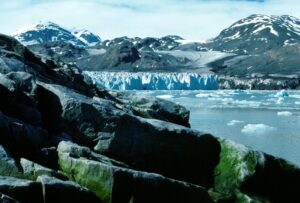
Bruce F. Molnia. Sept. 15, 1976. Muir Glacier and Adams Glacier; photograph taken from a shoreline location in upper Muir Inlet, Glacier Bay National Park and Preserve, Alaska. From the Glacier Photograph Collection. Boulder, Colorado USA: National Snow and Ice Data Center/World Data Center for Glaciology. Digital media.
Bruce F. Molnia. Sept. 8, 2003. Photo, from the same collection, taken from the same vantage point only 27 years later.
4.7.2. Arizona: On March 1, 2011, the Arizona Senate passed 2 pieces of legislation: S.B. 1393 says that the state legislature and not the federal government has the authority to regulate anthropogenic greenhouse gases and particulate matter; S.B. 1394 authorizes the Arizona governor to enter into interstate compacts to regulate GHGs. BNA says that both have an excellent chance of passing the lower chamber as well, as it also has a solid Republican majority. H.B. 2442, enacted in 2010, prevents state agencies such as the state Dept. of Environmental Quality from regulating GHGs without legislative approval. (William H. Carlile, Climate Change: Arizona Senate Passes ‘States’ Rights’ Bills Asserting Authority Over Greenhouse Gases, 43 BNA Daily Environment Report A-8, March 4, 2011.) It is difficult to understand how, if enacted, these bills would not run afoul of the commerce clause, but in the current political climate anything is possible. GHG regulation seems a job for the federal government, to me; regional compacts such as RGGI are commendable starting places, but not much more. See Christine A. Klein, The Environmental Commerce Clause, 27 Harv. Envtl. L. Rev. 1 (2003). I am not sure these bills deserve to be in this section, especially if they are merely intended as rhetorical states’ rights actions; at least they imply an acknowledgment that GHGs exist and are harmful.
4.7.3. Minnesota and South Dakota: The Big Stone II Project, an enormous coal-fired electric generating plant planned for northeastern South Dakota near the border with Minnesota that would have deposited about 4.7 million tons of CO2, or the equivalent of the pollution from roughly 670,000 cars into the atmosphere, was abandoned on Nov. 2, 2009, due to the efforts of the Sierra Club, local residents, and state and regional organizations, coupled with industry concern over the immanent passage of climate change legislation in Congress. [540]
4.7.4. New Mexico: A judge in New Mexico issued a preliminary injunction on April 13, 2010, in Leavell v. New Mexico Environmental Improvement Board, N.M. Dist. Ct., No. D-506-CV-201000050 (Jan. 13, 2010), which challenged the New Mexico Environmental Improvement Board’s authority to cap GHG emissions from in-state sources. [541] A decision is expected within two months.
4.7.5. South Dakota: The South Dakota Supreme Court upheld the state’s PUC decision to construct the Big Stone II coal-fired power plant, which would increase South Dakota’s carbon dioxide emissions by more than 33 percent, or about 4.7 million tons of CO2 each year, on the basis that it would not pose a serious threat to the environment. The court also pointed out that no emissions standards for GHGs have been enacted by any state or the federal government. At least one environmental group plans to contest the air quality permits, which have yet to be issued. [542]
4.7.6. Texas: Texas generates about 10% of the nation’s CO2 emissions, more than any other state, and has taken the position that government action, state or federal, is unnecessary. [543] Texas utility TXU Energy plans to build 11 new coal-fired power plants in the near future, which will double its emissions of CO2; it has the support of the state’s newly reelected Republican governor, Rick Perry, who is fast-tracking the plants’ permitting process via an executive order, RP49, issued in October, 2005. [544] Although the company claims it will invest in technology to limit carbon emissions, environmentalists are unconvinced. One group, Environmental Defense, has a Stop TXU Web page [545] and in October 2006, it sued the State Office of Administrative Hearings and the Texas Commission on Environmental Quality in Travis County state district court [546] ; the TCEQ must give its permission before the plants can be built.
In February 2007 a judge ruled that the governor’s executive order was not binding on state hearing administrators. The hearing is expected to be delayed as a result. [547] The Sierra Club joined the suit in December 2006. [548]
In December 2006, five banks announced that they would not contribute to TXU’s controversial $11 billion project, according to Rainforest Action Network, as they viewed the project as an economic risk. [549]
On Feb. 26, 2007, in a deal endorsed by NRDC and Environmental Defense, TXU Energy’s board of directors approved a bid to sell the company to private equity firms in the largest leveraged buyout in history. The projected power plants will be cut to 3 from 11, which “will prevent 56 million tons of annual carbon emissions,” TXU said. William Reilly, chairman emeritus of WWF and former EPA Administrator, will join the TXU board. [550] The deal included “a commitment by the investors to return the carbon-dioxide emissions by TXU to 1990 levels by 2020 and support a $400 million energy efficiency program.” [551] At this point it is not known whether shareholders will seek a higher price or look for other purchasers.
In March 2007, TXU announced plans for 2 demonstration plants that will employ integrated gasification combined cycle (IGCC) technology (coal gasification plus CO2 capture). TXU’s Sustainable Energy Advisory Board, which has representatives from Environmental Defense and NRDC, will review the plans. [552]
In October of 2009, Public Citizen sued the Texas Commission on Environmental Quality in Travis County District Court, claiming that the agency allows unlimited CO2 emissions in violation of the Texas Clean Air Act, and essentially “taking a page out of Massachusetts v. EPA.” [553]
See Environment America Research & Policy Center’s November, 2009, report, Too Much Pollution: State and National Trends in Global Warming Emissions from 1990 to 2007, prepared from an analysis of recent data from the U.S. Department of Energy, which found that Texas still leads the nation in emissions despite reducing emissions by 2% between 2004 and 2007.
But as if in remediation, Duke Energy (not a Texas company) announced that it and Xtreme Power, based in Austin, were launching a wind battery storage project—a 36-megawatt battery at the 153-megawatt Notrees Windpower Project near Kermit, Texas, possibly functional in late 2012. According to GRIST, it will be the largest in the world. (Todd Woody, Texas to install world’s largest wind energy storage system, GRIST, April 15, 2011.)
4.8. Domestic/International Businesses & Climate Change:
2007 Index of Silicon Valley: Produced by Joint Venture, a Valley-based research organization, the 2007 Index of Silicon Valley [554] was released in January, 2007, and showed that the economy there was growing steadily, after a 5-year decline. The report stated that: “…investment in environmental technologies grew by 178% between Q1 2005 and Q3 2006. The bulk of this investment went into Energy Generation, Energy Storage, and Advanced Materials. Silicon Valley has emerged as one of the top regions in the country for clean technology investment. In 2005, the region accounted for 23% of the deals in California and 5% of the deals in the nation.”[555] The New York Times states: “In Silicon Valley, investment in clean technology—from alternative energy products, like solar panels and hybrid cars, to the use of nanotechnology to solve environmental problems—went from $34 million in the first quarter of 2006 to $290 million in the third quarter….” [556] Furthermore, the residents of the area are embracing renewable energy and alternative modes of transport (including walking and biking, using public transit, and avoiding commuting by working from home) to a greater extent than the rest of the country. [557] This is clearly contrary to the Bush administration’s view that adapting to climate change will damage the U.S. economy.
Alcoa: In the late 1990s, Alcoa committed to reduce its GHG emissions by 25 percent from 1990 levels by 2010. The goal was met in 2003, but Alcoa continued to make improvements, and at the end of 2009 its emissions reduction totaled 43 percent from 1990 levels. According to William O’Rourke, vice president for sustainability and environment, Alcoa set new goals that commit it to cutting GHG emissions another 20 percent by 2020 and 30 percent by 2030. He suggested that significant carbon reductions could also be achieved if more aluminum were recycled: only 54% of aluminum cans are recycled in the U.S., compared to 98% in several European countries.
His remarks and others’ were made at an energy efficiency conference in Chicago April 7, 2010, sponsored by the Pew Center on Global Climate Change, which took the opportunity to release a report entitled: From Shop Floor to Top Floor: Best Business Practices in Energy Efficiency.
Alliance to Save Energy: In March 2007, ASE joined other industrialists (including ASE member Philips Lighting NA, the world’s largest manufacturer of light bulbs), the Natural Resources Defense Council, and energy specialists in the Lighting Efficiency Coalition, which has pledged to eliminate the incandescent light bulb by 2016, in favor of more efficient products. [558] In a news release ASE stated: “Once completed, this market transformation will save consumers and businesses approximately $18 billion annually on electricity bills and save an amount of lighting energy equivalent to the power generated by 30 nuclear power plants (at 1,000 MW) or up to 80 coal-burning power plants (at 500 MW). In addition, energy-efficient lighting would avoid power plant emissions of more than 158 million tons of carbon dioxide and 5,700 pounds of airborne mercury.” See also General Electric, infra this section; California; Australia.
American Electric Power: After containing CO2 emissions successfully in a pilot program for several years at a 31-year-old coal plant in West Virginia, AEP announced in 2011 that it was shelving the larger, $668 million project, the country’s most ambitious approach to containing emissions from existing electric plants and “one of the most advanced and successful in the world.” The political stalemate surrounding anthropogenic climate change, and the state of the economy, were cited as justifications for the decision. (Matthew L. Wald & John M. Broder, Utility Shelves Ambitious Plan to Limit Carbon, N.Y. Times, July 14, 2011.)
Ceres: Investors and Environmentalists for Sustainable Prosperity: Ceres, a network of investors, environmental organizations and public interest groups, works with companies to address sustainability issues such as global warming. Its mission is “integrating sustainability into capital markets for the health of the planet and its people.” Its latest report, Climate Risk Disclosure by the S&P 500, from January 2007, finds that “over half of the nation’s largest companies are providing inadequate disclosure to investors, despite growing financial losses in multiple sectors from climate change.”
2006 Corporate Governance and Climate Change: Making the Connection is a 300-page report issued by Ceres in 2006, which analyzes how 100 of the world’s largest companies are addressing the challenges from climate change.
From Risk to Opportunity: How Insurers Can Proactively and Profitably Manage Climate Change is another Ceres report from August 2006 discussing new insurance activities to tackle the causes of climate change and rising weather-related losses in the U.S. and globally.
Ceres reported in 2010 that “[a] record 101 climate change-related resolutions have been filed so far with U.S. and Canadian companies as part of the 2010 proxy season. The resolutions, seeking greater disclosure from companies on their financial exposure and response strategies to climate-related business trends, were filed by some of the nation’s largest public pension funds, as well as labor, foundation, religious and other institutional shareholders.”[559]
Clean Edge, Inc.: Founded in 2000, Clean Edge “is the world’s first research and publishing firm devoted to the clean-tech sector.” It has published the annual report, Clean Energy Trends, since 2003, among others; they are available on the Web for free registration. The March 2010 report was moderately optimistic about clean energy and technology, despite the massive 2009 downturn in the U.S. economy, the lack of success at Copenhagen in 2009, and Congress’s failure thus far to pass climate change legislation.
Cleantech Group: New technology and related business models offering competitive returns for investors and customers while providing solutions to global challenges. The Cleantech Awards have been given to individuals, companies, and other organizations that have furthered the sector since 2003. [560]
Climate Counts: Launched on June 19, 2007, nonprofit Climate Counts rates the climate performance of major consumer brands and their degree of commitment to reducing their impact on the environment. Gary Hirshberg, head of Stonyfield Farm, was primarily responsible for the project. The intent is for companies to become more active about reducing their effect on climate change, and for consumers to support with their business the companies that are. [561]
Climate Protection Campaign: Sonoma County aims to reduce emissions by 25% below 1990 levels by 2015, which it claims is the most ambitious target of any U.S. community.
Climate RESOLVE (Responsible Environmental Steps, Opportunities to Lead by Voluntary Efforts), a Business Roundtable initiative which encourages member companies to take voluntary action to control GHG emissions and reduce the GHG intensity of the U.S. economy, was 6 years old in 2010.
Climate Savers Computing Initiative: An initiative of businesses, consumers, and conservation groups, led by Google and Intel, began in 2007 to reduce GHG emissions from operation of computers by 54 million tons per year, or the annual equivalent of 11 million cars, by halving the electrical use of new computers by 2010. [562]
Combat Climate Change, a.k.a. the 3C Initiative: A coalition of 20 international companies committed to “drawing a roadmap to a low-emitting society” formed in Brussels on Jan. 11, 2007. Their interest is to develop an effective global climate protection policy for the period after the Kyoto Protocol expires. The companies “believe that the global community should aim at reducing the emissions of carbon dioxide and other greenhouse gases to acceptable levels as rapidly as possible, as well as providing secure and affordable energy for a stable, global development. The Swedish utility company Vattenfall AB coordinates the initiative. Vattenfall’s 80-page report, entitled: Curbing Climate Change: An outline of a framework leading to a low carbon emitting society was released in January 2006.
The Copenhagen Climate Council is a global collaboration between business and science founded by the leading independent think tank in Scandinavia, Monday Morning, based in Copenhagen. The members of the Copenhagen Climate Council came together to create global awareness of the importance of the U.N. Climate Change Conference, COP15, in Copenhagen, in December 2009, and to ensure support and assistance to global decision-makers when agreeing on a new climate treaty.
The EPA Green Power Partnership began in 2001 to recognize the growing number of companies and organizations that have voluntarily committed to green energy use. The “National Top 50” list, launched in 2004, gives the 25 largest purchasers of renewable green power; the “Fortune 500® Partners List” was launched in late 2006 to acknowledge the green power purchases of Fortune 500 companies; and the “100% Green Power Purchasers” list rates organizations that meet 100% of their electricity needs from green power.
EU Corporate Leaders Group on Climate Change began in 2006 when the Prince of Wales brought together “leaders from a cross-section of EU and international businesses who believe there is an urgent need to develop new and longer-term policies for tackling climate change.”
Fiji Water: In early November, 2007, Figi, which transports bottled water from the Fiji Islands in the South Pacific, announced that it was taking steps to become not just carbon neutral but “carbon negative,” meaning that it would offset more than the amount of GHGs released during the production of its product. It would also use more renewable sources of energy, such as wind power and alternative fuels, protect the local rainforest, and use less plastic and paper. [563] Its web site claims it will have a 25% smaller carbon footprint in 2010 than it had in 2007.
See Jonathan Hiskes, Don’t turn the fun off when talking about runoff: ‘The Story of Bottled Water’ and big fun learning about water, GRIST, Mar. 22, 2010, and the video: The Story of Bottled Water: How “manufactured demand” pushes what we don’t need and destroys what we need most, with Annie Leonard.
General Electric: After 128 years, GE announced improvements to incandescent light bulbs, called high efficiency incandescent, or “HEI lamps,” that will make their energy efficiency levels comparable to those of compact fluorescent bulbs. The company has made significant financial investments in this new technology to support the global effort to reduce GHG emissions.[564] See also ASE supra this section; California; Australia.
GreenBiz.com: The State of Green Business Report was launched in 2008 to measure the environmental impacts of the growing green economy. The 2009 report (freely available for registration) was a bit less optimistic than the initial report. The 2010 report found that the difficult economic climate of 2009 actually proved to be a stimulus for green business; cutting operating costs to retain or regain competitiveness is now more appreciated by business people and shareholders alike. The results in the 2011 report were mixed but still somewhat optimistic, despite the negative effects of the continuing recession on social and political perceptions of the importance of environmental issues. This report, as the previous ones did, identified 10 key trends and examined the greening of the U.S. economy through 20 indicators. Mr. Makower sees green business moving forward, and he is encouraged.
Green Rankings 2010: Newsweek’s goal was “to cut through the green chatter and quantify the actual environmental footprints, policies, and reputations” of the 500 largest publically held U.S. businesses and 100 of the largest global businesses. To do this, they teamed up with three leading environmental research organizations to create the most comprehensive rankings available. The site has a link to the 2009 rankings.
IKEA: In mid-September 2010 IKEA purchased six German wind farms from Spanish wind turbine firm Gamesa; the additional capacity will enable it to power 17 retail stores. It acquired 4 French wind farms in 2009 and with its other acquisitions can generate 10% of its electricity needs from wind power. It plans eventually to generate 100% of its power from renewable sources, specifically wind and solar. (IKEA starts to assemble European wind energy portfolio: Retail giant avoids self-assembly and acquires six German wind farms, BusinessGreen.com, Sept. 10, 2010.)
Institutional Investors Group on Climate Change (IIGCC): European-based, with 50 members, the group’s objective is to catalyze greater investment in a low carbon economy by bringing investors together to use their collective influence with companies, policymakers and investors.
Investor Group on Climate Change (IGCC): IGCC is a collaboration of Australian and New Zealand investors focusing on the impact that climate change has on the financial value of investments.
Investor Network on Climate Risk (INCR): INCR is a project of Ceres, supra, to provide tools for investors to manage the risks and capture the opportunities posed by climate change.
These three groups, the INCR, the IIGCC, and the IGCC, as well as the United Nations Environment Program Finance Initiative, reacted to COP-15’s outcome in Dec. 2009 by calling on world leaders to implement strong climate change and energy efficiency programs; they represent 190 companies and trillions in investments, and emphasized that investors rely on a stable regulatory environment to thrive. Their suggestions were expressed in their 2010 Investor Statement on Catalyzing Investment in a Low-Carbon Economy, released during the Investor Summit on Climate Risk, a meeting of 450 investors at the United Nations in January 2010. [565]
Investors and Business for US Climate Action: On March 19, 2007, more than 60 leading investors, asset managers and companies requested prompt and “tangible” action by the U.S. Congress on climate change in a 4-page document entitled: Imperatives of Climate Risk and Opportunity: A Call to Action from Leaders in Investing and Business. They specifically requested, among other things, 60-90% reductions below 1990 levels by 2050 through mandatory market-based solutions, and for the SEC to clarify what information companies should disclose to investors in their reports. [566] The group was organized by Ceres, supra.
On Jan. 27, 2010 (effective Feb. 8th), the SEC published an interpretive release “to provide guidance to public companies regarding the Commission’s existing disclosure requirements as they apply to climate change matters” Release Nos. 33-9106; 34-61469; FR-82, affecting 17 CFR PARTS 211, 231 and 241], an action 56 investment-industry leaders praised because it “will provide us with significantly improved information about the material risks and opportunities faced by our portfolio companies.” However, Sen. John Barrasso (R-WY) introduced legislation on February 24th (S. 3032, aka the Maintaining Agency Direction on Financial Fraud Act) “to prohibit the enforcement of a climate change interpretive guidance issued by the Securities and Exchange Commission, and for other purposes….”; there were no co-sponsors. The act’s name is an acronym for disgraced investment advisor Bernard Madoff, whose Ponzi scheme the SEC failed to catch; it was “clear”…to Mr. Barrasso “that the SEC should focus on its core mission of protecting American investors and maintaining fair markets. Instead, the SEC now wants to devote time and resources to climate change. This is absurd,” Barrasso said in a prepared statement.” [567]
U.S. Climate Action Partnership (USCAP) encourages the federal legislature to act swiftly to enact a policy framework for mandatory reductions of GHG emissions, including a cap-and-trade program. It wants to see reductions of 10 to 30 percent over the next 15 years. [568] The new group includes four environmental groups (NRDC, Environmental Defense Fund, [569] World Resources Institute, and the Pew Center on Global Climate Change) as well as manufacturers (e.g., General Electric, Alcoa, Caterpillar), public utilities (Duke Energy, PG&E of California, the FPL Group of Florida, PNM Resources of New Mexico), the oil company BP [see supra, Deepwater Horizon oil spill], and Lehman Brothers. [570] Its January 2007 proposal was entitled A Call for Action: Consensus Principles and Recommendations from the U.S. Climate Action Partnership: A Business and NGO Partnership. On Monday, Jan. 22, 2007, the day before President Bush’s State of the Union speech, the group issued a statement calling for the federal government to act swiftly and enact “strong national legislation to achieve significant reductions of greenhouse gas emissions.”[571]
In April 2007, ConocoPhillips, the world’s 5th-largest oil company, joined USCAP. The company issued a statement saying that it is in favor of mandatory limits on GHG emissions. [572]
In May 2007, General Motors became the first automaker to join USCAP, along with 9 companies and 2 environmental groups, The Nature Conservancy and the National Wildlife Federation. [573]
However, on Feb. 20, 2008, Business Week reported that “several companies that belong to USCAP are simultaneously supporting efforts and organizations that oppose mandatory cuts in greenhouse gases or promote policies that would make the USCAP reductions nearly impossible to meet.” Apparently, “[t]hree high-profile USCAP members—General Electric, Caterpillar, and Alcoa—also sit on the board of the Center for Energy & Economic Development [CEED], … that opposes regulations on greenhouse-gas emissions.” And several months ago, Duke Energy joined “Americans for Balanced Energy Choices …, a group hatched by CEED in 2000 that advocates expanded coal use.”[574]
On Jan. 15, 2009, USCAP released its Blueprint for Legislative Action: Consensus Recommendations for U.S. Climate Protection Legislation at a press conference and presented it to the House Energy and Commerce Committee. The Prologue says: “Our Blueprint is a balanced and integrated approach to key linked issues that must be addressed in any national climate legislation…. [It] is the consensus product of a diverse group of companies and non-governmental organizations.” The plan is more detailed than the 2007 proposal, but has been criticized by environmental groups for giving away many allowances to companies emitting CO2, although the free allowances would eventually be phased out. [575]
Together: Tony Blair, the former Prime Minister, got the CEOs of some British companies together to launch a 3-year campaign by this name in 2007 to help their customers cut their carbon emissions and reduce their impact on climate change. The campaign operated in the UK, Australia, and the U.S., and concluded in 2010.
WWF’s Climate Savers Program: Twelve major companies that participate in the program are aiming to cut at least 10 million tons of CO2 emissions a year by 2010. In February 2007, Nike Inc. won an award for achieving its emissions reduction target (13% for business travel and operational facilities between 1998 and 2005) 5 years ahead of its 2010 deadline.
The other companies are: Johnson & Johnson, IBM, Polaroid, Collins, and Xanterra from the U.S.; Sagawa and Sony from Japan; Lafarge from France; Catalyst from Canada; Tetra Pak from Sweden; and Novo Nordisk from Denmark. [576]
Xerox Corp.: The Company reported that it has reduced GHG emissions by 18% since 2002 when it set a reduction target of 10%; in the process it saved the company $18 million last year. On Monday, Dec. 3, 2007, it announced that it would increase its target to 25% by 2012. [577]
Yahoo!: In April 2007, Yahoo! announced plans to be fully carbon neutral by the end of the year. Co-founder and Chief David Filo said that “Yahoo! going carbon neutral is equivalent to shutting off the electricity in all San Francisco homes for a month, or, pulling nearly 25,000 cars off the road for a year.” [578]
See: Mark Muro, Jonathan Rothwell, & Devashree Saha, Sizing the Clean Economy: A National and Regional Green Jobs Assessment (Metropolitan Policy Program, Brookings Institute, 2011) (see also: Joanna M. Foster, ‘Green’ Economy Is Real but Needs a Push, Study Suggests, N.Y. Times, July 14, 2011.)
4.9. Extra-Political Progress (or lack thereof) Reducing GHG Emissions:
U.S. GHG emissions are expected to show an increase of 3.9% in 2010, based on economic growth and increased use of fossil fuels in electric generation and in industry, according to the Energy Information Administration. (Reporting:
U.S. Fossil Fuel Emissions Up 3.9 Percent in 2010, WCCR, Oct. 13, 2010.)
On Oct. 14, 2010, EPA released a draft plan to develop renewable energy projects on landfills, or superfund or brownfields sites that are unsuitable for anything else, as part of its RE-Powering America’s Land initiative. (Janice Valverde, Renewable Energy: EPA Drafts Plan for Renewable Projects on Superfund Sites, Brownfields, Landfills, WCCR, Oct. 14, 2010.)
5. The European Union
For commentary on the EU and climate change, see, e.g., Thomas Daniel Wuertenberger, The Regulation of CO2 Emissions Caused by Private Households — An Analysis of the Legal Situation in the European Union and Germany, 16 Missouri Environmental Law & Policy Review 1 (Winter 2009).
The European Economic Community [579] signed the UNFCCC on June 13, 1992 and ratified it on Dec. 12, 1993. [580] It entered into force Mar. 2 1, 1994. The EEC is an Annex I Party to the Convention. [581]
When the Kyoto Protocol was signed in New York on April 29, 1998, the EC stated that it and its Member States would fulfill their respective commitments under the Protocol’s article 3 (1) jointly, in accordance with its article 4. [582]
In June, 2000, the European Commission launched the European Climate Change Programme (ECCP) to develop a strategy to enable the EU to implement the Kyoto Protocol. The first ECCP, which ran from 2000 to 2001, established several working groups which then reported to the EC the 42 possible approaches they saw for reducing GHG emissions by about double the reduction required for the EU during the Protocol’s first commitment period. The EC in turn published a report on the findings in June, 2001, and later that year, in October, 2001, the Commission proposed three additional steps: first, an Action Plan for the ECCP was presented in a Communication from The Commission on the Implementation of the First Phase of the European Climate Change Programme (COM(2001)580); secondly, a proposal for a Council Decision concerning the approval of the Kyoto Protocol; thirdly, the Commission proposed a GHG emissions trading scheme to assist the private sector to find the most cost-effective ways to reduce carbon dioxide emissions.
On April 25, 2002, Council Decision 2002/358/EC, was published; it approved the Kyoto Protocol on behalf of the EC and its 15 member states, who ratified it on May 31, 2002, which meant that there were more than the number needed for the Protocol to enter into force; the last barrier was that 55 ratifying parties needed to have been responsible for over 55% of GHG emissions in 1990. [583]
Under the Protocol, the “EC 15” (that is, the 15 states who were Members at that time, and who are listed in Annex III of the Protocol; see 2002 O.J. (L130), at 20) are committed to cutting greenhouse gas emissions to 8% below 1990 levels by 2008-2012. [584] Most of the 10 new Member States, who joined in 2004 and who are also Annex-I Parties to the UNFCCC, have the same target. Romania and Bulgaria joined the EU in January of 2007, making a total of 27 states. The latter chose to accept 1988 levels of GHG emissions as a baseline, instead of 1990. Both Romania and Bulgaria are considered to be transitioning to market economies, but are listed in Annex I of the Convention.
On Jan. 30, 2007, the European Parliament’s Committee on the Environment, Public Health and Food Safety adopted a resolution stating that India and China should be subject to mandatory limits on GHG emissions for the Kyoto Protocol’s second phase, which begins after 2012. [585]
The European Parliament Environment Committee’s draft resolution on climate change, PE 654.321v01-00, is available online. Amendment 19, paragraph 9, states that “…non-Annex I countries have to be further involved in the process, as effective global emissions reduction can be carried out only with China and India also participating with emissions reduction measures; further recognizes that the developing countries cannot be treated as one block as countries like China or India are … more industrialized than African countries for instance; proposes, therefore, to differentiate between emerging countries and developing countries, especially least developed countries;…”
In February 2007, the EC proposed a new directive that would have all EU member states criminalize serious environmental offenses and impose sanctions for violations. [586]
On April 25, 2007, the European Parliament approved a new temporary committee on climate change policy that will act as a liaison with the U.S. Congress’s new Select Committee on Energy Independence and Global Warming, see supra. [587] The 60-member committee will have a one-year mandate: to make proposals on EU policy on climate change, to analyze and evaluate the state of climate change for the benefit of Parliament, to study the impacts of recent advances in combating climate change, and to interact with Member State governments, the governments of third countries, and the members of scientific and business communities. [588] Guido Sacconi was chosen to head the committee on May 22, 2007; he said on that occasion that establishing relations with the new Congressional committee was an “immediate priority.” [589]
On May 7, 2007, the EEA reported that emissions of the EU-15 (members before the 2004 EU enlargement) declined by 0.8% in 2005 from 2004 levels, making their emissions only 1.5% lower than the 1990 base year, whereas their goal is an 8% reduction. However, taking all current 27 member countries’ emissions into account, 2005 emissions were already 8% lower than 1990 levels. [590]
The following chart appeared in a BBC News article entitled EU push for climate funding unity: EU leaders are trying to break an impasse over funding to help poor countries combat global warming on the last day of their Brussels summit (Oct. 30, 2009).
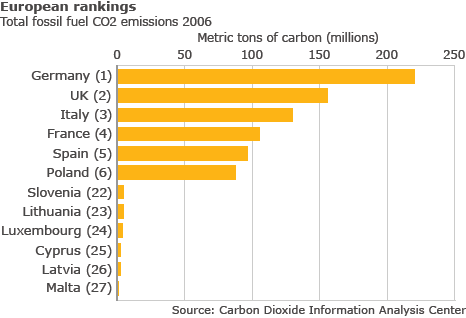
After a European Council meeting in March 2010, EU leaders repeated a conditional pledge to raise their emissions limit from 20% to 30% from 1990 levels, provided other developed nations followed suit and developing nations contribute according to their abilities. Italy and Poland oppose cuts deeper than 20%. [591]
5.1. Finding EU Documents on Climate Change
The official Web site of the European Union, Europa, contains EUR-Lex, the largest documentary source for treaties, legislation, case law, the Official Journal, and more.
The European Commission has an environment site. The Commission launched the European Climate Change Program (ECCP) in June 2000, to develop the necessary elements of the EU’s strategy to comply with the Kyoto Protocol. The brochure, The European Climate Change Programme: EU Action Against Climate Change, January 2007, outlines the EU’s current and projected policies on climate change.
The European Environment Agency has a Climate Change “theme” page for indicators, reports, links and data.
EU reports, required under the UNFCCC and the Kyoto Protocol, are available online from the EEA’s Reports about Europe’s environment page from 1995 to 2007.
The EU’s Committee of the Regions must be consulted on environmental matters (inter alia, as such matters have repercussions at regional or local levels), and issues opinions on proposed legislation.
5.2. Europe’s Emissions Trading Scheme (ETS)
The European Emissions Trading Scheme is the largest of its kind, and the only mandatory one in the world. It is a cap-and-trade system that sets a limit on the amount of GHGs industries can emit; if companies do not use up their quotas, they can sell them to higher-emitting companies. [592] The number of allowances falls gradually so that total emissions decrease. Currently the ETS covers CO2 emissions from power stations and industries such as steel, cement, paper and oil refining throughout the EU. Phase I of the EU’s Greenhouse Gas Emissions Trading Scheme began Jan. 1, 2005, and ran until the end of December 2007. Phase II will run from 2008 until 2012. In 2013, when Phase III begins, the national registries will be replaced by a single EU registry, and additional industries and gases will be included. It was established by Directive 2003/87/EC of the European Parliament and of the Council, Oct. 13, 2003, as amended by Directive 2004/101/EC. The hope is that the scheme will enable EU member states to meet their commitment under the Kyoto Protocol to cut emissions by 8% from 1990 levels by the first commitment period, 2008-12. More information is available from Europa’s European Climate Change Program page. In January 2011, it was called “the world’s first and biggest international scheme for the trading of greenhouse gas emission allowances,” covering around 11,000 power stations and industrial plants in 30 countries. (Stephen Gardner, Emissions Trading: EU Suspends Carbon Emissions Trading, Citing Fraud Related to National Registries, BNA Int’l Environment Reporter, Jan. 20, 2011.)
On Nov. 13, 2006, the EC published a report on modifying the EU’s Emissions Trading Scheme, entitled Building a Global Carbon Market—Report Pursuant to Article 30 of Directive 2003/87/EC. The report concentrates on expanding the scheme to other gases, compliance and monitoring procedures, and adding countries to the ETS or linking to other schemes. [593]
On Nov. 29, 2006, the European Commission set more stringent carbon limits for the ETS’s second phase, cutting member states’ carbon permits by an average of 7% below the emissions proposed by the national allocation plans, and 7% below 2005 emissions from 2008-2012. [594] The plans apply to Germany, Greece, Ireland, Latvia, Lithuania, Luxembourg, Malta, Slovakia, Sweden and the United Kingdom. [595] The EU Environment Commissioner Stavros Dimas said that the decisions sent “a strong signal that Europe is fully committed to achieving the Kyoto target and making the ETS a success.” [596] Predictably, several countries (especially Germany and Lithuania) were upset by the decisions.
On Nov. 29, 2006, the EC also approved emissions-trading plans for the above-listed 10 members, provided that allowable emissions are lowered by 7%. Five countries (Austria, the Czech Republic, Hungary, Italy, and Spain) have only submitted draft allocation plans; Denmark has not even done that. The deadline was June 30, 2006. [597]
In December 2006, the Institute for Public Policy Research (IPPR) published a report entitled Trading Up: Reforming the European Union’s Emissions Trading Scheme, by Tim Gibbs and Simon Retallack (free registration is required). The report considers the pros and cons of expanding the ETS to include aviation, maritime, and road transport.
On March 26, 2007, the Senate Energy and Natural Resources Committee held a “roundtable discussion” (described by Chairman Bingaman as being much less formal than a hearing) on using the ETS as a possible model for a U.S. cap-and-trade program. One expert, a senior lecturer at MIT, said that as the U.S. federal government exerts greater authority over the states, it could avoid some of the problems the EU had experienced in enforcing the system across its 27 member countries. [598]
In May 2007 the World Bank issued a report entitled State and Trends of the Carbon Market 2007 that showed that the EU’s ETS accounted for $24.4 billion of the global carbon market’s $30.1 billion in credits – double the amount issued in 2005. [599] See also, Symposium: The European Union Emissions Trading Scheme, 1 (1) Review of Environmental Economics and Policy 66 (Winter 2007). [600]
In May 2008 the updated report State and Trends of the Carbon Market 2008 was released, showing that the world carbon market in 2007 was now $64 billion, primarily as a result of the EU’s ETS, but also due to increases in other carbon markets. [601]
State and Trends of the Carbon Market 2009 was released May 2009. Analysts attribute to reduced economic activity an 11.2% drop in E.U. industrial GHG emissions, a number that falls at the high end of expectations. [602]
State and Trends of the Carbon Market reports from 2005-2010, Carbon Finance Unit Annual Reports, and other publications are on the World Bank’s Carbon Finance page.
In early 2011, trading was suspended on the ETS because several members’ insecure registries resulted in fraud running to about a half million permits or €30 million ($41 million). The suspension is expected to continue until at least Jan. 26th. A spokesperson said that the credibility of the ETS was not damaged, and that the system was not under threat. (Stephen Gardner, Emissions Trading: EU Suspends Carbon Emissions Trading, Citing Fraud Related to National Registries, BNA Int’l Environment Reporter, Jan. 20, 2011.) On Feb. 24, 2011, 3 more EU countries had updated their security systems and were allowed to resume trading after the fraud alert, bringing the total to 10; it is not currently known when all the registries will be open. (Stephen Gardner, Emissions Trading: EU Allows Three More Carbon Registries To Reopen, Plans Protective Amendments, 40 BNA Daily Environment Report A-7, Mar. 1, 2011.)
The EU’s ETS & Aviation: The European Commission has recently proposed to include airline flights within the EU in the ETS starting in 2011, which would mean that airlines would have to pay to emit more than their GHG permits would allow. (Climate change: Commission proposes bringing air transport into EU Emissions Trading Scheme, IP/06/1862, Dec. 20, 2006.) The proposal would cap aviation emissions at 2004-06 levels, and in 2012, external flights would be included. The Institute for Public Policy Research (IPPR) and the World Wildlife Fund believe that including airplane emissions in the ETS could benefit airlines financially, if the costs of compliance are passed on to consumers via ticket prices. Prior to Dec. 20, 2006, airlines, which are responsible for 3% of the EU’s CO2 emissions (more than refineries or steel plants) and which emit nitrogen oxides as well, were exempt from the ETS.
However, environmental groups were not pleased, claiming that it is a mistake to regulate only CO2 when airplanes emit other GHGs. They did not agree with airlines receiving their GHG permits for free, and they thought the program could be implemented sooner. [603] The U.S. is not pleased, claiming that to include airlines in the ETS would be a violation of international law, specifically the Chicago Convention. [604] The airlines, unsurprisingly, are not happy either. [605] Tony Blair said “he would not give up flying, [and] doubted any politician would tell people not to fly….” [606] In any case, the process of approval by member states and the European Parliament is likely to take years. [607] See infra, Individual Member States & Climate Change, United Kingdom.
On May 6, 2008, a hearing entitled Aviation and the Environment: Emissions was held before the Aviation Subcommittee of the House Transportation and Infrastructure Committee to discuss the EC’s Dec. 20, 2006, proposed directive to include civil aviation in the ETS. [608] Despite U.S. disapproval, an EU lawmaker was optimistic that a deal to include aviation in the ETS could be concluded by summer 2008, as a result of opposition fading in the last days of the Bush administration. [609]
Under legislation finalized in 2009 (Directive 2001/101/EC), about 4000 airline operators that use EU airports and are required to participate in the ETS, will have their emissions capped at 97% of 2004-2006 average annual emissions, beginning Jan. 1, 2012; they will have to reduce their emissions gradually through 2020. The system will “encourage” non-EU countries to “link into” the EU carbon market. (An Overview of Aviation & the European Union Emissions Trading System, EDF, June 2011.) The EC believes that the aviation trading system can be paid for by a small increase in the cost of tickets, analogous to fees (about $42.30 per return ticket) that the U.S. government imposes on flights that land and take off from the U.S.
Air Transport Association of America v. Secretary of State for Energy and Climate Change, Case No. C-366/10, including American Airlines, Continental Airlines, and United Airlines, contests their inclusion in the ETS; the case was referred to the Court of Justice of the EU in July 2010. (See Europa, Reducing emissions from the aviation sector; Stephen Gardner, Breaking News: EU Sets Carbon Dioxide Cap for Airlines Entering Emissions Trading System in 2012, WCCR, Mar. 8, 2011.)
On May 11, 2011, EDF, CBD, Earthjustice, Environment America, NRDC and the Sierra Club sent letters to the CEOs of American and United Airlines (the latter is merging with Continental) urging them to drop their lawsuit, in which EDF and other U.S. and European environmental organizations intervened on the side of the EU law. Oral argument was held July 5, 2011, and a decision is expected in a few months.
On July 20, 2011, John Mica, the chairman of the H.R. Transportation and Infrastructure Committee, and 7 co-sponsors, introduced H.R. 2594, the European Union Emissions Trading Scheme Prohibition Act of 2011. It was referred to the Committee on Transportation and Infrastructure, and to the Committee on Foreign Affairs. Its stated purpose is “to prohibit operators of civil aircraft of the United States from participating in the European Union’s emissions trading scheme, and for other purposes.” Its effect would probably be to prevent U.S. airlines from flying to or from Europe, and to force Americans to rely on foreign air carriers. (EDF, Press Release: Major environmental, development groups oppose bill that would obstruct pioneering anti-pollution law for airlines; Groups say bill based on “fundamentally erroneous legal and policy assumptions,” July 27, 2011; Letter from NGOs to Congress on H.R. 2594, the European Union Emissions Trading Scheme Prohibition Act of 2011, July 27, 2011.) The administration did not endorse H.R. 2594, but according to BNA, an official said the government “objects, on legal and policy grounds, to the EU’s attempt to unilaterally impose its own aviation policies on the rest of the world.” (Dean Scott, Emissions Trading: U.S. Officials, House Members United Against Extension of EU Caps to Airlines, 145 BNA Daily Environment Report A-10 (July 28, 2011).
5.2.1. EU Carbon Tax Initiative
The EU had a lot on its plate at its Oct. 29, 2009, European Council summit in Brussels, as the 2009 Copenhagen climate summit drew near, including the ratification of the Lisbon Treaty, which needed Czech president Vaclav Klaus’s signature, as well as deciding on the amount of money it is willing to commit to aid poor countries meet their commitments under a new global climate change deal, assuming one materializes in December 2009. [610] It had difficulty agreeing on the EU’s share of a global climate fund because of difficulties allocating the contributions of wealthier EU countries and newer, poorer members from central and eastern Europe, but apparently arrived at a tentative solution by the end of the conference. According to the BBC, “Polish Finance Minister Jacek Rostowski…[said] that eastern European nations should be allowed to contribute according to their means, not to how much they pollute – otherwise they were ready to block a deal.” [611] The leaders issued a statement at the end of the Brussels summit, with the summit’s conclusions on climate change on pages 3-7 and 15-21; however, it does not spell out how members’ contributions will be calculated. Swedish Prime Minister Reinfeldt said the next important stage in the negotiations will be a Nov. 3rd EU-U.S. Summit in Washington, D.C. [612]
Now that Ireland, Poland, and the Czech Republic have ratified the Lisbon Treaty, the priority in 2010 after COP-15 is a carbon tax (in addition to the current energy tax), according to Taxation Commissioner Laszlo Kovacs, as a necessary component to the EU Emission Trading System, which only covers about 40% of all emissions; the tax would cover additional sectors and would help the 27 member states meet their commitments to reduce GHG emissions by 20% by 2020 from 1990 levels. [613]
5.3. New EU Energy Plan
The EU is planning for a common European energy policy. On March 8, 2006, the European Commission published a Green Paper entitled A European Strategy for Sustainable, Competitive and Secure Energy, which laid out three main objectives for a European strategy: sustainability, competitiveness, and security of supply.
In line with those plans, EU Environment Commissioner Stavros Dimas wants to impose mandatory efficiency standards on all new vehicles sold in Europe, which would cause the cost of inefficient cars to soar in the next 5 years. Auto manufacturers have “infuriated” the Commission by missing their voluntary targets by “almost 50%.”[614] On Oct. 31, 2006, a 303-page final report entitled Review and Analysis of the Reduction Potential and Costs of Technological and Other Measures To Reduce CO2-Emissions from Passenger Cars was released and posted on Europa’s Automotive/Environment page.
The European Commission’s Jan. 10, 2007, Communication to the Council, the European Parliament, the European Economic and Social Committee and the Committee of the Regions, entitled Towards a European Strategic Energy Technology Plan, reiterates the goal mentioned above, of reducing GHG emissions by at least 20% compared to 1990 levels by 2020, [615] and further states that by 2050, global GHG emissions must be lower by 50% from 1990 levels, which would mean, in industrialized countries, reductions of 60 to 80%. On the same day, the Commission released a Communication to the European Council and Parliament entitled An Energy Policy for Europe that itemized EU international energy policy priorities in its Annex I. It stated the Commission’s intention to put forward a new Strategic Energy Review every two years, and a European Strategic Energy Technology Plan in 2007.
At the March 2007 meeting of the European Council in Brussels, a firm target of a 20% reduction of GHG by 2020 was set, and leaders agreed that the Council was willing to raise the goal to 30% if the U.S., China and India made similar commitments. An overall goal of 20% for renewable energy sources by 2020 [616] was set, up from the current 6.5%. [617] The Council also decided to phase out incandescent light bulbs in favor of more efficient compact fluorescents over the next two years. [618]
EU member states anticipated pushing the U.S. in a draft declaration on climate change being prepared for the EU-U.S. summit on April 30, 2007, in Washington, D.C. Scandinavian countries expressed concern that the declaration was not strongly worded enough.[619]
On Jan. 23, 2008, the European Commission released its proposals to reduce GHG emissions, including the goal above of reducing emissions 20% below 1990 levels by 2020; 20% of energy from renewable sources; emissions permits for utilities and other polluting industries would not be allocated as they are now, but purchase of all permits would gradually be phased in by 2013. The EU might require importers to purchase the same allowances that European manufacturers would have to buy, to protect their markets from lower-priced products. As the EU had cut emissions by 6% from 1990 levels and got 8.5% of its energy from renewable sources by 2005, the goals are considered reasonable, even if some
environmental groups find them not sufficiently stringent.[620] It might take 2 years for the plans to be approved by Member governments and the European Parliament. Additionally, the EC wants as many as 12 CCS (carbon capture and sequestration) plants operating in the EU by 2015, without which it considers that GHG emissions cuts will be futile, but acknowledges that such technology is enormously expensive and outside of the EU budget. The CCS future regulatory framework is in a proposal for a directive (COM (2008) 18 final) that must be incorporated in each member state’s legal code. [621]
See Quirin Schiermeier, News: Europe spells out action plan for emissions targets, 451 (7178) Nature 504 (Jan. 31, 2008) and Editorial: Towards falling emissions: Although Europe’s new energy plans may be too prescriptive on the means of achieving the goals, they offer the world an encouraging way forward, 451 (7178) Nature 499 (Jan. 31, 2008).
At a 2-day summit in Brussels in March 2008, leaders called for a deeper cut in emissions, to 30% from 1990 levels by 2020, and a 50% cut in global emissions by 2050. [622] Germany was reluctant, but Stavros Dimas said on the 21st that EU leaders were still committed to the 30% cut. [623]
5.4. EU Reports on GHG
In late October 2006, just in advance of the Nairobi COP-12 meeting, two EU bodies issued complementary reports on GHGs. The European Commission issued its fourth annual progress report entitled Progress Towards Achieving the Kyoto Objectives. (Reports from 2003-2010 are available under Progress Reports.) Although the report claims that seven member states (Austria, Belgium, Denmark, Ireland, Italy, Portugal and Spain) will exceed their Kyoto Protocol emission limits and will have to find additional methods to reduce emissions, the reports conclude that the EU will meet its targets if all goes as planned. [624]
The report entitled Greenhouse gas emission trends and projections in Europe 2006 was produced by the European Environment Agency. It concludes that the EU-15 will meet its Kyoto Protocol target, [625] and that the 10 newest members are on track to meet theirs despite rising emissions.
The 2010 annual report from the European Commission to the European Parliament and the Council, Progress Towards Achieving the Kyoto Objectives, was released on Oct. 12, 2010. It confirmed that the EU is on target to meet and perhaps exceed its Kyoto objective, an 8% reduction from 1990 levels, the base for most countries; average reductions for 2008 were 14.3%. (Stephen Gardner, Reporting: Report Confirms EU on Track to Meet Kyoto Targets for Reducing Greenhouse Gas Emissions, WCCR, Oct. 13, 2010.)
5.5. Individual Member States & Climate Change
France: In 2004, France closed its last coal mine. Since then it has generated 80% of its energy from nuclear power plants, and has very low carbon emissions.[626]
Leading French oil companies, car manufacturers, and agricultural groups established goals to increase usage in 2007 of a new fuel called E-85, containing 85% ethanol and 15% gasoline, thereby reducing GHG emissions. Car makers agreed to offer at least one flex-fuel model from 2007 forward at competitive prices. Gas distributors offered E-85 at 500-600 in 2007 and tripled that in 2008. [627]
The day after the February 2007 release of the IPCC’s Fourth Assessment Report in Paris, French President Jacques Chirac called for the establishment of a new, more powerful UN environmental body to be called the U.N. Environment Organization that will be aimed at slowing climate change. [628] It may also have the power to punish violators, as the current U.N. Environment Programme is criticized for being too weak. The US, China, Russia and India were not among the 45 nations that responded to his request. [629]
Germany: In January 2007, German Chancellor Angela Merkel spoke out against an EC proposal for a legally binding emissions limit of 120 grams of CO2 per kilometer by 2012 for all cars manufactured or imported into the EU. Germany is home to some of Europe’s biggest car manufacturers, including Volkswagen AG, BMW, DaimlerChrysler AG and Porsche AG, who worry that the limits would cause them to cut jobs. [630] The European Union’s Environment Commissioner, Stavros Dimas, has threatened to replace his own Mercedes sedan and the EU’s fleet of vehicles as well with Japanese hybrids such as the Toyota Prius or a Lexus hybrid.[631] In February 2007, Dimas backed down and proposed a 130 gram-per-km limit, which amounts to an 18% cut from 2005 levels, disappointing environmental groups.[632] The legislation was drafted later in 2007, and then brought to member states and the European Parliament for approval.
German automakers agreed in March 2007 to research technologies that could reduce CO2 emissions by 10 grams per kilometer by 2012.[633]
A new report issued April 25th questions the claim that nuclear energy is either less expensive or more environmentally friendly than other power sources. The Environment Minister, Sigmar Gabirel, concluded that Germany should focus on renewable energy sources and continue with its plan to close down nuclear reactors.[634]
Inspire: EU member states have agreed to share data such as satellite images, temperature records, and rainfall data for environmental decision-making. Formal adoption of the Inspire program was expected by early 2007, giving members 2 years to adopt it into their national legal codes.[635]
Italy: A report entitled Do Some Like it Hot? Italy Amidst a Changing Climate found that as a result of climate change, 16 new diseases have appeared in Italy over the last 10 years, migrating north from Africa, and that diseases typically found in the south of Italy are spreading north. [636]
The Italian Agency for New Technology, Energy, and the Environment, the ENEA, reports that Italy’s GHG emissions will decrease by over half over the next 13 years as a result of increased energy efficiency and steps to curb energy use.[637]
Norway: Norway announced in January 2007, that it will “purchase emissions quotas to offset the pollution its bureaucrats create jetting around the world, joining Britain in a government effort to reduce so-called greenhouse gases.”[638]
Since 1996, Statoil, Norway’s largest oil company, has been injecting compressed CO2 emissions from the Sleipner platform in the North Sea to sequester it in the porous sandstone about 2600 feet below the sea floor. Experts believe that the North Sea aquifer could hold all the CO2 emitted by Europe’s power plants for the next 600 years, and that the U.S. coastline could store emissions for thousands of years. However, critics worry that the companies will use the $53 million Norwegian tax dollars they save on CO2 emissions every year to boost production of fossil fuels, and that leaks might occur if the sequestered gas forms an acid that eats away at the confining rocks.[639]
In April 2007 Norway announced plans to reduce its GHG emissions to zero by 2050.[640] In January 2008 it revised those plans and moved the date back to 2030.[641]
In January 2007, Norway replaced its system of taxing vehicles based on engine capacity with a tax based on carbon dioxide emissions. It is part of a larger scheme of incentives to encourage people to purchase lower-emitting cars.[642]
United Kingdom: The Prince of Wales’s UK Corporate Leaders Group on Climate Change (UK CLG) was set up in 2005. It “brings together business leaders from a cross-section of UK and international business who believe there is an urgent need to develop new and longer-term policies for tackling climate change.” The Group is managed by the University of Cambridge Programme for Sustainability Leadership. There is also an EU Corporate Leaders’ Group on Climate Change (EU CLG) that was set up in 2006 also by the Prince of Wales.
On Oct. 30, 2006, just before COP-12 began, the British government released a major report on the economics of climate change. The lead author of the Stern Review on the Economics of Climate Change was Sir Nicholas Stern, Head of the Government Economics Service, Adviser to the Government on the economics of climate change and development, and former World Bank chief economist. The report warned that if global warming is not curbed, it could cost the world 5 to 20 percent of economic output,[643] and result in “economic downturns on a scale associated with the 20th century’s world wars and the 1930s Depression.”[644] However, the author believes that there is time to avoid the worst effects if governments make “strong, deliberate policy choices.”[645] In response, the UK Treasury proposed expansion of the current EU Emissions Trading Scheme to other sectors and gases, and expansion of the Kyoto Protocol’s Clean Development Mechanism. The UK’s Environment Secretary announced that new climate change legislation would be introduced shortly and would form a strategic part of the UK’s approach to fulfilling its goals and responsibilities.[646]
On Nov. 8, 2006, a leading environmental economist, Professor Michael Grubb, said that the Stern Review’s recommendations required an entirely new set of more stringent emissions targets. Although such targets were under discussion at the Nairobi meeting, no one was particularly optimistic that a breakthrough would occur, primarily because the United States and Australia will not accept targets, as they opted out of the Kyoto Protocol.[647]
And indeed, on Nov. 15th, the United Kingdom proposed legislation to formalize existing long-term targets for reducing carbon dioxide emissions by 60 percent by 2050, and to address the issues raised in the Stern Review.[648]
In January 2007, the Chief Economist of Chrysler, Van Jolissaint, attacked European attitudes toward global warming (describing them as “quasi-hysterical”) and the Stern Report, saying that it was based on “dubious economics,” and thus “illustrated the yawning gap between mainstream opinion on climate change among the educated elites of Europe and America.”[649]
The UK government is concerned that offsetting schemes, that allow airline customers or auto drivers to offset the environmental impact of their carbon emissions by paying for trees to be planted or by buying energy efficient light bulbs for use in developing nations, are open to abuse, difficult to verify, and confusing to customers. Thus the government is establishing voluntary standards to help consumers pick genuine schemes.[650]
On Feb. 1, 2007, the UK Air Passenger Duty came into effect. The new tax was announced by Chancellor of the Exchequer Gordon Brown on Dec. 6, 2006.[651] It doubles the amount of duty passengers pay on economy class flights in Europe, including internal UK flights, to £10; business and first-class long-haul flights now charge £80. The purpose is to make the airlines pay for damaging the environment.[652] However, no one is pleased, and the airlines are threatening to sue, as the duty was introduced within eight weeks of the Chancellor’s announcement and was not discussed in Parliament.[653]
In March 2007, the Conservative party proposed new environmental taxes on air fares in a document called: Greener Skies: A Consultation on the Environmental Taxation of Aviation. The proposal appeared to have made no group happy, with the exception of environmental groups and the Conservatives themselves, although the tax was designed not to impact family holidays.[654]
In March 2007, the UK unveiled its Draft Climate Change Bill, which makes the Britain the first country to propose binding limits on CO2 emissions.[655] It plans to cut CO2 emissions 60% by 2050 as compared to 1990 levels. The bill was open for public comment, with the finalized bill to be presented to Parliament in the fall of 2007.[656]
On the recommendation of a government-appointed committee, the reduction was raised to 80% by 2050 in October 2008. The bill was finally approved on Tuesday, Nov. 18th, 2008, and must now be signed into law by the Queen. Climate Change Secretary Ed Miliband says it is “the first legislation of its kind in the world.”[657]
The UK, which held the U.N. Security Council’s rotating presidency for April 2007, took the opportunity to host a meeting of the Council on April 17, 2007, to explore the connection between energy, security, and climate change. Prior to the meeting, the UK released a discussion paper entitled Energy, Security and Climate on March 28, 2007.[658] (See supra, Global Climate Change Security Oversight Act.) Fifty-three countries participated in the debate, including many non-members. However, the Group of 77 and China rejected the topic as outside the scope of the Security Council’s primary responsibility under the U.N. Charter; British foreign secretary Margaret Beckett responded by saying that the potential for climate change to cause wars brought the issue within the Security Council’s domain.[659]
A British team began on March 1, 2009, a journey to the North Pole to measure the thickness of the ice and determine how quickly the sea ice is melting. The study should be completed by late May and should give scientists a better idea of the speed of melting than satellite photos.[660]
On Sept. 23, 2010, the UK opened the world’s largest offshore wind farm, Thanet, off the coast of Kent. Its 100 turbines produce enough electricity for 200,000 homes, but the UK is still short of its goal of producing 15% of its energy from renewable sources by 2020. (Energy and Global Warming News for September 24th: Climate Progress, Sept. 24, 2010; Terry Macalister, British firms miss out as world’s biggest offshore windfarm opens off UK coast: Blow to UK green technology industry as less than 20% of £900m investment in Thanet windfarm goes to British firms, Guardian.co.uk, Sept. 23, 2010.)
Photograph: Vattenfall
6. The Rest of the World
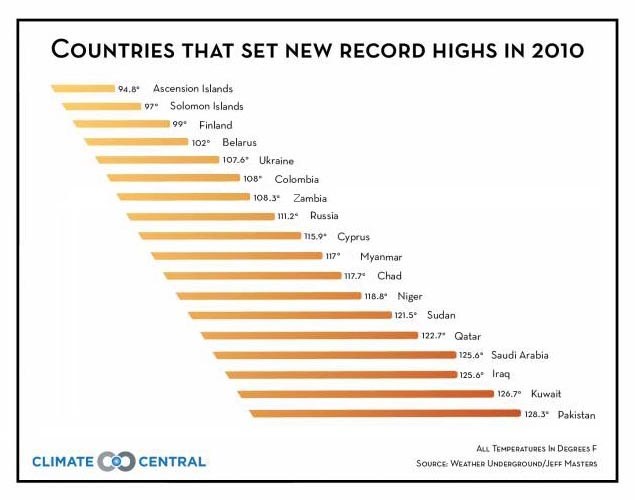 Graphic design by Russell Freedman; published Aug. 13th, 2010.
Australia: Former Prime Minister John Howard, who was up for reelection in 2007, faced severe competition from Labor leader Kevin Rudd (his eventual successor), who has said he would sign the Kyoto Protocol and fight climate change.[661]
Australia is so hot, and so dehydrated, as a result of a severe drought that is blamed on global warming, that residents in the state of Queensland may soon be drinking recycled sewage.[662]
A plan was announced on Feb. 20, 2007, to phase out inefficient incandescent light bulbs in Australia over the next three years. Environment Minister Malcolm Turnbull says it is the world’s first light bulb ban and that “during the Kyoto Protocol target period between 2008 and 2012, the light bulb phase-out would cut 800,000 tonnes of greenhouse gas emissions in Australia each year.”[663]
On April 27, 2007, the Climate Institute (a Sydney-based think tank) reported that Australia’s GHG emissions are growing at an increased rate that will make achieving its Kyoto Protocol goals unlikely. Although Australia and the U.S. are the only developed nations that did not ratify the Protocol, Australia is determined to meet the goal it accepted under it. Greenpeace and other environmental groups (see A Bright Future: 25% Renewable Energy for Australia by 2020), and the Australian Green party have issued reports urging stronger GHG emissions goals, zero electricity growth by 2010, and for 25% of electricity to come from renewable energy sources by 2020.[664] Indeed, in early May of 2007, Australia’s states announced a plan to launch a GHG reporting scheme by the middle of 2008, and a national emissions trading scheme by the end of 2010.[665] On June 2nd, 2007, the states and territories overrode federal objections to require facilities emitting more than 25 kilotonnes of GHGs to begin reporting their emissions in 2008-09 through the National Pollutant Inventory (NPI), unless the federal government introduces its own legislated reporting scheme in the meantime.[666]
A report from the Prime Minister’s Advisory Task Group on Emissions Trading released on June 1 said that Australia should begin to develop a GHG emissions trading scheme, but criticized the Kyoto Protocol and warned against damaging the Australian economy.[667]
Despite the strength of the Australian economy and low unemployment, PM Howard went down in a “landslide defeat” before opposition leader Kevin Rudd in the November 2007 general election, thus ending 11 years of conservative rule. Mr. Rudd promised to sign the Kyoto Protocol, to attend the Bali meeting in December 2007 which began negotiations for a post-Kyoto agreement, and to further distance his administration from that of President Bush by withdrawing Australia’s troops from Iraq.[668] He did so on his first official day in office, Dec. 3, 2007, which was also the first day of the U.N. climate conference in Bali, Indonesia. He has sworn “to put Australia at the forefront of the worldwide fight against global warming.”[669] The U.S. is now the only industrialized nation that has not ratified the Protocol.
In late November 2009, the Dalai Lama travelled to Sydney to give talks on climate change for the first time, in the light of the debate going on there over Prime Minister Kevin Rudd’s planned emissions trading scheme.[670] Mr. Rudd leads the Labor Party, but does not control the Senate. The new Liberal Party opposition leader, Tony Abbott, is against a cap-and-trade scheme, which would be the largest in the world outside of the EU, and calls it “a great big tax to create a great big slush fund to provide politicized handouts, run by giant bureaucracy.”[671] The debate is being watched closely in the U.S.
The government tried twice in 2009 to implement the Carbon Pollution Reduction Scheme but failed. Then on April 27, 2010, less than a week after Senator Graham abandoned climate change legislation in the U.S., the government announced it was abandoning plans to have an ETS in place by mid-2011, and will not reconsider such a scheme until the end of 2012, which means trading could not begin until at least 2013. Mr. Rudd blamed the Senate’s reluctance to act, and lack of movement on an international climate treaty.[672]
Mr. Rudd was succeeded by Julia Gillard, Australia’s first woman PM, in June 2010; the government was initially committed to climate change programs. However, after 10 years of drought, Queensland was struck by tropical storms in summer 2010 (at one point 6 inches fell in 1 hour), followed closely by massive flooding in December and January that washed away roads and railways, destroyed crops and brought industry to a halt. (Australia floods: 72 missing and at least eight dead, BBC News, Jan. 10, 2011.) Cyclone Yasi, category 5, continued the devastation. (Patrick Barkham & Adam Gabbatt, Cyclone Yasi strikes North Queensland: Category five cyclone tears roofs off pubs and houses, topples trees, and sends power cables crashing on to roads, guardian.co.uk, Feb. 2, 2011.) The cost of rebuilding Queensland and other areas is estimated at over $5 billion. PM Gillard plans to pay the bills partly by “abolishing, deferring and capping access to a number of carbon abatement programs.” (National Press Club address by Prime Minister Julia Gillard, The Australian, Jan. 27, 2011.)
Brazil: Shortly after the IPCC Fourth Assessment Report was released in February 2007, President Lula accused developed nations of not doing enough to stop climate change. He pointed out that Brazil has reduced deforestation of the Amazon rainforest by 50% in the last 3 years, that it is the largest producer of ethanol from sugar cane and has more alternative fuel cars than any other country.[673]
In November 2006, the Brazilian Chamber of Deputies passed a law to restrict deforestation of the Atlantic Rain Forest. The bill had been stalled by a controversial provision involving indemnification of landowners in the Rain Forest.[674]
During President Bush’s March 2007 trip to Latin America, he and Brazilian President Luiz Inacio Lula da Silva issued a ‘memorandum of understanding’ on developing ethanol and other alternative fuels as international commodities. It called for the formation of a U.S. steering group under the direction of the State Department and another such group to be formed in Brazil.[675]
Despite earlier optimism, the Brazilian government announced, in January 2008, a large increase in the rate of Amazon deforestation in the last 5 months of 2007, which was considered very unusual for that time of the year.[676]
On Dec. 29, 2009, Brazilian President Luiz Inacio Lula da Silva signed a law requiring that Brazil cut GHG emissions by 39% by 2020, meeting a commitment made at Copenhagen’s COP-15. Greenpeace’s representative in Brazil, Sergio Leitao, was skeptical that anything meaningful would result from it.[677]
Deforestation has slowed around the world in the last decade, partly due to a slowdown in logging in the Amazon.[678]
See Lars Friber, Varieties of Carbon Governance: The Clean Development Mechanism in Brazil—a Success Story Challenged, 18 (4) Journal of Environment & Development 395 (2009).
C40 Large Cities Climate Summit 2007: From May 14-17, 2007, mayors from over 30 of the world’s largest cities (which are responsible for 75% of the world’s GHG emissions) met in New York City to discuss climate change in urban areas at the second C40 Large Cities Climate Summit 2007; the first meeting was in London in 2005. [679] The event is partly sponsored by former President Clinton’s Climate Initiative. On May 16th, former President Clinton introduced the Energy Efficiency Building Retrofit Program, a $5 billion project of the Clinton Climate Initiative; it will retrofit buildings with energy efficient devices that will reduce their energy use. The C40 group issued a communiqué on its last day, May 17th, challenging the Group of Eight industrialized countries meeting in June in Germany, see infra, to find a way to stabilize GHG emissions, and urging the Parties to the UNFCCC and Kyoto Protocol meeting in Bali in November to begin negotiations on the post-Kyoto framework in order to avoid a gap after the first commitment period ends in 2012.[680]
Canada: Canada ratified the Kyoto Protocol, but its Conservative government ignored most of its targets. In February, 2007, the parliament voted for a bill to force the government to create a detailed plan for meeting its Kyoto promises.[681]
In December 2006, the Canadian province Manitoba entered into a Memorandum of Understanding with California, agreeing to collaborate on GHG technology and other ways to reduce GHG emissions. See supra.
On March 22, 2007, Nova Scotia’s Environment and Labor Minister introduced Bill No. 146, the Act Respecting Environmental Goals and Sustainable Prosperity, which would reduce the province’s GHG emissions by 10% from 1990 levels, or 35% from current levels, by 2020, thereby making it “one of the cleanest and most sustainable environments in the world” by that date. [682]
On April 25, 2007, Canadian Environment Minister John Baird announced a proposed climate action plan that would “stop the rise in greenhouse gases in three to five years” and represent a “U-turn” from the previous administration’s lack of action. [683] The plan was released shortly after a study prepared by Environment Canada entitled The Cost of Bill C-288 to Canadian Families and Business showed that meeting the country’s Kyoto targets in a more aggressive way would likely force the economy into recession.[684] On the same day, the Natural Resources Minister Gary Lunn announced new lighting efficiency standards that would ban incandescent lighting by 2012.[685]
Canada proposed on April 1, 2010, to limit GHG emissions from mobile sources, in line with U.S. regulations taking effect in the 2012 model year and issued on that date, see supra § 4.4.2.2.1. Environment Minister Jim Prentice said “[s]ince last May, we’ve been working with the United States to put in place tough North American standards for regulating greenhouse gas emissions from new vehicles.” The proposed Passenger Automobile and Light Truck Greenhouse Gas Emission Regulations, issued under the Canadian Environmental Protection Act, were published in the April 17 issue of the Canada Gazette, Part I, for a further 60-day formal comment period. The finalized regulations are expected to be published in the Canada Gazette, Part II, in summer 2010 and to take effect for the 2011 model year. [686] The final regulations, for the 2011-2016 model years, were announced on Oct. 1, 2010. (Canada Announces Final GHG Emission Regulations for New Light-Duty Vehicles, Marketwire, Oct. 1, 2010.)
On May 21, 2010, Canada announced that it would develop emissions standards for medium- and heavy-duty trucks for model years 2014-2018 in line with the new U.S. standards announced on the same day by President Obama, see supra § 4.4.2.2.1., Mobile Sources. (Peter Menyasz, Motor Vehicles Canada Proposes to Align Truck Emissions Standards With U.S.; Research Fund Set Up, WCCR, May 24, 2010.)
But 13 days before Cancun’s COP-16 in 2010, the conservative government defeated a bill that would have reduced GHG emissions by 25% from 1990 levels. (Canada senate kills climate bill ahead of UN summit: Canadian Prime Minister Stephen Harper’s Conservative government has defeated a climate change bill calling for cuts in CO2 emissions, BBC News, Nov. 18, 2010.)
Carbon Fund for Europe (CFE): On Mar. 20, 2007, the World Bank and the European Investment Bank announced the establishment of a new fund to pool money from several EU member states to finance climate-friendly projects in other Annex 1 countries and thus generate emissions credits under Kyoto’s Joint Implementation Mechanism, and in non-Annex 1 countries under Kyoto’s Clean Development Mechanism, thus helping them to meet their Kyoto and European Union’s Emissions Trading Scheme (EU ETS) commitments. This will be the 10th such fund managed by the World Bank.
Cebu Declaration on East Asian Energy Security: This agreement, to reduce dependence on traditional energy sources and encourage the use of biofuels, was signed by members of ASEAN—the Philippines, Thailand, Myanmar, Indonesia, Malaysia, Singapore, Brunei, Cambodia, Laos, and Vietnam—as well as China, Japan, New Zealand, India, South Korea, and Australia. The agreement, signed Jan. 15, 2007, sets no targets for capping GHG emissions.[687]
China: China has about 20% of the world’s population but consumes only 4% of the world’s oil, importing only about 3 million barrels a day. With its rapidly expanding economy, China exceeded the U.S.’s GHG emissions in 2008. [688] China plans to derive 15% of its energy from renewable sources by 2020.[689] However, despite experiencing its warmest winter in 30 years, it reiterated, shortly after the IPCC Fourth Assessment Report was released in February 2007, that developed nations must assume most of the responsibility for emissions cuts.[690]
The EPA has a page entitled: Clean Air and Energy Projects in China with links to various agreements and clean air, energy efficiency, and renewable energy projects.
On a visit by the Chinese premier to Tokyo to meet with Prime Minister Shinzo Abe, China agreed for the first time to participate in developing a post-Kyoto Protocol framework beginning after 2012, when the current Protocol expires, and to work with Japan toward that goal.[691]
China may be doing more to cut GHG emissions than has previously been thought. In 2006 it began a plan to boost energy efficiency 20% by 2010, a goal that even if only half met would be a larger reduction in emissions growth than the EU’s goal under Kyoto. Soon China may no longer offer the U.S. an excuse for doing nothing to halt climate change.[692]
Chinese media reported on May 7, 2007, that in 2006 the State Environmental Protection Administration closed 3176 businesses for pollution violations, after inspecting 720,000 factories, in an effort to clean up industrial areas. Other measures are planned but remain undisclosed at this time.[693]
China issued a 62-page national climate change plan in advance of the June 2007 G8 meeting, see infra, but reiterated that it will not compromise economic development in the process of dealing with the problem, and that it believes climate change is primarily the responsibility of developed western nations.[694]
The Institute of Energy Economics in Japan projected on Oct. 12, 2007, that CO2 emissions from China will be 2.6 billion tons by 2030, nearly double their 2005 levels.[695]
For the Chinese/Indian agreement on climate issues signed Oct. 20, 2009, see infra under India.
China has drafted stringent auto fuel economy standards, requiring carmakers to improve fuel economy by an additional 18% by 2015 (the average new Chinese car, minivan or SUV already gets 35.8 MPG); the standards should be released early in 2010. Midsize and compact cars must increase fuel economy more, up to 26%. Cars with economic engines are now taxed 1%, and purchasers of sports cars and SUVs must pay 40%, so cars tend to be smaller than in the US.[696] According to Yvo de Boer at the opening to the Barcelona climate talks in November, 2009, the last meeting before Copenhagen’s CPO-15, “developing countries, including China, India, Mexico, Brazil, and South Korea, are moving much faster than industrialized nations to address climate change. ‘China is probably the world leader in limiting greenhouse-gas emissions,’ de Boer said, in what many perceived as a direct criticism of the U.S.”[697] However, the Global Climate Change Lobby reported in November of 2009 that progress there lags due to built-in and deeply entrenched favoritism for cheaper fossil fuel.[698]
During his first visit to China, on Nov. 17, 2009, President Obama and President Hu Jintao announced a comprehensive package of measures to strengthen cooperation between the United States and China on clean energy; it included “very important efforts on helping China build a robust, transparent, and accurate inventory of their greenhouse gas emissions.”
A day after the U.S. announcement on Nov. 25, 2009, that it would pledge at COP-15 to cut GHG emissions about 17% by 2020 from 2005 levels (the same as in H.R. 2454, passed in June by the House), contingent on passage of legislation, China announced it would cut its carbon “intensity” 40% to 45% by 2020 compared with 2005 levels.[699] Emissions intensity is the amount of carbon dioxide produced per unit of gross domestic product.
Early in 2010 a New York Times editorial discussed “China’s Green Leap Forward.” Although concerned about global warming to some degree, China’s leaders are very aware that new business opportunities have materialized that they do not intend to miss out on, especially in the areas of solar power, wind energy, nuclear power, and mass transit (including the fastest bullet train in the world at 217 mph). For example, in October 2009, China signed a deal with First Solar from Arizona for a photovoltaic power complex, and on Jan. 8, 2010, a Chinese developer and eSolar of California signed a deal to produce the largest solar thermal project in the world in the Mongolian desert, generating 2000 megawatts of energy.[700]
Deforestation has slowed around the world in the last decade, partly due to a massive increase in planting new forests in China.[701]
Several Chinese cities are becoming thriving centers of clean energy manufacturing, unlike Europe or the United States where such companies are not supported by their governments to the same extent. Chinese government assistance may possibly run afoul of WTO rules banning subsidies to exporters, which were designed to prevent governments from giving their companies advantages over others in world markets. (Keith Bradsher, On Clean Energy, China Skirts Rules, N.Y. Times, Sept. 8, 2010.)
For academic commentary, see, e.g., Michael P. Vandenbergh, Climate Change: The China Problem, 81 S. Cal. L. Rev. 905 (July, 2008).
Miriam Schroeder, Varieties of Carbon Governance: Utilizing the Clean Development Mechanism for Chinese Priorities, 18 (4) Journal of Environment Development 371 (2009).
Climate Change and Impact Research: the Mediterranean Environment (CIRCE): A group of scientists from 62 research institutions from countries surrounding the Mediterranean (member countries are: Italy, Spain, Denmark, Greece, Germany, France, United Kingdom, Tunisia, Israel, Austria, Portugal, Egypt, Switzerland, Netherlands, Syria, and Algeria) met in Bologna in May 2007 to initiate a 4-year-long comprehensive study of the potential effects of climate change on the agriculture, forests, ecosystems, human health and air quality of the region.[702] Antonio Navarra, geophysicist and head of Italy’s National Institute of Geophysics and Volcanology, and Laurence Tubiana, who heads France’s Institute for Sustainable Development and International Relations, are co-directors of the project, which is funded by the EU’s Sixth Framework Programme.[703] CIRCE also collects articles related to climate change from magazines, newspapers and webzines, as well as radio and TV broadcasts, on its Web page.
G8: A March 2007 meeting of G8 environment ministers in Potsdam, Germany, brought together “the generators of some two-thirds of global greenhouse gas emissions and the users of about three-quarters of the biological capacity of the Earth,” in the words of the German Minister Sigmar Gabriel. No one was surprised that the US opposed carbon trading.[704] Gabriel said more work would be done on environmental issues during the G8 countries’ annual summit, June 6-8, 2007, in Heiligendamm, Germany.[705]
In preparation for the G8 meeting to be held June 6-8th, 2007, in Heiligendamm, Germany, the U.S. made contrarian revisions to a draft agreement on climate change written by the Germans and under discussion in Bonn. The U.S. wanted to delete passages about “resolute action” being “urgently needed,” expressions of “deep concern about the latest findings… by the [IPCC],” and calls for a global carbon market. One observer, Philip Clapp, president of the National Environmental Trust, speculated that the U.S. administration was “trying to lay landmines under a post-Kyoto agreement after they leave office.”[706] On May 18th, the chairmen and women of 15 House committees wrote a letter to the president in response to these efforts, requesting that he “reverse course and strengthen the G8 declaration.”[707] Speaker Pelosi met with German Chancellor Angela Merkel in advance of the G8 meeting to emphasize congressional concern over climate change.[708]
On May 31st, in advance of the G8 summit, President Bush announced that he planned to negotiate voluntary emissions cuts with other major GHG emitting countries in meetings this fall. His full proposal was presented at the G8 meeting but was discussed with leaders in the days preceding the meeting. Congressional leaders were critical of the proposal and environmental groups were skeptical.[709]
The day the G8 summit opened on June 6th, 2007, George Bush’s senior climate adviser, James Connaughton, said the U.S. would not agree to Chancellor Angela Merkel’s goal of cutting GHG emissions by 50% by 2050. Further, he did not believe that the G8 should dictate individual members’ emissions targets.[710] However, the following day, news sources reported that the leaders had agreed that CO2 emissions must be stopped and then substantially reduced. They also agreed to hold further talks on a successor agreement to the Kyoto Protocol.[711] The leaders announced a compromise agreement; Angela Merkel, currently chair of the G8, called the meeting a “great success.”[712] The leaders released a Joint Statement on June 8, 2007.
While the G8 summit was in progress, the world’s major developing countries, China, India, Brazil, South Africa and Mexico (the “G5”) met in Berlin. They met with the G8 leaders on June 8th and called for the developed nations to help them to reduce GHG emission in several ways, including access to fuel-efficient technologies unimpeded by expensive intellectual property rights.[713]
G8 members met in Kobe, Japan, in May of 2008 in preparation for the July summit in Toyako. Climate change was at the center of the agenda at that meeting. Representatives acknowledged the need to set targets for cutting GHG emissions 50% by 2050, but failed to set such standards.[714]
Iceland: The financially beleaguered island country has it easier than the rest of us when it comes to energy, in a way. Its vast hydroelectric and geo-thermal resources have provided most of its electricity and heating for some time, although until recently it produced more GHG emissions per capita than any other country because of its lack of fossil fuel resources to power cars and trucks (it is too young a landmass, only 2 million years old). It began a program in 1998 to convert hydrogen and oxygen into power for its fishing vessels and transportation system, with the goal of making the country completely independent of foreign oil by 2050, but it is behind schedule partly because of a dearth of hydrogen vehicles. (Tim Hirsch, Iceland launches energy revolution, BBC News, Dec. 24, 2001; Xuefei Chen, Iceland wants to be independent from fossil fuel despite financial crisis, People’s Daily Online, Dec. 24, 2009; Colin Woodard, Iceland strides toward a hydrogen economy: Global economic crises underscores urgency of the goal, even as it delays progress, Christian Science Monitor, Feb. 13, 2009, at 25; Iceland: Here we are, plug us in, Climate Progress, Aug. 10, 2010.)
India & Southeast Asia: A report published by the National Academy of Sciences in 2004, entitled: Rice Yields Decline with Higher Night Temperature from Global Warming, by Shaobing Peng, et al., showed that rice yields decline by 10% for each 1°C increase in growing-season minimum temperature, and specifically from the increased nighttime temperatures associated with global warming.[715] The research was conducted at the International Rice Research Institute Farm in the Philippines from 1979 to 2003.
See also: Wolfgang Cramer, Air Pollution and Climate Change Both Reduce Indian Rice Harvests, published Dec. 26, 2006 in 103 (52) Proceedings of the National Academy of Sciences 19609; & Maximilian Auffhammer, et al., Integrated Model Shows That Atmospheric Brown Clouds and Greenhouse Gases Have Reduced Rice Harvests in India, in the same issue of PNAS, page 19668.
Hitherto voluntary energy efficiency guidelines for industrial users, buildings, and household appliances that were enacted as part of India’s Energy Conservation Act of 2001 were made mandatory in June of 2007. [716]
The Institute of Energy Economics in Japan projected that by 2030, Indian GHG emissions will increase to 2.6 times their 2005 levels, reaching 840 million tons. [717]
On Wednesday, Oct. 21, 2009, Indian Environment and Forest Minister Jairam Ramesh and China’s Minister for National Development and Reforms, Xie Zhenhua signed a 5-year agreement to cooperate on climate issues. “‘Both India and China are collaborating to ensure a fair and equitable outcome at Copenhagen. An outcome that is in keeping with the principles of the Rio Convention of 1992, the Kyoto Protocol of 1997 and the Bali Action Plan of 2007. There is to my mind virtually no difference between the Indian and the Chinese negotiating position,’ Ramesh says, according to Thaindian News.” According to Bloomberg.com, “India and neighboring countries plan to make a joint statement at Copenhagen on their actions to combat climate change and they may sign a regional environment treaty next year.”[718]
Environment Minister Ramesh told Parliament on Dec. 3, a few days before COP-15 began in Copenhagen, that India is ready to voluntarily and unilaterally reduce carbon emissions intensity by 20 to 25 percent by 2020. (Emissions intensity is the amount of carbon dioxide produced per unit of gross domestic product.) India would not, however, agree to accept binding cuts or set a date after which its total emissions would begin to fall, a conviction India shares with other emerging economies.[719]
India surprised attendees at COP-16 in Cancun with its flexible, open and active attitude toward verification of national reductions pledges, something it has previously fought; its Minister on Environment, Jairam Ramesh, made constructive compromise offers that aided in bringing China and the U.S. together on difficult issues. (Shaun Tandon, In Cancun climate talks, India enjoys place in sun, GRIST, Dec. 13, 2010.)
See Gudrun Benecke, Varieties of Carbon Governance: Taking Stock of the Local Carbon Market in India, 18 (4) Journal of Environment Development 346 (2009).
Indonesia: A World Bank report entitled Indonesia and Climate Change: Current Status and Policies was released on June 5, 2007. [720] It pointed out that Indonesia was not only among the world’s top three GHG emitters, but also one of the countries most likely to suffer from its effects.
International Carbon Action Partnership: Leaders of more than 15 governments, including nine members of the EU, members of RGGI (see supra), and members of the Western Climate Initiative (see supra), New Zealand and Norway joined together on Oct. 29, 2007, to fight global warming.
International Renewable Energy Agency (IRENA): Formed on Jan. 26, 2009, IRENA now has 138 member states (the most recent member as of Nov. 23, 2009, is the EU; members include 46 African, 36 European, 32 Asian, 14 American and 9 Australia/Oceania States). IRENA “aspires to become the main driving force for promoting a rapid transition towards the widespread and sustainable use of renewable energy on a global scale.” The Preparatory Commission, currently operational, will be dissolved after entry into force of the Statute, which will occur upon the 25th deposit of an instrument of ratification; the agency will then consist of an Assembly, a Council, and a Secretariat. The interim headquarters is Abu Dhabi, and Hélène Pelosse is the Interim Director-General.[721] So far (as of Dec. 4, 2009) there have only been 6 ratifications of the statute; it is hoped that the agency will be fully operational by the end of 2010.
Japan: One of the reasons that Toyota is one of the world’s most profitable [722] and innovative car companies is because Japan has both high gasoline taxes and stringent energy efficiency standards.[723]
Under the Kyoto Protocol, Japan is required to reduce its greenhouse gas emissions to 6 percent below 1990 levels by the end of 2012; however, Japanese Prime Minister Yukio Hatoyama set a medium-term goal in September 2009, telling the United Nations General Assembly that Japan would cut emissions 25 percent by 2020. Then in November 2009 he set a long term goal, pledging that Japan will reduce its GHG emissions to 80 percent of 1990 levels by 2050.[724]
President Obama began his first trip to Asia in Japan in Nov. 2009; he and Prime Minister Hatoyama agreed to cooperate on climate change mitigation and energy technology, as well as to strive for Japan’s previously announced 80% reduction in GHG emissions by 2050. They also pledged to work to make the U.N. climate meeting in Copenhagen in December a success.[725]
On April 1, 2010, a municipal ordinance in Tokyo required that offices and factories that consume over 396,300 gallons of crude oil annually must reduce their GHG emissions 6-8% in the next 5 years, making Toyko the first Japanese city to regulate GHG emissions. Penalties for noncompliance will be up to $5300 and include public disclosure.[726]
In Dec. 2010, Japan, the world’s 5th largest GHG emitter, postponed plans for a national GHG emissions trading scheme that it had planned to start in 2013. (Risa Maeda, Japan shelves carbon emissions trading scheme: Japan postponed plans for a national emissions trading scheme on Tuesday, bowing to powerful business groups that warned of job losses as they compete against overseas rivals facing fewer emissions regulations, Reuters, Dec. 28, 2010.)
A powerful 9.0-magnitude earthquake off the northeast coast of Honshu, Japan, on Mar. 11, 2011, triggered a tsunami with waves at least 11 meters high (33 feet; waves up to 45 feet were reported), and reaching 6 miles inland in some cases. The twin disasters killed many people (27,000 are confirmed dead or missing on Mar. 28th); made at least 240,000 homeless, though some reports said upwards of half a million; and caused an emergency at Fukushima Dai-ichi Nuclear Power Station, 220 kilometers (about 137 miles) north of Tokyo. Several explosions, floods, and fires resulted in the loss of electrical power necessary to cool the facility’s 6 reactors, 3 of which were shut down at the time of the accident. Dangerous conditions, including the potential for a meltdown, result when pools used to cool spent fuel are allowed to overheat or if water levels drop. (Xaquín G.V., Bill Marsh & Graham Roberts, Hazards of Storing Spent Fuel, N.Y. Times, Mar. 18, 2011.) Officials eventually established off-site electrical power to the facility; it was hoped that cooling systems would be functional at all reactors by Mar. 24th, but by Mar. 30th, that had not happened and emergency cooling strategies were responsible for serious radiation leaks. (Ken Belson & Hiroko Tabuchi, Confidence Slips Away as Japan Battles Nuclear Peril, N.Y. Times, Mar. 29, 2011.) Residents were initially evacuated from a 20-km (12 mile) radius; those living 30 km (19 miles) away were advised to stay inside. (Fukushima Nuclear Accident Update Log, IAEA, updated daily, last visited on Mar. 28, 2011.) Significant aftershocks continue, including a magnitude 6.5 offshore earthquake on March 28th; rebuilding is expected to cost over $300 billion, making it the most costly natural disaster on record. (Lucy Birmingham, Japan Recovery Slowed by Aftershocks, Nuke Fears, Time, Mar. 28, 2011; David Jolly, Japan Faces Power Gap For Months, N.Y. Times, Mar. 29, 2011.)
Image gratefully and respectfully copied from the N.Y. Times, Mar. 29, 2011.
On Mar. 19th, leafy vegetables and milk from the affected area were found to have radiation levels above legal limits; on Mar. 23rd, radioactive iodine was discovered in Tokyo’s drinking water; on Mar. 24th, iodine was detected in seawater samples collected 30 km from the coast on the 22nd and 23rd. (David Jolly & Kevin Drew, Tokyo Says Radiation in Water Puts Infants at Risk, N.Y. Times, Mar. 23, 2011; David Jolly & Denise Grady, Anxiety Up as Tokyo Issues Warning on Its Tap Water, N.Y. Times, Mar. 23, 2011.) On Thursday Mar. 24th, 3 workers at Fukushima stepped into radioactive water in unit 3; 2 were burned. The next day, Japanese officials announced that they suspected a breach in the reactor vessel of that unit, and began suggesting a voluntary evacuation from a larger area around the facility. (David Jolly & Hiroko Tabuchi, Japan Raises Possibility of Breach in Reactor Vessel, N.Y. Times, Mar. 24, 2011; Shino Yuasa & Jay Alabaster, Breach in reactor suspected at Japanese nuke plant, AP, Mar. 24, 2011; David Jolly, Hiroko Tabuchi & Keith Bradsher, Japan Quietly Evacuating a Wider Radius From Reactors, N.Y. Times, Mar. 25, 2011.) On Mar. 30th, cesium 137, a long lasting radioactive element, was discovered by the IAEA 25 miles from Fukushima at levels higher than the standard the Soviets used to recommend evacuation from the area surrounding Chernobyl. Under discussion was the expansion of the current evacuation zone or possible abandonment of the land, but no decision was made by the end of the day. Also, on the 31st, significantly higher levels of radioactive iodine 131, 4,385 times the statutory limit, were found in seawater around the plant. Tokyo Electric Power Company, that operates the facility, said that at least 4 of the 6 reactors would have to be scrapped. (Matthew L. Wald & David Jolly, Dangerous Levels of Radioactive Isotope Found 25 Miles From Nuclear Plant, N.Y. Times, Mar. 30, 2011.)
In response, Germany shut down 7 older nuclear plants (Steven Erlanger & Judy Dempsey, Germany Steps Away From European Unity, N.Y. Times, Mar. 23, 2011; AP, Angela Merkel calls for nuclear power changes, Boston Herald, Mar. 24, 2011); India has ordered a safety audit of its 20 operating reactors (Pallava Bagla, India’s Nuclear Chief: Reactor Review But No Shutdown, Science Insider, Mar. 18, 2011); EU leaders, after a summit in Brussels, called for worldwide stress testing of all [442] nuclear facilities [65 more are under construction]. (John M. Broder, Matthew L. Wald & Tom Zeller, Jr., When All Isn’t Enough to Stop a Catastrophe, N.Y. Times, Mar. 29, 2011; AP, EU wants worldwide nuclear plant tests, Boston Herald, Mar. 25, 2011; Ailis Aaron Wolf, Survey: Americans Want to Hit the Brakes on More Nuclear Power: Over Half of U.S. Adults Now Back Moratorium on New Reactors…., WCCR, Mar. 22, 2011; Dennis Normile, Atomic Agency Chief: Nuclear Plants Harmed By Disaster, ScienceNOW, Mar. 18, 2011 (“… Yukiya Amano, director general of the International Atomic Energy Agency (IAEA), said it would be ‘unrealistic to think this accident will not impact decisions by governments’ on the use of nuclear power. Over the past week, countries around the world have announced plans to check the safety of operating reactors and rethink nuclear power policies.”); Matthew L. Wald, Lessons From Fukushima Taught on Capitol Hill, N.Y. Times, Mar. 29, 2011.) The phrase “regulatory capture” has been used in conjunction with the U.S. NRC. (e.g., Mark Seidenfeld, Bending the Rules: Flexible Regulation and Constraints on Agency Discretion, 51 Admin. L. Rev. 429, 452 (1999); Eric R. Pogue, The Catastrophe Model of Risk Regulation and the Regulatory Legacy of Three Mile Island and Love Canal, 15 Penn St. Envtl. L. Rev. 463 (2007)), and Japan’s Nuclear and Industrial Safety Agency, whose regulators approved a 10-year extension for the oldest of Fukushima’s reactors one month before the earthquake, tsunami and probable meltdown.
In the weeks since the earthquake, I have seen hypothetical connections made between global warming and perceived seismic activity due to melting glaciers’ reducing the weight on the earth’s crust. (Richard A. Kerr, Quake Question #6: Is Climate Change Responsible?, Science Insider, Mar. 16, 2011.) Whether that hypothesis is proved or provable, it appears certain that nuclear power, as an alternative to conventional fossil fuels or renewable energy, may have suffered a major setback as a result of events in Japan.
New Zealand: The government has announced that it wants 90% of its electrical generation to come from renewable sources by 2025; state-owned electricity generators have been instructed not to build new fossil-fuel plants for 10 years. In addition, the government introduced a bill that would require that biofuels make up 3.4% of all gas and diesel sales by 2012.[727]
On Dec. 4, 2007, the government introduced the Climate Change (Emissions Trading and Renewable Preference) Bill No. 187-1 into Parliament. It would establish an emissions trading scheme (NZETS) to cover all sectors and all GHGs and it would put a 10-year moratorium on construction of new fossil-fuel plants, as announced in October, supra.[728]
Russia: Regulations were drafted in January 2007 that would enable Russian companies to sell GHG emission credits through the Kyoto Protocol’s Joint Implementation mechanism.[729]
Government officials, interested in reviving the nuclear energy program after the 1986 Chernobyl disaster, plan to build 2 nuclear reactors a year through 2015, 3 a year from 2016, and 4 a year beginning in 2020.[730]
7. Online Scientific Resources Relating to Global Climate Change
7.1. General Web Sites & Blogs for Climate Change Resources and Programs
- 350.org: an international campaign that’s building a movement to unite the world around solutions to the climate crisis—the solutions that science and justice demand. The organization’s name refers to the number of parts per million of CO2. “If we can’t get below that, scientists say, the damage we’re already seeing form [sic] global warming will continue and accelerate.”
- Alliance for Climate Protection: Al Gore is Chairman of the Board; partners include “[d]ozens of highly successful business-people, media professionals, entertainers, religious leaders, academics and NGO leaders.” Its mission is to convince the American people of the importance of adopting a comprehensive solution to the climate crisis. It plans to launch a marketing campaign on climate change, at a cost of more than $100 million a year for three years.[731]
- American Association for the Advancement of Science has a Global Climate-Change Resources page, with links to reports, climate change news, events, recent relevant articles in Science, and more.
- Arctic Climate Impact Assessment (ACIA): A project of the Arctic Council, whose members are Canada, Denmark, Finland, Iceland, Norway, the Russian Federation, Sweden, and the United States, and the International Arctic Science Committee (IASC), a non-governmental organization that encourages and facilitates international cooperation in all areas of Arctic research. ACIA’s synthesis report is entitled Impacts of a Warming Arctic; its findings were released at the ACIA International Scientific Symposium in Reykjavik, Iceland, in 2004. ACIA also produced a 1042-page scientific report entitled Arctic Climate Impact Assessment in 2005.
- BBC has a Climate Change page (last updated, Aug. 2008). See also its Quick guide: Carbon offsetting.
- The Breakthrough Institute is an environmental think tank.
See Ted Nordhaus & Michael Shellenberger, Break Through: Why We Can’t Leave Saving the Planet to Environmentalists (Mariner Books; Reprint edition, March 10, 2009).
- CCIR-NYC: Climate Change Information Resources-New York Metropolitan Region (CCIR-NYC) is an information resource created for the use of policymakers, educators, and the public on how climate change will impact on the metropolitan area, and how residents can adapt to it. A project of the Center for International Earth Science Information Network (CEISIN) at Columbia University, under a grant from NOAA, and with the collaboration of the Goddard Institute for Space Studies and Hunter College. Last accessed in January 2011, the site has not been updated since March 29, 2005.
- The Carbon Mitigation Initiative “is a joint project of Princeton University, BP and the Ford Motor Company to find solutions to the greenhouse and global warming problem.”
- Climapedia: BNA’s climate change encyclopedia provides links to significant documents and other reference materials on issues of global warming, renewable and alternative energy, and financing for clean energy projects. Reference materials include policy recommendations, legislation, regulations, guidelines, and links to important or helpful Websites [in Economic/Scientific Analysis, Atmospheric Conditions].
- The Climate Analysis Indicators Tool (CAIT): provides a comprehensive and comparable database of greenhouse gases and other climate-relevant indicators. CAIT 7.0 features greenhouse gas data through 2006 for most countries of the world (as of spring 2010). Free registration required.
- Climate Central: A nonprofit, collaborative group of scientists and communicators, providing since 2008, a central authoritative source for climate change information.
- Climate Desk: A journalistic collaboration dedicated to exploring the impact—human, environmental, economic, political—of a changing climate.
- Climate Progress: An insider’s view of climate science, politics, and solutions: Called “The indispensable blog” by Tom Friedman of the New York Times, “Climate Progress is dedicated to providing the progressive perspective on climate science, climate solutions, and climate politics. It is a project of the Center for American Progress Action Fund, a nonprofit, nonpartisan organization,” and Joseph J. Romm, who among other things is, according to Time Magazine, “The Web’s most influential climate-change blogger.”
- EPA’s Current and Near-Term Greenhouse Gas Reduction Initiatives page describes and links to “partnerships and programs promot[ing] opportunities to conserve fossil fuels, improve energy efficiency, recover methane and sequester carbon” across the federal government.
- The DOE’s Energy Information Administration’s Official Energy Statistics from the U.S. Government page includes Voluntary Reporting of Greenhouse Gases Program, and Emissions of Greenhouse Gases Reports as well as U.S. GHG emissions data. [732]
- The Earth System Science Partnership (ESSP) is comprised of four global environmental change research programs: the International Programme of Biodiversity Science (DIVERSITAS); the International Geosphere-Biosphere Programme (IGBP); the International Human Dimensions Programme on Global Environmental Change (IHDP); and the World Climate Research Programme (WCRP); they joined together in 2001 to form the ESSP in response to the Amsterdam Declaration on Global Change, which was signed at the first Global Change Open Science Conference. ESSP “is a Partnership for the integrated study of the Earth System, the changes that are occurring to the system and the implications of these changes for global sustainability.”
- The Earth Policy Institute is “dedicated to providing a vision of an environmentally sustainable economy… [and] a roadmap of how to get from here to there.”
- EarthTrends is “a comprehensive online database, maintained by the World Resources Institute, that focuses on the environmental, social, and economic trends that shape our world.”
- ECOLEX: A Gateway to Environmental Law is a database operated by FAO, IUCN and UNEP. It provides access to treaties, legislation from national jurisdictions and state/provincial levels around the world, court decisions, and literature. It claims to be “the most comprehensive, global source of information on environmental law.” ECOLEX is freely available, but be sure to read the User Agreement.
- An Economic View of the Environment by Robert N. Stavins is posted on Harvard’s Belfer Center web page. Professor Stavins is Albert Pratt Professor of Business and Government, Director of the Harvard Environmental Economics Program, and Chairman of the Environment and Natural Resources Faculty Group. The blog is partly based on articles published in the Environmental Forum, by ELI.
- European Commission has a Climate Change page.
- Environmental Defense Fund has a Global Warming page.
- EPA’s Climate Change page has a link to scientific resources.
- Friends of the Earth UK has a Safe Climate page.
- Global Carbon Project (GCP): Founded in 2001, as part of the ESSP, supra, the project aims to “develop a complete picture of the global carbon cycle, including both its biophysical and human dimensions together with the interactions and feedbacks between them.” Each year it publishes an updated carbon budget and trends. Other reports are available on their Web site, under Products. The GCP reported on Nov. 27, 2006, that carbon dioxide emissions are now rising at a rate of 2.5% per year, whereas up to the year 2000 they were rising by less than 1% annually. [733] The Carbon Budget 2008 was released on Nov. 17, 2009.
- The Global Change Master Directory: a directory to Earth science data and services, on NASA’s Goddard Space Flight Center Web site, lists data sets by topic. Global Warming and Climate Change Policy Websites are also listed.
- The Goddard Institute for Space Studies is a subdivision of the Goddard Space Flight Center, located in New York City.
- The Global Roundtable on Climate Change, a group of nearly 100 international corporations and institutions created in 2004 by the Earth Institute at Columbia University, released The Path to Climate Sustainability: A Joint Statement by the Global Roundtable on Climate Change on Feb. 20, 2007. The document calls on governments “to set scientifically informed targets for greenhouse gases and carbon dioxide (CO2) emissions.” [734]
- Greenpeace, USA, has a Global Warming and Energy page. Greenpeace International has a Stop Climate Change page.
- Hadley Centre for Climate Prediction and Research: Located in the UK and a part of the Met Office, the UK’s national weather service, the centre’s aims are to improve understanding of climate change and to develop climate models that simulate global and regional climate variability over the last 100 years in order to predict future changes. It is the UK’s foremost climate change research centre.
- The International Energy Agency has a Topics page, of which several are relevant: Clean Fossil Fuels, Climate Change, CO2 Emissions, Emissions Trading and CDM, Sustainable Development, and more. The IEA’s World Energy Outlook 2009 was released Nov. 10, 2009. Earlier editions are also available, from 1993.
- LexisNexis has an Environmental Law & Climate Change Center.
- MarClim-Marine Biodiversity and Climate Change: MarClim was a 4-year (2001-2005) project that investigated the effects of climate change on marine biodiversity in the UK. [735]
- The National Academy of Sciences has a Global Change page. A 24-page report entitled Understanding and Responding to Climate Change: Highlights of National Academies Reports is available on that page. In May 2010, NAS released 3 new reports:
- The National Center for Atmospheric Research (NCAR), is operated by the University Corporation for Atmospheric Research and has a Climate Change page.
- NativeEnergy is a privately held Native American energy company. Its Web site has information on creating renewable energy projects, offsetting CO2 emissions from driving a car or air travel, and much more.
- The Natural Resources Defense Council has a Global Warming page.
- NOAA’s Earth System Research Laboratory Global Monitoring Division has a Carbon Tracker: “A system to keep track of carbon dioxide uptake and release at the Earth’s surface over time.”
- The Pew Center on Global Climate Change was established in 1998 and is supported by the Pew Charitable Trusts. It is “working to create a policy environment that leads to the adoption of mandatory federal limits on emissions that contribute to global warming.”
- Resources for the Future is a “nonprofit and nonpartisan” environmental think tank headquartered in Washington, D.C.; it has an Energy and Climate page.
- The Sierra Club has an Initiative to Limit Total Greenhouse Emissions.
- Tyndall Centre for Climate Change Research in the UK “brings together scientists, economists, engineers and social scientists, who together are working to develop sustainable responses to climate change through trans-disciplinary research and dialogue on both a national and international level. …”
- The UNFCCC’s Methods & Science page, contains issues that the Subsidiary Body for Scientific and Technological Advice (SBSTA) is working on.
- Warming Law: Changing the Climate in the Courts: A project of the Constitutional Accountability Center. Its archive goes back to March 2007.
- The Woods Hole Research Center has a document entitled The Warming of the Earth: A Beginner’s Guide to Understanding the Issue of Global Warming, available on the Web. The mission of the Center is “to understand the causes and consequences of environmental change as a basis for policy solutions for a better world, stabilizing climate and protecting the integrity of the global environment.”
- World Economic Forum: “The World Economic Forum is an independent international organization committed to improving the state of the world by engaging leaders in partnerships to shape global, regional and industry agendas. Incorporated as a foundation in 1971 and based in Geneva, Switzerland, the World Economic Forum is impartial and not-for-profit; it is tied to no political, partisan or national interests.”
The Global Information Technology Report 2009-2010, was published by the World Economic Forum in collaboration with INSEAD. It assesses the extent to which 133 economies leverage information and communication technologies for increased growth and development. Also, ENERGY VISION UPDATE 2010: Towards a More Energy Efficient World was produced by WEF and IHS Cambridge Energy Research Associates.
- World Glacier Monitoring Service: Glacier monitoring began in 1894 in Zurich, Switzerland. This group began in 1986 to maintain the collection of information, and studies 30 glaciers in all parts of the world. Shortly before the release of the Fourth Assessment Report by the IPCC in February 2007, the WGMS announced that due to climate change, glaciers are receding three times faster than they were in the 1980s. [736]
“Himalayagate”: However, in January 2010, “recent news reports highlighted a series of slip-ups behind [the IPCC Fourth Assessment Report: Climate Change 2007’s] claim that rising temperatures would melt most of the Himalayan glaciers by 2035.” [737] (The date should have been 2350.) A report from World Wildlife Fund was blamed for introducing the false statement into the IPCC report. Highly unfortunate, as the admission followed hard on the heels of “Climategate” in fall 2009, see supra.
Following the announcement of the mistake, the UN announced Feb. 26, 2010, that it would commission an independent group of top scientists to review its climate science panel in the wake of accusations of sloppy work. [738]
- The World Meteorological Organization (WMO): WMO is a Specialized Agency of the United Nations. It is “the UN system’s authoritative voice on the state and behavior of the Earth’s atmosphere, its interaction with the oceans, the climate it produces and the resulting distribution of water resources.” An intergovernmental organization, it has 187 Member States and Territories. Several of its programs and topics (in drop-down menus) address climate change.
- The World Wildlife Fund has a Climate Savers Program: Mobilizing Companies to cut carbon dioxide.
7.2. Scientific Materials
- Subscribers can access the ACEEE’s Green Book® Online from the American Council for an Energy-Efficient Economy for a small fee from GreenerCars.org; the Greenest Vehicles of 2010 and the Meanest Vehicles for the Environment in 2010 (i.e., the least environmentally friendly) are available for free. (Accessed Feb. 2, 2010.)
- The Asian Development Bank released a working paper on May 19, 2006, entitled Energy Efficiency and Climate Change: Considerations for On-Road Transport in Asia which finds that Asia’s levels of GHG emissions will likely triple over the next 25 years. [739]
- A conference entitled Avoiding Dangerous Climate Change was held in Exeter, England, from Feb. 1-3, 2005. It discussed the consequences of a predicted increase of 1.8 degrees Fahrenheit within 25 years, an increase of 3.6 degrees Fahrenheit before 2050, and an increase of 5.4 degrees Fahrenheit before 2070.
- The British Trust for Ornithology released a report in August 2005, by Robert A. Robinson, et al., entitled Climate Change and Migratory Species.
- The Department of Agriculture established the Federal Advisory Committee for the Expert Review of Synthesis and Assessment Product 4.3 (CERSAP), on March 16, 2007. [740] It will advise the Secretary on a study entitled The Effects of Climate Change on Agriculture, Land Resources, Water Resources, and Biodiversity.
- The Environmental Performance Index 2008 was produced by researchers at Yale and Columbia Universities; it ranked 149 countries over 6 categories: Environmental Health, Air Pollution, Water Resources, Biodiversity and Habitat, Productive Natural Resources, and Climate Change. The U.S. came in 39th, China, 104th, India, 120th, and Australia, 46th. Switzerland, Norway, Sweden and Finland took the top places, in that order.
- A study by David B. Lobell & Christopher B. Field entitled Global Scale Climate-Crop Yield Relationships and the Impacts of Recent Warming, published in 2 Environmental Research Letters 2 in March 2007, tied climate change to lower annual yields of wheat, rice, corn, soybeans, barley, and sorghum worldwide. [741]
- The International Polar Year (IPY) began March 1, 2007, and will continue until March 1, 2009, with over 60 nations participating in the research activities. The National Science Foundation is the lead agency for U.S. activities, and NASA is one of the participants. A video entitled NASA and IPY is available from NASA’s IPY site. This scientific occasion should be especially significant, given the many recently reported climate-change-related events at the poles.
- The Marine Environmental Change Network (MECN) is a collaboration between organizations in England, Scotland, Wales, the Isle of Man and Northern Ireland to collect climate change information. It is funded by DEFRA, the Department of the Environment, Food, and Rural Affairs. (Under construction, Feb. 2010.)
- The National Academy of Sciences reports that brown clouds of air pollution over South Asia, as well as elevated levels of GHG, reduced rice production in the area. The report is entitled Rice Yields Decline With Higher Night Temperature From Global Warming. [742]
- Biennial science reports are available from the California Climate Change Portal.
- Scientific Expert Group Report on Climate Change and Sustainable Development (SEG), Confronting Climate Change: Avoiding the Unmanageable and Managing the Unavoidable (Feb. 2007). The report warns that “immediate global action is needed to cut greenhouse gas emissions and to prevent rising sea levels and other potentially drastic effects of climate change.”
- The United Nations Environment Program (UNEP) and the Secretariat of the Convention on the Conservation of Migratory Species of Wild Animals (CMS) released a report during the Nairobi COP-12/MOP-2 entitled Migratory Species and Climate Change: Impacts of a Changing Environment on Wild Animals on Nov. 16, 2007.
“The report said climate changes have led some species to change their migratory patterns and others to abandon migration altogether, leading to some loss of biodiversity. This in turn affects tourism. … The report also notes that changing wind patterns are making it more difficult for many bird species to complete their intercontinental migratory journeys.” [743]
8. Online Legal & Policy Resources about Global Climate Change
- BNA’s Climapedia, its “… climate change encyclopedia[,] provides links to significant documents and other reference materials on issues of global warming, renewable and alternative energy, and financing for clean energy projects. Reference materials include policy recommendations, legislation, regulations, guidelines, and links to important or helpful Websites.”
9. Innovative or Alternative Technologies
Algae and CO2: PBS’s Nightly Business Report, on Nov. 27, 2006, had a segment called Environmental Algae. When algae are pumped into tubes with emissions from power plants and exposed to sunlight, the algae, extremely fast-growing plants, eat the emissions in the same way trees absorb CO2. The resulting algae powder can be burned by the plant in the same way coal is, or sold as a liquid to make ethanol or bio-diesel, both of which are less polluting ways to power cars. The system also reduces nitrous oxide.
Algae as fuel: Businesses, as well as academic laboratories, are exploring ways to use genetic engineering to create biofuel from strains of algae, which has the potential to be 10 times more productive than corn or soybeans, and would not compete with food production. (Andrew Pollack, Exploring Algae as Fuel, N.Y. Times, July 26, 2010.)
Alternative energy sources: The Power Struggle Reports: On Nov. 28, 2006, PBS’s Nightly Business Report began a 3-part series on alternative energy. The first segment, entitled Investing in the Alternative, examined investor interest in alternative energy companies and projects. The second, Tidal Power, looked at efforts to harness energy from the ocean, and focused on a tidal power project being built by Verdant Power, LLC, in New York’s East River. The third segment, Solar Power, focused on California, which is starting a program to boost energy efficiency, increase renewable energy sources, and cap greenhouse gasses.
The Advanced Fuels Infrastructure Research and Development Act, H.R. 547, was reported by the Committee on Science and Technology on Feb. 5, 2007, H. Rep. No. 110-7, 153 Cong. Rec. H1208 (daily ed. Feb. 5, 2007), and passed by the House (400 to 3) on Feb. 8, 2007. The bill would facilitate the development of markets for alternative fuels and ultra low- sulfur diesel fuel through research, development, and demonstration and data collection.
A Stanford University study released in April 2007 has shown that increased use of the ethanol/gasoline blend “E85” could result in higher levels of ground-level ozone and at least the same health risk as gasoline alone, if not a greater risk. [744] Furthermore, a United Nations report released in April 2007 entitled Sustainable Bioenergy: A Framework for Decision Makers warns that switching to biofuels could lead to deforestation, which would result in a net increase in emissions. Also, production of energy crops could lead to diversity loss and other environmental problems. It emphasizes that the environment as a whole must be protected.[745]
Anaerobic digestion: Anaerobic digestion systems convert organic waste into usable biogas. (Ali Qassim, Renewable Energy: Britain Proposes Lower Subsidies for Solar Plants, More Support for Anaerobic Digestion, WCCR, Mar. 22, 2011.)
Archangel Ancient Tree Archive: The group is collecting genetic material from the largest specimens of giant sequoias and coastal redwoods they can find in order to clone millions of them, plant them everywhere they will grow, and reverse climate change. (Jesse McKinley, From Ancient Giants, Finding New Life to Help the Planet, N.Y. Times, April 9, 2011.)
Carbon sequestration: Capturing and storing CO2 emissions in the sea floor or in geological reservoirs in the earth’s upper crust is another innovative approach. An interdisciplinary study from MIT, released in March 2007 and entitled The Future of Coal, discussed carbon capture and sequestration in detail. [746]
The Department of Energy released a report on March 27, 2007, that shows that the U.S. and Canada have a large capacity for storing CO2 and other greenhouse gases from power plants. The research was presented at a meeting of the Carbon Sequestration Leadership Forum where the U.S., Australia, India, China and other member countries reluctant to cut GHG emissions discussed sequestration as an alternative to cutting their energy use. [747]
The third edition of the Carbon Sequestration Atlas of the United States and Canada (Atlas III, from 2010) is available online. [748]
Two bills in the 110th Congress would accelerate development of carbon capture technology: S. 731, the National Carbon Dioxide Storage Capacity Assessment Act of 2007, and S. 962, the Department of Energy Carbon Capture and Storage Research, Development, and Demonstration Act of 2007. A hearing was held on April 16, 2007, on these bills before the Senate Committee on Energy & Natural Resources. [749] These bills became Title III of S. 1321, the Energy Savings Act of 2007, which was reported from committee and generally incorporated in S. 1419, the Renewable Fuels, Consumer Protection, and Energy Efficiency Act of 2007, as reported from the Committee on Energy and Natural Resources, which as introduced was identical to S. Amdt. 1502, a subsequent Senate substitute amendment to H.R. 6, which was enacted as the Energy Independence and Security Act of 2007, Pub. L. No. 110-140, on Dec. 19, 2007.
On Oct. 4, 2007, the Carbon Dioxide Pipeline Study Act of 2007, S. 2144, was introduced in Senate by Senator Coleman and referred to the Committee on Energy and Natural Resources. Its purpose is “to require the Secretary of Energy to conduct a study of feasibility relating to the construction and operation of pipelines and carbon dioxide sequestration facilities, and for other purposes.” S. 2323, the Carbon Capture and Storage Technology Act of 2007, a bill “to provide for the conduct of carbon capture and storage technology research, development, and demonstration projects, and for other purposes” was introduced by Senator Kerry on Nov. 7, 2007, and referred to the same Senate committee, which held a hearing on Jan. 31, 2008, “[t]o receive testimony on carbon capture, transportation, and sequestration and related bills, S.2323 and S.2144.” Among the witnesses was Scott Anderson, an energy policy specialist in the Austin, Texas, office of Environmental Defense, which cautiously supports the technology.
The DOE announced in May 2008 that it will make a contribution of hundreds of millions of dollars toward two CO2 capture and sequestration projects in the West and the Midwest. [750]
On July 25, 2008, EPA published: Federal Requirements Under the Underground Injection Control (UIC) Program for Carbon Dioxide (CO2) Geologic Sequestration (GS) Wells, at 73 Fed. Reg. 43492. The public comment period closed on Dec. 24, 2008; a Notice of Data Availability and Request for Comment for public review and comment on the proposal was published at 74 Fed. Reg. 44802 in Aug. 2009, ending Oct. 15, 2009. The rule was finalized Dec. 10, 2010, and effective Jan. 10, 2011; see 75 Fed. Reg. 77230.
“On May 4, 2010, EPA and DOE Announced the First Public Meeting of the Interagency Task Force on Carbon Capture and Storage: The U.S. Environmental Protection Agency (EPA) and U.S. Department of Energy (DOE) today announced the first public meeting of the Interagency Task Force on Carbon Capture and Storage will take place on May 6, 2010, in Washington, D.C. The May 6th meeting will give members of the public the opportunity to provide ideas for moving forward with carbon capture and storage projects. Energy Secretary Steven Chu, Council on Environmental Quality Chair Nancy Sutley and EPA Deputy Administrator Bob Perciasepe will attend the meeting and deliver brief remarks. “The task force, co-chaired by DOE and EPA, is charged with proposing a plan to overcome the barriers to the widespread, cost-effective deployment of carbon capture and storage within 10 years, with a goal of bringing five to 10 commercial demonstration projects online by 2016. The task force is comprised of 14 executive departments and federal agencies and was established by a presidential memorandum on February 3, 2010. The task force’s plan is due to the president in August 2010. There will be a live webcast of the entire meeting at: http://www.whitehouse.gov/administration/eop/ceq/initiatives/ccs/meetings”[751]
See: Christene Ehlig-Economides & Michael Economides, Sequestering carbon dioxide in a closed underground volume, 70 Journal of Petroleum Science and Engineering 123 (2010) (concluding “…that [CCS] is not a practical means to provide any substantive reduction in CO2 emissions, although it has been repeatedly presented as such by others.”)
Robert Socolow, Roberta Hotinski, Jeffery B. Greenblatt & Stephen Pacala, Solving the Climate Problem: Technologies Available to Curb CO2 Emissions, 46 (10) Environment 8, 16-17 (Dec. 2004).
Coal-to-liquid fuels: Converting coal to diesel fuel (aka “CTL”) has been mentioned as an innovative energy technology, but in fact the Fischer-Tropsch process was developed by German researchers Franz Fischer and Hans Tropsch in 1923. Environmental groups point out that it is not a renewable fuel, and that it produces about twice as much CO2 as regular gasoline, aside from that produced when it is manufactured. Congressional leaders remain unconvinced, however, and are pushing for liquid coal to provide a substitute for foreign oil. [752]
In the first session of the 110th Congress, several relevant bills were introduced in the House of Representatives (H.R. 370, the Coal-to-Liquid Fuel Promotion Act of 2007, which was referred to the Subcommittee on Readiness), and the Senate (S. 133, the American Fuels Act of 2007, which was sponsored by Senator Barack Obama (D-IL), and referred to the Committee on Finance; S. 154, the Coal-to-Liquid Fuel Energy Act of 2007, referred to the Committee on Energy and Natural Resources; & S. 155, the Coal-to-Liquid Fuel Promotion Act of 2007, referred to the Committee on Finance), to promote coal-to-liquid activities. Senator Obama clarified his position in a statement on June 13, 2007, stating that he will not support the technology until it is “perfected,” that is, unless coal-to-liquid fuels “emit at least 20 percent less life-cycle carbon than conventional fuels.”[753]
Desertec Foundation: A string of giant solar power stations along the shores of northern Africa and the Middle East could produce billions of watts of power which could provide Europe with a sixth of its electricity needs, thereby slashing its carbon emissions. The proposal was presented to the European Parliament in December 2007 by Prince Hassan bin Talal of Jordan. [754]
Electric vehicles: Electric vehicles (EVs), hybrid-electric vehicles (HEVs), plug-in hybrid electric vehicles (PHEVs), and extended-range electric vehicles (EREVs) are now being produced by small and large car manufacturers alike. But according to Joel Makower at GreenBiz.com, EVs will only claim about 20% of the market by 2020, and the internal combustion engine (ICE) will remain viable for some time. In combination with the Obama Administration’s new GHG emission regulations from April 2010, see supra, car manufacturers are working to improve fuel consumption and reduce GHG emissions.[755]
Tesla Motors, a manufacturer of electric cars based in Silicon Valley, was granted a waiver from state sales tax on $320 million worth of manufacturing equipment at the end of October 2009, which will prevent it from moving its production to New Mexico. California’s financial problems have been staggering, but Governor Schwarzenegger happily announced: “Tesla’s plan to continue expanding in California is exactly what our state needs as we look for new and innovative ways to stimulate the economy, build jobs and produce real solutions that will benefit our environment.” [756] California’s electricity generation is quite clean, but many owners power their Tesla’s with 100% renewable energy.
An all-electric car, the Audi A2, set the world’s record for miles driven (375) without recharging. The battery was created by DBM Energy, operates at 97% efficiency, and if plugged into a high-voltage, direct-energy source, can be fully charged in 6 minutes. The battery’s 27-year-old inventor, while vague about its price, is optimistic about going into large-scale production of German-made electric cars. (Stefan Nicola, German electric car sets world record, SpaceDaily, Oct. 26, 2010.)
FutureGen: A billion-dollar initiative begun in 2003, FutureGen will be the world’s first zero-emissions fossil fuel plant that will employ a technology called integrated gasification combined cycle. It is currently under development by the DOE with a projected completion date of 2013.[757] In late Feb. 2011, the FutureGen Industrial Alliance announced it will construct a carbon storage facility in Morgan County, Ill. (Leora Falk, Climate Change: FutureGen Selects Morgan County, Ill., Site For Carbon Storage Facility for Power Plant, 40 BNA Daily Environment Report A-8, Mar. 1, 2011.)
Geoengineering: Ideas include: “giant artificial ‘trees’ that would filter carbon dioxide out of the air, a bizarre ‘solar shade’ created by a trillion flying saucers that lower Earth’s temperature, and a scheme that mimics a volcano by spewing light-reflecting sulfates high in the sky.” These options are costly and although viewed with suspicion by many scientists, are considered as a possible last resort. [758]
In Sept. 2009, the U.K.’s Royal Society published a significant report entitled: Geoengineering the climate: science, governance and uncertainty. Professor John Shepherd, Professorial Research Fellow in Earth System Science, University of Southampton, who chaired the working group that prepared the report, testified at the Nov. 2009 H.R. Committee hearing, infra.
Witnesses told the House Committee on Science, Space & Technology on Nov. 5, 2009, at a hearing (the first in a series) entitled Geoengineering: Assessing the Implications of Large-Scale Climate Intervention, that the government should research the possibilities of geoengineering, but should not actually attempt to engineer the climate given the uncertainties and potentially negative consequences of doing so; reducing carbon emissions is still the preferable approach, at least until those efforts are proven insufficient.[759] Additional hearings will be held in the winter and spring of 2010.
Then-Science-&-Technology-Committee-Chairman Bart Gordon said that the hearing was “part of a partnership with the United Kingdom House of Commons Science and Technology Committee. The two Committees will hold parallel hearings and share materials once they are publically available.”[760]
An email from a Senior Committee Assistant on the House of Commons Science and Technology Committee said that the oral evidence session/s on the Committee’s geoengineering inquiry will probably be held sometime in Jan. 2010. They will be announced on the Committee’s home page once all the written evidence has been received (the deadline for written memoranda is Dec. 9, 2009).
The Asilomar International Conference on Climate Intervention Technologies (aka “the ‘Woodstock’ of geo-engineering”) will take place March 22-26, 2010, at the Asilomar Conference Center, Pacific Grove, California. Developed by the Climate Response Fund and the Climate Institute, “[t]he goal of the Conference will be to propose strategies to minimize risk associated with scientific experimentation and research on approaches for climate intervention.”
Geothermal energy: Renewable Energy Policy Project (REPP): REPP’s mission is to provide information, analysis, and strategies to support renewable energy technologies, such as water power, bioenergy, wind, solar and hydrogen power. See, e.g., its report Geothermal Energy: A REPP Issue Brief from December 2003. Geothermal energy derives from heat in the earth’s crust and can be used either directly or indirectly, for electricity production. Currently, it is used primarily in the western half of the U.S.
See also the U.S. Department of Energy’s Geothermal Technologies Program, and its GeoPowering the West page.
An 18-member panel at MIT released a nearly 400-page report in Jan. 2007, undertaken at the request of the Department of Energy and entitled: The Future of Geothermal Energy: Impact of Enhanced Geothermal Systems (EGS) on the United States in the 21st Century. [761] The report concluded that geothermal energy could supply much of the U.S.’s electricity with minimal environmental impact. It was the first study of geothermal energy in 30 years.
Nuclear energy: Nuclear energy is familiar to most readers, and it continues to be the hope of our energy future to many, especially the French; however, it may have been dealt a blow by the disaster at Japan’s Fukushima Dai-ichi facility (ongoing, as of this update in March 2011); see supra under Japan.
Ocean fertilization: Oceans are a natural carbon sink primarily because phytoplanktons absorb CO2. Ocean fertilization is the process of increasing iron content in the water to feed phytoplankton and thus increase storage of CO2. Its success is questionable, according to a new report, Ocean Fertilization: A Scientific Study for Policy Makers, published in Jan. 2011 by UNESCO. (Leora Falk, Climate Change: ‘Fertilizing’ Ocean With Iron Still Uncertain Way to Reduce Greenhouse Gases, U.N. Says, 22 BNA Daily Environment Report A-7, Feb. 2, 2011.)
Offshore geothermal energy: On April 21, 2011, the Italian Ministry of Energy announced that it was planning what it called the world’s largest offshore geothermal energy program, in the Tyrrhenian Sea about 125 miles north of Sicily, costing at least €130 million ($189 million). It will tap the energy of the submarine volcano Marsili and should produce enough energy to supply the city of Palermo, the country’s 5th largest. (Energy: Italy Plans to Tap Undersea Volcano for Energy, BNA International Environment Reporter, April 25, 2011.)
Salt power: When salt and fresh water mix at the mouths of rivers they are warmed by about 1 degree Celcius; Dutch and Norwegian scientists believe that harnessing the power of estuaries could provide 20% of the world’s energy. Unfortunately, that goal will probably not make a significant contribution until 2030, although a test plant is under construction in Norway and a Dutch plant is being planned. Both systems “depend on membranes placed between the salt and fresh water, which are currently prohibitively expensive and highly energy-intensive to produce.” [762]
SkySails have shown an average fuel savings of up to 35%, according to company data from seatrials, when existing or new large cargo vessels are retro- or outfitted with the SkySails auxiliary wind propulsion system.
Solar power: On Oct. 6, 2010, Interior Secretary Salazar announced that 2 solar energy plants will be built before the end of the year on public lands in California, funded by the American Recovery and Reinvestment Act of 2009, Pub. L. No. 111-5. The Imperial Valley Solar Project and the smaller Lucerne Valley Solar Project could, together, provide power for between 225,500 and 565,500 homes. (Glenn Hurowitz, White House approves solar for roof and California desert, GRIST, Oct. 5, 2010; Ari Natter, Solar Power: White House to Install Solar Panels as Government Seeks Sustainable Energy Use, WCCR, Oct. 5, 2010; Carolyn Whetzel, Solar Power: Interior Department Approves First Permits for Solar Plants to Be Built on Public Lands, WCCR, Oct. 5, 2010; Todd Woody, Just Deserts: Obama administration approves first big solar projects to be built on federal land, GRIST, Oct. 5, 2010; but see Matt Daily & Sarah McBride, Financing Dearth Holds Solar Back in U.S., N.Y. Times, Oct. 17, 2010.)
In December, 2010, Secretary Salazar approved construction of a 110-megawatt solar power plant on BLM land in Nevada that could power 75,000 homes. (William H. Carlile, Energy: Department of Interior Gives Green Light
To Solar Facility on Public Land in Nevada, BNA State Environment Daily, Dec. 22, 2010.)
Space solar power (SSP): Solar panels attached to an orbiting satellite would convert the electricity generated into microwaves for transmission to Earth, and then into direct-current electricity. Studied for over 40 years, according to EarthTrends, space solar arrays receive eight times more energy than terrestrial solar panels but are more expensive; the technology was the subject of a 75-page Pentagon study entitled Space-Based Solar Power As an Opportunity for Strategic Security (Report to the Director, National Security Space Office, Oct. 10, 2007).
Urban indoor composting: Boston is planning an urban indoor composting facility with which it hopes to “generate electricity and heat from decomposing yard clippings and food scraps. The process would curtail emissions of a destructive greenhouse gas, produce enough electricity to power up to 1,500 homes, and support a rooftop greenhouse for trees, shrubs, and flowers.” [763]
Voluntary Carbon Offsets Market: Outlook 2007: ICF International, a consulting firm that studies environmental issues, released this report (not available for free download) on Nov. 30, 2006, that claims that voluntary trading is likely to grow dramatically by 2010, especially among companies in countries like the U.S. that did not ratify the Kyoto Protocol. [764]
For example, H.R. 823 was introduced on Feb. 5, 2007, to authorize federal agencies and legislative branch offices to purchase greenhouse gas offsets and renewable energy credits. It was referred to the Committees on Oversight and Government Reform, House Administration, and Energy and Commerce.
Wind power: The use of wind energy use in the U.S. more than quadrupled between 2000 and 2006, and yet state and federal guidance to assist communities in planning projects is minimal. A new congressionally mandated study by the National Academy of Sciences points out that although it may eventually provide as much as 7% of the country’s electricity (currently less than 1%), wind power is not without negative effects, e.g., the effects on birds and bats. The report, Environmental Impacts of Wind-Energy Projects, may be purchased or read online.[765] The plan to construct the country’s first offshore wind farm, Cape Wind, on Nantucket Sound has been opposed by prominent politicians and two Indian tribes and has been stalled since 2001. Europe has over 800 such facilities. [766] (Tom Zeller, Jr., Cape Cod Project Is Crucial Step for U.S. Wind Industry, N.Y. Times, April 26, 2010. (“‘People should be cautious of thinking that protecting the viewshed protects the place,’ said … a research director with Greenpeace …. ‘The truth is that every model shows that the cape and islands and Nantucket are going to be drastically different places if climate change continues apace.’ ”))
At a House Appropriations Subcommittee on Interior and Environment hearing on Mar. 18, 2010, entitled Conserving America’s Land and Heritage: Department of the Interior FY2011 Budget Request, Interior Secretary Ken Salazar announced that he would make a decision on whether to proceed with the Cape Wind project by the end of April; he is waiting for input from an independent advisory council in mid-April. [767]
Approval for the 130-turbine wind farm was announced at a news conference on April 28, 2010. Opponents have not given up: two coastal Native American tribes are threatening to sue, and various state permits are still being appealed. Additionally, the FAA has not decided whether the project would interfere with aircraft radar, and the project has no contract yet with National Grid to transport wind power. (Martha Kessler, Wind Power: Interior Secretary Gives Go Ahead To Cape Wind Project In Nantucket Sound, WCCR, April 28, 2010.) The archetypical NIMBY project is far from a done deal.
The 28-year lease to Cape Wind Associates LLC for a 130-turbine wind farm was finally granted, 8 years after the permitting process began, on October 6, 2010; it could possibly power 200,000 Massachusetts homes when completed. Secretary Salazar hopes to expedite the process for future offshore wind projects. However, Cape Wind must still be approved by the Bureau of Ocean Energy Management and resolve several pending lawsuits before construction can begin, hopefully before the end of 2011. (Ari Natter, Wind Power: Interior Grants First Lease for Commercial Offshore Wind Farm, Looks to Speed Permits, WCCR, Oct. 6, 2010; Opponents of Nantucket Sound Wind Farm File Lawsuit in Federal Court To Halt Project, WCCR, June 28, 2010 (the opponents were environmental advocacy groups, claiming violations of the ESA, the Migratory Bird Treaty Act, and NEPA; the case is Public Employees for Environmental Responsibility v. Bromwich, D.D.C., No. 10-cv-01067, 6/25/10.))
In fact, BOEMRE signed off on Cape Wind on April 19, 2011, but 11 lawsuits against the project are still ongoing and other problems (such as financing) also remain. (Martha Kessler, Renewable Energy: Interior Department Bureau Approves Construction Plans for Cape Wind Project, 42 BNA Environment Report 859 (April 22, 2011))
Taking a different approach, Rhode Island has proposed 2 possible offshore sites (on map, below) and initiated a 3-year scientific study (on bird migration patterns, the concerns of fishermen, areas of cultural importance, and more) of all its waters within 30 miles of its coast; it will be completed in August 2010. Thus it hopes to avoid Massachusetts’ problems. [768]
See generally: S. C. Pryor1 & R. J. Barthelmie, Assessing climate change impacts on the near-term stability of the wind energy resource over the United States, Proceedings of the National Academy of Sciences (published online before print, May 2, 2011).
(Image shamelessly but very gratefully copied from: Katharine Q. Seelye, Regulators Approve First Offshore Wind Farm in U.S., N.Y. Times, April 28, 2010.)
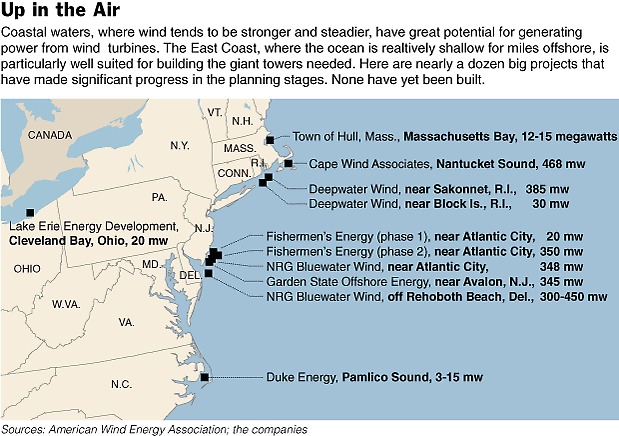
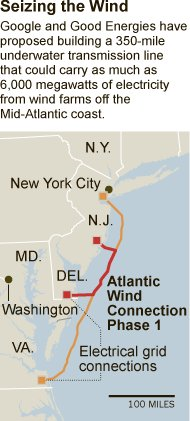
On Oct. 12, 2010, it was announced that Google and the renewable energy investment firm Good Energies were planning to invest heavily in an underwater transmission line that would carry electricity from offshore wind farms to 4 mid-Atlantic connection points (see map above) that would facilitate the task of bringing the energy onshore. Dubbed the “Atlantic Wind Connection,” the system could make construction of an offshore wind farm significantly simpler and less expensive. The environmentalists that have been briefed on the proposal (including the Sierra Club) are enthusiastic, despite the apparent potential for disruption of coastal sea life. Construction could begin in 2013, and the first phase could be running by 2016. It will create about 6,000 megawatts of new offshore wind energy — enough to power up to 2 million homes. (Matthew L. Wald, Offshore Wind Power Line Wins Praise, and Backing, N.Y. Times, Oct. 12, 2010.)
Zerofootprint Offsets: “Reduce your carbon footprint to Zero. Go as green as you can. Offset the rest.” A new interactive Web site that enables individuals to calculate their carbon footprint based on the car/s that they drive, the flights they take, and the amount they spend per month on home energy bills. The anonymous data will be collected for analysis by climate scientists. The new site was unveiled at the May 2007 C40 Large Cities Climate Summit, discussed supra.[769]
For academic and other commentary on alternative energy, see:
energy [r]evolution: A Sustainable World Energy Outlook: Greenpeace, the European Renewable Energy Council (EREC), and others, produced this 96-page report in January 2007. It concludes that alternative energy sources, such as solar, wind, geo-thermal, bio-energy and hydro, “could provide nearly 70% of the world’s electricity and 65% of global heat demand.” [770] The report strongly discourages the use of nuclear power, [771] and contains 10 regional scenarios addressing which renewable sources are preferable in each region.
U.S. Dept. of Energy, National Renewable Energy Laboratory, Exec. Summary: Large-Scale Offshore Wind Power in the United States (NREL/TP-500-49229, Sept. 2010), estimating that the U.S. could generate 20% of its energy from wind power by 2030.
[1] Warming Law was at: http://warminglaw.typepad.com/ until 2008, then: http://theusconstitution.org/blog.warming/
[2] IPCC Assessment Reports 1990-2007 (FAR, SAR, TAR & AR4) are available online in pdf.
[3] The date of entering into force was determined by the treaty’s Art. 23 (1), which stated it would do so on the 90th day after the date on which the 50th instrument of ratification, acceptance, approval or accession was deposited with the Secretary-General of the UN. See UNFCCC, 1771 U.N.T.S. 187, reprinted in 31 I.L.M. at 871 (1992), at page 21.
[4] See Status of Ratification of the Convention. Two other conventions – the Convention on Biological Diversity (CBD), and the UN Convention to Combat Desertification (UNCCD) – debuted at Rio. The secretariats of these conventions share information and coordinate activities through the Joint Liaison Group, established in 2001.
[5] Donald A. Brown, Climate Change, in Stumbling Toward Sustainability 276 (Washington, D.C.: ELI, 2002); Michael Grubb, The Kyoto Protocol: A Guide and Assessment 43 (London: Royal Institute of International Affairs, 1999).
[6] Referring to the Montreal Protocol on Substances That Deplete the Ozone Layer, Sept. 16, 1987, S. Treaty Doc. No. 100-10, 1522 U.N.T.S. 29, which entered into force Jan. 1, 1989. It was amended in 1990 in London, 30 I.L.M. 541 (1991); in 1992 in Copenhagen, 32 I.L.M. 874 (1993), in 1997 in Montreal, U.N. Doc. UNEP/OzL.Pro.9/12, and 1999 in Beijing, U.N. Doc. UNEP/OzL.Pro.11/10. The substances regulated are chlorofluorocarbons (CFCs), halons, carbon tetrachloride, and methyl chloroform. The Montreal Protocol was a modification to the Vienna Convention for the Protection of the Ozone Layer, March 22, 1985, T.I.A.S. No. 11,097, 1513 U.N.T.S. 293 (1985).
[7] According to the UNFCCC art. 1 (8), a sink is “any process, activity or mechanism which removes a greenhouse gas, an aerosol or a precursor of a greenhouse gas from the atmosphere.”
[8] 1995’s COP-1 is no longer available in the meetings archive, and COP-2 has no links to documents or agendas.
[9] Report of the Conference of the Parties on its First Session, Held at Berlin from 28 March to 7 April 1995, Addendum: Part Two: Action Taken by the Conference of the Parties at its First Session, FCCC/CP/1995/7/Add.1 (June 6, 1995), Decision 1/CP.1.
[10] Amy Royden, U.S. Climate Change Policy Under President Clinton: A Look Back, in Symposium: Rio’s Decade: Reassessing the 1992 Earth Summit, 32 Golden Gate U.L. Rev. 415, 425 (2002).
[11] Decision 20/CP.1 at page 59 of FCCC/CP/1995/7/Add.1, 6 June 1995.
[12] See Report of the Conference of the Parties on its Third Session, Held at Kyoto from 1 to 11 December 1997, Decision 1/CP.3.
[13] Kyoto Protocol to the UNFCCC, art. 3, Dec. 10, 1997, UN Doc. FCCC/CP/1997/L.7/Add.1, reprinted in 37 I.L.M. 32, 33 (1998). Annexes are at 42, 43.
[14] Brendan P. McGivern, Introductory Note, 37 I.L.M. 22, 24 (1998).
[15] Eric J. Lyman, International Issues: Little Headway Made as Bangkok Climate Talks Close; U.S. Says Commitment Hinges on Congress, WCCR, Oct. 9, 2009.
[16] E.g., Ben Russell, Parliament: Environment – Tories Condemn ‘Inept’ Prescott’s Failure on Kyoto, The Independent (London), April 25, 2001, at 8. (“Jane Griffiths, the Labour MP for Reading East, said … ‘Will you join with me in hoping that the fool on Capitol Hill changes his ways before it is too late?’”); Bill Nichols, Protesters Interrupt Powell at Summit on Earth; Secretary of State Defends U.S. at End of 10-Day Meeting, USA Today, Sept. 5, 2002, at A05; James Dao, Protesters Interrupt Powell Speech as U.N. Talks End, N.Y. Times, Sept. 5, 2002, at A10.
[17] Russia’s Putin Signs Kyoto Protocol, USA Today, Nov. 5, 2004.
[18] UNFCCC art. 19, May 9, 1992, 1771 U.N.T.S. 107, 185, reprinted in 31 I.L.M. 849 (1992); Kyoto Protocol art. 27, Dec. 10, 1997, UN Doc. FCCC/CP/1997/L.7/Add.1, reprinted in 37 I.L.M. 32, 42 (1998).
[19] COP-6 was suspended, after two weeks of unsuccessful negotiations. Press Release, Climate Change Talks Suspended; Negotiations to Resume During 2001, Nov. 25, 2000; COP-6b was scheduled for the following year.
[20] Greg Kahn, The Fate of the Kyoto Protocol Under the Bush Administration, 21 Berkeley Journal of International Law 548, text at notes 31-36 (2003).
[21] Report of the Conference of the Parties on its Seventh Session, Held at Marrakesh from 29 October to 10 November 2001, Addendum: Part Two: Action Taken by the Conference of the Parties, FCCC/CP/2001/13/Add.1.
[22] 144 CONG. REC. S196-97 (Jan. 29, 1998) (statement of Sen. Byrd, discussing flexibility mechanisms); II Public Papers of the President: William J. Clinton, Remarks at the National Geographic Society, Oct. 22, 1997, 1408-12 (1997).
[23] Kevin Smith, ‘Obscenity’ of carbon trading, BBC News, Nov. 9, 2006.
[24] Global Carbon Market Doubled in 2006, Driven by EU Trading, World Bank Says, BNA Int’l Environment Daily, May 4, 2007.
[25] Robert T. Watson, Ian R. Noble, Bert Bolin, N. H. Ravindranath, David J. Verardo & David J. Dokken (eds.), IPCC Special Report: Land Use, Land-Use Change, and Forestry (Cambridge: Cambridge University Press, 2000).
[26] Afforestation is the process of planting trees on land not forested in at least 50 years; reforestation is replacing trees that have been removed by deforestation. See Annex A, Definitions, modalities, rules and guidelines relating to land use, land-use change and forestry activities under the Kyoto Protocol, FCCC/CP/2001/13/Add.1 at 58, after Decision 11/CP.7.
[27] At the Nairobi COP/MOP meeting, a delegate from Germany said that “although greenhouse gas emissions were higher among developed countries, deforestation in developing countries contributes 20 percent of global greenhouse gas emissions.” Wachira Kigotho, As U.N. Conference Gets Under Way, Report Warns of Rising Threats to Africa, BNA Int’l Environment Daily, Nov. 8, 2006. More on LULUCF is on the UN FCCC Web site.
[28] “…[I]n one particularly caustic scene, Secretary of State Colin Powell was jeered and interrupted several times while delivering a closing statement… .” See World Summit on Sustainable Development Fails to Live Up to Expectations, Globalization101, Dec. 16, 2002.
[29] This was in accord with Article 3 (9) of the Kyoto Protocol, that required that the COP/MOP initiate consideration of commitments for subsequent periods at least 7 years before the end of the first commitment period, 2008 to 2012.
[30] Dean Scott, Developed Nations Saw 2.4 Percent Increase In Greenhouse Gas Emissions Over Five Years, 37 (43) Environment Reporter 2232 (Nov. 3, 2006).
[31] Greenhouse Gas Emissions Data, at 2; Press Release, 2006 UNFCCC greenhouse gas data report points to rising emission trends.
[32] Richard Black, Africa Focus for Climate Summit, BBC News (Nov. 6, 2006).
[33] Wachira Kigotho, As U.N. Conference Gets Under Way, Report Warns of Rising Threats to Africa, BNA Int’l Environment Daily, Nov. 8, 2006.
[34] Dean Scott, Climate Change: Negotiators Approve Treaty Review In 2008, Avoid Post-2012 Timetable, 37 (46) BNA Environment Reporter 2383 (Nov. 24, 2006).
[35] Tristana Moore, Experts Seek New Climate Strategy: Delegates to the United Nations Framework Convention on Climate Change and its Kyoto Protocol are meeting in the German city of Bonn, BBC News, May 7, 2007.
[36] Eric J. Lyman, U.N. Presses Case for Starting Talks Soon on Next Phase of Kyoto Accord, BNA Int’l Environment Daily, May 14, 2007; Eric J. Lyman, U.N. Negotiations Seen Setting Stage
For Agreement on Post-2012 Framework, BNA Int’l Environment Daily, May 21, 2007.
[37] Alister Doyle, Industrial Nations Agree Step to New Climate Pact, Planet Ark, Sept. 3, 2007.
[38] Dean Scott, U.N. Meeting Opens With Call for Action To Respond to Increasingly Dire Warnings, 38 (48) BNA Environment Reporter 2603 (Dec. 7, 2007).
[39] Juliet Eilperin, 150 Global Firms Seek Mandatory Cuts in Greenhouse Gas Emissions, Wash. Post, Nov. 30, 2007.
[40] David Fogarty, U.S. not all bad on climate change, lawmakers say, Reuters, Dec. 5, 2007.
[41] Charles Clover, US has ‘serious concerns’ about Bali deal, Daily Telegraph, Dec. 15, 2007.
[42] E.g., Jonathan Leake, Bali deal leaves greens in despair, TimesOnline, Dec. 16, 2007.
[43] Eric J. Lyman, Outlook 2008: General Policy: Climate Change Remains Top Priority, As Talks for Post-Kyoto Deal Continue, 12 BNA Int’l Environment Daily, Jan. 18, 2008.
[44] Dean Scott, Administration Official Suggests No Change In White House Resistance to Cap-and-Trade, 16 BNA Daily Environment Report A-12 (Jan. 25, 2008).
[45] Bangkok Climate Change Talks – 31 March to 4 April 2008.
[46] An Lu, UN Climate Change talks kick off in Bangkok, China View, Mar. 31, 2008.
[47] Sheryl Gay Stolberg, Bush Sets Greenhouse Gas Emissions Goal, N.Y. Times, April 17, 2008.
[48] UPDATE 3-US climate talks advance, but split on 2050 goals, Reuters UK, April 18, 2008.
[49] Eric J. Lyman, U.N. Official Says Talks Need to Show More Progress Toward Climate Treaty, WCCR, Aug. 17, 2009.
[50] Eric J. Lyman, International Issues: Little Headway Made as Bangkok Climate Talks Close; U.S. Says Commitment Hinges on Congress, WCCR, Oct. 9, 2009.
[51] John Broder, Hopes Fade for Comprehensive Climate Treaty, N.Y. Times, Oct. 20, 2009.
[52] Eric J. Lyman, International Issues: As U.N. Climate Talks in Copenhagen Near, Delegates Balk at Compromise, Official Says, WCCR (Oct. 29, 2009).
[53] Geoffrey Lean, Letter From Europe: Copenhagen reality check: Gov’ts concede new climate treaty unlikely until 2010, GRIST, Nov. 4, 2009; AFP, Obama urges climate action as Europe ups pressure on U.S., GRIST, Nov. 3, 2009.
[54] John Vidal, Climate talks in Barcelona end with threats of summit walkout, The Guardian, Nov. 6, 2009.
[55] Eric J. Lyman, International Issues: Barcelona Talks Stymied by Rich-Poor Divide; World Bank Provides Climate Aid to Africa, WCCR, Nov. 5, 2009.
[56] Jeff Tollefson, End of the road for Copenhagen? Expectations are dropping as December’s UN climate talks get closer, 462/12 Nature 144 (Nov. 2009).
[57] Dean Scott & Steven D. Cook, International Issues: Tentative Agreement in Copenhagen Seen As Possible, With Details to Be Sorted out Later, WCCR, Nov. 12, 2009.
[58] Robert P. Walzer, Energy & Environment: Forum Reflects Copenhagen Divisions, N.Y. Times, Nov. 11, 2009.
[59] Brendan Demelle, Cautious optimism for Copenhagen deal as Barcelona climate talks end, GRIST, Nov. 6, 2009; Eric J. Lyman, International Issues: Barcelona Talks End With Differing Views on Attainable Goals for Year-End Summit, WCCR, Nov. 6, 2009.
[60] Stephen Gardner, International Issues: EU Environment Ministers Plan Extra Climate Meeting, WCCR (11/06/09).
[61] Marianne Lavelle, Toward a Stalemate in Copenhagen: How Industry Pressures and National Agendas Dim Prospects for a Climate Treaty, Nov. 04, 2009.
[62] AFP, Environment ministers meet to prepare climate summit, GRIST, Nov. 16, 2009.
[63] Dean Scott & John Herzfeld, Climate Change: IPCC Chairman Sees Widening Gap in Talks; Indian Prime Minister to Meet With Obama, 223 BNA Daily Environment Report A4 (Nov. 23, 2009).
[64] Helene Cooper, Leaders Agree to Delay a Deal on Climate Change, N.Y. Times, Nov. 15, 2009; World leaders meeting in Singapore have said it will not be possible to reach a climate change deal ahead of next month’s UN conference in Denmark, BBC News, Nov. 15, 2009.
[65] John M. Broder, Obama Hobbled in Fight Against Global Warming, N.Y. Times, Nov. 15, 2009.
[66] Announcements of U.S.-China cooperation create a path to Copenhagen success, Climate Progress, Nov. 20, 2009.
[67] Barack Obama says he will go to Copenhagen climate change conference, Telegraph.co.uk, Nov. 10, 2009; Joseph Romm, Obama will go to Copenhagen—if he can seal a deal, GRIST, Nov. 10, 2009.
[68] John M. Broder & Jeff Zeleny, Obama Will Go to Copenhagen, N.Y. Times, Nov. 25, 2009.
[69] Dean Scott, International Issues: Obama to Arrive on Final Day of Talks to Signal Commitment to Copenhagen Deal, WCCR, Dec. 4, 2009.
[70] Robert Stavins wrote a detailed analysis of the Accord for GRIST; see A preliminary assessment of the Copenhagen Accord, Dec. 20, 2009.
[71] Andrew Light & Daniel J. Weiss, What you need to know following the Copenhagen climate summit, GRIST, Dec. 23, 2009.
[72] Eric J. Lyman, Climate Change: U.N. Officials Say Climate Change Process ‘Taking Stock’ After Copenhagen Summit, BNA Int’l Environment Daily, Jan. 12, 2010.
[73] Jacob Werksman, “Associating” with the Copenhagen Accord: What Does It Mean?, WRI, Mar. 25, 2010.
[74] Richard Black, ‘Paltry’ Copenhagen carbon pledges point to 3C world, BBC News, April 22, 2010.
[75] Dean Scott, International Issues: Failure to Reach Broad International Accord Suggests Focus on Top-Emitting Nations, Congressional Report Says, WCCR, Jan. 8, 2010.
[76] AFP, No guarantee of warming treaty this year, says U.N. climate chief, GRIST, Jan. 20, 2010.
[77] AFP, Two months after Copenhagen summit, U.N. climate pointman to quit, Feb. 18, 2010.
[78] Eric J. Lyman, International Issues: Outgoing U.N. Climate Chief Says Binding Treaty May not Happen Until 2011, WCCR, Feb. 23, 2010.
[79] Lynn Garner, Nancy Ognanovich, & Martha Kessler, Congress: Dorgan Retirement Means Senate Will Lose
Prominent Voice in Energy, Climate Debate, 41 BNA Environment Reporter 66 (Jan. 8, 2010); Jeff Zeleny & Adam Nagourney, Democrats Wary as Two Senators Decide to Retire, N.Y. Times, Jan. 6, 2010.
[80] Leora Falk, International Issues: Copenhagen Accord Commitments Might Not Slow Warming Sufficiently, UNEP Paper Finds, WCCR, Feb. 23, 2010.
[81] Dean Scott, International Issues: U.S. Negotiator Says More Climate Change Talks Needed; Cancun Picked to Host U.N. Talks This Fall, WCCR, Jan. 25, 2010.
[82] Dean Scott & Eric J. Lyman, Climate Change: Expectations Scaled Back for Mexico Talks In Hopes of Avoiding Replay of Copenhagen, 29 BNA Daily Environment Report A-7 (Feb. 16, 2010).
[83] Andrew C. Revkin, New Warnings on Climate Change, N.Y. Times, Jan. 20, 2007; Angela Charlton, World Scientists Meet on Global Warming, Forbes, Jan. 29, 2007; James Kanter & Andrew C. Revkin, Scientists Gather to Finalize Climate Report, N.Y. Times, Jan. 29, 2007; James Kanter & Andrew C. Revkin, World Scientists Near Consensus on Warming, N.Y. Times, Jan. 30, 2007, A13.
[84] David Adam, U.S. answer to global warming: smoke and giant space mirrors, The Guardian, Jan. 27, 2007.
[85] Dean Scott & Larry Speer, Climate Change: Bush Administration Embraces IPCC Findings But Resists Calls for Capping U.S. Emissions, BNA Int’l Environment Daily, Feb. 5, 2007.
[86] Dean Scott, Climate Change: President’s Budget to Cut U.S. Research, Technology Efforts to Curb Global Warming, BNA Int’l Environment Daily, Feb. 6, 2007.
[87] Seth Borenstein, Global Warming Man-Made, Will Continue, Forbes.com, Feb. 2, 2007.
[88] Alister Doyle, Tropical Losers, Northern Winners from Warming?, Scientific American.com, April 2, 2007; Andrew C. Revkin, Poorest Nations Will Bear Brunt as World Warms, N.Y. Times, April 1, 2007, at §1, p.1; Richard A. Kerr, Worse to Come From Global Warming, ScienceNOW Daily News, April 6, 2007.
[89] Billions face climate change risk, BBC News, April 6, 2007.
[90] James Kanter & Andrew C. Revkin, Emissions Already Affecting Climate, Report Says, N.Y. Times, April 6, 2007; Andrew C. Revkin, U.N. Draft Cites Humans in Recent Climate Shifts, N.Y. Times, April 5, 2007, A6.
[91] Climate change ‘can be tackled’, BBC News, May 4, 2007; Dean Scott, Rapid Global Effort Needed to Slow Warming, IPCC Warns in Final of Three Assessments, BNA Int’l Environment Daily, May 7, 2007; John Bohannon, IPCC Report Lays Out Options for Taming Greenhouse Gases, 316 (5826) Science 812 (May 11, 2007).
[92] I Public Papers of the President: William J. Clinton, Remarks on Earth Day, April 21, 1993, at 468, 470 (1993).
[93] Amy Royden, Rio’s Decade: Reassessing the 1992 Earth Summit: Reassessing the 1992 Climate Change Agreement: U.S. Climate Change Policy Under President Clinton: A Look Back, 32 Golden Gate U.L. Rev. 415, 420-21 (Spring, 2002).
[94] Jerry Gray, The Budget Truce: The Details, N.Y. Times, April 26, 1996, A22.
[95] Veronique Bugnion & David M. Reiner, A Game of Climate Chicken: Can EPA Regulate Greenhouse Gases Before the U.S. Senate Ratifies the Kyoto Protocol?, 30 Envtl. L. 491, 497 (2000).
[96] Michael Grubb, The Kyoto Protocol: A Guide and Assessment 53-54 (London: Royal Institute of International Affairs, 1999).
[97] Grubb, Kyoto Protocol at 64.
[98] Conditions Regarding U.N. Framework Convention on Climate Change: Hearing Before the Subcomm. on International Economic Policy, Export and Trade Promotion of the Senate Foreign Relations Committee, 105th Cong. (June 19 & 26, 1997).
[99] S. Res. 98 at 3, 105th Cong. (1997). The UNFCCC, which the U.S. signed and ratified, had specifically stated that “the developed country Parties should take the lead in combating climate change and the adverse effects thereof.” UNFCCC, art. 3 (1) at 4, 31 I.L.M. at 854.
[100] 144 Cong. Rec. S194-98 (Jan. 29, 1998) (statement of Sen. Byrd).
[101] II Public Papers of the President: William J. Clinton, Remarks at the National Geographic Society, Oct. 22, 1997, 1408, 1409-10 (1997).
[102] Grubb, The Kyoto Protocol at 63.
[103] Implications of the Kyoto Protocol on Climate Change: Hearing Before the S. Comm. on Foreign Relations, S. Hrg. 105-457, at 2 (1998).
[104] “At the last moment, a final deal was struck when the United States agreed to commit to a 7% reduction below 1990 emission levels in turn for acceptance of much of its position on ‘flexibility mechanisms,’ particularly those relating to trading.” Donald A. Brown, Climate Change, in Stumbling Toward Sustainability 290 (Washington, D.C.: ELI, 2002). The Europeans agreed to reduce their emissions by 8% and the Japanese by 6%. See Kyoto Protocol, Annex B, 37 I.L.M. at 43 (1998). See also Patricia Thompson, The Third Conference of the Parties to the United Nations Framework Convention on Climate Change: The December 1997 Kyoto Protocol, 9 Colo. J. Int’l Envtl. L. & Pol’y, 1997 Yearbook 219, 221 (1998).
[105] See 144 Cong. Rec. S196 (Jan. 29, 1998) (statement of Sen. Byrd).
[106] Greg Sargent, Bush Threatens U.N. Over Clinton Climate Speech, New York Magazine (web exclusive), Dec. 9, 2005.
[107] Clinton Damns Bush Climate Policy, BBC News, Dec. 10, 2005.
[108] Steve Hymon, Clinton Unveils Global Warming Initiative; At UCLA, he outlines an approach for cities to reduce greenhouse gases over the next 10 years, L.A. Times, Aug. 2, 2006, B3; Press Release: President Clinton Launches Clinton Climate Initiative: President Clinton, Mayor Ken Livingstone Announce Partnership Between Clinton Climate Initiative and Large Cities Climate Leadership Group…, Aug. 1, 2006; World Cities Partner with Clinton Climate Initiative To Combat Climate Change. On Dec. 4, 2006, Tokyo joined the Large Cities Climate Leadership Group.
[109] William Booth, Al Gore, Sundance’s Leading Man: ‘An Inconvenient Truth’ Documents His Efforts To Raise Alarm on Effects of Global Warming, Wash. Post, Jan. 26, 2006, A01. The official movie site is: http://www.climatecrisis.net/; Convenient truth: Gore ‘thrilled’ by nomination, Ex-VP’s film ‘An Inconvenient Truth’ gets nods for best documentary, song, AP, Jan. 23, 2007; David M. Halbfinger & Sharon Waxman, ‘The Departed’ Wins Best Picture, Scorsese Best Director, N.Y. Times, Feb. 26, 2007, E1.
[110] Doug Mellgren, Al Gore Nominated for Nobel Peace Prize, Breitbart.com, Feb. 1, 2007.
[111] Mike Ferullo, Gore, U.N. Panel Share Nobel Peace Prize For Raising Awareness of Global Warming, BNA Int’l Environment Daily (Oct. 15, 2007); Gore says prize must spur action, BBC News, Oct. 13, 2007; The Nobel Peace Prize for 2007.
[112] Letter to Members of the Senate on the Kyoto Protocol on Climate Change, Mar. 13, 2001, 37(11) Weekly Comp. of Presidential Documents 444 (Mar. 19, 2001). The President also retracted support for mandatory CO2 emissions reductions, claiming CO2 was not a “pollutant” under the CAA. Id. The letter was sent to Senators Jesse Helms, Larry E. Craig, Pat Roberts, and Chuck Hagel, all Republicans with strong industry ties, who apparently had complained about EPA Administrator Christine Todd Whitman’s pro-Kyoto statements. (Robert F. Kennedy, Jr., Bush Backpedals on Environment, Aug. 4, 2004; Mar. 28, 2001, Press Briefing by Press Secretary Ari Fleischer and comments on Kyoto; Dubya’s Global Warming Rollback, CBS News, Mar. 28, 2001; Dismay as U.S. Drops Climate Pact, CNN.com/ World, Mar. 29, 2001; Paul Meller, European Union Voices Concern for Climate Pact, N.Y. Times, Mar. 29, 2001, A22; U.S. Won’t Follow Climate Treaty Provisions, Whitman Says, N.Y. Times, Mar. 28, 2001, A19; Pro-Kyoto Nations Struggle to Keep Pact, AP, Oct. 9, 2006.) Earlier, on Mar. 2-4, 2001, Ms. Whitman had attended a meeting of environmental ministers in Trieste, Italy. EPA Newsroom, EPA Administrator Whitman Leads U.S. Delegation to G8 Environmental Ministers Meeting, Feb. 28, 2001. (Robert F. Kennedy, Crimes Against Nature: How George W. Bush and His Corporate Pals Are Plundering the Country and Hijacking Our Democracy 50-51 (New York: HarperCollins, 2004)). On Mar. 5, 2001, CNN reported that Ms. Whitman reassured the international community about the administration’s support for reducing global warming. (Climate Talks Secure U.S. Support, Mar. 5, 2001.) These were the remarks to which the senators, supra, objected. Kennedy, Crimes Against Nature at 51. Ms. Whitman resigned in June 2003.
[113] Dean Scott, Climate Change: More Emphasis on Long-Term Technologies Needed in Climate Program, Reviewer Says, 37(48) BNA Environment Reporter 2480 (Dec. 8, 2006).
[114] Clear Skies Acts of 2002, H.R. 5266 and S. 2815, 107th Cong. (2002); Clear Skies Acts of 2003, S. 1844, S. 485, and H.R. 999, 108th Cong (2003); and the Clear Skies Act of 2005, S. 131, 109th Cong. (2005). See also Remarks on Energy Independence, Feb. 6, 2003, 39 Weekly Compilation of Presidential Documents 161 (Feb. 10, 2003).
[115] Environment and Public Health Restoration Act of 2006, H.R. 5235, 109th Cong. § 2(b)(3)(A) (as introduced, April 27, 2006).
[116] Inhofe’s statement, Science of Climate Change, begins at 149 (113) Cong. Rec. S10012 (July 28, 2003).
[117] Dean Scott, Climate Change: Inhofe Decries ‘Alarmism’ by Media In Final Climate Hearing as Committee Chair, BNA Int’l Environment Daily, Dec. 7, 2006.
[118] Amena H. Saiyid, Climate Change: McCain, Lieberman to Reintroduce Bill Requiring Reductions in Greenhouse Gases, 37 (46) BNA Environment Reporter 2382 (Nov. 24, 2006).
[119] McCain on the Issues: A look at John McCain’s environmental platform and record, GRIST, Aug. 22, 2008.
[120] “Intensity” is the amount of GHG emitted per unit of economic activity. The president’s remarks are in I Public Papers of the Presidents 226, 228 (Feb. 14, 2002).
[121] “…I will not commit our Nation to an unsound international treaty [KP] that will throw millions of our citizens out of work.” Id. at 230.
[122] Dean Scott, Report Finds Firms Volunteering to Reduce Greenhouse Gases Fail to Set Formal Goals, 37 (22) Environment Reporter 1153 (June 2, 2006).
[123] Bush Administration Refuses To Issue National Assessment of Climate Change Impacts on the U.S.: Still No Sign of Critical Report Due in 2004; Bush Administration Suppressed Global Warming Report, Conservation Groups File Suit, Nov. 14, 2006.
[124] Karen Gullo, Judge Orders Bush Administration to Issue Global Warming Report, Bloomberg News, Aug. 21, 2007; Bob Egelko, Administration breaking law by withholding global warming report, judge rules, San Francisco Chronicle, Aug. 22, 2007; Press Release, Court Rules Against Bush Administration in Global Warming Case: Federal Judge Orders Production of Suppressed Scientific Reports on Global Warming Impacts, Aug. 21, 2007.
[125] CBD Press Release of Aug. 21, 2007,
[126] Frances Beinecke, Climate Change Is a Scientific Reality, Not a Political Debate, Switchboard, Mar. 17, 2010.
[127] A former associate with the U.S. Climate Change Science Program, Rick Piltz, called the suppression of the 2000 assessment and the refusal to produce the 2004 update “the central climate science scandal of the Bush administration.” FOE, Bush Administration Suppressed Global Warming Report, Conservation Groups File Suit, Nov. 14, 2006.
[128] Of these 6 members of the APP, all signed and ratified the UNFCCC; Australia, Japan, and the U.S. are Annex I Parties. Australia and the U.S. signed but did not ratify the Kyoto Protocol; China signed and approved the Protocol; India acceded to it; Japan signed and accepted it; and Korea signed and ratified it. India and China are not required to reduce carbon emissions under the present agreement.
[129] Asia-Pacific Partnership Plans 100 Projects Aimed at Cutting Greenhouse Gas Emissions, 37 (43) Environment Reporter 2233 (Nov. 3, 2006). For a contrarian view of the Asia-Pacific Partnership, see Amanda Griscom Little, Pact or Fiction? New Asia-Pacific Climate Pact is Long on PR, Short on Substance, Grist, Aug. 4, 2005.
[130] Deborah Zabarenko, U.S. scientists, evangelicals join global warming fight, Reuters, Jan. 17, 2007.
[131] John Heilprin, Evangelicals, Scientists Join on Warming, SFGate.com, Jan. 17, 2007; Laurie Goodstein, Evangelical’s Focus on Climate Draws Fire of Christian Right, N.Y. Times, Mar. 3, 2007, A9.
[132] Religious Leaders Urge Action on Warming, Reuters, May 21, 2007.
[133] Philip Pullella, Religion must help protect planet: conference, Reuters, April 27, 2007.
[134] And it did. See Phoebe Natanson, The Vatican’s Crusade on Climate Change: 2,400 Solar Panels Were Placed on Undulating Roof of the Vatican’s Hall, ABC News, Nov. 26, 2008.
[135] Vatican Urges More Action on Environment, BNA Int’l Environment Daily, Oct. 23, 2007.
[136] Brian Merchant, The Dalai Lama Calls for Action on Climate Change, treehugger, Nov. 30, 2009.
[137] Eric J. Lyman, International Issues: Pope Calls for Comprehensive Accord to Address Climate Change Issues This Year, WCCR (Jan. 13, 2010).
[138] Leslie Kaufman, Darwin Foes Add Warming to Targets, N.Y. Times, Mar. 3, 2010.
[139] Samantha Thompson, Onward Christian climate activists: Christian Coalition backs Sen. Graham on climate legislation, GRIST, Mar. 17, 2010.
[140] Nick Miles, U.S. Democrats Mull Climate Change, BBC News, Dec. 2, 2006.
[141] “‘Many democrats come from coal states and oil and gas states. So this issue isn’t just a Republican versus Democrat issue.’” Id., quoting the Reverend Jim Ball. But see Erik Stokstad, Environmentalists See a Greener Congress, 314 Science 1061 (Nov. 17, 2006); Amanda Griscom Little, Dingell Minded: John Dingell talks to Grist about climate change, fuel economy, and the 110th Congress, Grist, Dec. 20, 2006; Dean Scott, Climate Change: Outgoing House Chairman Predicts Takeover Will Not Bring Passage of Climate Legislation, BNA Int’l Environment Daily, Dec. 5, 2006.
[142] Andrew Edgecliffe-Johnson, Blair Optimistic Over Climate Change Deal, Financial Times, Jan. 27, 2007; Blair sees hope of climate deal, BBC News, Jan. 27, 2007.
[143] Dean Scott, Climate Change: Outgoing House Chairman Predicts Takeover Will Not Bring Passage of Climate Legislation, BNA Int’l Environment Daily, Dec. 5, 2006.
[144] The text of S. 183 is at 153 Cong. Rec. S169 (Jan. 4, 2007). It had only one co-sponsor.
[145] Id. at S168-69.
[146] Richard Simon, Senate panel OKs bill to boost fuel efficiency standard: High gas prices and global warming push members to approve MPG boost from 25 to 35 by 2020, L.A. Times, May 9, 2007.
[147] Id.
[148] Edmund L. Andrews, Auto Chiefs Make Headway Against a Mileage Increase, N.Y. Times, June 7, 2007.
[149] Roland Jones, U.S. ‘stuck in reverse’ on fuel economy: Only two super-efficient cars available, down from five, study shows, msnbc, Feb. 28, 2007; Ailis Aaron Wolf, SURVEY: BIPARTISAN 78% OF U.S. VOTERS REJECT GO-AHEAD-SLOW APPROACH TO FEDERAL MILE-PER-GALLON CAR STANDARDS, STRONG SUPPORT SEEN FOR “40 MPG BY 2010”, 40mpg.org, June 6, 2007.
[150] Samantha Young, Boxer Pledges Shift on Global Warming Policy With New Senate Role, Santa Barbara News-Press, Nov. 9, 2006; Richard Simon, A Global Warming Skeptic’s Parting Shot, L.A. Times, Dec. 7, 2006.
[151] Steven D. Cook, Climate Change: Boxer Pledges Action on Global Warming, Close Oversight of Bush Administration, BNA Int’l Environment Daily, Dec. 6, 2006.
[152] Margaret Talev, Boxer Plans Senate Hearings on Global Warming, McClatchy Newspapers, Nov. 14, 2006.
[153] Climate Change: Sen. Boxer Reorganizes Environment Panel, Naming Two Global Warming Subcommittees, 37 (46) BNA Environment Reporter 2382 (Nov. 24, 2006).
[154] Susan Jones, Democrats Push Bill to ‘Stop Global Warming,’ CNSNews.com, July 26, 2006; Stokstad, Environmentalists See a Greener Congress, 314 Science 1061 (Nov. 17, 2006).
[155] Amena H. Saiyid, Legislation: Waxman Reintroduces Climate Change Bill, Seeks Cuts 80 Percent Below 1990 Levels, 38 (12) BNA Environment Reporter 668 (Mar. 23, 2007).
[156] Dean Scott, Climate Change: Pelosi to Launch Select House Committee To Boost Awareness, Debate Scientific Issues, BNA Int’l Environment Daily, Jan. 18, 2007.
[157] Press Release: Pelosi Announces the Creation of Select Committee on Energy Independence and Global Warming, Jan. 18, 2007.
[158] Dean Scott, Climate Change: Pelosi Names Select Committee Members, Taps Markey to Chair Global Warming Panel, BNA Int’l Environment Daily (Mar. 12, 2007).
[159] Donald Kennedy, Editorial: Climate: Game Over, 317 (5837) Science 425 (July 27, 2007).
[160] See NOAA Reports 2006 Warmest Year on Record for U.S.: General Warming Trend, El Niño Contribute to Milder Winter Temps; Andrew C. Revkin, Agency Affirms Human Influence on Climate, N.Y. Times, Jan. 10, 2007, A16; Marc Kaufman, Climate Experts Worry as 2006 Is Hottest Year on Record in U.S., Wash. Post, Jan. 10, 2007, A01.
[161] Felicity Barringer & Andrew C. Revkin, The 110th Congress: Measures on Global Warming Move to Spotlight in the New Congress, N.Y. Times, Jan. 17, 2007, A24; Amanda Griscom Little, Tip Tip Hurray! Senate bills and corporate coalition push Washington toward climate action, Grist’s Muckraker column, Jan. 23, 2007, to compare the new bills.
[162] Edmund L. Andrews, Lease Chief Was Aware of Oil Error, Report Asserts, N.Y. Times, Jan. 17, 2007, C1.
[163] Amanda Griscom Little, Energizer Money: Enviros Delighted with House Democrats’ Energy Bill, Grist, Jan. 17, 2007.
[164] Dean Scott, Climate Change: Biden, Lugar Reintroduce Senate Resolution Urging Bush to Resume Treaty Negotiations, BNA Int’l Environment Daily, Jan. 18, 2007.
[165] Dean Scott, Senate Panel Clears Resolution Urging Bush To Restart International Climate Negotiations, BNA Int’l Environment Daily, Mar. 30, 2007.
[166] Dean Scott, Reid Considering Floor Vote on Resolution Urging Bush to Resume Climate Negotiations, BNA Int’l Environment Daily, April 16, 2007.
[167] Clifford Krauss, Energy Research on a Shoestring; 30 Years After Opening, a Lab for Alternative Power Goes Begging, N.Y. Times, Jan. 25, 2007, C1.
[168] Edmund L. Andrews & Felicity Barringer, Bush Seeks Vast, Mandatory Increase in Alternative Fuels and Greater Vehicle Efficiency, N.Y. Times, Jan. 24, 2007, A13, & Dean Scott, Climate Change: Bush Touts Boost in Renewable Fuels Target, New CAFE Authority to Curb U.S. Emissions, BNA Int’l Environment Daily, Jan. 25, 2007.
[169] Exec. Order 13423 of Jan. 24, 2007, 72 Fed. Reg. 3919 (Jan. 26, 2007).
[170] H. Josef Hebert, Utility Chiefs Wary of Emission Limits: Utility Executives Give Guarded Support to Global Warming Legislation, ABC News, Mar. 21, 2007.
[171] Mark Leibovich & Patrick Healy, Star in New Role, Gore Revisits Old Stage, N.Y. Times, Mar. 21, 2007, at A1, at: & Richard Simon, Capitol Hill warms up to Gore: The former vice president will be the star witness at hearings on climate change, LA Times, Mar. 21, 2007.
[172] Amena H. Saiyid, Legislation: Gore Seeks Bill to ‘Immediately Freeze’ Greenhouse Emissions, Impose Carbon Taxes, 38 (12) BNA Environment Reporter 667 (Mar. 23, 2007).
[173] Id.
[174] Marlon B. Allen, Report Says Climate Change Presents Serious Risks to U.S. Military Operations, BNA Int’l Environment Daily, April 18, 2007.
[175] Jeff Day, Former Commanders Say Climate Change Poses Threat to American Security, Stability, BNA Int’l Environment Daily, May 10, 2007.
[176] Linda Roeder, House Approves Legislation to Require Study of Global Warming Security Risks, BNA Int’l Environment Daily, May 14, 2007.
[177] Amena H. Saiyid, House Energy Panel Hears From Groups On How to Craft Bill to Cap Emissions, BNA Int’l Environment Daily, April 23, 2007; Dingell, Boucher Release Industry, Environmental Views on Prospective Climate Change Legislation, April 19, 2007.
[178] EO 13432 was published at 72 (94) Fed. Reg. 27715 (May 16, 2007); Steven Mufson & Michael A. Fletcher, Bush Calls For Cuts In Vehicle Emissions: Agencies Ordered To Draft New Rules, Wash. Post, May 15, 2007, D01; John Donnelly, Bush calls for rules to reduce emissions: In reversal, orders EPA to target climate change, Boston Globe, May 15, 2007.
[179] Steven Mufson, Democrats Push Coal-to-Liquids Energy Plan, Wash. Post, June 13, 2007, D01; Edmund L. Andrews, Democrats Propose Loan Plan for Coal Plants, N.Y. Times, June 13, 2007.
[180] Dean Scott, Swift Senate Action Vowed on Cap-and-Trade, But Warner Predicts Battle Is Only Beginning, 38 (41) BNA Environment Reporter 2233 (Oct. 19, 2007).
[181] Leora Falk, Auctions for Emissions Allowances Urged at House Select Committee Hearing, 15 BNA Daily Environment Report A-14 (Jan. 24, 2008).
[182] Dean Scott, Lieberman, Warner Tweak Cap-and-Trade Bill To Build Consensus at Subcommittee Markup, 211 BNA Daily Environment Report A-1 (Nov. 1, 2007).
[183] Dean Scott, Subcommittee Backs Cap-and-Trade Measure; Boxer Vows to Move Bill Before U.N. Meeting, 38 (43) BNA Environment Reporter 2337 (Nov. 2, 2007).
[184] Press release, Nov. 1, 2007, is at: http://lieberman.senate.gov
[185] Dean Scott, Subcommittee Backs Cap-and-Trade Measure; Boxer Vows to Move Bill Before U.N. Meeting, 38 (43) BNA Environment Reporter 2337 (Nov. 2, 2007).
[186] Steven D. Cook, Senate Environment Committee Backs Emissions Cap-and-Trade Legislation, 234 BNA Daily Environment Report A-16 (Dec. 6, 2007).
[187] Steven D. Cook, Senate Environment Committee Backs Emissions Cap-and-Trade Legislation, 38 (48) BNA Environment Reporter 2601 (Dec. 7, 2007).
[188] Leora Falk, Duke Energy CEO Says Cap-and-Trade Bill Should Include More Funds for Technology, 12 BNA Daily Environment Reporter A-9 (Jan. 18, 2008).
[189] U.S. Environmental Protection Agency, Office of Atmospheric Programs, EPA Analysis of the Lieberman-Warner Climate Security Act of 2008, S. 2191 in 110th Congress (Mar. 14, 2008).
[190] Matthew Brown, Business groups campaign against climate change bill, Boston Globe, Mar. 19, 2008, & Leora Falk, Business Groups Say Lieberman-Warner Bill To Take Toll on Economy, Lead to Job Losses, 39 (12) BNA Environment Reporter 548 (Mar. 21, 2008).
[191] Dean Scott, Lieberman-Warner Emissions Trading Bill Has Modest Impact on Economy, EIA Says, 83 BNA Daily Environment Report A-7 (April 30, 2008). The EIA’s report is Energy Market and Economic Impacts of S.2191, the Lieberman-Warner Climate Security Act of 2007.
[192] Dean Scott, U.S. Emissions Cap Would Hike Fuel Costs, Shift Refinery Operations Overseas, API Says, 87 BNA Daily Environment Report A-6 (May 6, 2008).
[193] Leora Falk, Voinovich Criticizes Lieberman-Warner Bill As Untenable, Plans Alternative Legislation, 86 BNA Daily Environment Report A-9 (May 5, 2008).
[194] Dean Scott, Congress Should Adopt Tax on Carbon, Abandon Trading Schemes, EPA Lawyers Say, 88 BNA Daily Environment Report A-10 (May 7, 2008).
[195] Leora Falk, Senate Climate Bill Goes Down to Defeat, Falling 12 Votes Short on Cloture Motion, 110 BNA Daily Environment Report A-10 ( June 9, 2008).
[196] Paul Icamina, Bush Calls For Climate Change Conference In Hawaii, AHN, Jan. 16, 2008.
[197] After UN push on climate, Bush to promote US agenda, Agence France-Presse, Sept. 25, 2007.
[198] Dean Scott, Agreement on Global Goal to Cut Emissions Expected by End of 2008,Connaughton Says, 12 BNA Daily Environment Reporter A-8 (Jan. 18, 2008).
[199] Dean Scott, House Panel Approves Lantos Measure Directing U.S. to Negotiate Emissions Cuts, BNA Int’l Environment Daily, May 24, 2007.
[200] H. Josef Hebert, House Approves Energy Bill, Houston Chronicle, Dec. 6, 2007.
[201] Steven Mufson, Details on the House Energy Bill, Wash. Post, Dec. 6, 2007, at:
[202] 153 Cong. Rec. S 15009 (Dec. 7, 2007); John J. Fialka & David Rogers, Senate Aims to Break Energy Bill Logjam, Wall St. Journal, Dec. 8, 2007.
[203] Fact Sheet: Energy Independence and Security Act of 2007: President Bush Signs Energy Bill To Improve Fuel Economy And Reduce Oil Dependence on the White House Web site, in the archives.
[204] Tom Doggett, House passes energy bill, Reuters, Dec. 18, 2007.
[205] Steven D. Cook, Growth in Vehicle Travel May Wipe Out Emissions Reductions From New CAFE Bill, 12 BNA Daily Environment Reporter A-7 (Jan. 18, 2008).
[206] Erika Bolstad, Senators launch new effort to open ANWR to drilling, Anchorage Daily News, Mar. 13, 2008, at:
[207] Juliet Eilperin, EPA Moves to Ease Air Rules for Parks: Regional Administrators Decry Decision, Wash. Post, Nov. 19, 2008.
[208] Scientists’ Report Documents ExxonMobil’s Tobacco-like Disinformation Campaign on Global Warming Science: Oil Company Spent Nearly $16 Million to Fund Skeptic Groups, Create Confusion, Union of Concerned Scientists News, Jan. 3, 2007. The report is: Smoke, Mirrors & Hot Air: How ExxonMobil Uses Big Tobacco’s Tactics to “Manufacture Uncertainty” on Climate Change; Clifford Krauss, Exxon Accused of Trying to Mislead Public, N.Y. Times, Jan. 4, 2007, C7; Dean Scott, Industry Tactics in Funding Climate Science Questioned in Report From Scientists’ Group, 38 (1) BNA Environment Reporter 10 (Jan. 5, 2007).
[209] See Atmosphere of Pressure; Peter N. Spotts, Has the White House Interfered on Global Warming Reports?, Christian Science Monitor, Jan. 31, 2007; Zachary Coile, House, Senate Target Climate Change; White House Efforts To Alter Scientific Reports Draw Rebuke, S.F. Chronicle, Jan. 31, 2007.
[210] Z. Coile, S.F. Chronicle, Jan. 31, 2007, supra; Spotts, Has the White House Interfered on Global Warming Reports, Christian Science Monitor, Jan. 31, 2007, supra.
[211] Mike Ferullo, Climate Change: Former White House Official Defends Edits of Scientific Work on Global Warming, BNA Int’l Environment Daily, Mar. 20, 2007; Andrew C. Revkin & Matthew L. Wald, Material Shows Weakening of Climate Change Reports, N.Y. Times, Mar. 20, 2007, A16; Thomas L. Friedman, Editorial Desk: How Many Scientists?, N.Y. Times, Mar. 28, 2007, A19.
[212] Matthew Daly, Dems Slam Interior Over Science Meddling, S.F. Chronicle, May 9, 2007.
[213] A Science Adviser Unmuzzled: Q&A: NASA’s chief climate scientist, who charged that his views on global warming were being squelched, says we’re getting close to a tipping point, Time Mag., April 3, 2006; Too Hot To Handle; Recent Efforts To Censor Jim Hansen, NASA’s Top Climate Scientist, Are Only the Latest. As His Message Grows More Urgent, We Ignore Him At Our Peril, Boston Globe (Feb. 5, 2006), E1; Andrew C. Revkin, Climate Expert Says NASA Tried To Silence Him, N.Y. Times, Jan. 29, 2006, §1, 1; Antonio Regalado & Jim Carlton, Agency Retreats From Discounting Global Warming – Hurricane Dispute Becomes Flashpoint as Scientists Decry White House Policies, Wall St. Journal, Feb. 16, 2006, at A4. But see State of the Art: Censoring Scientists?: Lessons of the James Hansen Affair, 12 New Atlantis 109 (Spring, 2006).
[214] Krishna Guha, Wolfowitz deputy under fire over climate, Financial Times, April 24, 2007, & Steven R. Weisman, Wolfowitz Escalates Battle to Stay at Bank, N.Y. Times, April 26, 2007.
[215] Brett Zongker, Smithsonian accused of altering exhibit, Wash. Post, May 21, 2007.
[216] Eli Kintisch, CDC Director’s Message on Risk Runs Afoul of White House Edits, 318 Science 726 (Nov. 2, 2007).
[217] H. Josef Hebert, Climate Science Manipulation Alleged, AP, Dec. 10, 2007.
[218] Klaus Marre, Waxman: White House censored climate scientists, The Hill, Dec. 10, 2007.
[219] Felicity Barringer, Whale Protection Caught in Agency Rivalry, Files Show, N.Y. Times, May 1, 2008, & Juliet Eilperin, White House Blocked Rule Issued to Shield Whales, Wash. Post, May 1, 2008, A03.
[220] Waxman: White House Involved in California Waiver Denial, May 19, 2008.
[221] Kate Sheppard, Bush, whacked: EPW approves legislation calling on Bush to overturn EPA decision he likely forced EPA to make, GRIST, May 21, 2008.
[222] See CBD’s Polar Bear page.
[223] Juliet Eilperin, Interior Reviewed Studies Weighing Risks to Polar Bear, Wash. Post, April 15, 2007, A06.
[224] Conservation Groups Advance Protections For Polar Bear from Global Warming, Press Release from CBD, Dec. 27, 2006; the proposed rule is at: 72 Fed. Reg. 1064 (Jan. 9, 2007).
[225] Flock of Siegel: Kassie Siegel of the Center for Biological Diversity answers questions, Grist, Jan. 15, 2007.
[226] Press Release, Conservation Groups Advance Protections For Polar Bear from Global Warming, Press Release from CBD, Dec. 27, 2006.
[227] Dan Joling, Groups Sue to Protect Marine Mammals, Forbes, Feb. 14, 2007; Suit Filed to Protect Polar Bears and Walrus From Oil Exploration and Global Warming, Center for Biological Diversity, Feb. 13, 2007. See also 50 C.F.R. 18.121-18.129 (Aug. 2, 2006). Authority for the regulations is the Marine Mammal Protection Act of 1972, 16 U.S.C. §§ 1361 et. seq.
[228] 71 Fed. Reg. 43926, 43927-928 (Aug. 2, 2006).
[229] Id. at 43926.
[230] See Executive Summary.
[231] John H. Broder & Andrew C. Revkin, Warming May Wipe Out Most Polar Bears, Study Says, N.Y. Times, Sept. 8, 2007, A11.
[232] Dan Joling, Decision on Listing Polar Bear Postponed, USA Today, Jan. 7, 2008; Editorial, Regulatory Games and the Polar Bear, N.Y. Times, Jan. 15, 2008.
[233] See H.R. 5058; Amena H. Saiyid, Markey Bill Would Force Interior to Protect Polar Bears From Oil Drilling in Chukchi Sea, 12 BNA Daily Environment Reporter A-1 (Jan. 18, 2008).
[234] Press Release, Environmental Groups Sue Bush Administration to Force Polar Bear Protection: Faced with Overwhelming Scientific Evidence, Government Continues Delay on Endangered Species Act Listing Due to Global Warming, Mar. 10, 2008.
[235] Carolyn Whetzel, Federal Court Orders Interior Department To Complete Listing of Polar Bear Under Act, 83 BNA Daily Environment Report A-7 (April 30, 2008).
[236] Dan Joling, Feds seek more time for decision on listing polar bears, AP, April 17, 2008,
[237] Critics: Polar bear plan must fight global warming, AP, May 21, 2008.
[238] Carolyn Whetzel, Endangered Species: Environmental Groups Sue to Force Completion of Proposed Penguin Listing, WCCR, Mar. 10, 2010.
[239] Press Release, Obama Fails to Protect Penguins from Climate Change and Fish Hooks – Lawsuit Next: Misses deadline to list seven species of penguins as endangered, Turtle Island Restoration Network, Jan. 4, 2010; Newsflash, Suit Filed to Save Penguins at Risk From Global Warming and Fisheries, CBD, Mar. 9, 2010.
[240] During the Clinton Administration, in 1998, EPA decided that the Clean Air Act did give it the authority to regulate carbon dioxide. However, in 1999, when environmental groups petitioned EPA to regulate CO2 emissions from new vehicles, under § 202(a)(1) of the CAA because those emissions contribute to global warming, EPA did nothing until 2003; under the Bush Administration, it denied the petition, claiming that GHGs weren’t air pollutants as defined by the statute. Dahlia Lithwick, Benchwarming: The Supreme Court Melts Down Over Greenhouse Gasses, Nov. 29, 2006; Dean Scott, Climate Change: Focus on Standing Leads Observers to Ask If Justices Will Address Merits of EPA Case, 37 (47) BNA Environment Reporter 2430 (Dec. 1, 2006).
[241] EPA: Control of Emissions From New Highway Vehicles and Engines: Notice of denial of petition for rulemaking, 68 Fed. Reg. 52922, 52931, Sept. 8, 2003.
[242] States challenging the Bush administration’s GHG policy were: California, Connecticut, Illinois, Maine, Massachusetts, New Jersey, New Mexico, New York, Oregon, Rhode Island, Vermont and Washington; cities were: New York, Washington and Baltimore.
[243] The amicus curiae briefs and briefs of the parties are on FindLaw and oyez.org; Andrew S. Neal, Climate Change: Supreme Court Hears Oral Arguments In Greenhouse Gas Regulatory Authority Case, 37 (47) BNA Environment Reporter 2429 (Dec. 1, 2006); Linda Greenhouse, Justices’ First Brush With Global Warming, N.Y. Times, Nov. 29, 2006.
[244] Dean Scott, Climate Change: Focus on Standing Leads Observers to Ask If Justices Will Address Merits of EPA Case, 37 (47) BNA Environment Reporter 2430 (Dec. 1, 2006); Nina Totenberg, High Court to Hear Greenhouse-Gas Case, NPR, Nov. 29, 2006.
[245] “The Democrats should use their newly won congressional majorities to pass such legislation, and President Bush, following Nixon’s example, should sign it.” Elizabeth Kolbert, Comment: Hot and Cold, New Yorker, Dec. 11, 2006, 37, 38.
[246] E.g., EDF, Court Rules 5-4 in Massachusetts versus EPA: Supreme Court finds that EPA can regulate heat-trapping pollution, putting pressure on Congress to act on global warming, Dec. 7, 2009; US ‘must regulate car pollution’, BBC NEWS, April 3, 2007; Linda Greenhouse, Justices Say E.P.A. Has Power to Act on Harmful Gases, N.Y. Times, April 3, 2007, A1; EPA Provided Insufficient Rationale For Declining to Cut Greenhouse Gases, 75 (37) U.S. Law Week 1583 (April 3, 2007); Andrew S. Neal, Supreme Court Finds EPA Has Authority To Regulate Greenhouse Gases From Vehicles, BNA Int’l Environment Daily, April 3, 2007; Eli Kintisch, Court Sees C02 Auto Emissions as Pollutant, ScienceNow Daily News, April 2, 2007.
[247] Dean Scott, Ruling May Accelerate Congressional Action Toward Passage of Cap-and-Trade Legislation, BNA Int’l Environment Daily (April 3, 2007).
[248] Felicity Barringer & William Yardley, Bush Splits With Congress and States on Emissions, N.Y. Times, April 4, 2007.
[249] David Schoenbrod, What Next on Global Warming?, Wall St. Journal, April 5, 2007, at A12.
[250] Felicity Barringer, Ruling Undermines Lawsuits Opposing Emissions Controls, N.Y. Times, April 3, 2007, at A5.
[251] H. Josef Hebert, EPA Won’t Specify Global Warming Plans, Houston Chronicle, April 24, 2007.
[252] Dean Scott, Johnson Signs Notice, Sets Hearing For Review of California Waiver Request, 38 (17) BNA Environment Reporter 956 (April 27, 2007); EPA Sets June 15 Deadline for Comments On Whether to Approve California Waiver, 38 (18) BNA Environment Reporter 1010 (May 4, 2007).
[253] David Whitney, California attorney general urges EPA to allow stricter emission standards (May 23, 2007).
[254] Erica Werner, California seeks greenhouse-gas control, Seattle Times (May 23, 2007).
[255] Chris Bowman, EPA panel gets an earful: Daylong hearing is held on state push to enforce tougher emissions rule, Sacramento Bee, May 31, 2007.
[256] Press Release, Gov. Schwarzenegger Warns U.S. EPA of California’s Intent to Sue if Federal Government Fails to Act on Waiver to Reduce Emissions (contains the April 25, 2007, letter to EPA but is not online after Jan. 2011; the Governors’ Records Archive runs only from 1959–1991 in Feb. 2011.)
[257] Samantha Young, California to sue EPA if it fails to act quickly on air standards, San Jose Mercury News, April 26, 2007.
[258] Zachary Coile, Dems drafting bill that could derail state warming law: California officials upset — Pelosi aides say plan needs work, S.F. Chronicle, June 5, 2007.
[259] AP, Move afoot to block states on carbon emissions: Democrat in House drafted wording; other Democrats opposed, msnbc.com, June 5, 2007.
[260] Steven D. Cook, Hearing Portends Committee, Floor Battle About Overturning Supreme Court Ruling, BNA Int’l Environment Daily (June 8, 2007).
[261] Letter from Attorneys General of Massachusetts, California, Connecticut, Delaware, Iowa, Maine, Maryland, Minnesota, New Jersey, New Mexico, New York, Oregon, Rhode Island, Vermont, and the Corporation Counsel for the City of New York, regarding the June 1, 2007 Discussion Draft of Boucher’s Motor Vehicle Bill, June 6, 2007.
[262] Press Release, Governors of Eight States Oppose Legislation that Preempts Efforts to Combat Climate Change, June 7, 2007.
[263] Letter from John D. Dingell, June 7, 2007.
[264] EPA, NHTSA Heads and California, Massachusetts Attorneys General to Appear Before Select Committee; Hearing To Examine Bush Administration’s Response to Mass. v. EPA, June 6, 2007; Frank Davies, EPA chief puts off emissions issue until 2008, Contra Costa Times, June 9, 2007.
[265] Dean Scott, EPA Urged to Accelerate Waiver Review; Johnson Says Agency on ‘Deliberative’ Path, 38 (24) BNA Environment Reporter 1322 (June 15, 2007).
[266] Frank Davies, EPA chief puts off emissions issue until 2008, Contra Costa Times, June 9, 2007.
[267] Schwarzenegger’s letter is no longer online after Jan. 2011; David Whitney, Lawsuit against EPA is vowed: Governor says state has waited too long for emissions ruling, Sacramento Bee, June 14, 2007, at A3.
[268] Dean Scott, DOT Staff Contacted Congress, Governors To Sway EPA on California Waiver Decision, 38 (27) BNA Environment Reporter 1474 (July 6, 2007).
[269] Dean Scott, Waxman Alleges Improper Lobbying Over California Vehicle Emissions Rules, 38 (24) BNA Environment Reporter 1322 (June 15, 2007); Dean Scott, DOT Staff Contacted Congress, Governors To Sway EPA on California Waiver Decision, 38 (27) BNA Environment Reporter 1474 (July 6, 2007).
[270] Richard Simon, EPA is getting heat over California’s tailpipe law, L.A. Times, July 27, 2007, at A 17.
[271] Dean Scott, Boxer Bill Would Set New Deadline for EPA To Decide California Vehicle Emissions Rules, 38 (29) BNA Environment Reporter 1562 (July 20, 2007); see S. 1785; Matthew Hay Brown, EPA gets push on emissions controls: Congressional backers of laws in Md., 11 states try to force agency to act, Baltimore Sun, Aug. 13, 2007.
[272] James E. McCarthy, California’s Waiver Request to Control Greenhouse Gases Under the Clean Air Act (CRS Report RL34099, Aug. 20, 2007).
[273] Steven D. Cook, EPA Official Says Greenhouse Gas Limits Likely to Follow Form of California Rules, 38 (41) BNA Environment Reporter 2234 (Oct. 19, 2007).
[274] Carolyn Whetzel, California Sues EPA Over Inaction on Waiver To Allow State To Regulate Vehicle Emissions, 217 BNA Daily Environment Report A-9 (Nov. 9. 2007).
[275] Frank D. Russo, Attorney General Brown and Governor Schwarzenegger to Sue Federal EPA Over Refusal to Allow California to Impose Greenhouse Gas Emission Limits on Vehicles: Waiver Denied to California and 16 Other States on Crucial Global Warming Initiative, California Progress Report, Dec. 19, 2007; EPA Denies California Vehicle GHG Waiver; State Will Sue to Overturn Decision, Green Car Congress, Dec. 19, 2007; John M. Broder & Felicity Barringer, E.P.A. Says 17 States Can’t Set Emission Rules, N.Y. Times, Dec. 20, 2007.
[276] Steven D. Cook, Waxman Opens Investigation Into EPA Denial Of California’s Greenhouse Gas Limit Waiver, 245 BNA Daily Environment Report A-8 (Dec. 21, 2007).
[277] Steven D. Cook, Waxman Seeks to Depose EPA Officials Over California Greenhouse Waiver Denial, 09 BNA Daily Environment Report A-1 (Jan. 15, 2008).
[278] Senate EPW, Boxer Excoriates No-Show EPA at California Waiver Briefing, Jan. 10, 2008.
[279] Senate EPW, EPA Obstruction Continues: Agency Fails to Provide Documents on Waiver Denial, Jan. 11, 2008.
[280] Steven D. Cook, EPA Withholds Portions of Documents Sent to Senate on California Waiver Denial, 14 BNA State Environment Daily (Jan. 23, 2008).
[281] Steven D. Cook, Johnson Says EPA Will Address Court Ruling, Conduct Rulemaking on Greenhouse Gases, 39 (4) BNA Environment Reporter 151 (Jan. 25, 2008).
[282] Justin Hyde, EPA staffers accused of withholding greenhouse gas information, Detroit Free Press, Jan. 23, 2008; Steven D. Cook, EPA Documents Show Staff Supported Greenhouse Gas Waiver, Boxer Says, 15 BNA Daily Environment Report A-1 (Jan. 24, 2008).
[283] Carolyn Whetzel, California, 15 Other States Seek Reversal Of EPA’s Decision to Deny Waiver Request, 01 BNA Daily Environment Report A-2 (Jan. 3, 2008).
[284] William H. Carlile, Arizona Proposes Emissions Regulations Modeled After California Clean-Vehicle Rules, 8 BNA Daily Environment Report A-8 (Jan. 14, 2008).
[285] Matthew L. Wald, E.P.A. Chief Defends His Decision on California, N.Y. Times, Jan. 25, 2008.
[286] Steven D. Cook, Johnson Says EPA Will Address Court Ruling, Conduct Rulemaking on Greenhouse Gases, 16 BNA Daily Environment Report A-1 (Jan. 25, 2008).
[287] Steven D. Cook, Massachusetts, 17 Other States Threaten To Sue if EPA Delays on Greenhouse Gases, 39 (4) BNA Environment Reporter 152 (Jan. 25, 2008).
[288] Reducing Global Warming Pollution from Vehicles Act of 2008, S. 2555, 110th Cong. 2d Sess., Jan. 24, 2008.
[289] Overruling EPA by Amending the Clean Air Act, Warming Law, Jan. 25, 2008.
[290] Steven D. Cook, EPA Refuses to Provide Time Frame For Complying with Massachusetts Decision, 40 BNA State Environment Daily (Feb. 29, 2008).
[291] Steven D. Cook, Johnson Declines to Say Whether Finding Of Endangerment Will Come by Term’s End, 39 (12) BNA Environment Reporter 547 (Mar. 21, 2008).
[292] Marc Santora, Global Warming Starts To Divide G.O.P. Contenders, N.Y. Times, Oct. 17, 2007, A1.
[293] Matthew Mosk & Juliet Eilperin, Palin Not Convinced on Global Warming, The Trail, Aug. 29, 2008.
[294] Appeals Board Wants EPA to Reconsider Emissions Permit for Coal-Fired Power Plant, 220 BNA Daily Environment Report A-8 (Nov. 14, 2008).
[295] “We will harness the sun and the winds and the soil to fuel our cars and run our factories.” Transcript, Barack Obama’s Inaugural Address, N.Y. Times, Jan. 20, 2009.
[296] “Starting in 2012, the budget proposes to invest $15 billion a year in clean energy….” AP, Obama 2010 budget highlights by agency, S.F. Chronicle, Feb. 27, 2009; Leora Falk, Obama’s Call for Emissions Trading May Help Voluntary, Other Carbon Markets, Experts Say, BNA Int’l Environment Daily, Mar. 2, 2009.
[297] Dean Scott, Obama Plan Uses 2005 Emissions Baseline; Reductions in Line With Recent Legislation, 38 BNA Daily Environment Report A-9, Mar. 2, 2009.
[298] Pat Mitchell, Obama/Salazar Decision on Offshore Wind Hailed as “Biggest Federal Step Forward to Date for Clean Energy” in the U.S.: Administration’s Action Sets the Stage for Major Offshore Wind Projects Up and Down the East Coast, April 22, 2009.
[299] Agence France-Presse, pressure cooker: Obama urges climate action as Europe ups pressure on U.S., GRIST, Nov. 3, 2009; Deng Shasha, U.S., EU vow to promote comprehensive agreement on climate change, China View, Nov. 4, 2009.
[300] See H.R. 2454 as introduced in the House.
[301] Key Features of the American Clean Energy and Security Act, posted: 21-May-2009; updated: 24-Jul-2009; The American Clean Energy Security Act: Summary of International Provisions; Lynn Garner & Leora Falk, President Praises Passage of Climate Bill, Expresses Concern Over Tariff Provision, 40 Environment Reporter 1548 (July 3, 2009).
[302] Grist has: How did your rep vote on the House climate and energy bill?, posted June 26th; see also Final Vote Results for Roll Call Vote 477.
[303] See the full text of H.R. 2454 placed on the Senate Calendar in July, 2009 (1428 pages). Grist has a special series, Counting Senate votes on climate and energy.
[304] Climate Change: Consultant Says Climate Bill Threatens U.S. Refining, 205 BNA Daily Environment Report A-10 (Oct. 27, 2009).
[305] Ari Natter, Energy Efficiency: Senate Energy Committee Seeks to Add More Efficiency Standards to Legislation, WCCR, April 16, 2010.
[306] Dean Scott, Legislation: Boxer Says Climate Bill Markup Will Be in November; Kerry-Graham Blueprint Offers Path to Compromise, WCCR, Oct. 13, 2009.
[307] Leora Falk, Emissions Trading: Analysis: BNA Compares the Major Provisions of the Senate and House Climate Bills, WCCR, Oct. 1, 2009.
[308] Legislation: Boxer Releases New Details of Climate Bill; EPA Analysis Shows Modest Impact, WCCR, Oct. 23, 2009.
[309] Leora Falk, International Issues: Pew Analysts Urge Reduced Expectations for Copenhagen, Cite Limited Progress on U.S. Senate Bill, WCCR, Oct. 30, 2009.
[310] Dean Scott, Climate Change: Boxer Says Recent Drop in U.S. Emissions Makes 20 Percent Cut by 2020 Feasible, 206 Daily Environment Report A-10 (Oct. 28, 2009).
[311] David Stout, Administration Steps Up Efforts on Climate Bill, N.Y. Times, Oct. 27, 2009; Senator Inhofe was called “the last flat-earther” by Dana Milbank in A senator in a hostile climate, Wash. Post, Oct. 28, 2009.
[312] Tyler Falk, Seeking sustainability, finding skeptics at the American Farm Bureau meeting, GRIST, Jan. 11, 2010.
[313] Lisa Leher, All GOP senators to boycott climate hearing, GRIST, Nov. 2, 2009; David Roberts, The big stories out of Tuesday’s Senate hearing on Kerry-Boxer, GRIST, Oct. 27, 2009.
[314] Juliet Eilperin, Senate Democrats pass bill to curb emissions without GOP, Wash. Post, Nov. 5, 2009. See also, Dean Scott, Legislation: Voinovich Says Senate Panel’s Markup of Climate Bill Violated Committee Rules, Ignored Impacts, WCCR, Nov. 6, 2009.
[315] Dean Scott, Legislation: Senate Environment Committee Passes Bill to Cap Emissions;Republicans Boycott Vote, WCCR, Nov. 5, 2009.
[316] Dean Scott, Legislation: Senate Finance Committee to Resume Hearings on Climate Bill; Baucus Doubtful About Floor Vote This Year, WCCR, Nov. 9, 2009; Dean Scott, Legislation: Baucus Says He Is Committed to Passage of Climate Change Legislation, WCCR, Nov. 10, 2009; Ian Talley, Climate Bill Likely on the Shelf For Rest of the Year, WSJ, Nov. 11, 2009.
[317] Agence France-Presse, U.S. Senate puts off action on climate bill until 2010, GRIST, Nov. 17, 2009.
[318] GOP senators absent at start of climate debate, St. Petersburg Times, Nov. 4, 2009.
[319] David Roberts, What does recent Senate drama on the climate bill mean? Peak Boxer, GRIST, Nov. 5, 2009.
[320] Dina Cappiello, 3 senators join forces to rescue climate bill, Seattle Times, Nov. 4, 2009.
[321] Dean Scott, Climate Change: Three Senators’ Proposal Could Expand Offshore Drilling, Impose Petroleum Taxes, 53 BNA Daily Environment Report A-5 (Mar. 22, 2010).
[322] Dean Scott, Climate Change: Senators Broaden Outreach on Compromise; Reid to Work on Strategy for Moving Bill, 55 BNA Daily Environment Report A-12 (Mar. 24, 2010).
[323] David Roberts, Just do it already: Coalition of 22 Democratic senators urges floor vote on climate bill this year, GRIST, Mar. 22, 2010.
[324] Ari Natter, Legislation: Compromise Climate Legislation May Omit Allowances for Renewables, Advocates Say, WCCR, Mar. 30, 2010; Darren Samuelsohn, Climate: Senate trio targets week of Earth Day for emissions bill, Environment and Energy Daily, Mar. 26, 2010.
[325] Dean Scott, Climate Change: Senators Urged to Resist State Preemption In Crafting Compromise Climate, Energy Bill, BNA State Environment Daily (April 8, 2010).
[326] Leora Falk & Dean Scott, Legislation: Voinovich Drafts Amendment for Senate Bill that Would Preempt State, EPA Rules on Greenhouse Emissions, WCCR, April 21, 2010.
[327] Juliet Eilperin, Post Carbon: Sen. Graham walks away from climate and energy bill, Wash. Post, April 24, 2010.
[328] Sheryl Gay Stolberg, The White House’s G.O.P. Mainstay? Maybe Not, N.Y. Times, April 26, 2010; David Roberts, On the Graham-Reid flustercluck, GRIST, April 28, 2010.
[329] Dean Scott, Legislation: Senate Likely to Move on Climate Bill Before Immigration Reform, Reid Says, WCCR, April 27, 2010 & Agence France-Presse, Senate Dem leader vows action on both climate and immigration, GRIST, April 27, 2010.
[330] John M. Broder, Graham Pulls Support for Major Senate Climate Bill, N.Y. Times, April 24, 2010; Dean Scott, Legislation: Graham Pulls Support for Climate Bill; Kerry Delays Unveiling of Legislation, WCCR, April 25, 2010.
[331] Dean Scott, Climate Change: Graham Refuses to Reconsider Decision To Withdraw Support for Senate Climate Bill, 79 BNA Daily Environment Report A-13 (April 27, 2010); Dean Scott, Legislation: Environmental, Business Groups Tell Senate Not to ‘Squander’ Opportunity for Climate Bill, WCCR, April 28, 2010.
[332] Dean Scott, Legislation: Kerry Says Setback Will Not Halt Climate Bill; Senators Moving Forward With EPA Analysis, WCCR, April 27, 2010.
[333] Joe Romm, BREAKING: Sen. Graham walks away from climate and energy bill over immigration plans, Climate Progress, April 24, 2010.
[334] Dean Scott, Climate Change: Pelosi Says Push for Senate Climate Vote Should Not Preclude Action on Immigration, 77 BNA Daily Environment Report A-2 (April 23, 2010).
[335] Dean Scott, Legislation: Environmental, Business Groups Tell Senate Not to ‘Squander’ Opportunity for Climate Bill, WCCR, April 28, 2010.
[336] Dean Scott, Breaking News: Kerry, Lieberman Unveil Climate Bill, Boost Allotments to Manufacturers, Utilities, BNA Daily Environment Report, May 12, 2010.
[337] Suzanne Goldenberg, We had a contingency plan for Louisiana spill, and it’s working, BP chief tells angry senators: But all three oil firms try to blame each other’s errors; hearing acknowledges regulatory oversight failed, guardian.co.uk, May 11, 2010; John M. Broder, Senate Gets a Climate and Energy Bill, Modified by a Gulf Spill That Still Grows, N.Y. Times, May 12, 2010.
[338] Michael von Bülow, Merkel urges climate action in U.S. speech, Nov. 4, 2009.
[339] 74 Fed. Reg. 18,886 (April 24, 2009); EPA Sends Final Proposal of Endangerment Finding to the White House, Warming Law, Nov. 10, 2009.
[340] Steven D. Cook, Mobile Sources: EPA Sends Finding on Endangerment From Emissions to White House for Review, 40 BNA Environment Reporter 2599 (Nov. 13, 2009).
[341] Leora Falk, Climate Change: U.S. Chamber Asks EPA to Reconsider Endangerment Finding, Reopen Process, 49 BNA Daily Environment Report A-7 (Mar. 16, 2010).
[342] John M. Broder, Energy & Environment: E.P.A. Sets Carbon Crackdown, N.Y. Times, Dec. 4, 2009; Dina Cappiello & H. Josef Hebert, EPA: Greenhouse gases endanger human health, Breitbart, Dec. 7, 2009.
[343] Steven D. Cook, Litigation: Texas, Industry Groups Sue EPA Over Finding That Greenhouse Gases Endanger Health, WCCR, Feb. 16, 2010.
[344] White House Press Secretary, President Obama Announces a National Fuel Efficiency Policy, May 19, 2009.
[345] Obama Announces New National Fuel Policy; Two Harmonized Standards, with Fleet Average of 35.5 mpg, 250 g CO2/mile by 2016, Green Car Congress, May 19, 2009; Remarks on Fuel Efficiency Standards, Daily Compilation of Presidential Documents, May 19, 2009.
[346] The Notice of Intent was published at 74 Fed. Reg. 24007 (May 22, 2009).
[347] Josh Voorhees, White House Rolls Out Details of Auto Fuel Economy, Emissions Standard, N.Y. Times, Sept. 15, 2009.
[348] The proposed rule was published at 74 Fed. Reg. 49454 (Sept. 28, 2009).
[349] Steven D. Cook, EPA: Study Links EPA Climate Regulation to Minority Group Poverty, Job Losses, WCCR, Mar. 30, 2010.
[350] EPA News Release, DOT Secretary Ray LaHood and EPA Administrator Lisa P. Jackson Propose National Program to Improve Fuel Economy and Reduce Greenhouse Gases / New Interagency Program to Address Climate Change and Energy Security, Sept. 15, 2009.
[351] Steven D. Cook, General Policy: EPA Sends Endangerment Finding for White House, Interagency Review, WCCR, Nov. 9, 2009; John M. Broder, E.P.A. Moves to Curtail Greenhouse Gas Emissions, N.Y. Times, Sept. 30, 2009.
[352] John Heilprin, EPA chief: Obama to work with Congress on climate, Yahoo! News, Dec. 9, 2009.
[353] EPA rules rope in new CO2 limits, Marketplace, April 1, 2010.
[354] Steven D. Cook, Motor Vehicles: EPA Announces Final Standard to Limit Greenhouse Gas Emissions From Vehicles, BNA Int’l Environment Reporter (April 5, 2010); Jonathan Hiskes, April Fuel: Everything you need to know about Obama’s new fuel-economy rules, GRIST, April 1, 2010.
[355] Jenna Greene, Car Emissions Rules Likely to Trigger Litigation, National Law Journal, April 2, 2010.
[356] First, Motor Vehicles. Next, Power Plants., Warming Law, April 1, 2010.
[357] Ken Thomas, US to implement new fuel efficiency rules, Chattanooga Times Free Press, April 1, 2010.
[358] The White House, Office of the Press Secretary, Remarks by The President on Energy Security at Andrews Air Force Base, Mar. 31, 2010.
[359] Steven D. Cook, EPA: Only Sources Covered by Criteria Standards Should Have Greenhouse Limits, Groups Say, WCCR, Mar. 18, 2010.
[360] Steven D. Cook, EPA: EPA Will Not Issue Final ‘Tailoring Rule’ by March 31 Deadline, Official Says, WCCR, Mar. 24, 2010.
[361] Ari Natter, Climate Change: Final ‘Tailoring Rule’ Could Be Published By End of April, EPA’s Top Air Official Says, 65 BNA Daily Environment Report A-5 (April 7, 2010).
[362] Steven D. Cook, EPA: EPA Sends Greenhouse Gas Tailoring Rule to OMB for Review by White House, Agencies, WCCR, April 21, 2010.
[363] Steven D. Cook, Breaking News: EPA Restricts Emissions Control Rules to Largest Greenhouse Gas Sources, WCCR, May 13, 2010.
[364] John M. Broder, E.P.A. Delays Plants’ Pollution Permits, N.Y. Times, Mar. 29, 2010; Steven D. Cook, Emissions Reduction: EPA Announces Phase-In of Requirements to Control Stationary Source Emissions, WCCR, Mar. 29, 2010).
[365] Dean Scott, Energy: Markey Says Mining Industry Should Stop Questioning Climate Science, Regulation; Industry Says EPA Acting Too Quickly, WCCR (April 14, 2010); Bruce Nilles, Coal-fired criticism and denial:Coal execs get slammed in House hearing, GRIST, April 14, 2010.
[366] Eli Kintisch, Stolen E-mails Turn Up Heat on Climate Change Rhetoric, 326 (5958) Science 1329 (Dec. 4, 2009).
[367] UN body enters climate e-mail row, BBC News, Dec. 4, 2009.
[368] Steven D. Cook & Pat Rizzuto, Research: Republicans, Administration Officials Spar Over Leaked E-Mails, Science at Hearings, 40 BNA Environment Reporter 2766 (Dec. 4, 2009).
[369] Statement of the IPCC Chairman on the establishment of an independent committee to review IPCC Procedures, Feb. 27, 2010; Leora Falk & Eric J. Lyman, Climate Change: U.N. Climate Panel Says it Will Establish Independent Committee To Review Policies, BNA Daily Environment Report, Mar. 2, 2010, at A-1.
[370] Eli Kintisch, Review of Climate Panel Aims for Summer Release, Science Insider, Mar. 10, 2010.
[371] Press Release: Nobel Prize-Winning Scientists and Economists Call on Senate to Address Climate Change Now: More Than 2,000 Say Delay Will Worsen Consequences and Drive Up Costs, Mar. 11, 2010.
[372] Jeffrey M. Jones, Conservatives’ Doubts About Global Warming Grow: Most subgroups show decline in global warming concern, Gallup, Mar. 11, 2010.
[373] Roger Harrabin, Climate science must be more open, say MPs, BBC News, Mar. 31, 2010.
[374] Steven D. Cook, General Policy: Sen. Murkowski Says She Likely Will Offer Resolution to Block EPA Regulatory Authority, WCCR, Jan. 20, 2010.
[375] Steven D. Cook, Legislation: Skelton, Peterson, Emerson Introduce Bill to Eliminate EPA Greenhouse Gas Authority, WCCR, Feb. 3, 2010.
[376] David Roberts, The Big Murkowski: Hanging EPA regulations around Democrats’ necks, GRIST, Jan. 20, 2010.
[377] Monitoring Massachusetts v. E.P.A.: Update on the Murkowski Menace, Warming Law, Jan. 20, 2010, and Editorial: Ms. Murkowski’s Mischief, N.Y. Times, Jan. 18, 2010.
[378] Press Release: Sen. Murkowski Offers Disapproval Resolution to Block EPA Endangerment of Economy: Legislative Veto of Agency Rule will Take Worst Option for Reducing Emissions off Table, Jan. 21, 2010.
[379] Dean Scott, EPA: Murkowski to Petition for Discharge of Bill to Bar EPA’s Greenhouse Authority by Month’s End, WCCR, Feb. 5, 2010.
[380] Steven D. Cook, Legislation: Skelton, Peterson, Emerson Introduce Bill to Eliminate EPA Greenhouse Gas Authority, WCCR, Feb. 3, 2010.
[381] Darren Goode, ENERGY: House GOP Planning Emissions Resolution, Mar. 1, 2010, and Steven D. Cook, General Policy: House Republicans to Introduce Measure to Reverse EPA on Greenhouse Gases, WCCR, Mar. 1, 2010.
[382] Steven D. Cook, Economic Impact: Jackson Says Delay in EPA Efforts on Climate Change Would Cost Jobs, WCCR, Mar. 8, 2010.
[383] Steven D. Cook, Litigation: Texas, Industry Groups Sue EPA Over Finding That Greenhouse Gases Endanger Health, WCCR, Feb. 16, 2010.; see also General Policy: Sixteen States File Motion to Intervene in Industry Challenge to Endangerment Rule, WCCR, Jan. 22, 2010.
[384] Steven D. Cook, Litigation: 12 House Republicans, 17 Organizations Challenge EPA Endangerment Finding in Court, WCCR, Feb. 11, 2010; more information is at: http://www.epalawsuit.com/first-court-action-media-relea/
[385] Joining the National Assoc. of Manufacturers on the petition are: the American Petroleum Institute (API), the National Petrochemical & Refiners Association (NPRA), the National Association of Home Builders, the Corn Refiners Association, the Brick Industry Association, the Western States Petroleum Association and the National Oilseed Processors Association. Erin Streeter, Manufacturing Sector Challenges EPA on ‘Endangerment Finding,’ Feb. 16, 2010.
[386] Steven D. Cook, Litigation: Texas, Industry Groups Sue EPA Over Finding That Greenhouse Gases Endanger Health, WCCR, Feb. 16, 2010.
[387] Jenna Greene, Car Emissions Rules Likely to Trigger Litigation, National Law Journal, April 2, 2010.
[388] Steven D. Cook, Virginia: Virginia Attorney General to Challenge EPA Over Vehicle Greenhouse Emissions Limits, BNA State Environment Daily (April 5, 2010); Brad Johnson, Cuccinelli’s Climate Denier Lawsuits Could Junk Auto Industry’s Recovery, WONK ROOM, April 5, 2010.
[389] Steven D. Cook, EPA: Virginia, Alabama Seek Court Order Reopening EPA Endangerment Finding, WCCR, April 16, 2010.
[390] Dean Scott, EPA: Governors Ask Congress to Block EPA Efforts to Regulate Greenhouse Gas Emissions; Scientists Urge Senate Action on Climate Bill, WCCR, Mar. 11, 2010.
[391] Dean Scott, Environmental Protection Agency: Skelton, Peterson Author House Resolution to Block EPA Greenhouse Gas Regulations, WCCR, Feb. 26, 2010.
[392] Dean Scott, EPA: Governors Ask Congress to Block EPA Efforts to Regulate Greenhouse Gas Emissions; Scientists Urge Senate Action on Climate Bill, WCCR, Mar. 11, 2010.
[393] Steven D. Cook, EPA: Study Links EPA Climate Regulation to Minority Group Poverty, Job Losses, WCCR, Mar. 30, 2010.
[394] Lynn Garner, Budget: Obama Seeks $28.4 Billion Energy Department Budget That Increases Clean Energy, Cuts Fossil Fuels, WCCR, Feb. 1, 2010.
[395] Steven D. Cook, Budget: President Requests Less Money for EPA but More Funding for Climate Programs, WCCR, Feb. 2, 2010; David Roberts, Digging into Obama’s 2011 budget on energy and the environment, GRIST, Feb. 1, 2010.
[396] Steven D. Cook, General Policy: White House Issues Draft Guidance to Gauge Effects of Greenhouse Gas Emissions From Federal Actions, WCCR, Feb. 18, 2010.
[397] Charlotte E. Tucker, EPA: EPA Launches Website to Increase Transparency, Understanding of Rulemaking Process, WCCR, Feb. 18, 2010.
[398] Alan Kovski, Climate Change: Inhofe Bill Would Bar Climate Impact Analysis Under National Environmental Policy Act, 81 BNA Daily Environment Report A-5 (April 28, 2010).
[399] John M. Broder & Clifford Krauss, Risk Is Clear in Drilling; Payoff Isn’t, N.Y. Times, Mar. 31, 2010.
[400] John M. Broder, Obama to Open Offshore Areas to Oil Drilling for First Time, N.Y. Times, Mar. 31, 2010.
[401] See Waiver of Federal Preemption: California Low-Emission Vehicle Standards, 58 Fed. Reg. 4166 (1993).
[402] In 1963, the California New Motor Vehicle Pollution Control Board adopted the nation’s first motor vehicle emission standard. See Proposed Action on Regulations, Notice of Public Hearing to Consider Adoption of Regulations to Control Greenhouse Gas Emissions from Motor Vehicles, 2004 Reg. LEXIS 36545 (Aug. 6, 2004). The CAA prohibits states from adopting vehicle emissions standards at CAA § 209 (a), codified at 42 U.S.C. 7543 (a); it allows California to issue such standards if it receives an EPA waiver. See CAA § 209 (b), codified at 42 U.S.C. 7543 (b).
[403] Marc Lifsher, Global Warming Plan Could Be Costly; Businesses can expect to make major changes and consumers may face higher bills, experts say, L.A. Times, Sep 1, 2006, at C.1.
[404] The California LEV II regulations are in 13 Code of Cal. Regs. § 1961. EPA’s waiver was granted at 68 Fed. Reg. 19811 (April 22, 2003).
[405] AB 1493 – Pavley Briefing Package: Global Warming and Greenhouse Gas Emissions from Motor Vehicles was codified at Cal. Health & Safety § 43018.5 (West 2006).
[406] AB 1493 was signed by Democratic Governor Gray Davis, but was supported by Governor Arnold Schwarzenegger, a Republican; Danny Hakim, Automakers Sue to Block Emissions Law In California, N.Y. Times, Dec. 8, 2004, at C1.
[407] See 13 Cal. Code Regs. § 1961.1.
[408] See id., § 1961.1 (e)(4).
[409] Request for Waiver of Preemption Under Clean Air Act Section 209(b), Letter from Catherine Witherspoon, California Air Resources Board, to Stephen L. Johnson, Administrator, U.S. EPA, Dec. 21, 2005 (url was correct on 1/18/2011 but I had to search the ARB web site for it.)
[410] Approval and Promulgation of Implementation Plans; New Jersey; Low Emission Vehicle Program, 72 Fed. Reg. 13228 (Mar. 21, 2007). (“On December 21, 2005, California requested that EPA grant a waiver of preemption under CAA section 209(b) for its greenhouse gas emission regulations. As of the date of this Notice, EPA has not taken action on California’s request.”)
[411] The named defendant in the case, Catherine E. Witherspoon, was Executive Officer of the California Air Resources Board at that time.
[412] Marc Lifsher & Jordan Rau, State on Verge of Greenhouse Gas Restrictions; The Senate votes to slash emissions 25%, the first such action in the nation, L.A. Times, Aug. 31, 2006, at A1.
[413] Glen Martin, Warming Law Applies Pressure to Industries: Agriculture, Forestry, Car Makers Need To Reduce Emissions, S.F. Chronicle, Dec. 25, 2006; Carolyn Whetzel, Climate Change: Industry Pushes California Air Board On How It Will Implement New Emissions Law, BNA Int’l Environment Daily, Jan. 25, 2007; and the California Air Resources Board’s Climate Change page.
[414] Carolyn Whetzel, Outlook 2008: California: State Begins Developing Detailed Plan For Reducing Greenhouse Gas Emissions, 12 BNA State Environment Daily (Jan. 18, 2008).
[415] Carolyn Whetzel, Climate Change: Analysis Finds Implementing California Law Will Reduce Energy Costs, Boost Employment, 56 BNA Daily Environment Report A-10 (Mar. 25, 2010).
[416] 4 States Plan Joint Effort To Cut Emissions, L.A. Times, Dec 2, 2006, at C3.
[417] Fact Sheet, SB 107 (Simitian/Perata): California Renewable Electricity Standard.
[418] Paul Rogers, Renewable Energy Bill Becomes Law: State Utilities’ Goal Is 20 Percent By 2010, San Jose Mercury News, Sept. 27, 2006, at 3B.
[419] XIV (28) State Net Capitol Journal (Oct. 2, 2006). See also, Carolyn Whetzel, Utility Regulators Bar Imported Electricity Failing to Meet State Emissions Standards, 38 (5) BNA Environment Reporter, Feb. 2, 2007.
[420] Click for the complaint in California v. General Motors.
[421] Karen Gullo & Alan Ohnsman, California Sues GM, Ford, Toyota Over Global Warming, Bloomberg.com, Sept. 20, 2006; Nigel Williams, Climate-Change Battle Heats Up, 16 (20) Current Biology R857 (Oct. 24, 2006); Marc Lifsher, California Sues Over Vehicle Emissions; The state wants carmakers to pay for damage caused by greenhouse gases, L.A. Times, Sept. 21, 2006, at C1.
[422] Marc Lifsher, Brown Seeks Carmaker Agreement on Emissions: The attorney general takes a conciliatory tone but says he’ll press a suit if a deal is not reached, L.A. Times, Feb. 2, 2007, at C1.
[423] “Arnold Schwarzenegger won re-election as California governor in a landslide last month [Nov. 2006] after distancing himself from President George W. Bush, a fellow Republican, and championing measures to cut the state’s greenhouse gas emissions.” Erik Kirschbaum, Climate Change Catching Voter Attention Around World, Dec. 13, 2006, CommonDreams.org.
[424] AP, UK, Calif. to Strike Global Warming Deal, USA Today, Aug. 1, 2006.
[425] Deborah Schoch & Janet Wilson, Governor, Blair Reach Environmental Accord; Schwarzenegger, saying the state `will not wait’ for federal government to act on global warming, signs pact with Britain’s prime minister,
L.A. Times, Aug. 1, 2006, at B3; Office of the Governor, Press Release: Gov. Schwarzenegger, British Prime Minister Tony Blair Sign Historic Agreement to Collaborate on Climate Change, Clean Energy, July 31, 2006. [Jerry Brown took over as CA governor in Jan. 2011; documents from the former administration are unavailable online since that date.]
[426] Carolyn Whetzel, California Wants to Link State Program With European Emissions Trading Scheme, BNA Int’l Environment Daily, April 2, 2007.
[427] Carolyn Whetzel, California, Manitoba to Explore Options For Collaborating on Emissions Trading, BNA Int’l Environment Daily, Dec. 18, 2006.
[428] Carolyn Whetzel, California, United Kingdom to Work On Global Low-Carbon Fuel Standard, BNA Int’l Environment Daily, April 6, 2007.
[429] Carolyn Whetzel, Australian State of Victoria to Work With California on Global Warming Initiatives, BNA Int’l Environment Daily, May 10, 2007.
[430] Ontario Teams Up With California on Global Warming, BNA Int’l Environment Daily, June 4, 2007.
[431] David Crane & Brian Prusnek, White Paper: The Role of a Low Carbon Fuel Standard in Reducing Greenhouse Gas Emissions and Protecting Our Economy, Jan. 8, 2007.
[432] Press Release: Gov. Schwarzennegger Issus Directive to Establish World’s First Low Carbon Standard for Transportation Fuels: World’s first Greenhouse Gas Standard for transportation fuels will spark research in alternatives to oil, boost clean technology industry in California and reduce greenhouse gas emissions, Office of the Governor, Jan. 9, 2007; Press Release: Governor Schwarzenegger Tackles California’s Challenges, Asks Legislature to Work Together Toward Bipartisan Solutions, Jan. 9, 2007 [press releases unavailable online after Jan. 2011]; Greg Lucas, STATE OF THE STATE: Bold move on global warming, S.F. Chronicle, Jan. 10, 2007; Jennifer Steinhauer & Felicity Barringer, Schwarzenegger Orders Cuts in Emissions, N.Y. Times, Jan. 10, 2007, A20.
[433] The text of the EO and a press release entitled Gov. Schwarzenegger Signs Executive Order Establishing World’s First Low Carbon Standard for Transportation Fuels, are no longer available online after Jan. 2011.
[434] Carolyn Whetzel, California Senate Backs Bill to Codify Proposed Low-Carbon Fuel Standard, BNA Int’l Environment Daily, June 7, 2007.
[435] Jim Sanders, See the light, ban old bulbs, lawmakers say: Assembly pair seek phaseout of the incandescent models, Sacramento Bee, Jan. 31, 2007; Kate Folmar, Bright Idea? Bill To Ban Old Bulbs: Assemblyman Wants All To Use Energy-Saving Fluorescent Lights, San Jose Mercury News, Jan. 31, 2007.
[436] Levine Legislation to Make California First State in the Nation to Ban Incandescent Light Bulbs: “How Many Legislators does it take to Change a Light Bulb Act” Touts the Multiple Benefits of Energy-Saving Light Bulbs.
[437] Cary Lowe, California steamin’; Sooner than you think, global warming is going to alter how and where we build and live, L.A. Times, June 10, 2007, at M7.
[438] Juliet Eilperin, A Surprise Video Message: Obama Addresses Climate Summit, Wash. Post, Nov. 19, 2008, A03.
[439] Press Release, 26 Global Leaders Sign Agreement to Partner on Climate Action: Declaration Will Inform and Advance Negotiations for Next Global Agreement on Climate Change, Nov. 19, 2008 [unavailable online after Jan. 2011].
[440] Jennifer Steinhauer, As States Innovate on Issues, Schwarzenegger Blurs the Party Lines, N.Y. Times, Jan. 12, 2007; David Roberts, One Nation, Under Terry: An Interview with California Environmental Adviser Terry Tamminen, Grist, Jan. 4, 2007.
[441] Nancy Moore, Reporting: Texas Carbon Rates Down 2 Percent but State Still Leads U.S. in Emissions, WCCR (Nov. 13, 2009).
[442] 406 F. Supp. 2d 265 (S.D.N.Y. 2005); Matthew F. Pawa & Benjamin A. Krass, Global Warming as a Public Nuisance: Connecticut v. American Electric Power, 16 Fordham Environmental Law Review 407, 435 (2005).
[443] 406 F. Supp.2d 265, 274 (S.D.N.Y. 2005).
[444] See Brief for Plaintiffs-Appellants in Conn. v. AEP, 05-5104 cv.
[445] 71 Fed. Reg. 17656, n.175 (April 6, 2006).
[446] Committee on State Practices in Setting Mobile Source Emissions Standards, National Research Council, State and Federal Standards for Mobile Source Emissions (2006), at 222; see Oregon’s DEQ’s Low Emission Vehicle Information. Oregon’s regulation is Oregon Administrative Rules 340-257-0100 (2006), Fleet Average Greenhouse Gas Exhaust Emission Requirements, Reporting and Compliance.
[447] Felicity Barringer, Ruling Undermines Lawsuits Opposing Emissions Controls, N.Y. Times, April 3, 2007, at A5.
[448] Press Release: Gov. Schwarzenegger Warns U.S. EPA of California’s Intent to Sue if Federal Government Fails to Act on Waiver to Reduce Emissions, April 25, 2007 [unavailable after Jan. 2011].
[449] Erica Werner, California seeks greenhouse-gas control, Seattle Times, May 23, 2007.
[450] William H. Carlile, New Mexico Adopts Emissions Regulations Modeled After California Clean-Vehicle Rules, BNA State Environment Daily, Dec. 4 2007; Press Release, Environmental Improvement Board Approves Clean Car Program for New Mexico, Nov. 28, 2007.
[451] Dean Scott, House Oversight Committee Clears Legislation Directing Federal Agencies to Cut Emissions, 38 (24) BNA Environment Reporter 1323 (June 15, 2007).
[452] Steven D. Cook, Waxman Would Require Federal Vehicles To Follow California Greenhouse Gas Limits, BNA Int’l Environment Daily, May 18, 2007.
[453] The final rule (157 pages) setting the CAFE standards is at 71 Fed. Reg. 17566 (April 6, 2006). The case consolidated 6 cases filed in the 9th and 2nd Circuits.
[454] Kassie R. Siegel, California Challenges Bush Administration Low Gas Mileage Standards, California Progress Report, May 13, 2007.
[455] CBD, Ninth Circuit Court of Appeals to Decide Major Global Warming Lawsuit, May 14, 2007.
[456] Climate Change: Sacramento Aims to Join Chicago Climate Exchange, 38 (1) BNA Environment Reporter 16 (Jan. 5, 2007).
[457] Australian Utility Joins Chicago Climate Exchange, BNA Int’l Environment Daily , Mar. 30, 2007.
[458] Press Release: Dozens of States Join The Climate Registry To Track Greenhouse Gas Emissions, May 8, 2007.
[459] Janet Wilson, 31 states target global warming: They form a climate registry that will measure and track greenhouse gas emissions by industry, L.A. Times, May 9, 2007; Carolyn Whetzel, Planned Emissions Registry to Include 31 U.S. States, Two Canadian Provinces, BNA Int’l Environment Daily, May 10, 2007.
[460] Carolyn Whetzel, Multi-State Group Releases Draft Standard For Reporting Greenhouse Gas Emissions, 38 (43) BNA Environment Reporter 2340 (Nov. 2, 2007).
[461] Dean Scott, Shell Oil, Duke Energy to Report Emissions Under Voluntary Climate Registry Initiative, 10 BNA Daily Environment Report A-1 (Jan. 16, 2008).
[462] Press Release, All Canadian provinces and territories now participating in leading North American greenhouse gas registry; Nunavut joins The Climate Registry’s Board of Directors, signaling support for consistent GHG reporting standards across North America, Sept. 24, 2009. However, in Jan. 2011 it would appear Nunavut is no longer a member.
[463] BNA Environmental Due Diligence Memo, Mar. 3, 2010.
[464] 2009 U.S. App. LEXIS 22774
[465] Steven Patrick, Fifth Circuit Joins Second in Ruling Courts May Hear Cases on Damage From Global Warming, WCCR, Oct. 19, 2009.
[466] Nuisance Case Update: A Victory for Katrina Victims; a Defeat for Alaskan Villagers, Warming Law, Oct. 19, 2009; Order Granting Defendants’ Motions To Dismiss for Lack of Subject Matter Jurisdiction, in Kivalina v. ExxonMobile.
[467] Kivalina Appealed to the Ninth Circuit, Warming Law, Nov. 11, 2009.
[468] Jon Lender, State Senate Approves Global Warming Bill, Hartford Courant, May 7, 2008; Martha Kessler, Connecticut Senate Passes Legislation Setting Goals for Greenhouse Gas Reductions, 89 BNA Daily Environment Reporter A-12 (May 8, 2008).
[469] 2005 U.S. Dist. LEXIS 42335.
[470] 2007 U.S. Dist. LEXIS 24268.
[471] See the West Coast Public Utility Commissions’ Joint Action Framework on Climate Change.
[472] Carolyn Whetzel, Climate Change: Four Western States Agree to Join Forces in Battle Against Global Warming, 37 (48) BNA Environment Reporter 2482 (Dec. 8, 2006).
[473] David Klepper, Western Kansas coal plant denied, Kansas City Star, Oct. 18, 2007.
[474] The Midwestern Greenhouse Gas Reduction Accord Advisory Group finalized their recommendations in 2008.
[475] Thomas J. Lueck, Bloomberg Draws a Blueprint for a Greener City, N.Y. Times, April 23, 2007. PlaNYC’s home page has links to NYC’s emissions inventories, 2007-2010, as of Jan. 2011.
[476] NY yellow taxicabs ‘to go green’, BBC News, May 22, 2007.
[477] Spitzer’s Image: New York Governor Eliot Spitzer resigns, leaving behind eco-legacy, GRIST, Mar. 12, 2008.
[478] Andrew Strickler, Paterson backs divisive congestion pricing plan, Newsday.com, Mar. 22, 2008.
[479] Nicholas Confessore, $8 Traffic Fee for Manhattan Gets Nowhere, N.Y. Times, April 8, 2008, at A1.
[480] Tom Fredrickson, Spitzer Outlines Aggressive Energy Plan, Crain’s New York Business, April 19, 2007.
[481] 2007 U.S. App. LEXIS 22688 (Sept. 24, 2007).
[482] Gerald B. Silverman, New York: State Issues Draft Regulations to Implement Regional Controls on Power Plant Emissions, BNA Environment Reporter, Dec. 8, 2006.
[483] California May Join Emission Alliance; Under the plan to cut greenhouse gases, power plants can trade credits with Northeast facilities, L.A. Times, Oct. 17, 2006, at C3; Office of the Governor, Press Release: California, New York Agree to Explore Linking Greenhouse Gas Emission Credit Trading Markets; Gov. Schwarzenegger Tours Carbon Trading Floor, Oct. 16, 2006 (Gov. Schwarzenegger said: “I recently signed legislation giving California the most ambitious greenhouse gas reduction goal in the country. … So I am happy to announce today that … we will form a greenhouse gas trading partnership with RGGI, the multi-state greenhouse gas cooperative spearheaded by Gov. Pataki.” Id.)
[484] Scott Allen, Mass. power plants to pay emissions penalties: State rejoins a Northeast greenhouse gas initiative, Boston Globe, Jan. 19, 2007.
[485] Gerald B. Silverman, New York: State Issues Draft Regulations to Implement Regional Controls on Power Plant Emissions, 37 (48) BNA Environment Reporter 2511 (Dec. 8, 2006).
[486] Hannah Fairfield, When Carbon is Currency, N.Y. Times, May 6, 2007.
[487] Dean Scott, RGGI States Urged to Set Minimum Price, Take Other Steps to Protect Auction Integrity, 38 (43) BNA Environment Reporter 2339 (Nov. 2, 2007); Charles Holt & William Shobe, et al., Auction Design for Selling CO2 Emission Allowances Under the Regional Greenhouse Gas Initiative (Final Report, Oct. 2007).
[488] Rick Valliere, Most Regional Initiative States Not Ready For First Auction in June, Seminar Told, 16 BNA State Environment Daily (Jan. 25, 2008).
[489] Gerald B. Silverman, Regional Climate Initiative Sets Terms, Dates for First Carbon Emissions Auctions, 52 BNA Daily Environment Report A-1 (Mar. 18, 2008).
[490] Gerald B. Silverman, Regional Climate Initiative Sets Terms, Dates for First Carbon Emissions Auctions, 39 (12) BNA Environment Reporter 549 (Mar. 21, 2008).
[491] Leora Falk, Study Finds Rise in Carbon Emissions From Power Plants Largest Since 1998, 39 (12) BNA Environment Reporter 552 (Mar. 21, 2008).
[492] The report, Running out of Time, is no longer on EIP’s Web site as of Jan. 2011.
[493] Gerald B. Silverman, New York Agency Approves Final Rules To Implement Regional Greenhouse Initiative, 180 BNA Daily Environment Report A-4 (Sept. 17, 2008).
[494] Felicity Barringer & Kate Galbraith, The Energy Challenge: States Aim to Cut Gases by Making Polluters Pay, N.Y. Times, Sept. 16, 2008.
[495] Gerald B. Silverman, New York Agency Approves Final Rules To Implement Regional Greenhouse Initiative, BNA State Environment Daily, Sept. 17, 2008; & the NYS Energy Research & Development Authority.
[496] Indeck Energy Sues State Questioning Legality of Regional Greenhouse Gas Program, Jan. 29, 2009.
[497] Legal challenge unlikely to halt RGGI, Carbon Finance, Feb. 4, 2009.
[498] Gerald B. Silverman, New York Agency Releases Spending Plan For Proceeds From RGGI Allowance Auctions, BNA State Environment Daily, Mar. 2, 2009; Operating Plan for Investments in New York under the CO2 Budget Trading Program and the CO2 Allowance Auction Program (Draft, Feb. 25, 2009.
[499] Gerald B. Silverman, New York: Gov. Paterson Orders New York to Review State’s Regulations for Regional Initiative, BNA State Environment Daily, Mar. 9, 2009.
[500] Dan Hendrick, Another Successful RGGI Auction, But Funds Still In Limbo, Eco Politics Daily, June 25, 2009.
[501] Steven D. Cook, Emissions Trading: Clearing Price for Emissions Allowances Drops Slightly at Sixth RGGI Auction, WCCR, Dec. 4, 2009.
[502] Gerald B. Silverman, New York: New York Settles Lawsuit With Plant Owners Who Challenged Implementation of RGGI, BNA State Environment Daily, Dec. 29, 2009; Notice of Lodging of Consent Decree Pertaining to New York’s Regional Greenhouse Gas Initiative Regulations, NYSERDA, Feb. 9, 2010.
[503] See Memo of Understanding, Southwest Climate Change Initiative & Executive Summary, Final Report & Appendices.
[504] EPA’s State and Local Climate and Energy Program, Climate Change Action Plans.
[505] New York v. Abraham, 199 F. Supp. 2d 145 (S.D.N.Y. 2002), aff’med by 355 F.3d 179 (2d Cir. 2004).
[506] Energy Policy and Conservation Act of 1975, Pub. L. No. 94-163, 89 Stat. 871, as amended by the National Appliance Energy Conservation Act of 1987, Pub. L. No. 100-12, 101 Stat. 103, codified at 42 U.S.C. § 6201, et seq.
[507] NRDC Press Release, Energy Department Agrees to Accelerate Introduction of New, Improved Energy Savings Standards, Nov. 13, 2006; Editorial: Signs of Energy, N.Y. Times, Dec. 5, 2006.
[508] Every state but South Dakota has a city involved in the program. Lisa Stiffler, Cities’ vows to cut gas emissions questioned, Seattle Post-Intelligencer, Jan. 10, 2007.
[509] Amanda Little, An interview with Seattle Mayor Greg Nickels on his pro-Kyoto cities initiative, Grist, June 15, 2005.
[510] Dean Scott, Climate Change: Report Says U.S. Cities Likely to Fall Short Of Target to Reduce Emissions by 2012, 38 (2) BNA Environment Reporter 72 (Jan. 12, 2007).
[511] Testimony of Al Gore before the House Energy & Commerce Committee, Energy & Air Quality Subcommittee, Mar. 21, 2007.
[512] Rob Davis, How Cities’ Climate-Change Promise Became an Afterthought, Voice of San Diego, Jan. 10, 2008.
[513] West Coast Governors’ Global Warming Initiative
[514] West Coast Governors’ Global Warming Initiative, Staff Recommendations to the Governors, Nov. 2004. See page 4 for the chart of Largest Global Carbon Emitters.
[515] Carolyn Whetzel, Six Western States, Two Provinces Agree To Reduce Emissions 15 Percent by 2020, 163 BNA Daily Environment Report A-8 (Aug. 23, 2007).
[516] Tom Alkire, Western States to Complete Design Of Emissions Trading Scheme by August, 10 BNA Daily Environment Report A-10 (Jan. 16, 2008).
[517] The states are: Alaska, Arizona, Colorado, Hawaii, Kansas, Nebraska, New Mexico, Oregon, Texas, Washington, California, Idaho, Montana, Nevada, North Dakota, Oklahoma, South Dakota, Utah, and Wyoming. The islands are the Northern Mariana Islands, American Samoa, and Guam.
[518] Dustin Bleizeffer, Western states develop energy, ask for help, Casper StarTribune.net, June 11, 2007, & Glen Warchol, Gov’s call for clean coal funding backed by his Western peers, Salt Lake Tribune, June 11, 2007, at 1.
[519] Five Western Governors Announce Regional Greenhouse Gas Reduction Agreement; Lisa Stiffler, Gregoire joins the West’s war on warming: 5 governors target pollution, Seattle Post-Intelligencer, Feb. 27, 2007.
[520] The B.C. Government’s Media Room has more information; Carolyn Whetzel, British Columbia Joins Regional Initiative To Curb Greenhouse Gas Emissions, BNA Int’l Environment Daily, April 27, 2007.
[521] Update on California Auto Emissions Standards: Auto Industry Drops Some of Its Preemption Lawsuits. (Oh, and California Finally Gets Its Waiver), Warming Law, July 6, 2009.
[522] Danny Hakim, Automakers Sue to Block Emissions Law In California, N.Y. Times, Dec. 8, 2004, at C1.
[523] Central Valley Chrysler-Jeep Inc. v. Witherspoon, No. CV-F-04-6663 REC/LJO, 2005 U.S. Dist. LEXIS 26536 (E.D.C.A. Oct. 20, 2005).
[524] Carolyn Whetzel, Climate Change: Court Dismisses Auto Industry Challenge To California’s Greenhouse Gas Standards, 239 BNA Daily Environment Report A-14 (Dec. 13, 2007).
[525] A Foreign Embarrassment, Warming Law, Dec. 13, 2007.
[526] Carolyn Whetzel, Climate Change: Automobile Industry Drops Legal Challenge To California Greenhouse Gas Regulations, 65 BNA Daily Environment Report A-9 (April 7, 2010).
[527] Green Mountain Chrysler Plymouth Dodge Jeep v. Dalmasse, Nos. 2:05-CV-302, 2:05-CV-304, 36 ELR 20243 (D. Vt. Nov. 30, 2006) (Sessions, C.J.). The EPCA is codified at 42 U.S.C. § 6291 et seq.
[528] Tony Perriello, Automakers Claim Federal Preemption Of State Law as Emissions Trial Opens, 38 (15) BNA Environment Reporter 889 (April 13, 2007); Clean Cars Campaign has more information and relevant court documents.
[529] Candace Page, All eyes on Vermont as auto-emissions case procedes [sic], Burlington Free Press, April 8, 2007.
[530] Slip opinion, Mass. v. EPA.
[531] Felicity Barringer, U.S. Court Backs States’ Measures to Cut Emissions, N.Y. Times, Sept. 13, 2007, at A1.
[532] See opening briefs; Bush Administration Signals Involvement in Vermont Clean Cars Lawsuit, Warming Law, Mar. 25, 2008.
[533] Breanne Ardila, Green Mountain: A “Fleeting” Win for the States, 15 Mo. Envtl. L. & Pol’y Rev. 575 (summer 2008).
[534] Automakers Move to Dismiss California Preemption Lawsuit. Finally., Warming Law, April 7, 2010.
[535] One, Two, Three Strikes, You’re Out, Warming Law, Nov. 25, 2008.
[536] Automakers Move to Dismiss California Preemption Lawsuit. Finally., Warming Law, April 7, 2010; Steven D. Cook, Mobile Sources: Automobile Industry Drops Lawsuits Against States Adopting California Standards, 41 BNA Environment Reporter 778 (April 9, 2010).
[537] Update on California Auto Emissions Standards: Auto Industry Drops Some of Its Preemption Lawsuits. (Oh, and California Finally Gets Its Waiver), Warming Law, July 6, 2009.
[538] Matthew Mosk & Juliet Eilperin, Palin Not Convinced on Global Warming, The Trail, Aug. 29, 2009.
[539] Philip Rucker & Eli Saslow, Gov. Palin Says She Will Quit, Citing Probes, Family Needs, Wash. Post, July 4, 2009.
[540] Industry News: Big Stone II Coal Project Canceled, LCG Consulting, Nov. 4, 2009; Bruce Nilles & Mary Anne Hitt, Another coal plant bites the dust, GRIST, Nov. 6, 2009.
[541] William H. Carlile, New Mexico: Complaint Seeks to Halt New Mexico Rules To Establish Greenhouse Emissions Cap, BNA State Environment Daily, Jan. 15, 2010; William H. Carlile, New Mexico: Preliminary Injunction Halts Regulators’ Plans To Cap New Mexico Greenhouse Emissions, BNA State Environment Daily, April 19, 2010.
[542] Mark Wolski, South Dakota Supreme Court Upholds Permit for Big Stone II Power Plant, BNA State Environment Daily, Jan. 23, 2008.
[543] Jim Marston, Texas Is on the Wrong Side of Global Warming, Austin American-Statesman, Aug. 22, 2006.
[544] That was Exec. Order RP49, Relating to an electric customer education choice campaign, electric conservation by state agencies, and diversity of energy supply, Oct. 27, 2005. The order reduces the approval process for a new power plant to 6 months. Environmental groups claim that it violates state law and the Texas Constitution.
[545] See Environmental Defense’s Texas Office.
[546] Environmental Defense, Inc. vs. Texas Commission on Environmental Quality, cause no. D-1-GN-06-003957.
[547] Kelley Shannon, Judge Blocks Perry’s Fast-Track Order Before Wednesday’s Hearing, Dallas Morning News, Feb. 21, 2007; Scott Streater, Judge Blocks Perry Order, Star-Telegram, Feb. 21, 2007.
[548] Jaime S. Jordan, Sierra Club Joins Coal Plant Lawsuit, Dallas Business Journal, Dec. 27, 2006; Aaron Brand, Groups sue over coal plant order, Texarkana Gazette, Jan. 21, 2007; petition in intervention filed by the Sierra Club, Dec. 27, 2006.
[549] Lisa Lee, Environmentalists Say 5 Banks Pass on TXU Project, Reuters, Dec. 29, 2006.
[550] Jessica Hall, TXU agrees to be acquired for $31.8 billion, Reuters, Feb. 26, 2007.
[551] Andrew Ross Sorkin, A Buyout Deal That Has Many Shades of Green, N.Y. Times, Feb. 26, 2007, at A1.
[552] Kurt Fernandez, Energy: TXU, Buyout Partners Announce Plans For Two Carbon Dioxide Capture Plants, 38 (11) BNA Environment Reporter (Mar. 16, 2007).
[553] Press release: Activists Urge Texas Court to Force State Air Agency to Regulate Global Warming Emissions, Public Citizen, Oct. 6, 2009; Call Me Mini-Mass v EPA: Texas Lawsuit Seeks to Compel State to Address CO2 Emissions, Warming Law, Oct. 14, 2009.
[554] Prior editions of The Silicon Valley Index are available on the Joint Venture web site.
[555] Id., 2007 Index of Silicon Valley, at 14.
[556] Laurie J. Flynn, Silicon Valley Rebounds, Led by Green Technology, N.Y. Times, Jan. 29, 2007, at C8.
[557] See supra, 2007 Index of Silicon Valley, at 34-39.
[558] Ronnie Kweller, Alliance Calls for Only Energy-Efficient Lighting in U.S. Market By 2016, Joins Coalition Dedicated to Achieving Goal, Mar. 14, 2007; Matthew L. Wald, A U.S. Alliance to Update the Light Bulb, N.Y. Times, Mar. 14, 2007.
[559] Ceres’ Climate Resolutions Toolkit – 2010 has a link to the 2010 Resolution Tracker.
[560] Todd Woody, technically good ideas: Cleantech Open winners get it done quick and cheap, GRIST, Oct. 28, 2009.
[561] Press Release: New Global Warming Scorecard Gives People Power To Make Climate-Based Buying Decisions, June 19, 2007.
[562] Laurie J. Flynn, Technology Group Seeks to Save Power, N.Y. Times, June 13, 2007; Mark Boslet, Google, Intel going green: Tech powers join push to save energy with more efficient computers, servers, San Jose Mercury News, June 13, 2007.
[563] Claudia H. Deutsch, For Fiji Water, a Big List of Green Goals, N.Y. Times, Nov. 7, 2007, at C3.
[564] Press Release, GE Announces Advancement in Incandescent Technology; New High-Efficiency Lamps Targeted for Market by 2010, Mar. 22, 2007.
[565] Leora Falk, International Issues: Investors Call for Swift Implementation of Climate Legislation in U.S., Abroad, WCCR, Jan. 14, 2010.
[566] Edward Luce, US business lobbies for emissions cuts, Financial Times, Mar. 19, 2007 (free registration required).
[567] Ben Geman, Barrasso cites Madoff scandal in bid to block SEC on climate, The Hill, Feb. 24, 2010; Press Release: Barrasso Bill Blocks SEC Climate Change Regulations, Feb. 24, 2010.
[568] Felicity Barringer, A Coalition For Firm Limit On Emissions, N.Y. Times, Jan. 19, 2007, at C1; Amanda Little, Senate bills and corporate coalition push Washington toward climate action, Grist, Jan. 23, 2007.
[569] EDF, Blueprint Lays Out Clear Path for Climate Action, May 8, 2007.
[570] Felicity Barringer, A Coalition For Firm Limit On Emissions, N.Y. Times, Jan. 19, 2007, at C1.
[571] Duke CEO Urges Federal Emissions Legislation, Charlotte Business Journal, Jan. 22, 2007; Bush ‘must fight climate change’, BBC News, Jan. 23, 2007; Press Release, Major Businesses and Environmental Leaders Unite To Call for Swift Action on Global Climate Change, USCAP, Jan. 22, 2007.
[572] Kristen Hays, ConocoPhillips joins emissions push, Houston Chronicle, April 10, 2007.
[573] Press Release, Major Businesses and Environmental Organizations Join Call To Enact National Climate Change Legislation, May 8, 2007; Katie Merx, GM joins green group: Now the hard part: Keeping word to make cleaner cars, Detroit Free Press, May 9, 2007.
[574] Ben Elgin, Green—Up to a Point: Despite their eco-rhetoric, some USCAP members are supporting efforts to undermine restrictions on carbon dioxide emissions, BusinessWeek, Feb. 20, 2008.
[575] Steven Mufson, Coalition Agrees on Emissions Cuts, Wash. Post, Jan. 15, 2009.
[576] Barbara Casassus, Corporate Responsibility: WWF Hails Efforts of Corporations To Meet Voluntary Emissions Targets, BNA Int’l Environment Daily, Feb. 5, 2007.
[577] AP, Xerox announces gas emissions reductions saving the company millions, International Herald Tribune, Dec. 3, 2007.
[578] Yahoo! to Go Carbon Neutral in 2007, GreenBiz.com, April 17, 2007.
[579] The European Community, aka the European Economic Community, most commonly known as the European Union, with 12 member states, was established in 1965; it was the successor to the European Coal and Steel Community, founded in 1953 with 6 members. See Duncan E. Alford, European Union Legal Materials: An Infrequent User’s Guide, on Globalex. Three new EU members were added in 1995 and 10 more in 2004. On Jan. 1, 2007, Romania and Bulgaria joined, for a total of 27 member states. See Overviews of the European Union activities: Enlargement.
[580] The UNFCCC was approved on behalf of the European Community by Council Decision 94/69/EC of 15 Dec. 1993, Official Journal L 33, Feb. 7, 1994, at 0011-0028.
[581] The 25 EU Member States have ratified the UNFCCC individually and as members of the EEC.
[582] Council Decision of 25 April 2002 concerning the approval, on behalf of the European Community, of the Kyoto Protocol to the United Nations Framework Convention on Climate Change and the joint fulfilment of commitments thereunder, 2002/358/EC, 2002 O.J. (L130) 1, at 2 (sec. 9).
[583] EU Ratifies Global Warming Pact, BBC News, May 31, 2002; European Union ratifies the Kyoto Protocol, May 31, 2002.
[584] Europa gives an 8% reduction for the EU; the targets are different for each country or region, and are listed in Annex B of the Protocol. According to the UNFCCC site, “the individual targets for Annex I Parties … add up to a total cut in greenhouse-gas emissions of at least 5% from 1990 levels in the commitment period 2008-2012.”
[585] Stephen Gardner, Climate Change: EU Parliament Committee Urges Mandatory Kyoto Protocol Targets for China, India, BNA Int’l Environment Daily, Feb. 5, 2007.
[586] Joe Shaulis, European Commission Proposes Criminalizing Environmental Offenses, Feb. 9, 2007.
[587] Arthur Rogers, EU Parliament Sets Up ‘Select Committee’ On Energy Independence, Global Warming, 38 (17) BNA Environment Reporter 962 (April 27, 2007).
[588] MEPs vote to set up a new temporary committee on climate change, April 25, 2007.
[589] Arthur Rogers, New Head of EU Climate Committee Says Dialogue With U.S. Congress ‘a Priority’, BNA Int’l Environment Daily, May 23, 2007.
[590] Stephen Gardner, EU Figures Show Drop in 2005 Emissions In 15 Countries Subject to Kyoto Targets, BNA Int’l Environment Daily, May 11, 2007.
[591] Stephen Gardner, Climate Change: EU Leaders Call For Renewed Efforts In International Climate Change Talks, 58 BNA Daily Environment Report A-2 (Mar. 29, 2010).
[592] Carbon Moves May Boost Airlines, BBC News, Dec. 18, 2006.
[593] Stephen Gardner, European Commission Publishes Plan For Review of Emissions Trading Scheme, BNA Int’l Environment Daily (Nov. 14, 2006).
[594] EU Embarks on Tough Carbon Cuts, BBC News, Nov. 30, 2006; Press Release: Questions and Answers on Emissions Trading and National Allocation Plans for 2008 to 2012, MEMO/06/452, Nov. 29, 2006; Press Release: Emissions trading: Commission decides on first set of national allocation plans for the 2008-2012 trading period, IP/06/1650, Nov. 29, 2006.
[595] See National Allocation Plans for 2005 to 2012.
[596] EU Embarks on Tough Carbon Cuts, BBC News, Nov. 30, 2006.
[597] Stephen Gardner & Niels Sorrells, Climate Change: Carbon Trading Plans for 10 EU Members Approved on Condition of Further Reductions, BNA Int’l Environment Daily, Nov. 30, 2006.
[598] Noah Smith, Climate Change: Senate Energy Committee Hears Testimony On EU Emissions Trading as Model for U.S., BNA Int’l Environment Daily, Mar. 27, 2007.
[599] Global Carbon Market Doubled in 2006, Driven by EU Trading, World Bank Says, BNA Int’l Environment Daily, May 4, 2007.
[600] Researchers Tout EU Emissions Trading as Success, BNA Int’l Environment Daily, May 30, 2007.
[601] Dean Scott, World Carbon Market Doubled in Last Year Led by European Trading, World Bank Says, 89 BNA Daily Environment Report A-10 (May 8, 2008).
[602] Stephen Gardner, Emissions Trading: Carbon Emissions Under EU Trading System Decline 11 Percent in 2009, Analysis Shows, BNA Int’l Environment Reporter, April 9, 2010.
[603] Matthew Tempest, EU Aviation Plan Fails to Appease Campaigners, Guardian Unlimited, Dec. 20, 2006.
[604] Honor Mahony, U.S., EU Square Off on Airline Pollution, BusinessWeek.com, Dec. 5, 2006; Stephen Gardner, Washington Pressures Europe to Drop Plans To Include External Flights in Carbon Trading, BNA Int’l Environment Daily, Jan. 11, 2007.
[605] Ryanair hits back in ‘green’ row, BBC News, Jan. 5, 2007.
[606] Blair green views ‘muddle-headed’, BBC News, Jan. 9, 2007.
[607] James Kanter, Europe Acts to Penalize Jet Pollution, N.Y. Times, Dec. 21, 2006.
[608] Andrew Childers, U.S., Europe Remain at Odds Over EU Plan To Reduce Carbon Emissions From Airlines, 88 BNA Daily Environment Report A-5 (May 7, 2008).
[609] Stephen Gardner, Key EU Lawmaker Optimistic About Deal To Bring Aviation Into Emissions Trading, 89 BNA Int’l Environment Daily (May 8, 2008).
[610] ‘President Blair’ overshadows EU summit in Brussels, The Telegraph, Oct. 29, 2009; EU strikes climate funding deal, BBC News, Oct. 30, 2009.
[611] EU push for climate funding unity, BBC News, Oct. 30, 2009.
[612] Stephen Gardner, Financing: EU Leaders Fail to Agree on Contribution to Climate Change Fund for Poor Nations, WCCR (Oct. 30, 2009).
[613] Joe Kirwin, Carbon Tax: Carbon Tax Initiative to Be High Priority on European Commission’s 2010 Agenda, WCCR (Nov. 12, 2009).
[614] Roger Harrabin, EU Plans Attack on Car Emissions, BBC News, Jan. 12, 2007; see also CARS 21: A Competitive Automotive Regulatory System, Final Report; & Stephen Gardner, Climate Change: EU Proposal for Carbon Emissions Rules For Cars to Contain More Relaxed Target, BNA Int’l Environment Daily, Jan. 18, 2007.
[615] David Miliband (UK), Cristina Narbona (Spain) & Janez Podobnik (Slovenia) [EU environment ministers], ‘Testing time’ for EU climate policy, BBC News, Feb. 18, 2007, calling for a 30% emissions reduction by 2020.
[616] EU agrees renewable energy target, BBC News, Mar. 9, 2007.
[617] Presidency Conclusions of the Brussels European Council, Mar. 9, 2007; the renewables target was one of the most controversial points. Stephen Gardner, Climate Change: European Union Leaders Agree to Targets For Greenhouse Gas Emissions, Renewables, 38 (11) BNA Environment Reporter 614 (Mar. 16, 2007).
[618] Bruno Waterfield, Brussels pulls plug on old light bulbs, Telegraph.co.uk, Mar. 10, 2007.
[619] Climate Change: EU States Spar Over Climate Draft for U.S. Summit, BNA Int’l Environment Daily, Mar. 23, 2007.
[620] Andrew Bounds & Tony Barber, EU proposes sweeping climate change fight, Financial Times, Jan. 24, 2008 (free registration required); Jonathan Stearns & Mathew Carr, EU to Revamp Emissions Trading, Raising Energy Costs (Update5), Bloomberg.com, Jan. 23, 2008.
[621] Stephen Gardner, European Commission Proposes Regulation Of Carbon Sequestration to Cut Emissions, 16 BNA Daily Environment Report A-4 (Jan. 25, 2008).
[622] EU SUMMIT: EU leaders to call for timetable to reach 30 pct global emissions cut, Forbes.com, Mar. 11, 2008.
[623] Roger Harrabin, EU ‘committed’ to stiff CO2 cuts, BBC News, Mar. 21, 2008.
[624] Stephen Gardner, European Union Reports on GHG Emissions; See EU-15 Just Hitting Kyoto Targets in 2010, BNA Int’l Environment Daily (Nov. 1, 2006).
[625] The EU-15 used 1990 emissions as the base year for carbon dioxide, methane and nitrous oxide, and 1995 emissions for fluorinated gases for members except Finland and France, which selected 1990 as a base year for those gases. Id. at 5.
[626] France closes its last coal mine, BBC News, April 23, 2004.
[627] Lawrence J. Speer, Motor Vehicles: French Government, Industry Sign Charter To Boost Use of Ethanol; Tax Breaks Offered, BNA Int’l Environment Daily, Nov. 28, 2006.
[628] Lawrence J. Speer, At Paris Conference, 46 Countries Join Call To Create New U.N. Environment Organization, BNA Int’l Environment Daily, Feb. 6, 2007.
[629] Angela Charlton & Seth Borenstein, 46 Nations Back New Environmental Body, AP, Feb. 3, 2007; Alister Doyle, 46 nations call for tougher U.N. environment role, Wash. Post, Feb. 3, 2007.
[630] Merkel Opposed to EU Plans for Car Emissions Scheme, Jan. 29, 2007.
[631] EU Environment Minister Plans to Buy Japanese Car to Spite Germans, Der Spiegel, Feb. 1, 2007.
[632] Car Firms Facing Pollution Curbs, BBC News, Feb. 7, 2007.
[633] German Automakers to Study Alternative Fuels, BNA Int’l Environment Daily, Mar. 13, 2007.
[634] Germany Highlights Costs, Impacts of Nuclear Energy, BNA Int’l Environment Daily, May 2, 2007.
[635] Stephen Gardner, Access to Information: EU Institutions Reach Agreement on Sharing Of Data for Environmental Decisionmaking, BNA Int’l Environment Daily, Nov. 28, 2006.
[636] Climate Change: Italian Report Blames Emerging Diseases on Climate, BNA Int’l Environment Daily, Nov. 29, 2006. The report was no longer online in January, 2011.
[637] Eric J. Lyman, Italian Report Projects Major Decline In Emissions Due to Higher Efficiency, BNA Int’l Environment Daily, April 25, 2007.
[638] Norway Pledges To Offset Emissions by Jetsetting Officials, International Herald Tribune, Jan. 2, 2007.
[639] Robert Lee Hotz, Deep-Sixing CO2 Emissions; A Norwegian oil firm injects gas below the seabed to cut its taxes, a practice that could spread as nations fight global warming, L.A. Times, Sept. 3, 2006, at A1.
[640] Marcus Hoy, Norwegian Prime Minister Announces Plans To Cut Carbon Emissions to Zero by 2050, BNA Int’l Environment Daily, April 24, 2007.
[641] Catherine Stein, “Climate Agreement” to make Norway a green leader, Aftenposten, Jan. 16, 2008.
[642] Marcus Hoy, Norway Revises Vehicle Purchase Tax To Target Carbon Dioxide Emissions, BNA Int’l Environment Daily, Jan. 23, 2007.
[643] Tom Blass, British Report on Economics of Warming Prompts New Initiatives to Cut Emissions, BNA Int’l Environment Daily (Oct. 31, 2006).
[644] Alister Doyle, World’s Report on Global Warming: ‘Must Try Harder,’ Reuters (Nov. 1, 2006).
[645] Tom Blass, British Report on Economics of Warming Prompts New Initiatives to Cut Emissions, BNA Int’l Environment Daily (Oct. 31, 2006).
[646] Id.
[647] Richard Black, Stern Vision “Needs New Targets,” BBC News (Nov. 8, 2006).
[648] Climate Change: U.K. Legislation Would Formalize Reduction Targets, BNA Int’l Environment Daily (Nov. 21, 2006).
[649] Steve Schifferes, Chrysler Questions Climate Change, BBC News, Jan. 10, 2007; Chrysler chief economist on climate change, BBC News, Jan. 10, 2007.
[650] UK to tackle bogus carbon schemes, BBC News, Jan. 18, 2007.
[651] Pre-Budget Report statement to the House of Commons, delivered by the Rt. Hon Gordon Brown MP, Chancellor of the Exchequer, Dec. 6, 2006.
[652] Airports Face Chaos Over Tax Rise, BBC News, Jan. 13, 2007.
[653] Air Tax Increase Comes into Force, BBC News, Feb. 1, 2007.
[654] Airlines oppose Tory tax proposal, BBC News, Mar. 11, 2007; Tories plan green tax on flights, BBC News, Mar. 11, 2007.
[655] ‘Binding’ carbon targets proposed, BBC News, Mar. 13, 2007.
[656] Michael Hopkin, Britain introduces sweeping climate-change bill: UK politicians aim to lead the world on long-term carbon cuts, Nature, Mar. 13, 2007; Devika Bhat & Elsa McLaren, Government sets out climate change blueprint, TimesOnline, Mar. 13, 2007.
[657] British lawmakers pass landmark climate change bill, Terra Daily, Nov. 18, 2008.
[658] See Statement on Behalf of Group of 77…by Mr. Farukh Amil… in the Security Council Open Debate on “Energy, Security and Climate” (New York, 17 April 2007); Mark Turner & Fiona Harvey, UN may accept climate affects security, Financial Times, April 4, 2007.
[659] John Herzfeld, U.N. Security Council Debate Draws Mixed Views on Suitability of Forum, BNA Int’l Environment Daily, April 18, 2007; U.N. Council Hits Impasse Over Debate on Warming, N.Y. Times, April 18, 2007.
[660] Explorers begin epic Arctic trek: A British team has begun a gruelling trek to the North Pole to discover how quickly the Arctic sea-ice is melting, BBC News, Mar. 1, 2009.
[661] Australia’s Labor Gets New Leader, BBC News, Dec. 4, 2006.
[662] Steve Lewis & Dorothy Illing, States Split Over Controversial Recycling Plans, The Australian, Jan. 29, 2007; Queensland To Drink Waste Water, BBC News, Jan. 29, 2007; Tim Johnston, Parched in Australia: Drought alters views on global warming, International Herald Tribune, Nov. 8, 2006, at 1.
[663] Plan To Give Old Light Bulbs the Flick, Sydney Morning Herald, Feb. 20, 2007.
[664] Murray Griffin, Report Questions Australia’s Ability to Meet Kyoto Goal Despite Government Commitment, BNA Daily Environment Report, May 1, 2007.
[665] Murray Griffin, Australian States Plan to Require Reporting Of Greenhouse Gas Emissions by Mid-2008, BNA Int’l Environment Daily, May 9, 2007.
[666] Murray Griffin, Australian States Overrule Canberra To Include Carbon in Pollutant Inventory, BNA Int’l Environment Daily, June 12, 2007.
[667] Murray Griffin, Australian Report Calls for Immediate Start On Emissions Trading, but Criticizes Kyoto, BNA Int’l Environment Daily, June 4, 2007; Australia PM pledges climate plan, BBC News, June 3, 2007.
[668] Paul Reynolds, Australia shifts course, away from US, BBC News, Nov. 26, 2007.
[669] Rudd becomes PM, ratifies Kyoto, Sydney Morning Herald, Dec. 3, 2007; Australia to be ‘climate bridge’, BBC News, Dec. 6, 2007.
[670] Brian Merchant, The Dalai Lama Calls for Action on Climate Change, treehugger, Nov. 30, 2009.
[671] Opinion: Global Warming Revolt: A carbon tax faces new opposition, Wall St. Journal, Dec. 2, 2009; Reuters, Most World Leaders to Attend U.N. Climate Summit, Dec. 1, 2009.
[672] Murray Griffin, Emissions Trading: Australia Puts Greenhouse Gas Trading Plan on Hold; May Consider Measure in Late 2012, WCCR, April 27, 2010.
[673] Emilio San Pedro, Brazil scolds rich on environment, BBC News, Feb. 7, 2007.
[674] Michael Kepp, Brazilian Lawmakers Approve Legislation To Restrict Logging in Atlantic Rain Forest, BNA Int’l Environment Daily, Dec. 8, 2006.
[675] Michael Kepp & Lynn Garner, Energy: Brazil-U.S. Renewable Fuels Agreement Aims to Build Global Market for Ethanol, BNA Int’l Environment Daily, Mar. 20, 2007; Advancing Cooperation with Brazil on Biofuels, Mar. 9, 2007.
[676] Brazil Amazon deforestation soars, BBC News, Jan. 24, 2008.
[677] Agence France-Presse, Brazil’s Lula signs law cutting CO2 emissions, Dec. 30, 2009.
[678] Richard Black, Forest loss slows, as China plants and Brazil preserves, BBC News, Mar. 25, 2010.
[679] Press Release: Launch of C40 Large Cities Climate Summit Features Mayoral Panels on Transport, Water, & Energy, May 15, 2007.
[680] John Herzfeld, Conference of Large-City Mayors Urges G8 Leaders to Commit to Stabilization, BNA Int’l Environment Daily, May 22, 2007.
[681] Lee Carter, Canada Vote Reignites Kyoto Row, BBC News, Feb. 15, 2007.
[682] Peter Menyasz, Nova Scotia Proposes Legislation to Cut Current Emissions Levels by 35 Percent, BNA Int’l Environment Daily, April 4, 2007.
[683] See Remarks: Regulatory Framework Environment Minister John Baird, P.C. M.P., April 25, 2007.
[684] Peter Menyasz, Canada’s Proposed Climate Program To Reduce Emissions 20 Percent by 2020, BNA Int’l Environment Daily, April 26, 2007.
[685] Peter Menyasz, New Canadian Lighting Efficiency Standards Would Ban Most Incandescent Bulbs by 2012, BNA Int’l Environment Daily, April 26, 2007.
[686] Peter Menyasz, Motor Vehicles: Canada Proposes Vehicle Emissions Limits To Match U.S. Standard for 2011 Model Year, BNA Int’l Environment Reporter, April 6, 2010; Peter Menyasz, Motor Vehicles: Canada Publishes Proposed Greenhouse Gas Emissions Regulations for Vehicles, WCCR, April 19, 2010.
[687] Asian States Sign Key Energy Deal, BBC News, Jan. 15, 2007.
[688] April Streeter, China Gets Dubious Honor of #1 CO2 Emitter, Treehugger, June 14, 2008.
[689] China Admits to Climate Failings, BBC News, Jan. 28, 2007.
[690] Climate Change ‘Affecting’ China: At least 300,000 people in north-west China are short of drinking water because of unseasonably warm weather, which officials link to climate change, BBC News, Feb. 6, 2007.
[691] Peter Alford, China, Japan to go green together, The Australian, April 12, 2007.
[692] Mark Clayton, Is China outdoing US in curbing carbon?, Christian Science Monitor, April 27, 2007, at 2.
[693] China Shut 3,176 Polluting Factories in 2006, BNA Environment Daily, May 16, 2007.
[694] China unveils climate change plan, BBC News, June 4, 2007.
[695] Emissions From China, India to Double by 2030, BNA Int’l Environment Daily, Oct. 17, 2007.
[696] Keith Bradsher, China Is Said to Plan Strict Gas Mileage Rules, N.Y. Times, May 28, 2009.
[697] Brendan DeMelle, Negotiators take aim at U.S. on day one of Barcelona climate talks, Grist, Nov. 2, 2009.
[698] Marianne Lavelle, Toward a Stalemate in Copenhagen: How Industry Pressures and National Agendas Dim Prospects for a Climate Treaty, Global Climate Change Lobby, Nov. 4, 2009.
[699] Dean Scott, International Issues: U.S., China Announcements on Emissions Suggest Progress in Copenhagen, Panel Says, WCCR, Nov. 30, 2009.
[700] Todd Woody, China powers the global green tech revolution, Grist, Jan. 11, 2010.
[701] Richard Black, Forest loss slows, as China plants and Brazil preserves, BBC News, Mar. 25,2010.
[702] Eric J. Lyman, Multi-Country Mediterranean ‘Climate Group’ To Monitor Warming’s Effect on Region, BNA Int’l Environment Daily, May 15, 2007.
[703] Mediterranean nations face up to threat of climate change, terra Daily, May 6, 2007; Largest-ever project on Mediterranean climate launched, Cordis, May 9, 2007.
[704] G8 + 5 Environment Ministers Confer on Climate, Biodiversity, Environment News, Mar. 16, 2007; US ‘blocks environment progress’, BBC News, Mar. 19, 2007. The G-8 includes Germany, France, the UK, Italy, Japan, Canada, the US & Russia; Brazil, Mexico, China, India & South Africa, the world’s major emerging economies, also attended.
[705] Niels C. Sorrells, Climate Change: G8 Environment Ministers Reach Consensus On Warming, Set Stage for Leaders’ Summit, BNA Int’l Environment Daily, Mar. 20, 2007.
[706] Richard Black, US seeks G8 climate text changes: The US is trying to block sections of a draft agreement on climate change prepared for next month’s G8 summit, according to documents seen by the BBC, BBC News, May 14, 2007; Juliet Eilperin, U.S. Aims to Weaken G8 Climate Change Statement, Wash. Post, May 13, 2007.
[707] Congressmen Call for Stronger G8 Declaration, BNA Int’l Environment Daily, May 21, 2007.
[708] Louis Charbonneau, Merkel, Pelosi say world should unite on climate, Reuters, May 29, 2007; Bertrand Benoit, US and Germany split on climate change, Financial Times, May 28, 2007; Merkel to meet Bush in bid to broker G8 climate deal, May 28, 2007; Helene Cooper & Andrew C. Revkin, U.S. Rebuffs Germany on Greenhouse Gas Cuts, N.Y. Times, May 26, 2007; US ‘opposes’ G8 climate proposals, BBC News, May 26, 2007.
[709] Dean Scott, Bush Unveils Plan to Negotiate ‘Global Goal’ To Cut Emissions After Kyoto Ends in 2012, BNA Int’l Environment Daily, June 1, 2007; Sheryl Gay Stolberg, Bush Proposes Goals on Greenhouse Gas Emissions, N.Y. Times, June 1, 2007; Eli Kintisch, Bush Climate Goals Greeted With Skepticism, ScienceNOW Daily News, June 1, 2007; Stephen Gardner, Nancy Ognanovich & Vir Singh, U.S., China Have ‘Crossed the Rubicon,’ EU Commission Says as G8 Summit Nears, BNA Int’l Environment Daily, June 5, 2007.
[710] US rejects German G8 climate goal: Washington says it will not agree to a deal on slashing greenhouse gas emissions at the G8 summit in Germany, BBC News, June 6, 2007.
[711] G8 leaders ‘agree climate deal’: Leaders of the G8 nations have agreed to seek “substantial” cuts in emissions in an effort to tackle climate change, BBC News, June 7, 2007; Jeff Mason & Thomas Krumenacker, G8 leaders agree “substantial” greenhouse gas cuts, Reuters, June 7, 2007; Dean Scott, U.S. Engagement Needed to Curb Warming, But Bush Talks May Help, U.K. Official Says, BNA Int’l Environment Daily, June 6, 2007.
[712] Stephen Gardner & Nancy Ognanovich, G-8 Countries Reach Compromise Deal, Including Pledge to Consider Future Targets, BNA Int’l Environment Daily, June 8, 2007; Stephen Gardner, Summit Discussions Conclude With Pledge By Developing Nations, G-8 to Do ‘Fair Share’, BNA Int’l Environment Daily, June 11, 2007.
[713] Ravi Kanth Devarakonda, Climate Change: Emerging G5 Take Counter-Proposal to G8, IPS News, June 7, 2007.
[714] Joseph Coleman, Agreement on 2020 emissions target eludes G8 environment ministers, AP, May 26, 2008.
[715] Pollution ‘Reducing rice harvest’: Pollution-laden clouds may be partly to blame for India’s dwindling rice harvests, according to research, BBC News, Dec. 5, 2006.
[716] Vir Singh, India to Set Mandatory Efficiency Rules For Industrial Users, Buildings, Appliances, BNA Int’l Environment Daily, June 13, 2007.
[717] Emissions From China, India to Double by 2030, BNA Int’l Environment Daily, Oct. 17, 2007.
[718] Gaurav Singh & John Duce, China, India Sign Climate Change Cooperation Accord, Bloomberg.com, Oct. 21, 2009.
[719] Tripti Lahiri & Michael Standaert, Emissions Reduction: India Pledges to Reduce Carbon Intensity of Its Economy Up to 25 Percent by 2020, WCCR, Dec. 3, 2009.
[720] Jonathan Hopfner, World Bank Report Outlines Indonesia’s Role as Major Source of Greenhouse Gases, BNA Int’l Environment Daily, June 12, 2007.
[721] Renewable Energy: EU Joins International Renewable Energy Agency, 40 BNA Environment Reporter 2769 (Dec. 4, 2009).
[722] Martin Fackler, Toyota’s Sales Projections Show It Surpassing G.M., N.Y. Times, Dec. 22, 2006; Frank Ahrens & Sholnn Freeman, Toyota Topples The King, Wash. Post, April 25, 2007; Toyota ‘world’s largest carmaker’, BBC News, April 24, 2007.
[723] See Toyota’s Environment page; Thomas L. Friedman, The Power of Green, N.Y. Times, at 40 (April 15, 2007).
[724] Toshio Aritake, Emissions Trading: Japanese Prime Minister Pledges to Cut Country’s Emissions 80 Percent by 2050, WCCR, Nov. 9, 2009.
[725] Toshio Aritake, International Issues: Obama, Hatoyama Renew U.S.-Japan Alliance With Focus on Warming, Other Global Issues, WCCR, Nov. 13, 2009.
[726] Toshio Aritake, Climate Change: Tokyo Requires Offices, Factories to Reduce Greenhouse Gas Emissions or Face Fines, 64 BNA Daily Environment Report A-2 (April 5, 2010).
[727] Eduard Goldberg, New Zealand Wants 90 Percent of Electricity To Come From Renewable Sources by 2025, BNA Int’l Environment Daily (Oct. 15, 2007); and New Zealand Introduces Biofuels Legislation, id.
[728] Eduard Goldberg, New Zealand Introduces Carbon Trading Bill, Pushes for Energy From Renewable Sources, BNA Int’l Environment Daily, Dec. 6, 2006; New Zealand Climate Change (Emissions Trading and Renewable Preference) Bill (No. 187-1).
[729] Sergei Blagov, Russia Moves Toward Selling Carbon Credits Under Kyoto Protocol ‘Flexible Mechanisms’, BNA Int’l Environment Daily, Jan. 24, 2007.
[730] AP, Russia to build more nuclear reactors to supply power, Houston Chronicle, Mar. 16, 2007.
[731] Marilyn Elias, ‘Green’ bandwagon is getting a big push, USA Today, March 23, 2008.
[732] According to the Voluntary Reporting of Greenhouse Gases 2005 report, 221 firms cut their emissions by 6.1% from the previous year. See Dean Scott, U.S. Firms Voluntarily Reporting Emissions Made Progress on Cuts in 2005, DOE Says, BNA Int’l Environment Daily, Jan. 4, 2007.
[733] Richard Black, Carbon Emissions Show Sharp Rise, BBC News, Nov. 30. 2006.
[734] Pat Milton, Industry Leaders Fight Greenhouse Gases, Feb. 20, 2007, reprinted in ABC Money on Feb. 21st.
[735] Climate shifts small UK sea life: Britain’s Barnacles, Limpets and Seaweeds Are Moving North and East in Response to Climate Change, BBC News, Dec. 20, 2006.
[736] Richard Black, Melting of Glaciers ‘Speeds Up’: Mountain glaciers are shrinking three times faster than they were in the 1980s, scientists have announced, BBC News, Jan. 29, 2007.
[737] Madhur Singh, Research: IPCC Says It ’Regrets’ Himalayan Glacier Report; Indian Minister Says Government Vindicated, WCCR, Jan. 21, 2010.
[738] David Adam, UN to commission independent scientific inquiry into IPCC: UN climate body to appoint scientists to review climate change panel as UK climate change secretary writes to Rajendra Pachauri to express concern over ‘damaging mistakes,’ guardian.co.uk, Feb. 26, 2010.
[739] Asia’s Greenhouse Gas ‘To Treble’: Asia’s greenhouse gas emissions will treble over the next 25 years, according to a report commissioned by the Asian Development Bank (ADB), BBC News, Dec. 14, 2006.
[740] 72 (51) Fed. Reg. 12590 (Mar. 16, 2007).
[741] Carolyn Whetzel, Climate Change: Study Links Temperature Increases, Lower Annual Yields of Cereal Crops, BNA Int’l Environment Daily, Mar. 19, 2007.
[742] Shaobing Peng, et al., Rice Yields Decline With Higher Night Temperature From Global Warming, 101 (27) Proceedings of the National Academy of Sciences 9971 (July 6, 2004).
[743] Wachira Kigotho, Climate Change: UNEP Report Describes Impact Of Warming on Migratory Species, BNA Int’l Environment Daily, Nov. 24, 2006.
[744] Mark Z. Jacobson, Effects of Ethanol (E85) versus Gasoline Vehicles on Cancer and Mortality in the United States, 41 (11) Environmental Science & Technology 4150 (2007).
[745] UN warns on impacts of biofuels: A UN report warns that a hasty switch to biofuels could have major impacts on livelihoods and the environment, BBC News, May 9, 2007.
[746] Lynn Garner, Climate Change: Domenici Wants Global Participation Before Signing on to Carbon Reductions, BNA Int’l Environment Daily, Mar. 26, 2007.
[747] Lawrence J. Speer, Nations Discuss Progress on Carbon Capture, Storage, Stress Need for Advanced Research, 38 (13) BNA Environment Reporter 725 (Mar. 30, 2007).
[748] Lawrence J. Speer, DOE Finds Large Capacity for Storing Carbon Dioxide Across U.S., Canada, 38 (13) BNA Environment Reporter 725 (Mar. 30, 2007).
[749] Dean Scott, Bingaman, Domenici Pledge Quick Action On Bills to Accelerate Sequestration Efforts, BNA Int’l Environment Daily, April 18, 2007. The hearing was S. Hrg. 110-83.
[750] Leora Falk, Energy Department to Provide Funding For Carbon Capture, Sequestration Projects, 89 BNA Daily Environment Report A-6 (May 8, 2006).
[751] News release, EPA and DOE Announce First Public Meeting of Interagency Task Force on Carbon Capture and Storage, May 4, 2010.
[752] Edmund L. Andrews, Lawmakers Push for Big Subsidies for Coal Process, N.Y. Times, May 29, 2007.
[753] Peter Wallsten, Obama yields to a greener side: Under pressure from environmental groups, the Illinois Democrat hedges on his support of coal as an alternative fuel, L.A. Times, June 13, 2007.
[754] Robin McKie, How Africa’s desert sun can bring Europe power: A £5bn solar power plan, backed by a Jordanian prince, could provide the EU with a sixth of its electricity needs – and cut carbon emissions, The Observer, Dec. 2, 2007.
[755] Stephen Power, Baby Steps to Drive Auto Fuel Savings: Despite Washington’s New 35.5 MPG Standard, Low-Tech Changes Will Rule the Road in Near Term, Wall St. Journal, April 2, 2010.
[756] Laura Mahoney, Motor Vehicles: Tesla Motors Expands Electric Car Production After California Offers Waiver From Sales Tax, WCCR, Oct. 30, 2009.
[757] Dean Scott, DOE, Industry Discuss FutureGen Costs; Environmental Impact Statement Upcoming, 38 (10) BNA Environment Reporter (Mar. 9, 2007).
[758] Seth Borenstein, Some Scientists Eye Odd Climate Fixes, Wash. Post, March 18, 2007.
[759] Leora Falk, Research: Congress Urged to Back Geoengineering Research to Address Climate Changes, WCCR, Nov. 5, 2009.
[760] Press Release: Geoengineering Research Needed, Members Hear, Nov. 5, 2009; Lizzie Buchen, Geoengineering in the House, The Great Beyond, Nov. 06, 2009.
[761] MIT News Office, MIT-led panel backs ‘heat mining’ as key U.S. energy source, Jan. 22, 2007.
[762] Alister Doyle, Salt could shake up world energy supply: Only up to powering light bulbs so far, “salt power” is a tantalizing if distant prospect as high oil prices make alternative energy sources look more economical, Reuters, Mar. 19, 2008.
[763] Andrew Ryan, Urban decay, redefined: City hopes to turn yard clippings and food scraps into heat, electricity, Boston Globe, Feb. 26, 2008.
[764] Climate Change: Report Predicts Explosive Growth by 2010 In International Voluntary Emissions Trading, 37 (48) BNA Environment Reporter 2481 (Dec. 8, 2006).
[765] Press Release: Use of Wind Energy in U.S. Growing, But Planning and Guidelines Are Lacking; New Report Examines Wind Energy’s Impacts on Emissions, Wildlife, and Humans, National Academies, May 3, 2007; Matthew L. Wald, Wind Farms May Not Lower Air Pollution, Study Suggests, N.Y. Times, May 4, 2007.
[766] Ari Natter, Wind Power: Department of Interior, Atlantic Governors Agree to Form Consortium to Expedite Wind Power Permits, WCCR, Feb. 19, 2010.
[767] Lynn Garner, Wind Power: Interior Decision Due Soon on Cape Wind; Atlantic Has Great Potential, Salazar Says, WCCR, Mar. 18, 2010; Katharine Q. Seelye, Pressure Is Building on Disputed Wind Farm, N.Y. Times, April 25, 2010.
[768] Sindya N. Bhanoo, A Race to Reap Energy From the Ocean Breezes, N.Y. Times, April 2, 2010.
[769] Steve Lohr, On the Web, an Advanced Carbon Calculator for Personal Use, N.Y. Times, May 15, 2007.
[770] Energy Roadmap Backs Renewables: Half of the world’s energy needs in 2050 could be met by renewables and improved efficiency, a study claims, BBC News, Jan. 25, 2007.
[771] “The risk of nuclear accidents, the production of highly radioactive waste and the threat of proliferating nuclear weapons are only a few reasons why nuclear power needs to be phased out.” See energy [r]evolution at 13.